
Key Takeaways
- Looking fine on the outside is not evidence of low risk; patients entering alcohol treatment without visible support often score equal or higher on readiness and self-efficacy.8
- Self-stigma, self-reliance, and avoidance are the three barriers keeping high-functioning men out of care, and each one actively protects the drinking rather than the reputation.1,10
- Waiting for rock bottom is not a prerequisite for recovery; earlier entry means shorter, more discreet stays, while three or more months of combined care produces the strongest twelve-month outcomes.3
- Evidence-based residential care works equally well for men when they engage, and wearable monitoring adds clinical resolution as a supporting instrument, though the RCT base is still young.2,6,7
The Man Who Still Looks Fine
Your calendar is full. Your last review was strong. Your kids ate breakfast this morning and your spouse kissed you on the way out the door. By every visible measure, you are the guy other men ask for advice.
And yet you are reading this at your desk, or in a parked car, or in a hotel room on the third night of a trip, because something quiet has started to nag at you. The pour got heavier. The 3 a.m. wake-up became a routine. You know exactly how many days it has been since you had a clean one, and you know you are the only person keeping that count.
Here is what the research actually shows about men like you: patients who enter alcohol treatment without an obvious support person flagging the problem are not functioning worse than everyone else. On some measures of self-efficacy and readiness, they are functioning better. Looking fine is not a diagnosis. It is a description of the surface.8
This article is written for the man who has not lost anything visible yet. Not to scare you, and not to sell you a bottom. To give you language, evidence, and a private way to decide what to do next, while the decision is still yours to make quietly.
A Private Self-Audit That Fits How You Actually Live
What You Notice First (And Nobody Else Does)
Forget the checklists. You have already scrolled through a dozen of them, and none of them describe you. You have not lost a job. You have not been arrested. Your labs at your last physical were, at worst, unremarkable.
What you have noticed is quieter than that.
- You wake up at 3:17 a.m. almost every night. Not always thirsty, not always sweating, but awake. You look at the ceiling and calculate hours until you have to be sharp. You reach for your phone to check heart rate on your watch and pretend you are checking email.
- You have started avoiding certain calendar blocks. The 8 a.m. standup after a Thursday dinner. The Saturday morning kids’ game after a Friday client night. Your out-of-office is a shield now, not a courtesy.
- Your tolerance has climbed in a way you can measure. Two drinks used to blur the edges. Now four barely register. You know this because you have been counting, silently, for months.
- Your temper has a shorter fuse in the afternoon. Your memory of specific conversations is patchy. You are cycling through mints, gum, and cold water more than you did a year ago.
None of this shows up on the outside. Research on adults entering alcohol treatment found that patients who could not point to anyone in their life who saw the problem were not functioning worse than everyone else, and on measures like self-efficacy and readiness, they sometimes scored higher. Meanwhile, a 2024 review on men’s help-seeking documents exactly the pattern you are living: high external stability, growing internal load, and avoidance strategies that keep both intact.1,8
The audit is not what other people see. It is what you already know.
Why ‘I’m Still Functioning’ Is Not the Reassurance You Think It Is
Here is the trap. The better you are at holding the shape of your life together, the more evidence you collect that nothing is wrong. Promotion last year. Mortgage current. Kids doing well in school. You point to all of it every time the thought crosses your mind.
That reasoning is doing something specific for you: it is buying more time to keep drinking or using the way you already are. The 2024 review on men and addiction names this directly. Men with alcohol-use disorder who perceive higher stigma are significantly more likely to use avoidance strategies instead of seeking help. Avoidance is not laziness. It is competence turned inward. You are using the same skills that got you where you are — problem framing, risk management, keeping calm under pressure — to manage the problem privately, indefinitely.1
The functioning is not proof that you are fine. It is the cost of not being fine yet.
Think about what maintaining the surface actually takes right now. The mental bandwidth spent hiding the count. The Sunday spent recovering enough to look normal Monday. The workouts scheduled to offset the drinks. The lies, even small ones, told to a spouse who has stopped asking. The energy that used to belong to your work and your family is now partly assigned to a full-time internal PR job.
You can keep running that job. Plenty of men do, for years. The question is not whether you can. The question is what it is costing you to.
The Three Barriers That Keep Men Like You Out of Treatment
Self-Stigma: The Cost of Believing Help Means Weakness
You do not have a problem with other men getting help. If a friend told you he was seeing someone, you would nod and mean it. The stigma is not about them. It is about you.
Somewhere along the way, you built a private rule: needing help is a category you are not allowed to enter. Not because it is shameful in the abstract, but because it would rearrange how you see yourself. The competent one. The one who figures it out. The one people call when their own thing is falling apart.
Research puts a name on what you are doing. Higher self-stigma about seeking help is linked to less positive attitudes toward getting psychological help and to higher levels of alcohol and drug use. The stigma itself keeps the use going. It is not a side effect of the drinking. It is part of the machinery.10
Read that again slowly. The belief that asking for help would signal weakness is doing measurable damage. It is not protecting your reputation. It is protecting the drinking.
The men who make the call are not the ones who ran out of pride. They are the ones who decided their pride was worth more than the story they had been telling themselves about what strength looks like.
The Self-Reliance Trap
You have handled hard things before. Layoffs. A parent’s illness. A deal that nearly went sideways. You worked the problem, you kept your head, and you came out the other side. That track record is real, and it is part of why you are still standing here.
It is also the exact reason this problem has lasted as long as it has.
The 2024 review on men and addiction identifies norms of hegemonic masculinity as one of the core barriers to help-seeking. In plain terms: the same instinct that tells you to handle it yourself, the one that has served you in every other domain, does not work here. Substance use rewires the reward system in ways willpower does not reach. You cannot out-discipline neurochemistry, and the more you try, the more evidence you accumulate that you are failing at something you should be able to fix alone.1
Self-reliance is not the problem. Applying it to the wrong problem is. You would not do your own colonoscopy. You would not represent yourself in federal court. The men who recover are the ones who eventually decided this belonged in the same category.
Avoidance as a Coping Strategy
Avoidance does not look like avoidance from the inside. It looks like being busy. It looks like a full quarter, a packed travel schedule, a new project you volunteered for. It looks like productivity.
The 2024 review found that men with higher perceived stigma around alcohol-use disorder are significantly more likely to use avoidance strategies instead of seeking help. You are not lazy about this. You are strategically not looking at it. Every time the thought surfaces, you have somewhere else to put your attention. Another deliverable. Another workout. Another drink.1
Notice the pattern: the coping strategy is the same behavior as the problem. You avoid thinking about the drinking by staying busy enough to justify the drinking. The loop closes on itself.
Breaking it does not require a breakdown. It requires one honest conversation, in one private setting, with someone whose job is to hear it. That is a much smaller action than the size of the thing you have been carrying.
Rock Bottom Is a Lagging Indicator
The story you have heard about recovery says something has to break first. The DUI. The confrontation. The morning you cannot get out of bed for a meeting that actually mattered. The script says you have to lose enough to admit you had a problem, and only then does help count.
That script is wrong for you specifically, and the evidence is not subtle.
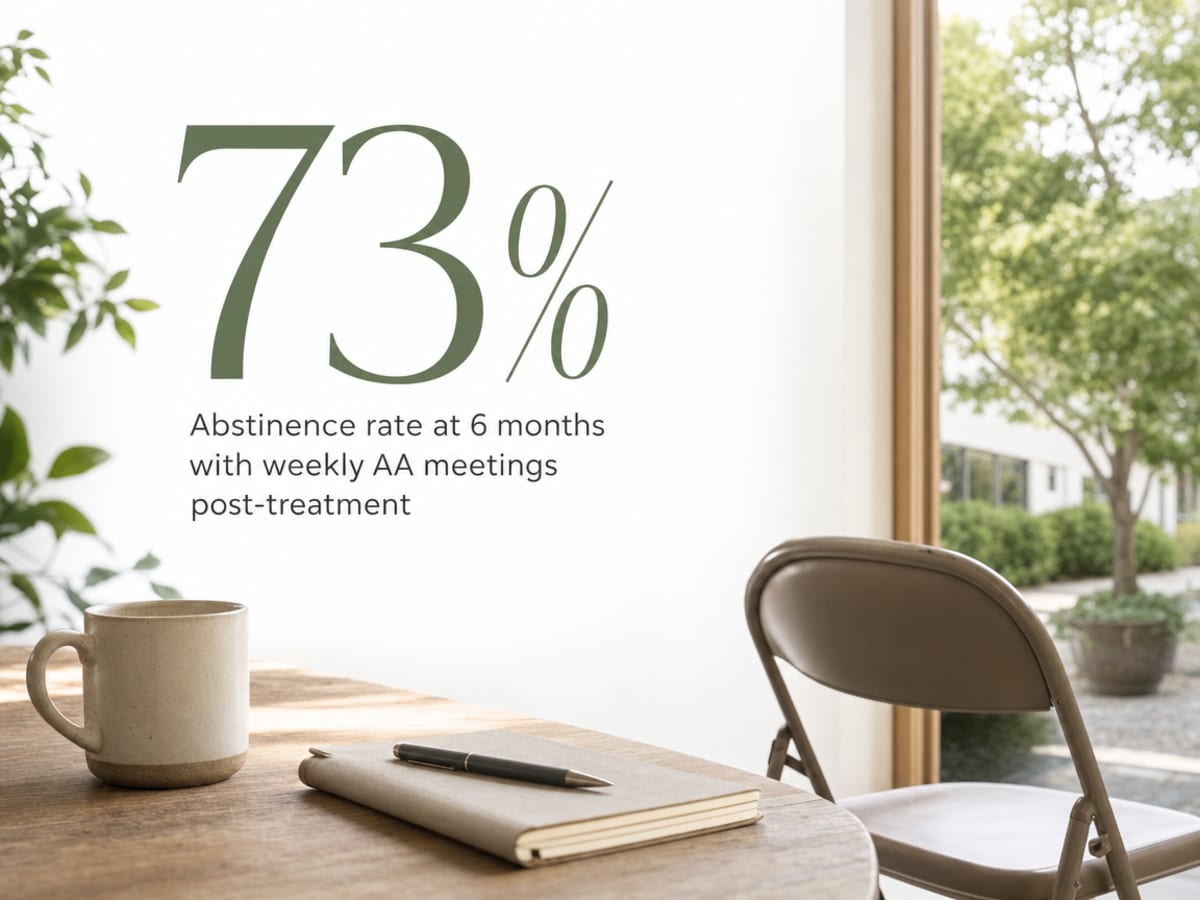
Among adults who complete residential treatment and then attend at least one mutual-help meeting per week for the first six months, roughly 73% are abstinent at the six-month mark. Read the scope carefully: post-residential completers, weekly meeting attendance, first six months. That is the population where continuing care produces measurable holds. Men who wait until the external picture cracks tend to enter care in worse shape, stay longer, and lose the discretion that made an earlier stay feasible in the first place. Longer treatment durations — three months or more of engagement across residential and outpatient care — are consistently linked to better twelve-month outcomes.3
Rock bottom, in other words, is a description of what happened. It is not a prerequisite. It is the point at which the cost of staying the same finally exceeded the cost of changing, and for most men who wait for it, that arithmetic gets settled by other people. A spouse. An employer. A judge.
You still have the arithmetic in your own hands. That is the window. It does not stay open by default.
What Discreet, Professional-Grade Residential Care Actually Looks Like
The Shape of a Short, Structured Stay
You are probably picturing something you saw in a movie. Fluorescent hallways, group circles, someone in a bathrobe crying about their father. That is not what a private residential program for a working professional looks like.
Picture instead a small facility. Twenty men at most, not two hundred. Private or semi-private rooms. A medical team that starts with a full physical, psychiatric evaluation, and a supervised detox if your body needs one. The first days are quiet on purpose. You sleep. You eat food someone else cooked. You stop managing the internal PR job for the first time in months, maybe years.
From there the days have structure. Individual counseling. Group sessions with men in situations you will recognize. Behavioral therapy that teaches you what actually happened in your brain and what to do when the pull comes back. Medication management if you need it. Mindfulness, fitness, time outside. Nothing mystical. Just a schedule someone else holds so you do not have to.
The length is not indefinite. When you enter earlier, before things have cracked open, the stay is usually shorter and the return to your desk is cleaner. A program built for men like you is designed around that reality: your assistant needs a plausible story, your spouse needs to know you are coming back, and your work needs to keep moving. Serenity Park’s small-capacity residential program in Little Rock is built to that shape.
Evidence-Based Treatment Works for Men When Men Actually Engage
Here is a piece of research that should quiet one of the loudest voices in your head, the one telling you treatment is for other people and will not work for you.
A comprehensive review of sex and gender differences in substance use disorders found that men and women do not substantively differ in treatment outcomes when they receive evidence-based care. Across large clinical trials and analyses of more than 1.7 million treatment episodes, completion rates and outcomes are broadly comparable between genders. The problem in men’s care is not that the treatments do not work on men. The problem is entry. Men delay, avoid, and disqualify themselves from the front door, and by the time they arrive, the picture has usually gotten worse than it needed to be.2
Read that carefully. The evidence base behind cognitive behavioral therapy, medication-assisted treatment, group work, and structured residential care is not gendered against you. It is waiting on you.
The men who do well are not the ones with more willpower or a better story. They are the ones who showed up and then stayed engaged long enough for the work to hold. Everything after the phone call is a system that has been tested on people who look like you. You are not the exception it was not built for.
Wearables as a Clinical Instrument, Not a Gimmick
The Signals Clinicians Can Now Read Alongside You
You already wear one. Whoop on the wrist, Oura on the finger, Apple Watch tracking your resting heart rate, maybe a continuous glucose monitor if you have been paying attention to metabolic health. You check the numbers most mornings. You know what a bad night looks like on your sleep score before your coffee is done brewing.
The clinical version of this is not different in kind. It is different in who reads the data and what they are trained to do with it.
A 2023 pilot study followed 77 adults in substance use treatment who wore commercial fitness trackers and completed short daily surveys on their phones. The researchers were looking for physiological signals that showed up before a drug use recurrence, not after. They found one. Heart rate variability was significantly elevated in the week prior to recurrence compared with periods of sustained abstinence, at a statistical significance of p less than 0.001. The signal was there in the data seven days before the behavior.6
Think about what that means practically. Your body is sending information about stress load, sleep debt, and autonomic strain before the conscious pull to drink or use fully lands. A clinician watching those signals in a treatment setting can call you on the phone Tuesday morning instead of hearing about the weekend on the following Monday.
Serenity Park’s program in Little Rock integrates wearable monitoring through Huml Health for this reason. The clinicians are reading the same categories of data you already read on yourself, but they have intervention authority. That is the difference between tracking and treating.
The Honest Limits of the Evidence
Here is where a lot of treatment marketing overreaches, and where you deserve a straight answer.
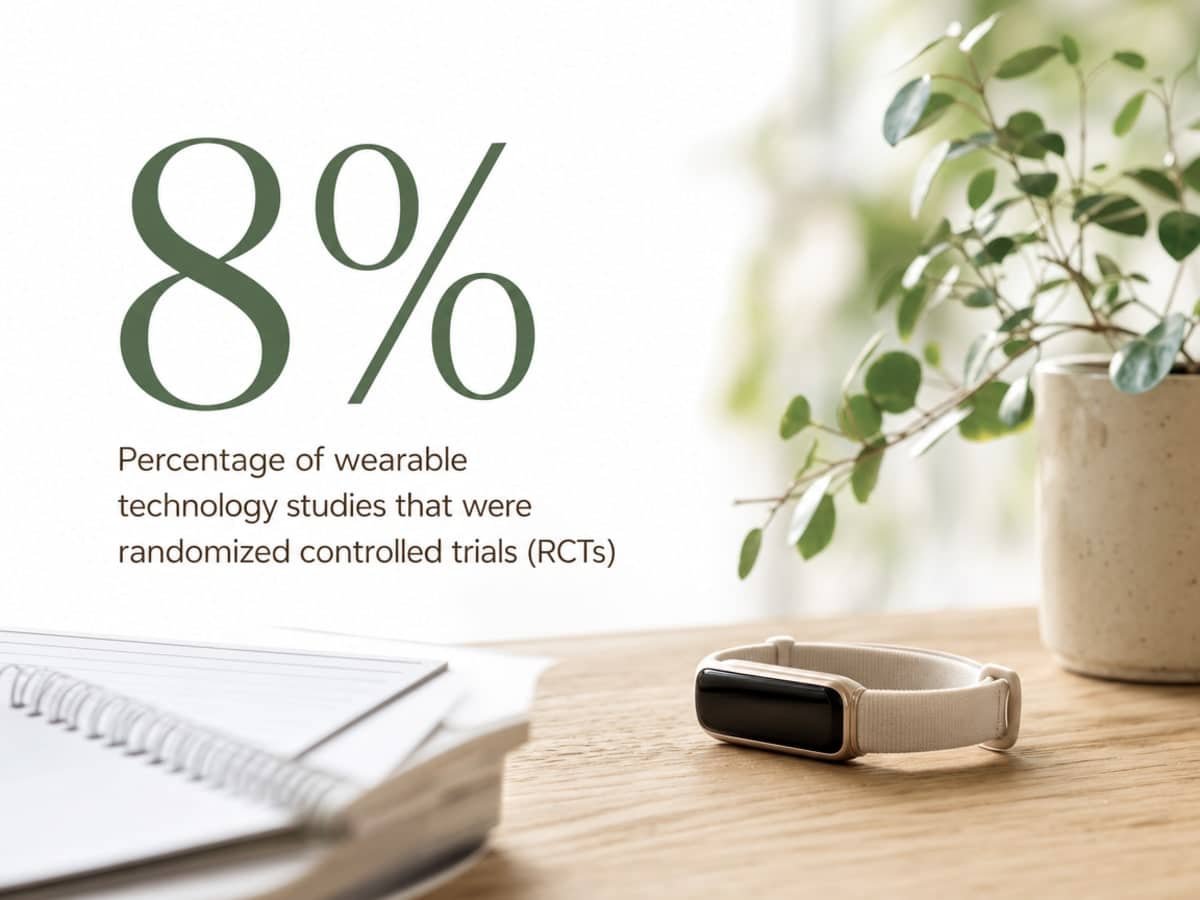
The wearable evidence base in addiction care is promising, but it is still young. A 2025 scoping review of 75 clinical trials using wearables for patient monitoring found that only about 8% were randomized controlled trials, the study design that produces the strongest causal evidence. Of those RCTs, four showed positive clinical impact. The rest of the field is pilot studies, feasibility work, and observational data. It is real science, but it is not settled science.7
You are the kind of reader who respects that distinction. A program that pretends the data alone will save you is selling something. A program that uses continuous physiological signals to make the clinical work sharper, while still holding you to the standard treatment framework, is doing something worth your time.
The Compounding Cost of Waiting
Waiting has a price tag. You do not see it on a statement, but you are already paying it.
Start with sleep. The 3 a.m. wake-ups you have been tracking on your watch are not free. They erode judgment, patience, and the specific kind of focus your work relies on. You are covering it with caffeine and adrenaline, and the coverage gets more expensive every quarter.
Add the hidden spend. The nicer bottles because they seem more acceptable. The bar tabs on trips that never quite make it onto the expense report. The delivery orders. The gym membership you use less than you used to. The private math adds up faster than you have let yourself calculate.
Then the relational drift. Your spouse has stopped asking about the pour, which is not the same as being fine with it. Your kids have adjusted their expectations of what you are like on Sunday mornings. None of this is a crisis yet. All of it is a slow reallocation of trust away from you.
Here is the part that matters clinically. Men who wait until the external picture cracks tend to arrive in worse shape and need longer stays to stabilize. The continuing-care literature is clear that three months or more of engagement across residential and outpatient care produces the strongest twelve-month outcomes. Enter earlier, and the residential piece can be shorter and more discreet. Wait, and the same math still applies, only now the stay is longer and the reasons are visible to everyone around you.3
The cost of waiting is not theoretical. It is the version of your life you are quietly trading for one more month of not deciding.
Making the Call Before the External Picture Cracks
You do not have to be ready. You have to be willing to have one conversation.
The reason to make the call now, while your calendar still holds and your spouse still trusts you and your work still respects you, is not that things are terrible. It is that they are not, yet. Every part of the current picture that is worth protecting is easier to protect from where you are sitting today than from where you will be sitting six months from now if nothing changes.
A short residential stay handled quietly in Little Rock, twenty men at most, is a very different event than an intervention orchestrated by people who ran out of patience. One you author. The other happens to you.
Serenity Park exists for the version of you that is reading this at 11 p.m. with the door closed. Small, private, medically supervised, wearable-informed, and staffed by clinicians who have talked to hundreds of men who introduced themselves the same way you would: I probably do not need to be here, but.
Pick up the phone before the sentence changes.
Frequently Asked Questions
If I’m still performing at work and at home, do I actually have a problem worth treating?
Yes, and the fact that you are asking is data. Adults entering alcohol treatment who could not name anyone in their life who saw the problem were not functioning worse than peers with visible support, and on some measures scored higher. Looking fine describes your surface, not your risk. If you are counting drinks privately, treatment is worth a conversation.8
Can I get treatment without my employer, colleagues, or extended family finding out?
A private residential program built around discretion is designed for exactly this. Small-capacity facilities like Serenity Park’s twenty-man setting in Little Rock handle intake, medical care, and communication with your outside world on your terms. Federal privacy law protects your records. You control what your employer, colleagues, and extended family are told, and when.
How long does a residential stay actually take when I enter early rather than in crisis?
Earlier entry usually means a shorter, cleaner stay. Longer engagement across residential and outpatient care, three months or more combined, produces the strongest twelve-month outcomes. The residential piece itself can be significantly shorter when your body and life have not fully cracked. Men who wait for crisis tend to need longer inpatient stabilization.3
Does evidence-based treatment work as well for men as it does for women?
Yes. A large review found men and women do not substantively differ in substance use treatment outcomes when they receive evidence-based care, with completion and retention broadly comparable across more than 1.7 million treatment episodes. The gap in men’s care is entry, not efficacy. The therapies waiting for you have been tested on people who look like you.2
What happens after residential care, and how much continuing care do I really need?
Continuing care is where recovery actually holds. Among men who complete residential treatment and attend at least one mutual-help meeting per week for the first six months, roughly 73% are abstinent at the six-month mark. Expect weekly outpatient counseling, peer support meetings, and, at Serenity Park, alumni contact. It is lighter than residential but consistent.3
How are wearables actually used in treatment, and is the science solid enough to trust?
Clinicians read continuous data on sleep, heart rate, and stress, the same signals you already track. Heart rate variability was significantly elevated the week before drug use recurrence in one pilot of 77 adults. Honest limit: only about 8% of wearable studies to date are randomized controlled trials. Useful as a supporting instrument, not a replacement for clinical work.6,7
References
- Patterns and Challenges in Help-Seeking for Addiction among Men. https://pmc.ncbi.nlm.nih.gov/articles/PMC11508344/
- Sex and Gender Differences in Substance Use Disorders. https://pmc.ncbi.nlm.nih.gov/articles/PMC5945349/
- The Continuing Care Model of Substance Use Treatment. https://pmc.ncbi.nlm.nih.gov/articles/PMC4007701/
- A Review of Wearable Biosensors in Alcohol Use Disorder Treatment. https://pmc.ncbi.nlm.nih.gov/articles/PMC8019775/
- Wearable and Wireless mHealth Technologies for Substance Use Disorders. https://pmc.ncbi.nlm.nih.gov/articles/PMC7963000/
- Identifying Biomarkers of Drug Use Recurrence using Wearable Device Technologies and Smartphone Applications. https://pmc.ncbi.nlm.nih.gov/articles/PMC10416187/
- Wearables research for continuous monitoring of patient outcomes in clinical trials: A scoping review. https://pmc.ncbi.nlm.nih.gov/articles/PMC12063813/
- Functioning of Adults in Alcohol Use Disorder Treatment. https://pmc.ncbi.nlm.nih.gov/articles/PMC7530911/
- Wearable biosensors have the potential to monitor patient recovery and alcohol use. https://pmc.ncbi.nlm.nih.gov/articles/PMC8672322/
- Stigma, Help Seeking, and Substance Use. https://files.eric.ed.gov/fulltext/EJ1260094.pdf