
Key Takeaways
- When his stated limit and actual consumption diverge night after night, that gap signals loss of control over amount, not miscalculation — track the specific numbers for a week 1.
- Repeated failed cut-back attempts, not a single slip, meet the DSM-5 criterion; document each attempt, its trigger, duration, and what ended it 15.
- Notice the hours alcohol consumes before, during, and after drinking, and name three activities crowded off the calendar to show real time cost 15.
- Climbing tolerance means his nervous system has adapted, not that he holds his liquor; compare how much he needs now versus a year or two ago 15, 16.
- Morning tremors, sweats, nausea, or racing heart that ease once he drinks again are withdrawal — document timing relative to his last drink, since abrupt stopping risks seizures 21.
- If irritability and anxiety follow a schedule tied to hours since his last drink, that’s his nervous system in withdrawal, not a personality shift 1.
- List three to five activities he’s quietly abandoned with rough dates; when dropped pursuits all required sobriety, drinking is doing the choosing 15, 2.
What You’re Actually Watching For at Home
You’ve already noticed. That’s why you’re here, reading this instead of asking him directly, because you’ve asked before and the answer never quite fits what you’re seeing. The wine that used to last a week now disappears in two nights. The promised “just one” turned into four again on Tuesday. Sunday mornings have a rhythm now: the stomach thing, the food he blames, the quiet apology that isn’t quite an apology.
Here’s what most articles get wrong. They tell you to look for a crisis, a lost job, a DUI, a bottle in the garage. But clinical alcohol dependence, what doctors now call alcohol use disorder, rarely arrives with that kind of announcement. It shows up as a pattern of small compromises that partners usually spot months or years before the drinker does 13.
What you’re going to find in the next few sections is a bridge. On one side, the specific things you’re seeing at the dinner table, in the garage, in his mood between drinks. On the other side, the eleven criteria a clinician would actually use to make a diagnosis 14. Seven of those criteria are things you can observe without a medical degree. Those seven are what this piece is about, and they’re what will help you move from “something feels off” to a defensible, specific case for a conversation with a professional.
Dependence vs. Heavy Drinking: Why the Distinction Matters
Before you name what you’re seeing, it helps to know that heavy drinking and clinical dependence aren’t the same thing, even though the language in most articles blurs them into one worry. Heavy drinking is a pattern. Dependence is a diagnosis. And a lot of men, especially high-functioning ones in their thirties and forties, live in the first category for years without crossing into the second.
Here’s the scale of the pattern piece. CDC data on U.S. adults show binge drinking prevalence is significantly higher among men (22.5%) than women (12.6%), and when men binge, they drink more per occasion (a median of 5.9 drinks compared to 4.5) and slightly more often (1.9 occasions versus 1.4) 19. Roughly one in six adults binge drinks, and more than nine out of ten people who drink excessively report bingeing rather than steady daily heavy use 18. So if your husband’s drinking looks intense on Friday and Saturday but structured Monday through Thursday, you’re looking at a very common male pattern. Common doesn’t mean safe, but it also doesn’t automatically mean dependent.
What tips a pattern into a disorder is loss of control. Clinically, alcohol use disorder is defined as a problematic pattern of drinking that causes significant impairment or distress, marked by things like craving, unsuccessful attempts to cut back, and continued use despite consequences 1, 14. Someone can binge heavily on weekends and still stop when he decides to. Someone who’s dependent can’t reliably make that decision anymore, even when he means it.
That’s the line you’re trying to see clearly. The next section gives you the actual framework a clinician would use to draw it.
The DSM-5 Framework a Clinician Would Actually Apply
Clinicians don’t diagnose alcohol use disorder by how much someone drinks. They diagnose it by counting symptoms. The DSM-5-TR, which is the diagnostic manual any psychiatrist, addiction physician, or primary care doctor in the U.S. is working from, defines AUD as a problematic pattern of alcohol use leading to clinically significant impairment or distress, requiring at least 2 of 11 specific criteria within a 12-month window 14. The number of criteria a person meets determines severity: 2 to 3 is mild, 4 to 5 is moderate, and 6 or more is severe 14, 8.
That threshold matters for you. It means a clinician isn’t looking for one dramatic sign. They’re looking for a cluster. Someone who drinks more than intended, has tried and failed to cut back, and keeps drinking despite arguments at home already meets three criteria — that’s mild AUD by the book, even if he still shows up to work every Monday.
The 11 criteria cover behaviors like loss of control, cravings, tolerance, withdrawal, time spent drinking or recovering, giving up activities, and continued use despite physical, psychological, or social consequences 15, 2. Some of them live inside his head — cravings, for instance, or the private feeling that he needs a drink. Those you can infer but not directly witness.
Seven of the eleven, though, are things you can actually see from your side of the kitchen. Those are the ones the next section walks through, one at a time.
Seven Signs That Move the Needle From Worried to Documented
The Pour That Never Stops at One
You’ve watched it happen enough times to predict it now. He pours “just one” while dinner is finishing, and by the time the plates hit the sink, he’s on his third. Or he opens a bottle of wine planning to have a glass with you, and the bottle is gone before the movie ends. He didn’t sit down intending to drink that much. He just did.
This is the first DSM-5 criterion, and it’s the one clinicians see most often: drinking more, or for longer, than intended 15, 2. It sounds almost too ordinary to matter. Everyone has poured a bigger glass than planned. But what makes it a diagnostic sign isn’t the occasional overshoot. It’s the pattern. Week after week, the ceiling he sets for himself keeps moving, and the moving isn’t a choice he’s making consciously.
What to note: how often his stated limit and his actual consumption diverge, and by how much. A man who says “I’ll have two” and reliably has five, most nights, isn’t miscalculating. He’s showing you loss of control over the amount 1. Write down what he said he’d drink and what he actually drank. Do it for a week. The gap between the two numbers is the sign.
The Cut-Back Promises That Keep Failing
Dry January lasted eleven days. The “only weekends” rule held for a month. The Whole30 was going to reset everything, and it did, right up until the work trip. You’ve probably lost count of the resets by now.
The second DSM-5 criterion is unsuccessful efforts to cut down or stop 15. Notice the word efforts, plural. A single failed attempt doesn’t meet the criterion. What clinicians are looking for is the pattern of genuine intent followed by an inability to sustain it. He isn’t lying to you when he says he wants to drink less. He means it. He just can’t hold the line, and the reason he can’t is the whole point.
This one carries weight because it separates a man who’s chosen heavy drinking as a lifestyle from a man whose relationship with alcohol has shifted underneath him. Choice is intact in the first case. In the second, choice is exactly what’s compromised 1.
What to note: the specific attempts. When he tried, what triggered him to try, how long it lasted, and what ended it. Three failed cut-back attempts in a year is a defensible observation. “He can’t seem to stop” is not.
The Time Alcohol Now Takes
Count the hours. Not just drinking hours, but the ones before and after. The stop at the store on the way home. The nap that used to be a walk with you. The Saturday morning that starts at eleven now instead of seven because he needs to sleep it off. The evenings where he’s technically present but really just parked on the couch with a glass, checked out until bed.
DSM-5 calls this a great deal of time spent obtaining alcohol, using it, or recovering from its effects 15, 2. It’s one of the more quietly damaging criteria because the time cost accumulates without any single moment feeling like a crisis. A weekend that used to include a hike, a project, and dinner with friends now includes drinking, more drinking, and recovery.
What to note: what has quietly disappeared from the calendar. If you can name three activities he used to do on weekends that alcohol has crowded out, and if his recovery from a Friday night now takes until Sunday afternoon, you’re looking at a real signal, not a phase.
The Shift in What He Can Handle Physically
The two beers that used to loosen him up don’t touch him anymore. He can put away most of a bottle of bourbon over an evening and seem, to a stranger, roughly the same as he was three drinks in. You’ve watched his tolerance climb, and it doesn’t look like maturity or better metabolism. It looks like his body has adjusted to needing more.
Tolerance is a formal DSM-5 criterion, and clinically it’s defined as either needing markedly increased amounts to get the desired effect or noticing a markedly diminished effect at the same amount 15, 5. It’s one of the physical markers of dependence, not just heavy use, and it tends to escalate quietly. He may even be proud of it. Men often frame tolerance as competence — I can hold my liquor — when what it actually reflects is his central nervous system adapting to the constant presence of alcohol 16.
There’s a second physical shift worth watching for: appetite and weight changes, gastrointestinal complaints, elevated resting heart rate you might notice when you hug him at night 16. These aren’t diagnostic on their own, but stacked with tolerance, they tell you his body is doing serious work to keep up.
What to note: how much he drinks now compared to a year ago, two years ago, to reach the state he’s after. If the amount has doubled and the effect looks smaller, that’s tolerance.
The Sunday Morning Symptoms He Keeps Explaining Away
The stomach thing. The headache he blames on dehydration or the barometric pressure. The bad sleep he attributes to the mattress. The 3 a.m. wake-up with a racing heart he says is stress from work. The morning tremor in his hands that he covers by not pouring coffee until he’s had a shower.
These are withdrawal symptoms, and withdrawal is one of the strongest DSM-5 criteria a partner can observe 15. When someone’s brain and body have adapted to regular alcohol, the hours between drinks — especially overnight — produce a rebound: trouble sleeping, shakiness, sweating, nausea, anxiety, a racing heart, sometimes irritability that mysteriously improves once he’s had a drink 13, 2.
The tell isn’t any single symptom. It’s the pattern of symptoms clustering after longer gaps without alcohol, and easing when he drinks again. If his Sunday morning stomach feels better once he has a Bloody Mary at brunch, that’s not the brunch cure working. That’s withdrawal being suppressed.
What to note: morning symptoms, timing relative to his last drink, and whether they improve after he drinks again. Be specific.
The Mood Between Drinks
He’s fine when he’s drinking. He’s fine an hour or two after. But the man who comes home Wednesday evening, before the first pour, is a different man than the one you married. Shorter. Sharper. A hair-trigger about small things — the dishwasher, the thermostat, the way you asked about his day.
MedlinePlus describes AUD as including a negative emotional state when not drinking — anxiety and irritability that lift once alcohol is in his system 1. This is one of the harder signs to name because it looks like personality change, and personality change looks like a lot of things: work stress, midlife discontent, a bad marriage. But if the irritability has a schedule, if it maps onto the hours he hasn’t had a drink yet, that’s not personality. That’s his nervous system asking for what it’s learned to expect.
What to note: the timing of his mood shifts across a normal week. If you can predict his worst hours by looking at his last drink and his next one, you have your answer.
The Things Quietly Being Given Up
He used to coach the Saturday league. He used to run three mornings a week. He used to build things in the garage on Sundays and disappear into a book on weeknights. Now the league has a new coach, the running shoes are dusty, the garage is where the extra beer fridge lives, and he watches TV until he falls asleep on the couch.
DSM-5 lists this as giving up or reducing important social, occupational, or recreational activities because of drinking 15, 2. He probably hasn’t framed it that way to himself. He’ll say he lost interest, or life got busy, or his knee is bothering him. Sometimes those things are true. But when the pattern is that every dropped activity is one that required him to be sober, and the retained activities are ones that accommodate drinking, the drinking is doing the choosing.
This sign matters because it captures how dependence narrows a life without any single dramatic loss. Nothing catastrophic happened. He just, quietly, became someone smaller.
What to note: three to five specific activities he used to do regularly and no longer does, with rough dates for when each faded. That list is one of the most persuasive things you can bring to a clinician.
The Withdrawal Question Nobody Warns You About
Here’s what most “signs of alcoholism” articles leave out, and it’s the part that changes your calculus completely. If your husband has been drinking heavily for months or years, telling him to just stop on his own isn’t a safer path than treatment. It can be the more dangerous one.
When a dependent drinker’s body has adapted to constant alcohol, cutting off that supply abruptly triggers a rebound in the nervous system. Mild withdrawal looks like the Sunday morning symptoms already described: shakes, sweating, nausea, insomnia, a racing heart, anxiety that feels bottomless. Severe withdrawal is a different category of event. Delirium tremens — disorientation, hallucinations, dangerous swings in blood pressure and heart rate — occurs in less than 5% of people withdrawing from alcohol, but when it happens, it’s a medical emergency, and withdrawal seizures can arrive without warning 21.
You didn’t cause this, and you can’t safely manage it at the kitchen table. That’s not a failure on your part. It’s the biology of what you’ve been watching.
Screening Tools and Where Your Observations Fit In
At some point, what you’ve been watching gets handed to a clinician, and the clinician will use a scored instrument to translate it into something the medical system recognizes. The two most common are the AUDIT, a 10-item questionnaire developed by the World Health Organization, and its shorter three-item version, the AUDIT-C 20. Both are designed to be answered by the drinker, not the partner. But knowing how they work tells you where your observations will actually land.
The AUDIT scores from 0 to 40. A score of 8 or higher flags hazardous drinking or possible AUD. Scores of 15 or more suggest severe AUD, and anything in the 20-to-40 range warrants referral to a specialist for diagnostic evaluation and treatment 6, 7. On the AUDIT-C, a score of 4 or higher in men signals unhealthy alcohol use worth a fuller assessment 7. These aren’t diagnoses. They’re triggers for the longer clinical conversation where the DSM-5 criteria get applied.
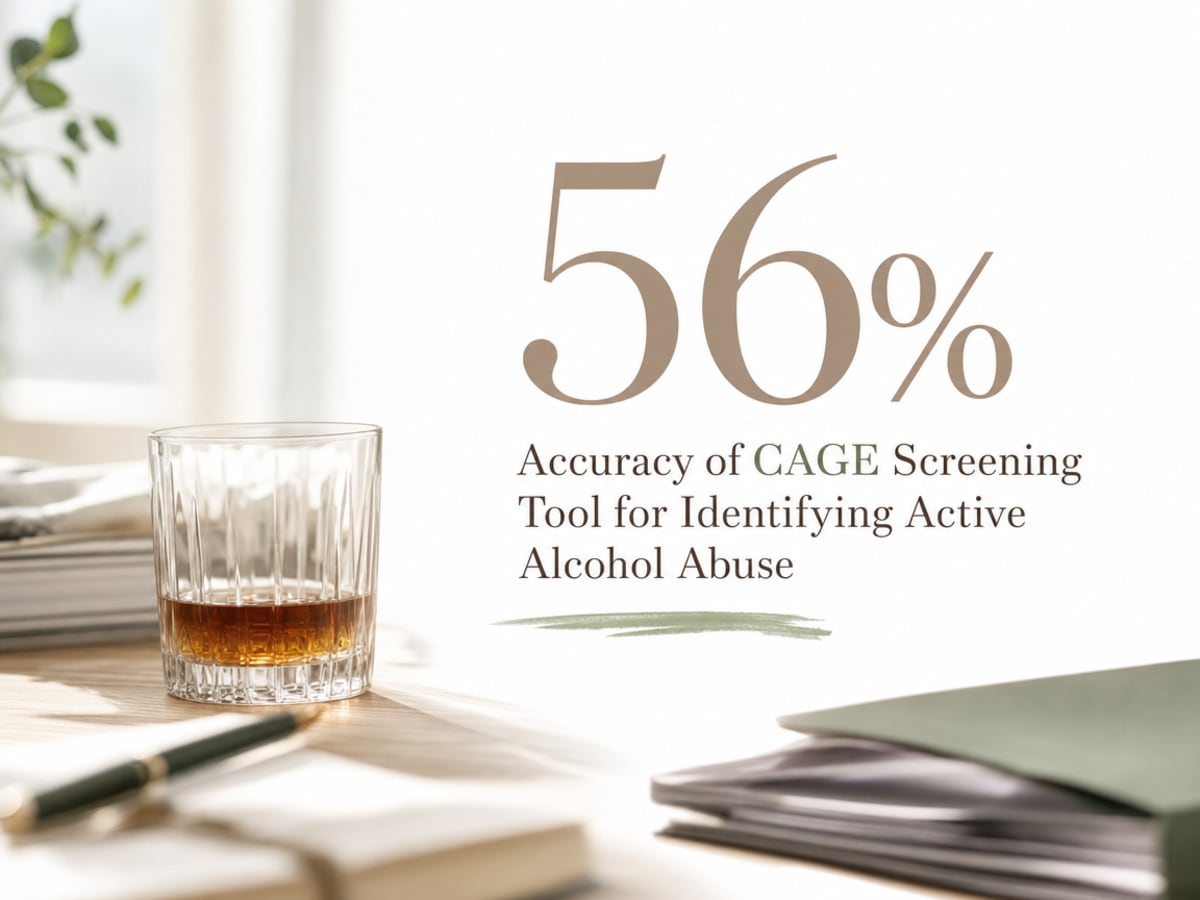
Here’s the thing worth knowing: older tools like the CAGE questionnaire are still in circulation, but CAGE only identifies active alcohol abuse with roughly 56% accuracy, which is why most guidelines now prefer AUDIT 6. If a primary care visit uses only CAGE and he answers carefully, the screen can miss him.
Your observations aren’t the screen, but they’re the reason the screen happens. When you tell a clinician he pours past his stated limit most nights, has failed three cut-back attempts this year, wakes with tremors, and dropped his Saturday league, you’re giving them exactly the collateral history that turns a routine visit into a full AUD evaluation 4.
What to Do in the Next 72 Hours
You don’t need a plan for the next year. You need a plan for the next three days, and it’s smaller than you think.
Day one: write it down. Open a note on your phone and list what you’ve actually observed over the past thirty days. His stated limit versus his actual consumption on five specific nights. The failed cut-back attempts, with rough dates. The activities he’s dropped. The morning symptoms. Timing of mood shifts against his last drink. You are not building a case against him. You are building the collateral history a clinician needs to move past a five-minute screen and into a full evaluation 4.
Day two: call his primary care doctor’s office, not his. Ask whether the practice does AUD assessments and whether you, as his partner, can share observations before his next visit. Many practices will accept a written summary in the chart. If the practice only uses brief screening, ask specifically whether they’ll administer the AUDIT 20. If several of the seven signs are present — especially withdrawal symptoms — ask directly about referral for a specialty addiction evaluation rather than a wait-and-see appointment.
Day three: know the line for medical detox. If he’s showing morning tremors, sweats, a racing heart after longer gaps, or any history of withdrawal seizures, unsupervised quitting is not the goal. Medically supervised withdrawal comes first, then residential or outpatient care 21. Programs like Serenity Park Recovery Center that combine medical detox with family involvement give you a way in — because treatment retention improves when partners are part of the process, not kept outside it 17.
You’ve been carrying this quietly for a long time. The next three days are where you stop carrying it alone.
Frequently Asked Questions
How is alcohol dependence different from just drinking too much?
Heavy drinking is a pattern; dependence is a diagnosis. A heavy drinker can still stop when he decides to. Someone who’s dependent meets at least two of the DSM-5 criteria for alcohol use disorder — things like loss of control, cravings, tolerance, or withdrawal — inside a 12-month window 14. It’s the cluster of symptoms, not the volume, that separates the two.
How many DSM-5 signs does he need to meet before it’s considered a disorder?
Two criteria in the past 12 months is the diagnostic threshold. Two to three symptoms is classified as mild AUD, four to five as moderate, and six or more as severe 14, 8. A clinician counts the symptoms; the number determines severity, and severity guides whether outpatient counseling, intensive outpatient care, or medically supervised residential treatment is the appropriate starting point.
Should I ask him to just stop drinking on his own?
Not if he’s showing withdrawal signs. When someone dependent on alcohol stops abruptly, the rebound can include seizures or delirium tremens, which occurs in less than 5% of people withdrawing but is a medical emergency when it happens 21. Clinical guidance recommends hospital admission for medically assisted withdrawal in anyone at high risk. Evaluation comes first, not willpower.
What if he refuses to take a screening test like the AUDIT?
You can’t force it, but you can still move things forward. Your observations — the failed cut-backs, the morning tremors, the dropped activities — count as collateral history a clinician can use during his next primary care visit 4. Ask his doctor’s office whether they’ll accept a written summary in his chart. That often reframes a routine appointment into a real AUD conversation.
Can he still be dependent if he holds down his job and never seems drunk?
Yes. High tolerance is itself a DSM-5 criterion — needing more alcohol to feel the effect, or feeling less at the same amount, reflects his nervous system adapting to constant use 15, 16. Many high-functioning men meet several AUD criteria while still performing at work. The diagnosis rests on symptom clusters, not visible impairment or job loss.
What should I document before talking to a clinician?
Six specifics carry the most weight: his stated drinking limit versus actual consumption on named nights, failed cut-back attempts with rough dates, activities he’s dropped, morning symptoms and their timing after his last drink, mood shifts mapped to hours since drinking, and any tolerance changes over the past year or two. That collateral history helps a clinician move past a brief screen into a full evaluation 4.
References
- Alcohol Use Disorder (AUD). https://medlineplus.gov/alcoholusedisorderaud.html
- Alcohol use disorder: MedlinePlus Medical Encyclopedia. https://medlineplus.gov/ency/article/000944.htm
- Screen and Assess: Use Quick, Effective Methods. https://www.niaaa.nih.gov/health-professionals-communities/core-resource-on-alcohol/screen-and-assess-use-quick-effective-methods
- Alcohol Use Disorder: Screening, Evaluation, and Management. https://www.ncbi.nlm.nih.gov/books/NBK436003/
- Alcohol use disorder: Recognition, testing, and initial management. https://pmc.ncbi.nlm.nih.gov/articles/PMC10378729/
- Table 2.. https://pmc.ncbi.nlm.nih.gov/articles/PMC12916135/table/T2/
- Table 1.. https://pmc.ncbi.nlm.nih.gov/articles/PMC12635680/table/T1/
- Screening and Diagnosis of Alcohol Use Disorder (AUD) in Primary Care. https://medschool.cuanschutz.edu/docs/librariesprovider294/default-document-library/screening-and-diagnosis-of-aud-in-primary-care-9-30-20-final.pdf?sfvrsn=47398db9_0
- DSM-IV-TR Diagnostic Criteria for Alcohol Abuse and Dependence. https://www.ncbi.nlm.nih.gov/books/NBK44358/
- Alcoholism. https://medlineplus.gov/ency/article/000281.htm
- Alcohol Use and Your Health. https://www.cdc.gov/alcohol/fact-sheets/alcohol-use.htm
- Frequently Asked Questions. https://www.cdc.gov/alcohol/faqs.htm
- Understanding Alcohol Use Disorder. https://www.niaaa.nih.gov/publications/brochures-and-fact-sheets/understanding-alcohol-use-disorder
- Alcohol Use Disorder: From Risk to Diagnosis to Recovery. https://www.niaaa.nih.gov/health-professionals-communities/core-resource-on-alcohol/alcohol-use-disorder-risk-diagnosis-recovery
- Table 1. DSM-5 criteria for diagnosis of alcohol use disorder. https://pmc.ncbi.nlm.nih.gov/articles/PMC12916135/table/T1/
- Alcohol use disorder. https://bestpractice.bmj.com/topics/en-us/198?locale=zh_TW
- Chapter 1—Substance Use Disorder Treatment. https://www.ncbi.nlm.nih.gov/books/NBK571084/
- Data on Excessive Alcohol Use. https://www.cdc.gov/alcohol/excessive-drinking-data/index.html
- Binge Drinking Among Adults, by Select Characteristics — United States, 2018. https://www.cdc.gov/mmwr/volumes/70/wr/mm7041a2.htm
- Alcohol Use Disorders Identification Test (AUDIT). https://nida.nih.gov/sites/default/files/files/AUDIT.pdf
- Acute Alcohol Withdrawal. https://www.ncbi.nlm.nih.gov/books/NBK65581/