
Key Takeaways
- Family research and early involvement measurably improves treatment entry, retention, and long-term outcomes, so making calls before he’s ready is legitimate work, not overstepping 2, 4.
- Watch for the small signs in a still-functioning man — creeping drink counts, early refills, small lies about ordinary things — and trust the pattern you’ve been noticing.
- Have the conversation in quiet moments using short, honest statements about what you see and feel, and skip labels, ultimatums you can’t enforce, and history arguments.
- Start admissions with one call — the DHS line at 1-844-763-0198, SAMHSA at 1-800-662-HELP, the SAMHSA locator, or a residential program directly 11, 13, 12.
- Sort out payment early by checking commercial insurance, Arkansas Medicaid outpatient coverage, or state-funded DHS treatment through the 8 catchment areas 8, 10, 14.
- Detox is the first stage, not the whole plan — a real continuum includes medical detox, residential treatment, and aftercare that carries past discharge 9.
- Vet residential programs with specific questions about detox, family involvement, co-occurring care, staffing, aftercare, and privacy, and press hardest on family-centered practices 6.
- Plan for the risky window and the months after discharge by keeping naloxone accessible, knowing 911 and 988, and staying involved in aftercare where family support drives outcomes 15, 16, 5.
You’re the one doing the research, and that already matters
It’s late, or it’s early, and you’re the one with the phone in your hand. Maybe he’s asleep down the hall. Maybe he’s not home yet. Either way, you’re the one typing the search that finally admitted what you already knew: this can’t keep going the way it’s been going.
Take a breath. You are doing something.
Most people looking for rehab in Arkansas on behalf of someone else — a husband, a son, a brother, a dad — feel like they’re overstepping. You’re not. Research on substance use treatment shows that when family members get involved early, the person struggling is more likely to actually enter care and stay in it 2. Your fingerprints on this process aren’t a problem. They’re part of what works.
This guide is written to you, in plain language, about how to help a man in Arkansas find real treatment — what to say, how admissions works here, and how to tell a solid residential program from one that just has a nice website. You don’t have to have it all figured out tonight. You just have to keep reading, keep asking, and know that calling a program to ask questions is a legitimate first step, not a commitment.
Why your role changes his odds
Here’s something worth sitting with for a minute: the family member who does the quiet research, the one who makes the first call, the one who keeps showing up — that person changes outcomes. Not in a soft, feel-good way. In a measurable way.
SAMHSA’s clinical evidence review found that family involvement in substance use treatment is linked with higher rates of entry into treatment, fewer barriers to getting in the door, lower dropout during treatment, and better long-term outcomes 4. That’s four different points where you, sitting at the kitchen table right now, can tilt the odds. Entry. Barriers. Retention. Long-term recovery. You are already working on the first two by reading this.
This matters because a lot of families feel like they’re on the sidelines, waiting for him to hit some magic moment of readiness. You are not on the sidelines. Programs that follow a family systems approach — including Serenity Park in Little Rock — treat the family as part of the treatment plan, not spectators of it. That framing exists because the research supports it, not because it sounds nice on a website.
For most families, though, the takeaway is simpler than you’d expect. You don’t have to convince him tonight. You have to keep being the person who’s informed, steady, and one step ahead of the next crisis. That’s the work. And it counts.
Reading the signs in a man who is still holding it together
High-functioning is the phrase that trips up families the most. He’s still going to work. Still closing deals, still making court, still coaching Saturday soccer. The mortgage gets paid. From the outside, nothing is on fire.
That’s exactly why you’ve been second-guessing yourself.
Here’s what to actually watch for, in the man who is still functioning: the drink that used to be one is now three or four before he unwinds. The bottle in the truck. The pills refilled a little too early, from a little too many doctors. Weekends that start on Wednesday. A new short temper with the kids. Sleep that comes only with something in it. Weight loss, or weight gain, that neither of you talks about. The 6am shower that isn’t really about being clean.
You’ll also notice the small lies. Not big ones — the small ones. Where he was. How much was left in the bottle. Whether he ate. Small lies are the part of addiction that lives inside a still-functioning life, and they are usually the piece the family sees long before the employer does.
Trust that pattern. You’re not being dramatic. You’re being accurate.
The conversation: what to say before he’s ready
Scripts for the quiet moments
The best conversations about rehab almost never happen during a blowup. They happen on a Tuesday morning when he’s a little hungover and quiet, or on the porch after the kids are in bed, or in the truck on the way home from something ordinary. Pick the quiet moment, not the loud one.
Keep it short. Keep it about you and what you see, not about him and what he is. Try something like:
“I love you, and I’ve been scared for a while. I’m not asking you to promise anything tonight. I just need you to know I’ve started making some calls to figure out what help looks like.”
Or, when he’s minimizing:
“I hear you that you can handle it. I still need to say the drinking is hurting me, and it’s hurting us. Can we talk about it for ten minutes without either of us walking away?”
Or, when he’s already open a crack:
“There’s a place in Little Rock I’ve been reading about. I’d like to call them together, or I can call first and tell you what they said.”
Notice what those scripts don’t do. They don’t diagnose him. They don’t threaten. They don’t demand an answer by Friday. They tell the truth about your experience and leave a door open. That’s usually enough for one conversation. You don’t need him to say yes today. You need him to know you’re not going away.
What not to say, even when you’re exhausted
You are tired. Some of what comes out of your mouth in a bad moment is going to be honest and also unhelpful. That’s human. But a few phrases tend to shut down the conversation for weeks, so it’s worth naming them out loud now, when you’re calm.
- Try to avoid the ultimatum you can’t enforce (“If you drink one more time, I’m gone”) unless you have actually decided you will do it. He can tell the difference, and empty threats teach him to stop listening.
- Avoid the word “addict” as a label. Say “drinking” or “the pills” or “what’s been happening.” Labels invite defense.
- Skip the highlight reel of every past mistake. Stay in this week, this month. History is a losing argument at 11pm.
- And don’t apologize for bringing it up. You are not overreacting. You are the person who noticed first.
How Arkansas admissions actually works
Four places you can start a call today
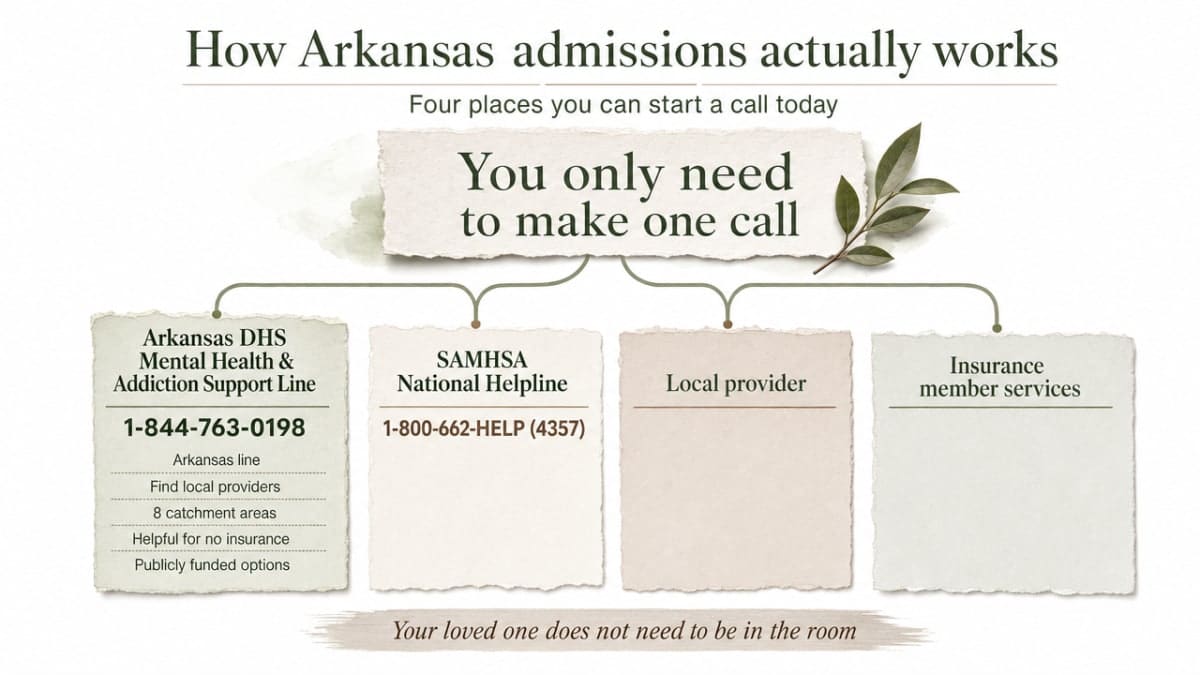
Here’s the part nobody tells you: you don’t have to know which rehab to pick before you pick up the phone. You just have to make one call. Any of these four are a legitimate place to start tonight, and none of them require your loved one to be in the room.
The DHS Mental Health & Addiction Support Line at 1-844-763-0198. This is Arkansas’s own line, run through the Department of Human Services, and it exists specifically to help people locate providers in their area 11. Arkansas is divided into 8 catchment areas for state-funded substance use treatment, and this line can point you toward the providers in yours 10. If your loved one doesn’t have insurance, this is often the fastest way to understand what publicly funded options exist 10.
The SAMHSA National Helpline at 1-800-662-HELP (4357). Free, confidential, open 24/7, 365 days a year, in English and Spanish 13. You can call as the family member. You don’t have to identify yourself, and you don’t have to have a plan.
The SAMHSA online treatment locator. It lists state-licensed providers and lets you filter by level of care and payment 12. Useful when it’s 2am and you’re not ready to talk to a stranger yet.
A residential program directly. You can call a place like Serenity Park in Little Rock and simply ask questions — about their family involvement, their detox process, what a typical day looks like, whether they take your insurance. You are not signing him up. You are gathering information. Admissions coordinators talk to families all the time before the person is ready. That’s a normal call, not a strange one.
Insurance, Medicaid, and paying for care
Money is usually the second thing families ask about, right after “will he go.” Fair. Here’s what you actually need to do.
If he has commercial insurance through his employer, the phone number on the back of his card is a real starting point. Call the behavioral health number and ask what residential substance use treatment is covered, whether medical detox requires prior authorization, and which Arkansas facilities are in-network 14. Write down the reference number for the call. Insurers lose notes.
If he’s on Arkansas Medicaid, coverage for the follow-up piece — outpatient counseling, medication management, continuing care — is spelled out in the state’s Outpatient Behavioral Health Services Manual 8. That matters because a solid residential stay flows into outpatient care, and knowing what Medicaid will cover on the back end helps you plan past week four.
If he has no insurance at all, Arkansas offers state-funded SUD treatment through the DHS system, and the 1-844-763-0198 line is where families start that conversation 10, 11. Community health centers and county clinics also come into play here 14.
For private-pay residential care, ask each program directly about cost, what’s included, and whether they offer any sliding scale or financing. Programs vary. Don’t guess at numbers — ask.
What an admissions coordinator will ask you
The first call is less of an interrogation than you’re bracing for. Coordinators are used to talking to a spouse, a mom, or an adult daughter who is calling before the person is ready. They will not demand that he get on the phone.
Expect questions like:
- What is he using, and how much on a typical day?
- How long has this been going on?
- Has he had a seizure, DTs, or a bad withdrawal before?
- Any current medications or medical conditions you know of?
- Any prior treatment?
- Is there insurance, and if so, whose?
- Is he safe right now, and are you safe?
You will not know every answer. That’s fine. Say what you know. “He drinks about a fifth of vodka a day, has for maybe two years, and he had a bad shake last time he tried to stop” is more than enough to get a real conversation going. The coordinator’s job on this call is to help you figure out the next step, not to admit him on the spot.
Detox is step one, not the whole plan
One of the hardest things to explain to a family is this: a week in detox is not rehab. It’s the door, not the room.
Medical detox is what happens when a body that’s been dependent on alcohol or drugs is helped through withdrawal safely, usually with medications, monitoring, and a nurse who’s seen this a hundred times. For a man drinking heavily, detox is not optional — alcohol withdrawal can cause seizures and, in rare cases, kill people. Same with benzodiazepines. Detox is where you keep him alive while the substance clears his system.
But SAMHSA’s clinical guidance is direct about what detox is, and what it isn’t. It’s described as the first stage of treatment, and it has to be followed by continued care for recovery to actually stick 9. Detox alone doesn’t teach him how to handle a Sunday afternoon six months from now. It doesn’t rewire the habits, the triggers, or the reasons underneath the drinking.
What a real plan looks like, in Arkansas, is a continuum of care: medical detox, then residential treatment where he lives on-site and does the actual work — individual counseling, group therapy, family sessions, psychiatric care if he needs it — then aftercare on the back end. Aftercare might be outpatient counseling, medication management, an alumni group, or a mix, and Arkansas Medicaid covers a range of outpatient behavioral health services that can carry him past discharge 8.

How to tell a strong residential program from a mediocre one
Ten questions to ask on the first call
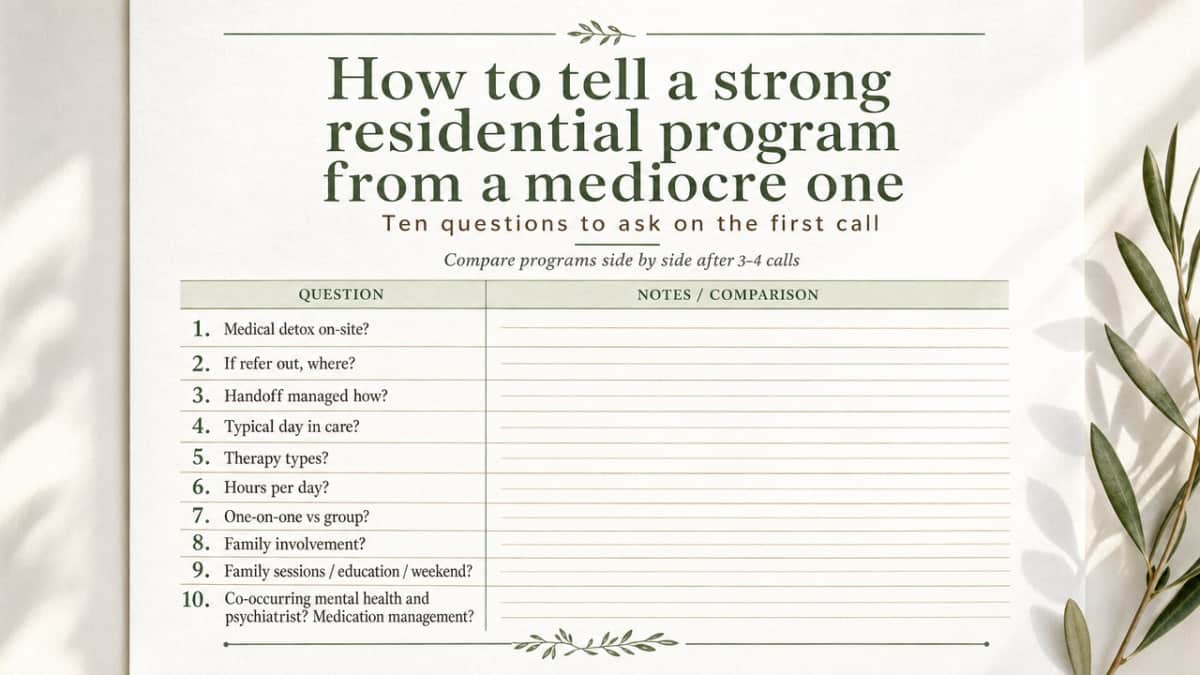
You don’t need a checklist to sound smart. You need one so you can compare programs side by side after you’ve made three or four calls and everything starts to blur together. Keep a notebook. Ask these:
- Do you provide medical detox on-site, or do you refer out? If they refer out, where, and how is the handoff managed?
- What does a typical day in residential care look like — what kinds of therapy, how many hours, and how much of it is one-on-one versus group?
- How do you involve the family? Do you offer family sessions, family education, or a family weekend, and are they in person or virtual?
- What is your approach to co-occurring mental health issues like depression, anxiety, or trauma? Is there a psychiatrist on staff?
- How do you handle medication management, including medications for alcohol or opioid use disorder?
- What is the staff-to-client ratio, and how many men do you have in the program at one time?
- What does aftercare look like when he leaves — outpatient referrals, alumni groups, continuing care?
- Do you take his insurance, and can you run a benefits check today?
- How do you protect his privacy, especially around his employer or professional licensing board?
- Can I call you again with more questions, even if he isn’t ready yet?
A strong program answers all ten without getting cagey. Family involvement, in particular, is worth pressing on — the research is clear that family-centered treatment improves both substance use outcomes and how the family functions after 6. If a program treats your questions like an inconvenience, that tells you something.
Discretion when a career, license, or custody is on the line
Say it plainly on the call. “He’s a physician, and his license matters.” Or “He’s a partner at his firm.” Or “There’s a custody agreement, and I need to understand what shows up where.” You are not being paranoid. You are being responsible.
A residential program worth its salt will already have answers. Ask how admissions is documented, who at the facility knows he’s there, and what — if anything — gets communicated to outside parties without his written consent. Federal privacy rules for substance use treatment records are strict, and a good coordinator can walk you through them without dodging.
Ask about the physical setting too. A small-capacity residential center like Serenity Park, with around 20 men on-site, feels different from a 100-bed facility. Fewer people in the building means fewer chances of running into someone from his industry. For high-functioning professionals, that matters more than the website copy suggests.
If he has an employer with an EAP, ask the program whether they’ve worked with EAPs before and how they handle that relationship. A yes, with specifics, is what you’re listening for.
Taking care of yourself while you carry this
You’ve been carrying a lot. The 3am wake-ups. The hidden bottles you found and didn’t mention. The way you scan his face when he walks in the door. That constant, low hum of worry is exhausting, and it’s real.
Here’s the part that surprises most family members: getting support for yourself isn’t selfish or premature. Clinical guidance on family involvement in substance use care recommends that relatives receive counseling on evidence-based approaches that support their loved one’s engagement in treatment and protect their own health 7. You are allowed to have your own person to talk to before he ever calls anyone.
A therapist who understands addiction, an Al-Anon meeting, a trusted friend who won’t gossip, your own doctor for the sleep you’re not getting — any of these count. So does calling the SAMHSA National Helpline at 1-800-662-HELP as the family member, just to talk through what you’re seeing 13. You can call for you.
Eat something today. Go to bed at a normal hour when you can. This is going to be a long stretch, and the version of you that shows up next month matters.
Safety planning if things get worse before they get better
Sometimes the window between deciding he needs help and actually getting him there is the most dangerous stretch. Withdrawal from alcohol or benzos can turn medical fast. An opioid slip after a period of not using carries a real overdose risk because his tolerance has dropped.
Keep naloxone in the house if opioids are anywhere in the picture, and make sure another adult knows where it is and how to use it. The CDC’s family guidance walks through overdose signs and how naloxone works, and it’s worth reading before you need it 15.
Know your two numbers: 911 for a medical emergency, and 988 if he’s talking about not wanting to be here anymore. Keep the car keys somewhere he can’t grab them drunk. If you or the kids feel unsafe, that changes the plan — leave first, call from somewhere else.
What happens after residential care ends
Here’s the part that catches families off guard: discharge day is not the finish line. It’s the start of the stretch that decides whether the work sticks.
A solid handoff from residential care in Arkansas usually includes a written aftercare plan — outpatient counseling, medication management if he’s on anything for cravings or a co-occurring condition, an alumni group, and often peer support meetings in the community. Arkansas Medicaid covers a range of outpatient behavioral health services that can carry him through the months after discharge, so if he’s Medicaid-eligible, ask the program to line up providers before he leaves 8.
Your role doesn’t end either. Peer-reviewed research on treatment outcomes is direct about this: social support, particularly from family, has a significant impact on treatment adherence and post-treatment abstinence 16. The scoping review of family-focused practices reaches the same place — family involvement improves not just entry and completion but the shape of recovery afterward 5.
Practically, that means showing up for family sessions during residential, staying in the loop with his outpatient counselor when he consents, and being honest with yourself about what your household needs to look like. You don’t have to be his sponsor. You have to keep being the steady person you already are.
Frequently Asked Questions
What do I say if he refuses to talk about rehab?
Drop the word “rehab” for now. Say what you see and how you feel: “I’ve been scared, and I love you, and I need you to hear that.” Then stop talking. Silence is fine. You don’t need a yes tonight — you need him to know the door is open and you’re not going away.
Can I call an Arkansas rehab to ask questions before my loved one agrees to go?
Yes, and admissions coordinators expect these calls. You can call Serenity Park in Little Rock, or any Arkansas program, and ask about detox, family involvement, insurance, and privacy without committing to anything. You can also call the SAMHSA National Helpline at 1-800-662-HELP for confidential guidance 13. Gathering information is a legitimate first step.
What if we don’t have insurance or can’t afford private rehab in Arkansas?
Arkansas DHS provides state-funded substance use treatment for people without insurance, organized through 8 regional catchment areas 10. Call the DHS Mental Health & Addiction Support Line at 1-844-763-0198 to find providers in your area 11. Community health centers and county clinics also come into play, and some private programs offer sliding-scale or financing options — ask directly 14.
Is a week of detox enough, or does he need residential treatment too?
Detox alone is not treatment. SAMHSA’s clinical guidance describes detox as the first stage that must be followed by continued care for recovery to hold 9. A real plan looks like medical detox, then residential treatment where the actual work happens, then aftercare — outpatient counseling, medication management, alumni support. Ask any program what happens on day eight and day forty.
How do we protect his job, professional license, or reputation during treatment?
Say it plainly on the admissions call: “He’s a physician” or “There’s a license involved.” Federal privacy rules for substance use records are strict, and a good coordinator will walk you through what’s documented and who’s notified. Ask about small-capacity residential settings, EAP experience, and written-consent requirements. Discretion is a legitimate clinical question, not a vanity one.
What should I do tonight if I’m worried about an overdose or a medical emergency?
Call 911 for a medical emergency, or 988 if he’s talking about not wanting to be here. If opioids are anywhere in the picture, keep naloxone in the house and make sure another adult knows how to use it — the CDC’s family guidance walks through overdose signs and how naloxone works 15. If you’re not safe, leave first and call from elsewhere.
References
- THE IMPORTANCE OF FAMILY THERAPY in Substance Use Disorder Treatment (Advisory 39). https://library.samhsa.gov/sites/default/files/pep20-02-02-016.pdf
- Executive Summary (Substance Use Disorder Treatment and Family Therapy – TIP 39). https://www.ncbi.nlm.nih.gov/sites/books/NBK571078/
- Chapter 1—Substance Use Disorder Treatment and Family Therapy (TIP 39). https://www.ncbi.nlm.nih.gov/books/NBK571084/
- Substance Use Disorder Treatment and Family Therapy – Evidence Summary Box (TIP 39). https://www.ncbi.nlm.nih.gov/books/NBK571084/box/ch1.b4/
- Family-focused practices in addictions: a scoping review of substance use treatment services. https://pmc.ncbi.nlm.nih.gov/articles/PMC5781095/
- Family-Based Interventions for Substance Use Disorders: A Systematic Review of Randomized Controlled Trials. https://pmc.ncbi.nlm.nih.gov/articles/PMC13068785/
- Engaging the Family in the Care of Young Adults With Substance Use Disorders. https://pubmed.ncbi.nlm.nih.gov/33386324/
- Arkansas Medicaid Outpatient Behavioral Health Services Manual. https://humanservices.arkansas.gov/wp-content/uploads/SP-19-0054_Attachment_S_-_Arkansas_Medicaid_Outpatient_Behavioral_Health_Manual.pdf
- Detoxification and Substance Abuse Treatment (Treatment Improvement Protocol – TIP 45). https://www.ncbi.nlm.nih.gov/books/NBK144075/
- Find Substance Abuse or Mental Health Treatment. https://humanservices.arkansas.gov/divisions-shared-services/shared-services/office-of-substance-abuse-and-mental-health/samh-treatment/
- Specialized Women Services (SWS) – Arkansas Department of Human Services. https://humanservices.arkansas.gov/divisions-shared-services/shared-services/office-of-substance-abuse-and-mental-health/specialized-women-services-sws/
- Find Substance Use Disorder Treatment – SAMHSA. https://www.samhsa.gov/substance-use/treatment/find-treatment
- National Helpline for Mental Health, Drug, Alcohol Issues | SAMHSA. https://www.samhsa.gov/find-help/helplines/national-helpline
- Help for mental health, drugs, alcohol: AR Medicaid, CHIP. https://www.samhsa.gov/find-support/health-care-or-support/professional-or-program/medicaid-or-chip/arkansas
- Information for Families About Opioid Use Disorder and Overdose Prevention. https://www.cdc.gov/drugoverdose/prevention/family.html
- The role of family and social support in substance use treatment outcomes. https://www.ncbi.nlm.nih.gov/pmc/articles/PMC3860465/
- Programs for Mental Health & Substance Abuse Issues. https://humanservices.arkansas.gov/learn-about-programs/programs-for-mental-health-substance-abuse-issues/