
Residential Addiction Treatment in Little Rock, AR
Key Takeaways
- Residential programs in Pulaski County meet Arkansas DHS licensure standards, offering 24/7 clinical care, structured therapy, and the same Level 3 intensity found nationally.12
- Staying local keeps family sessions, sponsors, and step-down outpatient providers connected to your care, which supports the extended engagement linked to better outcomes.8
- Funding pathways exist across commercial insurance, expanded Arkansas Medicaid coverage under the 1115 demonstration approved in July 2025, and DHS catchment-area beds for uninsured residents.1,4
- Before committing, verify DHS licensure, ASAM six-dimension assessment, on-site medical and psychiatric staffing, and a written discharge plan into outpatient care.13,16
The Benefits of In-State Treatment in Arkansas
If you’re considering addiction treatment, staying close to home in Arkansas offers significant advantages. A local residential program provides the same core services as facilities in other states: 24-hour structured care, group and individual therapy, psychiatric evaluation, and a comprehensive aftercare plan. Arkansas licenses these programs through DHS, ensuring specific standards for hours, staffing, and service intensity. This means a local facility meets the same rigorous standards as any other Level 3 residential program nationwide.11,12,15
The continuity of care provided by a local program is invaluable. Family members can easily participate in Saturday family sessions, and a sponsor from your local meetings can visit. The counselor who supports you during your stay can continue to check in after you leave, fostering a consistent and supportive recovery journey.
The Local Context: Why Residential Care Matters in Pulaski County
Arkansas has made progress in addressing the opioid crisis, with provisional data showing a decrease in drug overdose deaths. In 2024, the state reported 389 drug overdose deaths, down from 516 in 2023. This reduction is partly due to widespread naloxone distribution, with 7,615 reported overdose reversals documented across the state. While more people are surviving overdoses, survival is not the same as recovery.5,17
Residential treatment plays a crucial role in the recovery process after an overdose reversal or hospital discharge. Pulaski County serves as a central hub for these services, concentrating the state’s licensed clinical programs, hospital systems, and DHS-supported behavioral health infrastructure. Residents of Little Rock, North Little Rock, Sherwood, or Jacksonville can access high-quality care without leaving the region.18
Understanding Residential Treatment: What It Is and Is Not
The Live-In, Structured Stabilization Model
Residential treatment involves living at the facility, where your daily schedule, meals, and therapy are structured by the program. This immersive environment is designed for stabilization and rehabilitation in substance use disorder care. It typically includes a bed, a roommate or private room, secure medication management, a 24/7 clinical team, and a detailed daily schedule of therapeutic activities. This structured approach minimizes unstructured time, which can be beneficial for individuals early in recovery.11
Distinguishing Residential Care from Other Treatment Levels
Residential treatment differs from other levels of care. Detoxification focuses on medically supervised withdrawal, typically lasting three to seven days, and is not a standalone treatment for addiction.
Partial hospitalization (PHP) and intensive outpatient (IOP) programs provide daily treatment, but clients return home at night. While effective for some, especially later in recovery, this can expose individuals to environmental triggers. Residential care bridges the gap between detox and outpatient services, offering 24-hour structure after acute withdrawal has passed.11
Licensed Clinical Care vs. Non-Clinical Support
Pulaski County offers various recovery resources, including shelters like the Little Rock Compassion Center for Men and the Union Rescue Mission’s transient lodge, which provide housing and support. Additionally, Narcotics Anonymous and Cocaine Anonymous meetings are available throughout the county. These resources are valuable but are distinct from licensed residential treatment programs.19
A licensed residential program carries Arkansas DHS licensure for SUD treatment, employs clinicians 24/7, and provides structured therapy hours. Unlike shelters or faith-based houses, these programs are equipped to offer medical stabilization and daily therapeutic interventions.13
Arkansas’s Definition of a Residential Program
Under Arkansas law, a residential treatment program must meet specific criteria to be licensed. The Arkansas DHS, through the Office of Alcohol and Drug Abuse Prevention, regulates these facilities. Residential services must operate 24 hours a day, seven days a week, and provide a minimum of 28 hours of structured treatment weekly, with at least five hours daily from Monday to Friday. Structured treatment includes clinical activities such as group therapy, individual counseling, educational sessions, and psychiatric services, delivered by qualified professionals.12,13
When evaluating programs in Pulaski County, ask direct questions:
- Is the facility DHS-licensed as an alcohol and other drug abuse treatment program?
- Are staff on-site 24 hours a day?
- How many hours of structured clinical treatment are provided weekly?
- What is the schedule for Saturdays and Sundays?
A reputable residential facility will readily provide clear answers based on these licensure standards.
ASAM Level 3 and the Six Dimensions of Placement
Clinical placement in addiction treatment is guided by the ASAM Criteria, a standardized framework used by clinicians and payers. Level 3 represents residential care, offering 24-hour clinically managed services in a structured environment, with various sublevels based on intensity.15
The ASAM assessment evaluates six dimensions to determine appropriate placement:
- withdrawal potential
- biomedical conditions
- emotional/behavioral/cognitive conditions
- readiness to change
- relapse potential
- recovery environment
The recovery environment is particularly critical; if an individual’s home environment involves active substance use, residential treatment may be recommended over outpatient care. A thorough intake process in Little Rock will assess all six dimensions to ensure appropriate placement.16
A Typical 20 to 90 Day Residential Stay
The Initial 72 Hours: Intake and Stabilization
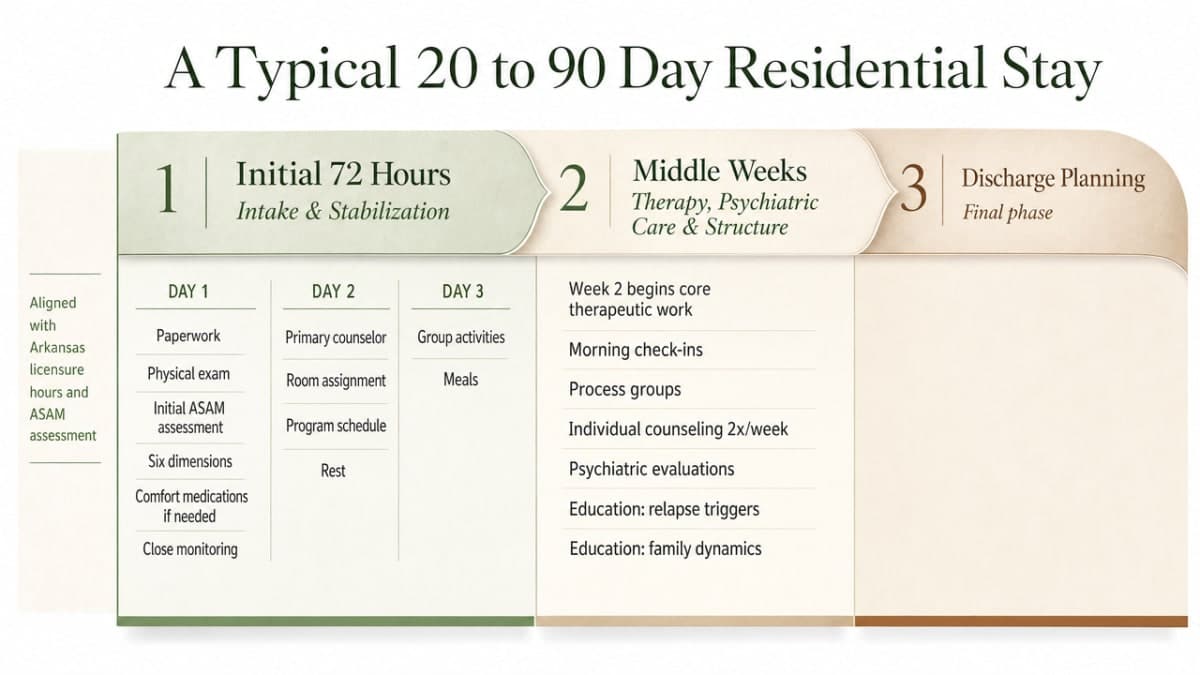
The first day typically involves paperwork, a physical examination, and an initial ASAM assessment across all six dimensions. If withdrawal is a concern, medical staff will provide comfort medications and monitor the individual closely. By day two, clients meet their primary counselor, receive room assignments, and review the program schedule. The initial days often involve significant rest as the body begins to heal. By day three, individuals typically begin participating in group activities and meals.16
The Middle Weeks: Therapy, Psychiatric Care, and Structure
The core therapeutic work begins in week two. Days are filled with morning check-ins, process groups, individual counseling (typically twice a week), psychiatric evaluations, educational sessions on relapse triggers and family dynamics, and on-site 12-step meetings. Arkansas licensure mandates at least 28 hours of structured programming per week, ensuring consistent clinical engagement. This period allows individuals to address underlying issues, develop coping mechanisms, and build a sense of belonging within the recovery community. Psychiatric needs, such as depression, anxiety, or PTSD, are often identified and treated during weeks three or four.9,12
Discharge Planning and Continuing Care
Effective discharge planning starts early in the residential stay. Counselors work with clients to develop a written plan that includes step-down care (e.g., IOP or outpatient groups), prescriber information, scheduled appointments, local recovery meetings, and family involvement.
A comprehensive discharge plan ensures a smooth transition to ongoing support.
The Clinical Rationale for Men’s Programs
Men’s-only residential treatment is a clinical choice supported by outcome data. SAMHSA’s guidance highlights that residential treatment is linked to better abstinence outcomes for men compared to outpatient care, and program completion correlates with improved overall results. Programs tailored to men’s specific needs, which often include addressing shame, vulnerability, and communication styles, can be more effective. In a men’s program, individuals may feel more comfortable discussing sensitive topics like trauma, fatherhood, and job loss without the perceived need to “translate” their experiences for a mixed audience. This environment fosters peer connection and a sense of belonging, which are crucial for recovery.9,14
Evidence-Based Outcomes of Residential Treatment
Residential treatment is supported by moderate-quality evidence. A systematic review of 23 studies found that residential care improves substance use and life outcomes across various domains. Another review concluded that completing a residential program is associated with improvements in substance use and mental health, consistent across different demographics.7,9
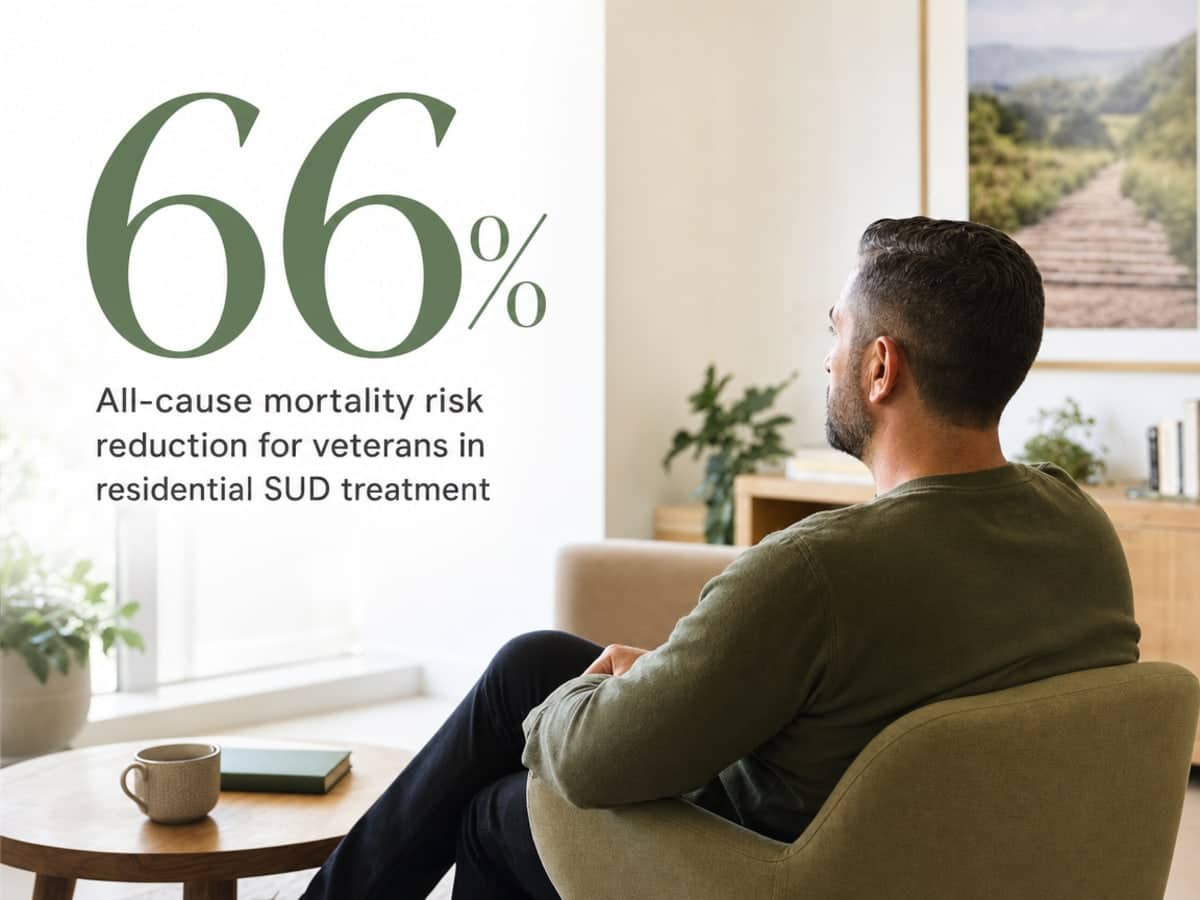
A 2024 study on veterans in residential SUD treatment reported a 66% reduction in all-cause mortality risk during the study period, along with significant symptom improvements lasting up to one year. While this specific statistic applies to a veteran population in VA programs, it underscores the life-saving potential of residential care for appropriate candidates. A key takeaway from the evidence is that completing the residential stay is more impactful than the specific facility chosen.10
Funding Residential Treatment: Insurance, Medicaid, and Uninsured Options
Commercial Insurance and Prior Authorization
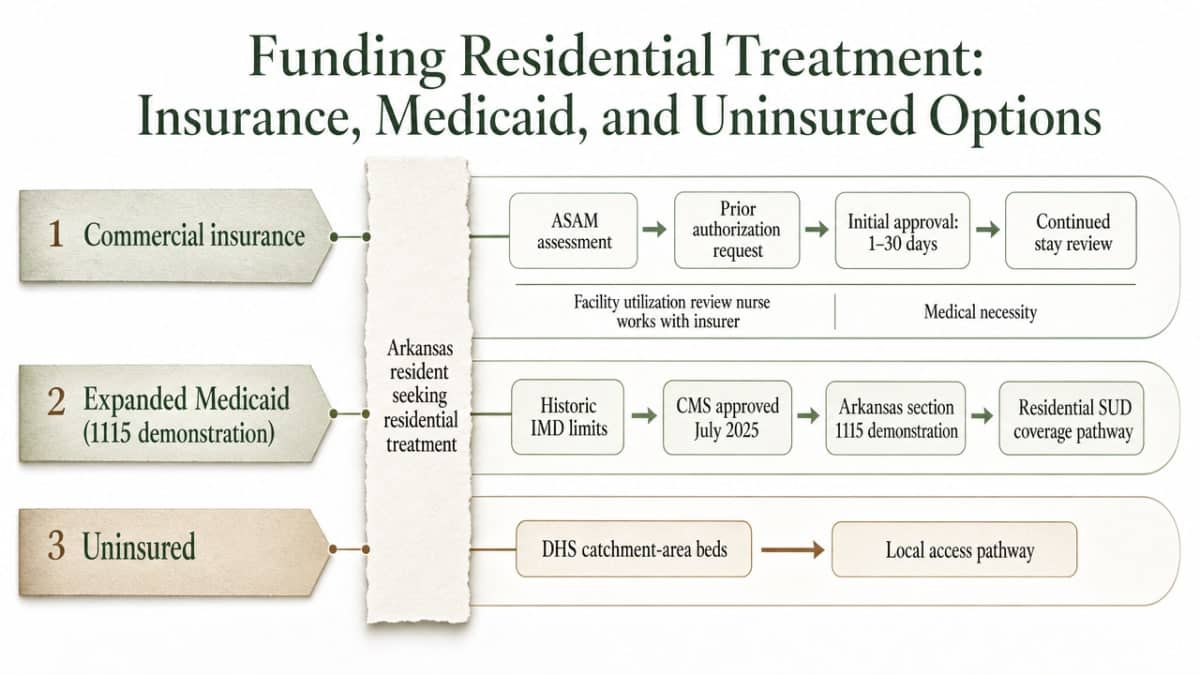
Commercial insurance plans typically require prior authorization for residential stays. A utilization review nurse from the facility will contact your insurer, presenting the ASAM assessment to request an initial block of days. Arkansas regulations for hospital-based residential SUD care allow initial approvals ranging from one to 30 days, with continued stays reviewed based on medical necessity. A reputable facility will manage the prior authorization process on your behalf.3,16
Medicaid Coverage in Arkansas
Historically, federal Medicaid rules limited coverage for SUD care in larger residential facilities classified as Institutions for Mental Diseases (IMDs). However, Arkansas’s section 1115 demonstration, approved by CMS in July 2025 (effective through June 30, 2030), now allows federal financial participation for certain Medicaid services in IMDs for SUD or SMI treatment. A technical correction in November 2025 further clarified that the demonstration includes SUD treatment services in residential and inpatient IMD settings under the waiver. This expansion means more residential options are now available for individuals on Arkansas Medicaid.1,2
Options for Uninsured Individuals
Even without insurance, a path to residential treatment exists. Arkansas DHS divides the state into eight catchment areas, funding contracted providers to serve uninsured residents within each. Little Rock and Pulaski County are in the central catchment. The DHS operates a phone line to connect individuals with providers in their area for state-funded beds. While there may be a waiting list, contacting the DHS line is a crucial first step.4,18
Identifying a Quality Residential Program
When contacting potential programs, use this checklist to assess their quality:
- Licensure: Confirm the program is licensed by Arkansas DHS as an alcohol and other drug abuse treatment program, regulated by the Office of Alcohol and Drug Abuse Prevention 13.
- Assessment Process: Inquire if they use the ASAM six-dimension framework for placement, rather than offering a fixed length of stay without a thorough evaluation 16.
- Medical and Psychiatric Care: Ask about the availability of prescribing physicians, access to psychiatrists, and overnight nursing staff. Comprehensive care for co-occurring mental health conditions is vital for effective treatment 9.
- Discharge Planning: Understand their discharge process. A strong program will outline the transition to outpatient care, prescribers, and recovery meetings well before your departure 8.
A serious program will provide clear, confident answers to these questions.
The Advantages of Local Treatment: Family, Work, and Aftercare
Choosing a residential program in Pulaski County offers practical benefits for long-term recovery. Family members can actively participate in therapy sessions and engage with clinicians, fostering a shared understanding of the recovery process. For those returning to work, local treatment facilitates communication between employers and counselors, supporting a smoother reintegration. Additionally, establishing connections with local sponsors and recovery meetings during treatment ensures a robust support system upon discharge. This continuity of care is a clinical advantage, as research shows that extended engagement in treatment, including residential and subsequent outpatient care, leads to better outcomes.8
Taking the Next Step Towards Treatment
To begin your journey, gather essential information:
- details about substances used
- last use date
- withdrawal history
- current medications
- insurance information
If you have Arkansas Medicaid or no insurance, note that as well. For uninsured individuals, contact the DHS line to be routed to a state-funded provider in the central catchment area.4
Next, contact a licensed program. Inquire about DHS licensure, structured hours, and discharge planning. Allow the facility to handle prior authorization with your insurance. If the first program isn’t the right fit, continue your search. Making the initial call, preparing for your stay, and showing up on day one are significant achievements in the recovery process. Serenity Park Recovery Center is a local men’s residential program in Little Rock worth considering.3
Frequently Asked Questions
How long does residential addiction treatment in Little Rock usually last?
Most stays range from 20 to 90 days, determined by an ASAM assessment across six clinical dimensions rather than a fixed duration. The total duration of treatment engagement, including residential and structured outpatient care for three months or more, is linked to better outcomes than short, standalone stays.8,16
What is the difference between residential treatment and detox?
Detoxification is a short medical process, typically three to seven days, focused on safely removing alcohol or drugs from the body with medication to manage withdrawal. Residential treatment is the subsequent live-in, structured stabilization and rehabilitation phase, offering 24-hour clinical staffing and daily therapy. Often, both are necessary, with detox preceding residential care.11
Will Arkansas Medicaid or my commercial insurance cover a residential stay?
For Arkansas Medicaid, coverage for residential stays expanded after CMS approved the state’s section 1115 demonstration in July 2025, allowing federal funding for SUD care in qualifying IMD residential settings. Commercial plans typically require prior authorization, with initial approvals up to 30 days and continued stays reviewed based on medical necessity.1,3
What if I don’t have insurance? Can I still get residential care in Arkansas?
Yes. Arkansas DHS divides the state into eight catchment areas and contracts with providers to serve uninsured residents, with Little Rock in the central catchment. You can call the DHS locator line to be connected with a funded provider. While there might be a waitlist, making the call is an important step.4
Can my family stay involved while I’m in a residential program?
Staying in Pulaski County allows family members to easily participate in family sessions, meet your counselor, and contribute to the discharge plan. This continuity between your treatment team and your family is a significant clinical advantage, not just a courtesy.
How can I tell a licensed clinical program apart from a shelter or sober living house?
Ask if the facility is licensed by Arkansas DHS as an alcohol and other drug abuse treatment program, regulated by the Office of Alcohol and Drug Abuse Prevention. A licensed program operates 24/7 with clinical staff and provides structured therapy on a set weekly schedule. Shelters and faith-based houses serve different, non-clinical purposes.12,13,19
References
- July 22, 2025 Janet Mann Deputy Secretary and Medicaid Director …. https://www.medicaid.gov/medicaid/section-1115-demonstrations/downloads/ar-opps-sud-smi-appvl-07222025.pdf
- [PDF] November 7, 2025 Janet Mann Secretary and Medicaid Director …. https://www.medicaid.gov/medicaid/section-1115-demonstrations/downloads/ar-opps-tech-corrections-appvl-11072025.pdf
- ARKANSAS STATE LIBRARY. https://humanservices.arkansas.gov/wp-content/uploads/Hospital-Treatment-for-SUD-Emergency-Rule-A.pdf
- Find Substance Abuse or Mental Health Treatment. https://humanservices.arkansas.gov/divisions-shared-services/shared-services/office-of-substance-abuse-and-mental-health/samh-treatment/
- Substance Misuse Education and Prevention. https://healthy.arkansas.gov/programs-services/prevention-healthy-living/substance-misuse-education-and-prevention/
- Changes in Drug Overdose Mortality and Selected …. https://www.cdc.gov/nchs/data/hestat/drug-overdose/drug-overdose-2022-2023.htm
- The effectiveness of residential treatment services for substance use disorder: a systematic review. https://pubmed.ncbi.nlm.nih.gov/31254749/
- The Continuing Care Model of Substance Use Treatment. https://pmc.ncbi.nlm.nih.gov/articles/PMC4007701/
- A realist review of residential treatment for adults with substance use disorder. https://pubmed.ncbi.nlm.nih.gov/36747370/
- Effectiveness of residential treatment services for veterans with …. https://pubmed.ncbi.nlm.nih.gov/38211367/
- Residential Treatment for Substance Use Disorder – NCBI – NIH. https://www.ncbi.nlm.nih.gov/books/NBK541232/
- Licensure Standards for Alcohol and Other Drug Abuse Treatment Programs. https://humanservices.arkansas.gov/wp-content/uploads/Licensure_Standards_for_Alcohol_and_Other_Drug_Abuse_Treatment_Programs.pdf
- Arkansas Summary — State Residential Treatment for Behavioral Health Conditions. https://aspe.hhs.gov/sites/default/files/2021-08/StateBHCond-Arkansas.pdf
- Addressing the Specific Behavioral Health Needs of Men. https://library.samhsa.gov/sites/default/files/sma14-4882.pdf
- Overview of Substance Use Disorder (SUD) Care Clinical Guidelines: A Resource for States. https://www.medicaid.gov/state-resource-center/innovation-accelerator-program/iap-downloads/reducing-substance-use-disorders/asam-resource-guide.pdf
- The ASAM Criteria (Fourth Edition) – Summary for Dissemination. https://hcpf.colorado.gov/sites/hcpf/files/ASAM-Fourth-Ed-Disseminate-Summary.pdf
- Award Number: 5H79TI085733-02 (SOR 3 Closeout Report). https://humanservices.arkansas.gov/wp-content/uploads/SOR3-Closeout-Report-9.2024-1.pdf
- Programs for Mental Health & Substance Abuse Issues. https://humanservices.arkansas.gov/learn-about-programs/programs-for-mental-health-substance-abuse-issues/
- Community Resource Manual – Mutual Help and Men’s Shelters (Pulaski County excerpt). https://healthy.arkansas.gov/wp-content/uploads/BH-Community-Resource-Manual_Sept-2017_-_Copy.pdf