
Key Takeaways
- Ketamine dependence rarely produces dramatic physical withdrawal, so tolerance, solo use, bladder symptoms, and memory slips are the honest signals to read rather than movie-style benchmarks.
- Chronic use hits bladder, brain, and mood hardest, and cessation is the mainstay of treatment for ketamine-induced cystitis, with earlier stopping tied to better reversal 8, 13.
- No medication yet functions like Suboxone for ketamine use disorder, so therapy, structure, and time carry the work, with CBT and motivational interviewing leading the evidence base 6, 7.
- A thirty to forty-five day residential setting lets cessation, stabilization, polysubstance care, and urology or psychiatry referrals happen in parallel rather than sequentially 1, 13.
The Drug Most Rehab Ads Skip Over
You have probably scrolled through a dozen rehab websites by now. Alcohol. Opioids. Meth. Maybe a line about cocaine. Rarely does ketamine get its own paragraph, let alone its own page. That silence can make you feel like your situation is too niche, too weird, or not serious enough to warrant a bed in a residential program. It is none of those things.
Ketamine sits in a strange corner of the American drug landscape. It is real medicine in an operating room. It is a newer psychiatric tool for treatment-resistant depression. And on Friday nights, in hotel rooms and clubs and private house parties, it is a bump off a key or a line on a coffee table. That triple identity is part of why the addiction side rarely makes it into rehab marketing. It is easier to sell certainty about alcohol than to explain a drug that most people cannot quite categorize.
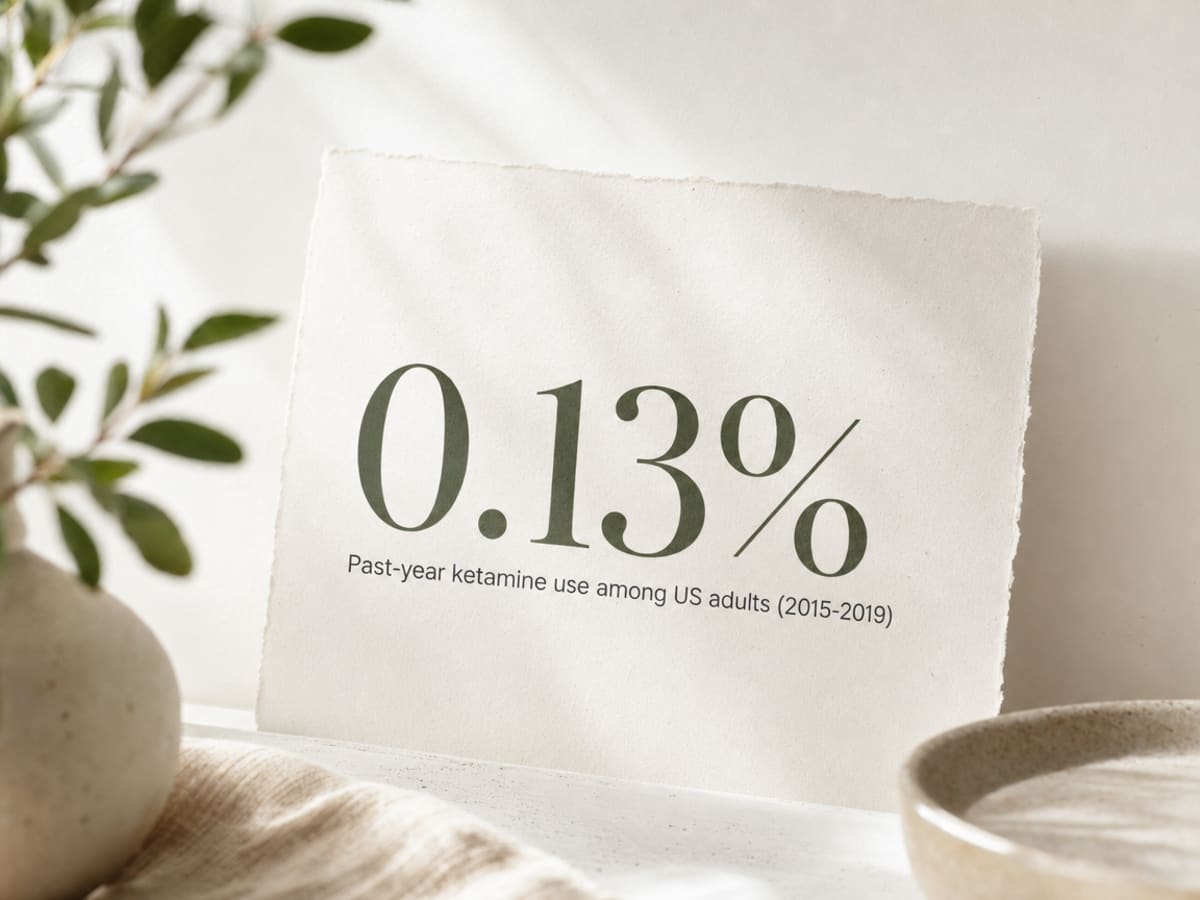
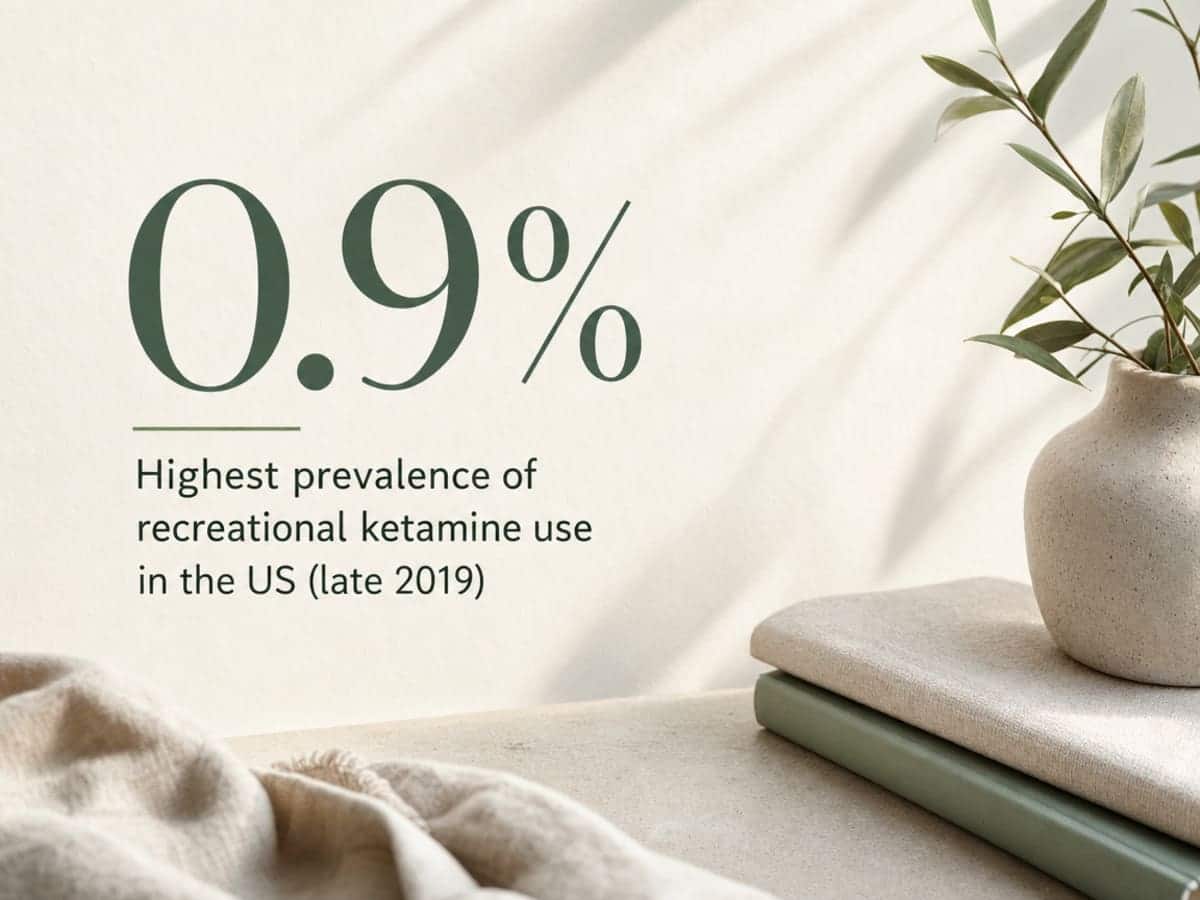
The numbers back up the invisibility. An estimated 0.13% of US adults reported past-year ketamine use in the 2015–2019 National Survey on Drug Use and Health, and among teens and adults the prevalence peaked at 0.9% in late 2019 3, 4. Small numbers, in absolute terms. But the trend is up, and inside that trend are men who look a lot like you: professionals with structured lives, curious minds, and a growing sense that something has gotten away from them.
Being in a small cohort does not mean your problem is small. It means you have had to figure most of this out alone. That part changes now.
How to Tell If What You Have Is a Ketamine Use Disorder
There is no clean, universal test for this. But there are signals your body and your calendar have been sending you, probably for a while now. This section is about learning to read them honestly, without the internal lawyer that keeps arguing your case down.
The Signals That Actually Matter
Start with the questions that cut through the noise. When was the last time you went a full weekend without a bump? Not planned to, actually did. If that answer takes more than a few seconds to find, that is a signal.
Look at tolerance. The vial that used to last a month now lasts a weekend. The bump that used to send you sideways barely blurs the edges. Ketamine builds tolerance fast, and men who use it regularly often end up chasing a feeling they can no longer catch. That chase is dependence taking shape.
Watch for the private hours. Ketamine is a social drug for most people, until it is not. A line alone before a Zoom call. A bump in the car before a client dinner. The shift from party to solo is one of the clearest markers that something has changed.
Then there is the physical evidence you have been quietly managing. Burning when you pee. Getting up three times a night. A tightness in your lower belly that comes and goes. Memory that skips like a scratched record during meetings you should remember. Clinicians are specifically told to watch for exactly this pattern of physical and psychological dependence when ketamine is used recreationally 12.
If two or three of these are true, you are not overreacting. You are noticing. That is the first real work.
Why Ketamine Dependence Looks Different from Alcohol or Opioid Dependence
Part of what makes ketamine hard to see clearly is that it does not follow the script. You know the alcohol script. Shaking hands in the morning. A drink to steady the day. Opioid withdrawal has its own recognizable shape: sweats, cramps, the flu that is not the flu.
Ketamine does not do that. There is no dramatic physical withdrawal that lands you in an ER. Stop for a few days and you might feel flat, anxious, unable to sleep, irritable, and gripped by a craving that feels more mental than physical. It is real dependence, but it wears different clothes. That is why so many men convince themselves it cannot be an addiction. If it does not look like the movies, it does not count.
It counts. The 2024 review of medications for ketamine use disorder is direct about this: dependence and craving are the central clinical problems, even though the withdrawal profile is milder than what you see with alcohol or opioids 7. Chronic, frequent use also brings its own signature harms that alcohol and opioids do not share, particularly bladder damage and measurable deficits in working and episodic memory 1.
Different drug, different pattern, same underlying trap. What matters is not whether your experience matches someone else’s addiction. It is whether you can stop when you decide to. If the honest answer is no, that is the diagnosis your body is already making.
What Ketamine Is Doing to Your Body Right Now
You have probably told yourself that ketamine is the safer choice. No hangover to speak of. No needle. No comedown that flattens a week the way MDMA can. That story is mostly comforting and partly true. What it leaves out is that ketamine, used often enough, quietly attacks two specific systems in your body: your bladder and your brain. Both are systems you rely on to do your job and keep your life running. Neither one advertises the damage until the damage is already meaningful.
Bladder Pain You Have Not Told Your Doctor About
Start here, because this is the harm most men hide the longest. You noticed it a while back. A burn when you finish urinating. A pressure low in your pelvis that does not quite go away. Waking up two or three times a night to pee small amounts. Maybe some blood you told yourself was nothing. You did not bring it up at your last physical because you did not want to explain the context.
This is ketamine-induced cystitis, and it is not rare in men who use frequently. The bladder lining becomes inflamed and ulcerated. The bladder itself shrinks and stiffens over time. Urgency goes from annoying to disabling. In the worst cases, men end up with a bladder that holds less than a cup of fluid, requiring surgical reconstruction with poor long-term outcomes 13.
That is a hard sentence to read alone in your apartment. It is a very different sentence to read inside a program where cessation is the environment, not a promise you have to keep by willpower. If your bladder is talking to you, it is asking for a place where you cannot half-quit. The good news your urologist would want you to hear: catching this early and stopping now is when reversal is most possible.
Memory Slips, K-Holes, and the Cognitive Cost
Then there is the part of the damage you carry into every meeting. The name you should know and cannot find. The email you sent Monday that you have no memory of writing. The client story you told twice in the same call. You have started building small workarounds: more notes, more calendar reminders, more coffee. The workarounds are working, until they are not.
Frequent ketamine use is directly linked to measurable deficits in working memory and episodic memory, alongside the ulcerative cystitis picture, in the clinical literature on chronic use 1. That is not a warning about someday. That is a description of what regular use is likely already doing.
The k-holes are their own category. What started as an accidental over-bump has become something you sometimes seek out, or at least stopped avoiding. Each dissociative episode is your brain briefly disconnecting from itself. Do that often enough and the reconnection gets less clean. Mood flattens between sessions. Sleep frays. The edges of your personality feel further away than they used to.
Bladder, brain, mood and sleep regulation. Those are the three organ systems chronic ketamine use hits hardest, and they are the three that a residential program can actually monitor and protect while your body remembers how to run itself 1. Naming the cost is not doom. It is the map you need to see why stopping now is worth the interruption it takes.
The Polysubstance Reality: Ketamine Rarely Travels Alone
Here is the part of your story that most rehab intake forms are not built to hear. You do not just use ketamine. You use ketamine at 1 a.m. after four drinks and a bump of cocaine to take the edge off the come-up. You use it on a Saturday night that also included MDMA. On a chemsex weekend, ketamine is one of three or four substances moving through your body in a specific choreography you have gotten good at managing. Solo ketamine use exists, but for a lot of men, ketamine is the connective tissue between other drugs, not the headline.
The research reflects this. In the national survey data, men who use ketamine are consistently more likely to report polysubstance use, and sexual minority men reporting more than one substance carried the highest risk profile in the sample 3. That is not a moral point. It is a clinical one. Your treatment has to account for the whole cocktail, not just the drug you named on the phone.
Polysubstance use complicates the first week of care in real ways. Alcohol withdrawal has a timeline and a real medical risk that requires supervised detox. Cocaine and MDMA have their own crash patterns. Ketamine dependence brings craving, insomnia, and low mood without the acute physical withdrawal that alcohol or opioids produce 7. Those timelines overlap. A program that only knows how to treat one substance at a time will miss two of yours.
What you need is a setting where the intake conversation starts with every substance on the table and the medical team maps them together. That is the standard a residential program should meet before you unpack your bag.
What Treatment Actually Looks Like Day-to-Day
You have read enough about what ketamine is doing. The harder question is what actually happens when you stop, where you stop, and who is in the room helping you stop. The honest answer is less dramatic than the movies and more structured than most men expect. Days have a shape. Weeks build on each other. What follows is the frame most clinicians work from and what your time actually looks like inside it.
The Stepwise Framework: Cessation, Stabilization, Therapy, Coordination
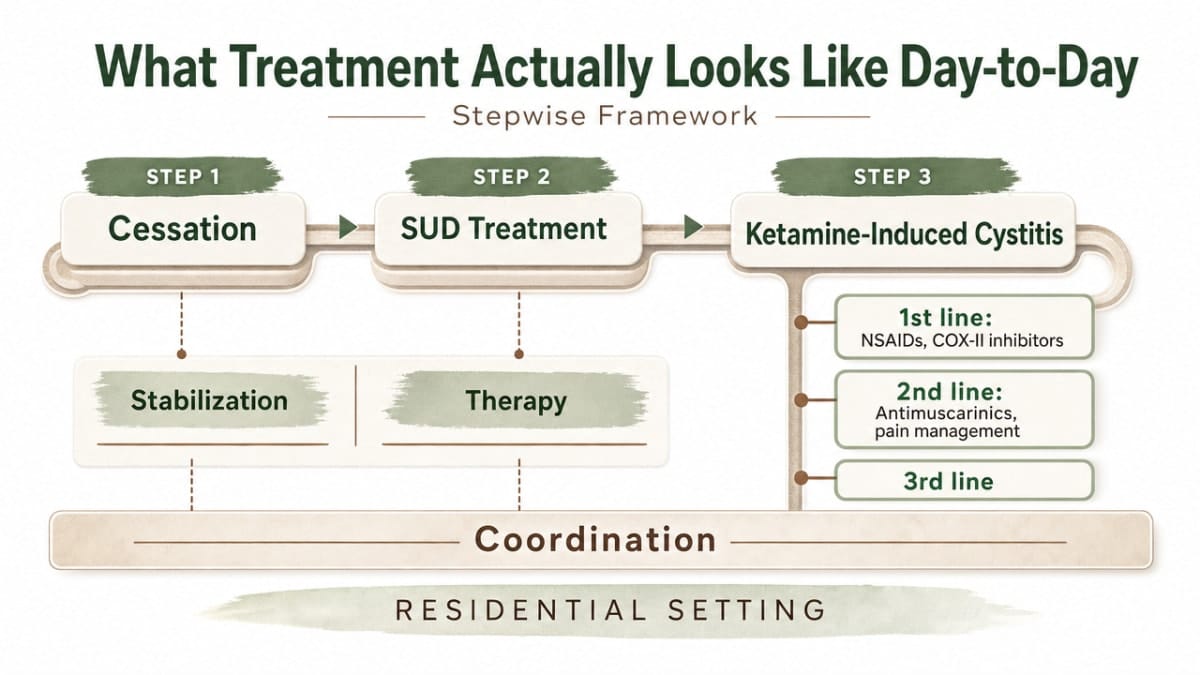
Clinicians teaching ketamine misuse care work from a stepwise map, and it is worth seeing it laid out because it removes a lot of the mystery.
- Step one is cessation.
- Step two is substance use disorder treatment.
- Step three is management of ketamine-induced cystitis, with a first line of NSAIDs and COX-II inhibitors, a second line of antimuscarinics and pain management, a third line of intravesical injections of urothelium-protective agents, and a fourth line of surgery, which has poor outcomes and is the reason earlier steps matter so much 13, 8.
In a residential setting, those steps stop being separate errands and become a single week. Cessation happens the moment you check in, because the environment holds it. You are not white-knuckling through Friday night in your apartment. Stabilization comes next, usually the first three to seven days, where the medical team watches for the polysubstance picture you brought with you: alcohol withdrawal if it applies, sleep that is broken for a while, mood that flattens before it lifts, and cravings that come in waves.
By the second week, therapy is the center of your day. Individual counseling in the morning. Group in the afternoon. Psychiatric evaluation early on so any depression or anxiety underneath the use gets its own treatment plan. If your bladder symptoms need a urologist, that referral happens in parallel, not after discharge. That parallel coordination is what the literature has been asking for since 2012, when the first major review argued that urology and addiction specialists have to work together 1.
The steps are simple to name. Living them together in one place is what makes them work.
Why Medication Is a Small Part of the Answer
If you were hoping for a Suboxone-style medication that takes the craving off the table, this is the part where honesty has to lead. There is not one. The 2024 systematic review of pharmacological management of ketamine use disorder found only very low-quality evidence across the board. Benzodiazepine regimens and haloperidol have shown potential utility in intoxication and withdrawal. Naltrexone, lamotrigine, and a combination of paliperidone palmitate with bupropion have shown some potential for craving and relapse prevention 7. Potential is the operative word. None of these are standard of care.
What that means in practice: medication may be part of your first week if you are agitated, sleepless, or coming off alcohol alongside ketamine. A psychiatrist may prescribe something targeted for depression or anxiety that predates your use. But no pill is going to do the work of the program for you. Anyone selling you a quick pharmacological fix for ketamine dependence is ahead of the evidence.
The reason to read this carefully is not to feel discouraged. It is to know where the real work is. When medication is a small part of the answer, therapy, structure, and time become the whole rest of it.
CBT, Motivational Interviewing, and the Work That Actually Moves the Needle
Cognitive behavioral therapy and motivational interviewing are the two names you will hear most often, and they are the two that actually earn their keep. The evidence base for both across substance use disorders is strong. Motivational interviewing shows small to moderate effects for alcohol and moderate effects for drug use compared with no-treatment controls, and CBT is a core, empirically supported approach across multiple substance use disorders 6. Current guidance applies that same standard psychosocial toolkit to ketamine use disorder, because it is what works when robust pharmacotherapy does not exist.
In CBT sessions, you get concrete. What situations reliably lead you to use. What the internal script sounds like ten minutes before a bump. What replacement behaviors actually hold when the craving arrives at 11 p.m. on a Saturday. You build these on paper and then rehearse them out loud, because rehearsal is what makes them available under pressure.
Motivational interviewing is different in feel. It is less about tools and more about resolving the argument you have been having with yourself for months. A good clinician will not lecture you about ketamine. They will help you say out loud what you already know: that you have been paying for this drug with parts of your life you were not planning to spend.
Add group therapy, where you sit with other men who know the specific shame of a drug most rehab pamphlets do not name, and the days start doing something. That is the needle moving.
Therapeutic Ketamine vs. Ketamine Use Disorder: Clearing Up the Confusion
This is the sentence you may have used on yourself more than once: ketamine is medicine now. Doctors give it to people with depression. Clinics advertise infusions on billboards. If it treats depression, how can what you are doing be that bad?
Two different things are true at the same time, and holding both is the honest move. Therapeutic ketamine is a supervised, dose-controlled psychiatric treatment for mood disorders, delivered by clinicians who screen for substance use history and watch closely for signs of misuse or dependence 14. There is also emerging evidence that ketamine infusions paired with psychotherapy may help some people reduce alcohol or cocaine use, with one 2018 review reporting 65.8% abstinence at one year for the ketamine plus psychotherapy group versus 24% for treatment as usual in trials for alcohol and heroin dependence 11. That is a striking finding. It is also not what you are doing on a Saturday night.
Recreational ketamine is unsupervised, escalating, and mixed with other substances. It is the exact use pattern that clinical guidelines flag as high-risk for dependence and the reason ketamine is a Schedule III controlled substance 12. Same molecule, different world. The clinic setting is the medicine. Without it, you are left with the drug.
The 30-45 Day Question: What Residential Time Buys You
Thirty to forty-five days is a real chunk of your calendar. It is a stretch of missed meetings, delegated cases, and an out-of-office reply that will raise questions you have not yet decided how to answer. It is worth asking, plainly, what that time actually buys you that a weekend retreat or an outpatient counselor cannot. The answer has two parts: what continued use is quietly costing the man you are trying to remain, and what a small, private, men-only residential setting is built to protect while you get your feet back under you.
What Continued Use Costs the Man You Are Trying to Stay
Do the math on the parts of your life you have been quietly renegotiating. The bladder symptoms are the loudest one, because they end in an operating room if they end badly. Cessation is the mainstay of treatment for ketamine-induced cystitis, and the earlier stages are where reversal is most possible. The later stages move through antimuscarinics, intravesical therapies, and then augmentation enterocystoplasty, a surgery with poor long-term outcomes 8, 13. That is what late looks like.
Then there is your working memory, which is the tool you actually sell. Frequent ketamine use is directly linked to deficits in working and episodic memory in the clinical literature 1. You already feel it in meetings. Another year of use is another year of accumulating small deficits that your workarounds will eventually stop covering.
Thirty to forty-five days is short compared to the timeline of a bladder reconstruction, a licensing complaint, or a marriage that ran out of patience. Continued use is not free time. It is time on a meter you cannot see, until the bill arrives all at once.
Privacy, Professional Continuity, and a Small Men’s Program in Little Rock
The other reason residential time is worth the interruption is what it lets you stop doing. You stop coordinating your own care between a therapist who does not know about the ketamine, a urologist who has half the story, and a psychiatrist who is treating the anxiety underneath. In one place, those conversations happen in the same chart.
Serenity Park runs a men-only residential program in Little Rock with a cap of twenty clients. That is a small enough room that your intake is not a form fed into a queue. Wearable monitoring through Huml Health tracks heart rate, sleep, and stress patterns during the first weeks, when your autonomic system and sleep are the least reliable parts of the picture. The individualized treatment list already includes drug addiction treatment broadly, which means ketamine and other club-context substances are inside the scope, not outside it.
Thirty to forty-five days is not a lot to ask of a life you are trying to keep.
Frequently Asked Questions
Does ketamine actually cause addiction, or is it just psychological?
Both, and the line between them is thinner than it sounds. Ketamine produces real physical and psychological dependence in men who use it recreationally, which is why clinicians are told to watch closely for exactly that pattern 12. The withdrawal looks milder than alcohol or opioid withdrawal, but craving, insomnia, low mood, and loss of control are consistent features 7. That is addiction.
Will a residential rehab program take my ketamine use seriously if I don’t also have an alcohol or opioid problem?
A good one will. Ketamine use disorder is recognized in current clinical teaching and treated within standard substance use disorder frameworks, with added attention to bladder and cognitive harms 13. At Serenity Park, drug addiction treatment is part of the core scope, which means ketamine is inside the program, not a footnote. If you use only ketamine, your treatment plan is built around that.
Is there a medication that treats ketamine addiction like Suboxone treats opioids?
Not yet. The 2024 systematic review of pharmacological management found only very low-quality evidence for any medication in ketamine use disorder. Benzodiazepine regimens and haloperidol may help during intoxication and withdrawal, and naltrexone, lamotrigine, or paliperidone palmitate with bupropion have shown some potential for craving 7. None are standard of care. Therapy, structure, and time do most of the work.
Can my bladder heal if I stop using ketamine?
Early damage often improves once you stop. Cessation of ketamine is the mainstay of treatment for ketamine-induced cystitis, and immediate, absolute cessation is described as the obligatory starting point 8, 9. Late-stage damage, where the bladder has scarred and shrunk, may require antimuscarinics, intravesical therapies, or surgery with poor long-term outcomes 13. The earlier you stop, the more your bladder can recover.
If ketamine is used to treat depression now, how can it also be addictive?
Same molecule, very different context. Therapeutic ketamine is dose-controlled, supervised, and delivered by clinicians who screen for substance use and watch for misuse 14. Recreational ketamine is unsupervised and escalates, which is why it remains a Schedule III controlled substance with recognized dependence potential 12. The clinical setting is what makes ketamine medicine. Outside that setting, the same drug behaves very differently.
How long does residential treatment for ketamine use disorder usually last?
Most men benefit from thirty to forty-five days of residential care, sometimes longer if polysubstance use or bladder complications need coordinated management. That window gives cessation time to hold, lets stabilization and therapy build on each other, and allows parallel referrals to urology or psychiatry rather than sequential ones 1, 13. Shorter stays can help, but the stepwise framework works best when it has room to breathe.
References
- Ketamine use: a review. https://pubmed.ncbi.nlm.nih.gov/21777321/
- Trends in Ketamine Use, Exposures, and Seizures in the United States. https://pmc.ncbi.nlm.nih.gov/articles/PMC8630483/
- Past-Year Ketamine Use: Evidence from a United States Representative Sample of Adults. https://pubmed.ncbi.nlm.nih.gov/35348042/
- Recreational Ketamine Use Has Increased in Recent Years, But Remains Rare. https://www.nyu.edu/about/news-publications/news/2021/october/recreational-ketamine-use.html
- A case series of group-based ketamine-assisted psychotherapy delivered in a residential eating disorder treatment center. https://pubmed.ncbi.nlm.nih.gov/35524316/
- Cognitive-Behavioral Therapy for Substance Use Disorders. https://pmc.ncbi.nlm.nih.gov/articles/PMC2897895/
- The Pharmacological Management of Ketamine Use Disorder. https://pmc.ncbi.nlm.nih.gov/articles/PMC11882168/
- Pathophysiology, clinical presentation, and management of ketamine-induced cystitis. https://pmc.ncbi.nlm.nih.gov/articles/PMC10399845/
- Ketamine bladder syndrome: an important differential diagnosis in lower urinary tract symptoms. https://pmc.ncbi.nlm.nih.gov/articles/PMC4544340/
- Ketamine for Adults With Substance Use Disorders. https://www.ncbi.nlm.nih.gov/books/NBK602506/
- Efficacy of Ketamine in the Treatment of Substance Use Disorders. https://pmc.ncbi.nlm.nih.gov/articles/PMC6094990/
- Ketamine – StatPearls – NCBI Bookshelf. https://www.ncbi.nlm.nih.gov/books/NBK470357/
- Ketamine Misuse. https://ictp.uw.edu/wp-content/uploads/2024/03/UW-PACC-Murphy-Ryan-Ketamine-Misuse-2.1.24.pdf
- Guidelines for ketamine use in clinical psychiatry practice. https://pmc.ncbi.nlm.nih.gov/articles/PMC11094435/