
Key Takeaways
- In Arkansas, DHS licensure is the legal minimum every residential SUD program must hold, while CARF, Joint Commission, or COA accreditation is the voluntary third-party review that actually signals clinical quality 9.
- Credible Little Rock facilities speak ASAM: residential care should operate at Level 3.5, with on-site medically supervised detox capable of Level 3.7 acuity for withdrawal management 10.
- Compare staffing depth and census before committing — ask who covers weekdays, weekends, and overnight, whether a psychiatric provider is on staff, and how clinical attention scales at full capacity 11.
- Continuing care is a design principle, not a discharge handout; residential outcomes depend on structured step-down, in-house alumni groups, and aftercare planning that starts during treatment 6.
The Diligence Problem Nobody Talks About
You already know how to vet a vendor. You read the contract, check the credentials, ask what happens when something goes wrong, and watch how the answer is delivered. You do this every week in your professional life.
Then you sit down at 11 p.m. to look at residential addiction treatment for yourself, or for someone you love, and every website looks roughly the same. Warm photography. The word “holistic.” A promise about healing. A phone number. The same rubric you’d apply to a general contractor, a specialist referral, or an outside counsel engagement suddenly feels harder to run, because the industry has trained you to shop on tone rather than substance.
That’s the diligence problem. Not that credible programs don’t exist in Little Rock. They do. But the surface signals a treatment center puts in front of you are mostly marketing, and the signals that actually predict clinical quality — accreditation body, licensure status, ASAM alignment, staffing model, census, continuing care structure — usually live one layer down, in language the industry hasn’t been in a hurry to translate for you.
This piece gives you that translation, and a checkable rubric you can hold up against any facility in the state, including this one.
Licensure Is the Floor, Not the Ceiling
What Arkansas DHS Licensure Actually Requires
Start with the legal baseline, because it’s narrower than the marketing suggests.
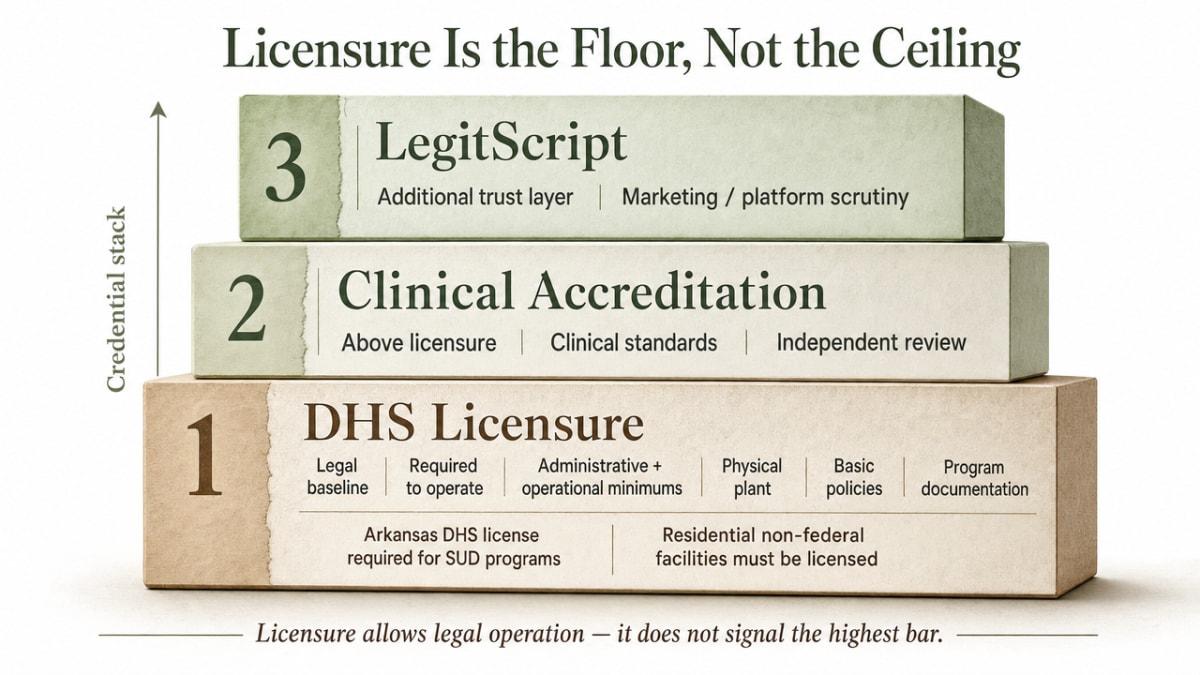
In Arkansas, the Department of Human Services requires a license for anyone operating a substance abuse treatment program in the state. The language is unambiguous: licensure is required of any individual, partnership, association, or corporation running a SUD program, full stop 7. HHS’s own state profile confirms the same rule for residential programs specifically — every non-federal residential SUD facility in Arkansas must be licensed by DHS 9.
That sounds like a strong filter. It isn’t. Licensure is the state’s way of saying a facility has cleared the minimum administrative and operational bar to legally exist. It verifies things like physical plant standards, basic policies, and program documentation. It does not, on its own, tell you anything about clinical outcomes, staffing depth, therapy quality, or whether the program follows current evidence-based practice.
When you’re evaluating a Little Rock facility, DHS licensure is a yes/no gate. If a program isn’t licensed, stop reading its website. If it is, you’ve confirmed only that the state has let it open its doors.
What Accreditation Adds That Licensure Doesn’t
Here’s the distinction most facility websites blur, and the one you should hold onto.
Arkansas doesn’t require accreditation. The state permits it as a pathway — a facility that carries accreditation from CARF, The Joint Commission (formerly JCAHO), or COA can be awarded licensure on that basis, provided the DHS office also verifies the other listed compliance areas 7. HHS’s state summary puts the same point more directly: accreditation is not required, but accredited facilities automatically receive licensure when the remaining requirements are met 9.
Read that carefully. Licensure is the legal minimum every program must clear. Accreditation is a separate, voluntary, third-party review — and it is the actual quality signal.
When a facility carries CARF behavioral health accreditation, an outside body has audited its clinical program design, staff credentialing, treatment planning, outcomes measurement, and continuous improvement processes. That auditor has no financial stake in the facility’s admissions. The Joint Commission and COA function similarly. Accreditation is the reason two centers can both be “DHS-licensed” in Little Rock and deliver completely different care.
LegitScript: The Marketing-Integrity Check
One more layer, and it lives outside the clinical world entirely.
LegitScript addiction treatment certification isn’t a state license or a clinical accreditation. It’s a certification that verifies a facility’s business and marketing practices — that the program is who it says it is, that it doesn’t engage in patient brokering, and that its advertising claims are honest. Google and Facebook both require it before a treatment center can run paid ads.
Why does this matter to you at 11 p.m.? Because a large share of the polished websites you’re comparing exist to buy your click. LegitScript certification is the check on whether the facility behind the ad is operating legitimately or running the referral-fee playbook that has plagued this industry.
A credible Little Rock facility will typically carry all three: DHS licensure, clinical accreditation (CARF, TJC, or COA), and LegitScript certification. Serenity Park holds all three. Ask any facility you’re considering to confirm the same, in writing, before your first call.
ASAM Levels of Care: The Language a Credible Facility Speaks
Why ASAM Is the Right Spine for Evaluation
Marketing language is fluid. Clinical language isn’t.
When a website talks about “the right program for you,” you’re being sold a feeling. When a clinician talks about ASAM Level 3.5 or Level 3.7, they’re using a specific placement framework developed by the American Society of Addiction Medicine that ties a patient’s condition to a defined intensity of care. Arkansas has already adopted this vocabulary. The state’s own hospital services rules define a Substance Abuse Residential Treatment Unit as a specialized program built on ASAM criteria for assessment, treatment, and ongoing care 10.
That matters for you as an evaluator. It means you don’t have to invent a rubric — the state has already told you the language a credible facility should be fluent in. If a Little Rock program can’t tell you which ASAM level its residential track corresponds to, or how it decides when someone moves down the ladder, you’re talking to admissions, not clinicians.
Where a Facility’s Offering Actually Sits
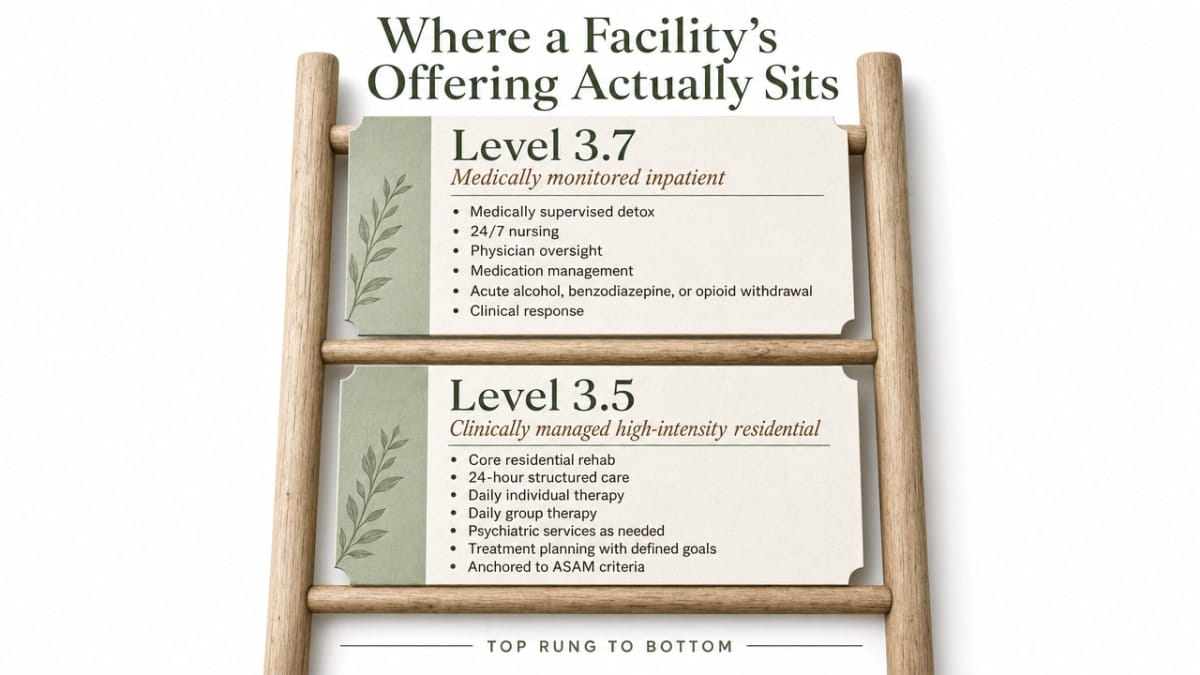
Picture the continuum as a ladder, top rung to bottom.
At the top sits Level 3.7, medically monitored inpatient services — this is where medically supervised detox happens. Around-the-clock nursing, physician oversight, medication management for withdrawal. It’s the setting for someone whose body is going through acute alcohol or benzodiazepine or opioid withdrawal and needs a clinical response, not a quiet room.
One rung down: Level 3.5, clinically managed high-intensity residential. This is the core of what most people mean when they say “rehab.” 24-hour structured care in a residential setting, daily individual and group therapy, psychiatric services as needed, treatment planning against defined goals. The Arkansas hospital services manual anchors this level explicitly to ASAM criteria 10, which is why a credible residential program in Little Rock should be able to point to 3.5 (or 3.5 stepping down from 3.7) as the level it delivers.
Below residential comes Level 2.1, intensive outpatient (IOP) — typically nine or more clinical hours per week while the person lives at home or in sober housing. Then standard outpatient and continuing care, where session frequency drops and the emphasis shifts to relapse prevention and long-term stability.
Here’s what to do with this ladder. When you’re on the phone with a facility, ask two questions. First: which ASAM level does your residential program operate at, and can your detox unit handle 3.7? Second: what does step-down look like — do you transition clients internally to 2.1, refer to a partner IOP, or hand them a list on discharge day?
The answers tell you whether the program understands its own place in the continuum or is treating “residential” as a single generic product. Serenity Park operates its residential track at the 3.5 level with 3.7-capable medically supervised detox on-site, which is what allows a client to move through withdrawal and into structured residential care without changing facilities or care teams.
Detox: What the State Actually Recognizes
Detox is where the marketing language gets loosest, so this deserves its own beat.
Arkansas Medicaid defines Substance Abuse Detoxification narrowly: it is a set of interventions aimed at managing acute intoxication and withdrawal from alcohol or other drugs 8. That’s it. Not a two-week wellness reset. Not “our detox experience.” A short, clinical intervention with a specific medical purpose.
The state is equally specific about where it must happen. Detox has to be delivered in a facility that is licensed by DHS as a Substance Abuse Detoxification provider 8— meaning a residential SUD program with the right licensure category or an inpatient hospital. A facility that markets “detox support” but isn’t licensed to provide detoxification is describing something else, and you should ask directly what that something is.
Two questions cut through the ambiguity fast. Does your facility hold DHS licensure specifically for Substance Abuse Detoxification, not just residential treatment? And is your detox medically supervised on-site — with physician oversight and medication management for withdrawal — or is it a referral out? If the answer to either is soft, that’s the answer.
Clinical Staffing: The Question Most Facilities Won’t Answer Cleanly
Interdisciplinary Team or Bed-Rental Operation
Ask a facility to describe its clinical team, and listen for the specifics.
A credible residential program in Little Rock is staffed by an interdisciplinary team, not a rotating bench of contractors. That means:
- a medical director or physician with addiction medicine experience,
- nursing coverage appropriate to the acuity of care being delivered,
- licensed clinicians running individual and group therapy,
- a psychiatric provider available for evaluation and medication management,
- and case management that owns discharge planning from day one.
SAMHSA’s 2024 federal guidelines put the principle plainly: staffing patterns should align with the size of the program, the scope of practice, the extent of services delivered, and the number of patients served 11. That’s a benchmark, not a suggestion.
The cleanest way to test this on a call: ask who is on-site during a typical weekday, who is on-site over the weekend, and who is on-call overnight. Ask what happens clinically when a client at 2 a.m. of day three of alcohol detox develops a complication. If the answer is vague, or if you hear “we send them out,” you’re looking at a residential shell, not a residential program. If the facility can name roles, credentials, and coverage windows without a callback, that’s the team you’re actually hiring.
Census and Ratio: Why 20 Is Not 60
Census is the number nobody puts on the homepage, and it’s one of the most predictive things you can ask about.
A 60-bed facility and a 20-bed facility can carry identical accreditations, identical licenses, and identical service lists. What they can’t carry identically is attention. When your treatment team is responsible for three clients instead of ten, individual sessions run longer, treatment plans get revisited more often, and the small clinical signals that predict trouble — sleep disruption, appetite change, a shift in group participation — actually get noticed. That’s not a marketing claim; it’s arithmetic.
Serenity Park caps census at up to 20 men at a time. That number isn’t a luxury feature. It’s a deliberate constraint that governs how the interdisciplinary team allocates hours per client and how quickly a change in someone’s presentation reaches a clinician.
When you’re comparing facilities, ask two questions. What is your maximum census? And how does your clinical staffing scale when you’re at capacity versus half-full? A program that can answer both without checking is running a defensible operation. A program that can’t is telling you where the pressure will land when things get busy.
Dual Diagnosis and Trauma-Informed Care as Table Stakes
If a facility treats addiction as if it exists in isolation, walk away.
Co-occurring mental illness and substance use disorder are not a subspecialty in this population — they’re the baseline. NIMH data show that a substantial share of U.S. adults with a mental illness also have a co-occurring substance use disorder, which is why integrated care is table stakes for any credible residential program 5. For the reader this article is written for — an attorney, physician, executive, or business owner whose drinking or using has escalated under sustained professional pressure — untreated anxiety, depression, or ADHD is often part of the mechanism, not a footnote to it.
Trauma sits in the same category. CDC evidence links adverse childhood experiences to increased risk of substance use disorders and mental health problems in adulthood 4. A program that treats trauma-informed care as a marketing phrase rather than a staffing and clinical-model decision is not equipped for the men it’s admitting.
Three questions to ask directly:
- Does your program have a psychiatric provider on staff who can evaluate and prescribe, not just refer out?
- Are your clinicians credentialed in a trauma-focused modality, and which one?
- And is dual-diagnosis treatment integrated into the same daily schedule as substance use treatment, or run as a parallel track the client has to hold together on their own?
The right program will answer all three without softening. Serenity Park integrates psychiatric care, individual counseling, and trauma-informed clinical practice into a single treatment plan for each of its 20 clients, because separating them makes no clinical sense for the men who need residential care in the first place.
Continuing Care Is Not an Add-On
Here’s the part of the rubric that gets treated as a bonus feature and shouldn’t be.
Residential treatment works. It also has a specific condition attached to that fact. The peer-reviewed literature on residential SUD outcomes is clear that these programs can be effective, but the effect is tied to what happens after discharge — residential treatment is most effective when it’s followed by continuing care 6. Not sometimes. As a design principle. A 30- or 60-day residential stay without a real step-down plan is a clinical episode without a clinical follow-through, and the outcomes tend to reflect that.
So when you’re evaluating a facility, treat continuing care as a first-tier question, not a discharge-day handout.
Ask three things:
- Does the program build the aftercare plan during treatment, with the client’s clinical team involved, or is it handed off to a case manager in the final week?
- Does the facility run its own continuing care group and alumni structure, or is aftercare a referral list?
- And how does the program handle the specific step-down from residential to IOP or outpatient — internally, through a warm handoff, or through a phone number you’re expected to call yourself?
For the professional reader, this matters twice over. Once because the evidence says it does. And once because the risk window after residential discharge — new travel schedule, old client dinners, familiar bar around the corner from the office — is exactly when a structured continuing care group and an alumni network stop being nice-to-haves and start being the mechanism that keeps the work from unraveling.
The Local Context in Arkansas
One number to set the stakes, and then we move on.
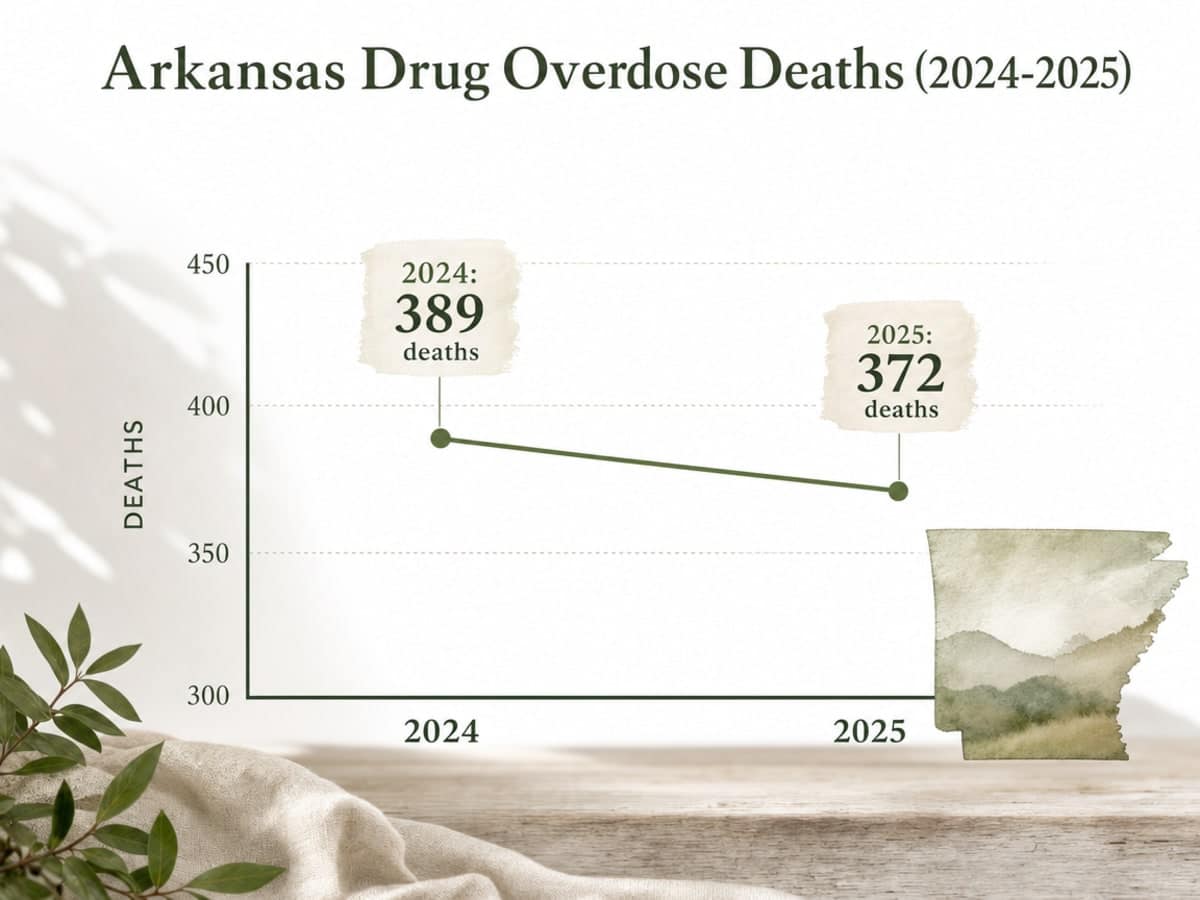
Provisional data from the Arkansas Department of Health Vital Statistics show 372 drug overdose deaths in Arkansas in 2025, down from 389 in 2024 1. The direction is the right one. The absolute number is still a room full of people who did not make it to a treatment center, or made it and didn’t get the level of care they actually needed. That is the environment you’re making a decision inside.
For a professional reader in Little Rock, the local context matters in a specific way. Pulaski County is where the state’s clinical resources concentrate — hospital systems, licensed residential programs, psychiatric coverage, and the specialty providers who staff dual-diagnosis care. That density is a real advantage. It also means the range of quality between two facilities on the same interstate exit is wider than it looks from the outside. A DHS license opens a door in Arkansas; a rigorous clinical model behind that door is a separate question, and the one you’ve been reading this article to answer.
Keep the rubric in mind. The state’s overdose trend is moving, slowly, in the right direction because more men are getting into the right level of care, not just any bed with a license attached to it.
A Working Diligence Checklist Before You Call
Pull everything above into a script. Here’s what to ask, in order, before you spend an hour on an admissions call.
- On credentials. Are you licensed by Arkansas DHS specifically for residential SUD treatment, and separately for Substance Abuse Detoxification 8? Who is your clinical accreditor — CARF, The Joint Commission, or COA — and when was your last survey 9? Are you LegitScript certified?
- On level of care. Which ASAM level does your residential track operate at, and is your detox 3.7-capable 10? How do you decide when a client steps down?
- On staffing. Who is on-site weekdays, weekends, and overnight? Do you have a psychiatric provider on staff, and are your clinicians credentialed in a specific trauma-focused modality? How does staffing scale at full census versus half 11?
- On census. What’s your maximum, and how many clients are in-house right now?
- On continuing care. When does aftercare planning start, do you run your own alumni group, and how is step-down to IOP handled — internally or by referral 6?
If a facility can’t answer these in one call, keep looking. The right program treats these as the first questions, not the ones you have to pry loose.
How Serenity Park Measures Against the Rubric
Now apply the checklist to this facility, the same way you’d apply it to any other.
On credentials: Serenity Park carries Arkansas DHS licensure for residential substance use treatment and for Substance Abuse Detoxification 8, CARF accreditation as the third-party clinical verification 9, and LegitScript certification on the marketing-integrity side. All three, verifiable.
On level of care: the residential track operates at ASAM Level 3.5, with medically supervised detox delivered on-site at 3.7 acuity 10. A client moves through withdrawal and into structured residential work without changing buildings, teams, or medical records.
On staffing and census: an interdisciplinary team — physician oversight, psychiatric care, licensed clinicians, nursing coverage, case management — built around a maximum of 20 men. Staffing scales with that ceiling 11, which is the point of the ceiling.
On continuing care: aftercare planning starts during treatment, and the alumni structure and continuing care group are run by the facility, not outsourced 6.
That’s the rubric. If another Little Rock program meets it, that’s a legitimate option. If Serenity Park is the one that does, you know why.
Frequently Asked Questions
What’s the difference between DHS licensure and CARF accreditation in Arkansas?
DHS licensure is the legal minimum. Every non-federal residential SUD program in Arkansas must hold it to operate 9. CARF accreditation is a separate, voluntary third-party audit of the clinical program itself — staff credentialing, treatment planning, outcomes measurement — and it’s the actual quality signal 7. Every legal facility is licensed. Only some are accredited.
Is medically supervised detox available at residential treatment centers in Little Rock?
Yes, but only at facilities specifically licensed by DHS as Substance Abuse Detoxification providers 8. Detox is defined narrowly as clinical intervention for acute intoxication and withdrawal, and it has to happen in a licensed detox setting or inpatient hospital. Ask directly whether a facility carries that specific licensure category and whether detox is delivered on-site with physician oversight.
What ASAM level of care should I look for in a residential program?
For structured residential treatment, ASAM Level 3.5 — clinically managed high-intensity residential — is the standard. If medically supervised detox is part of what you need, the facility should also handle Level 3.7. Arkansas hospital services rules define residential SUD units as ASAM-based 10, so a credible program will name its level without hedging.
How do I know if a facility can actually treat co-occurring mental health conditions?
Co-occurring mental illness and substance use are common enough that integrated care is table stakes, not a specialty 5. Ask three things: is there a psychiatric provider on staff who can evaluate and prescribe, are clinicians credentialed in a specific trauma-focused modality, and is dual-diagnosis work built into the same daily schedule as substance use treatment or run as a separate track?
Why does census size matter when evaluating a residential treatment center?
Census governs attention. A 20-bed program and a 60-bed program can carry identical licenses and accreditations, but the clinical hours available per client are not identical. Smaller census means longer individual sessions, treatment plans revisited more often, and earlier detection of changes in sleep, appetite, or group participation. Ask for the maximum census and how staffing scales at full capacity.
What questions should I ask about continuing care before admission?
Residential treatment is most effective when followed by continuing care 6, so treat aftercare as a first-tier question. Ask when the aftercare plan gets built — during treatment or in the final week. Ask whether the facility runs its own continuing care group and alumni structure or hands out a referral list. Ask how step-down to IOP actually works.
References
- Substance Misuse Education and Prevention – Arkansas Department of Health. https://healthy.arkansas.gov/programs-services/prevention-healthy-living/substance-misuse-education-and-prevention/
- Vital Statistics – Arkansas Department of Health. https://healthy.arkansas.gov/programs-services/data-statistics/vital-statistics/
- CDC Drug Overdose Deaths: National, State, and County Data. https://www.cdc.gov/drugoverdose/fatal/dashboard/index.html
- Preventing Adverse Childhood Experiences (ACEs): Leveraging the Best Available Evidence. https://www.cdc.gov/violenceprevention/aces/fastfact.html
- Statistics: Mental Illness. https://www.nimh.nih.gov/health/statistics/mental-illness
- The Effectiveness of Residential Treatment for Substance Use Disorders: A Review. https://www.ncbi.nlm.nih.gov/pmc/articles/PMC6761952/
- Licensure Standards for Alcohol and Other Drug Abuse Treatment Programs. https://humanservices.arkansas.gov/wp-content/uploads/Licensure_Standards_for_Alcohol_and_Other_Drug_Abuse_Treatment_Programs.pdf
- Counseling Services Section II (Arkansas Medicaid Manual). https://humanservices.arkansas.gov/wp-content/uploads/CNSLSERV_II.doc
- Arkansas Summary — State Residential Treatment for Behavioral Health Conditions. https://aspe.hhs.gov/sites/default/files/2021-08/StateBHCond-Arkansas.pdf
- Hospital Services Section II (includes Residential Rehabilitation Services to Treat Substance Use Disorders). https://humanservices.arkansas.gov/wp-content/uploads/HOSPITAL_II.docx
- Federal Guidelines for Opioid Treatment Programs. https://library.samhsa.gov/sites/default/files/federal-guidelines-opioid-treatment-pep24-02-011.pdf