
Drug Addiction Treatment in Little Rock, AR
Key Takeaways
- Arkansas licenses residential treatment under strict standards covering 28 weekly structured hours, written aftercare plans, and 42 CFR Part 2 confidentiality, so a Little Rock program is not clinically inferior to out-of-state options 1.
- Methamphetamine drove 40.9% of Arkansas treatment discharges in 2022, so programs built around opioid replacement protocols are a poor fit; ask specifically how a facility handles stimulant detox and the day-seven mood drop 5.
- Staying local keeps the same therapist, psychiatrist, family sessions, and continuing care group intact after discharge, while out-of-state plans often collapse into video calls and generic hotline lists at handoff.
- Before signing, request a sample weekly schedule with times, named outpatient and psychiatric providers already booked for discharge, and confirmation that a spouse or parent can attend in-person family sessions more than once.
Why staying close to home is a clinical decision, not a compromise
If you’re reading this at 2 a.m. with a coffee going cold, or scrolling on your phone while someone you love sleeps in the next room, you already know the hard part: something has to change. What you may not know yet is that leaving Arkansas to get that change is not the stronger move. It often makes recovery harder to hold onto.
The reflex to send a son, a husband, or yourself out of state usually comes from a good place. You want distance from the people, bars, and text threads that keep pulling him back in. That instinct is not wrong. But distance is not the same as clinical quality, and it is not the same as recovery that lasts past discharge day.
Arkansas licenses residential treatment under a detailed set of rules that spell out staffing, detox monitoring, confidentiality, and what has to happen before someone walks out the door on day 30 or 45 1. A program in Little Rock that meets those standards is not a step down from a facility in Malibu or Nashville. It is a program held to the same kind of framework, in the state where your family actually lives.
That matters because the work does not end at discharge. It moves to a Tuesday-night group, a psychiatrist appointment, a sponsor across town, a wife who can drive to family therapy without booking a flight. Staying close is not settling. It is choosing the version of recovery that has a fighting chance the week after treatment ends.
What addiction actually looks like in Arkansas right now
Most rehab websites you land on read like they were written for someone in Ohio or California. The photos change, the city name changes, and the assumptions stay the same: this is an opioid story. In Arkansas, that assumption is wrong, and it matters for how you pick a program.
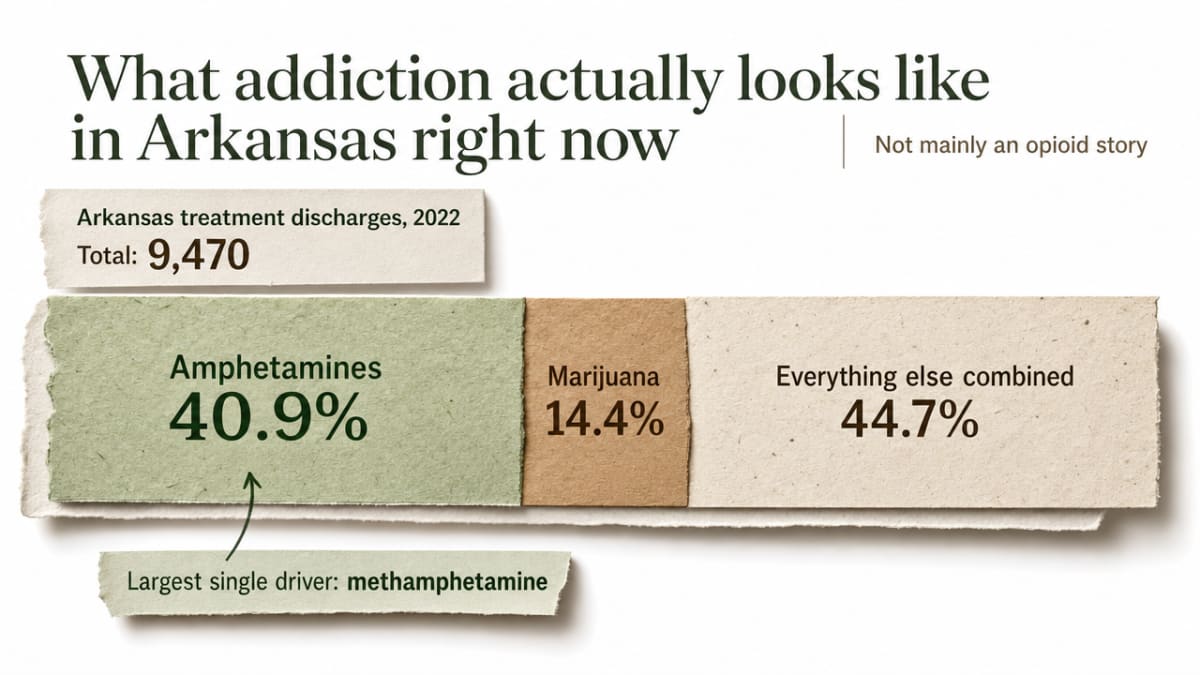
The 2022 SAMHSA Treatment Episode discharge data for Arkansas tells a different story than the national headline. Out of 9,470 treatment discharges that year, amphetamines were the primary substance in 40.9% of cases. Marijuana came in at 14.4%. Everything else combined — alcohol, opioids, cocaine, sedatives — made up the remaining 44.7% 5. Methamphetamine is not a side note here. It is the largest single driver of people walking through treatment doors.
That changes what good care looks like. A program built primarily around opioid replacement therapy is not going to serve a man whose main problem is meth. There is no buprenorphine equivalent for stimulant use. What works is a longer runway of structured days, sleep restoration, psychiatric evaluation for the paranoia and depression that follow heavy use, and behavioral therapy that holds up after the acute crash passes.
None of this means opioids are absent. Fentanyl is very much in the Arkansas supply, and the state now runs a public opioid dashboard tracking deaths, overdoses, arrests, and prescriptions in near real time 3. But if you are choosing a Little Rock program for your husband or your son, ask directly how they handle stimulant use disorder. Ask what the first ten days look like when meth is the primary substance. If the answer sounds identical to their opioid protocol, keep looking.
The addiction on the ground here does not match the one on the national brochure. Your program should know that.
The state’s overdose trajectory and what it changes for families
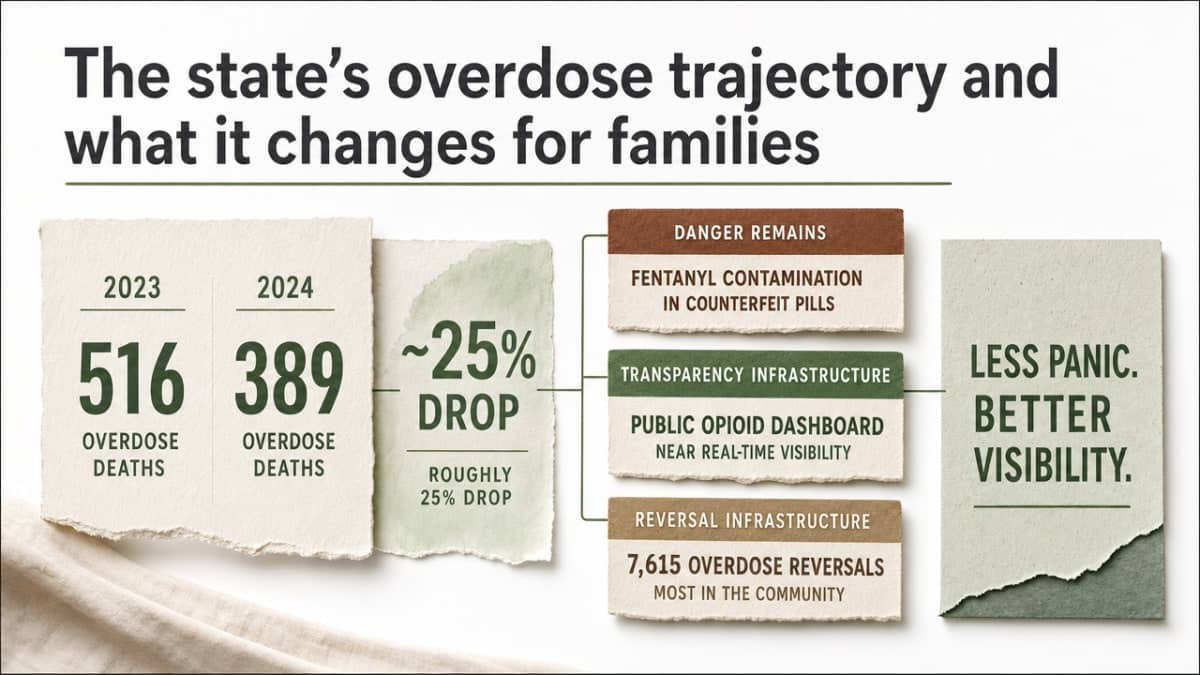
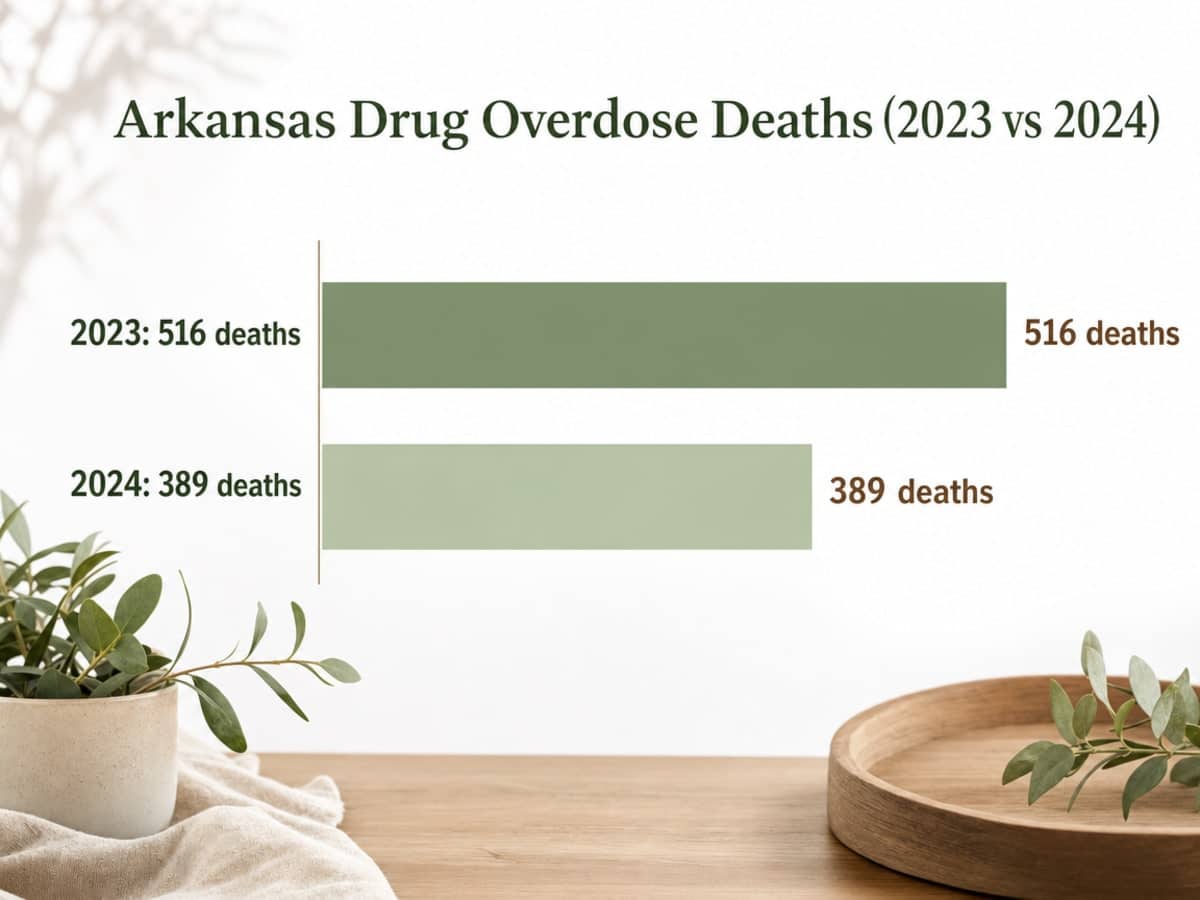
There is a real piece of good news in the Arkansas data, and you deserve to hear it before we keep going. In 2024, the state recorded 389 drug overdose deaths, down from 516 the year before 2. That is roughly a 25% drop in a single year. If you have been watching this crisis from your kitchen table for a decade, that number matters.
It does not mean the danger is gone. Fentanyl contamination is still showing up in pills sold as something else, and the state now runs a public opioid dashboard specifically so families, clinicians, and law enforcement can see what is happening in near real time instead of finding out at a funeral 3. The infrastructure around reversal has grown alongside that transparency. Statewide, the SOR III grant period logged 7,615 overdose reversals, most of them in the community, not in hospitals 10. That is thousands of people who got another chance because someone nearby had naloxone and knew what to do.
Here is what the trajectory changes for your family. Two years ago, sending a son to a program 1,200 miles away might have felt like the only defensible choice. Today, the state has more reversal coverage, more public data, and a treatment system that responded to a genuine emergency. You are not choosing between a serious out-of-state facility and a resigned local one. You are choosing between two serious options, and one of them keeps you inside the same care network your loved one will need on the Wednesday after he comes home.
The numbers are moving in the right direction. Your decision does not have to be made in panic.
What a compliant residential program in Arkansas should include
When you tour a program or get someone on the phone, most of what you hear will sound reassuring. Every website talks about evidence-based care and compassionate staff. That language is not a filter. The Arkansas licensure standards are.
Three requirements in the DHS manual do more work than any brochure:
- A licensed residential program has to deliver at least 28 hours of structured treatment every week.
- The program must build a written aftercare plan before your loved one walks out the door, not scramble one together on discharge morning.
- Everything about his care is protected under 42 CFR Part 2, a federal confidentiality rule that is stricter than standard HIPAA and specifically shields substance use treatment records 1.
These are not aspirational goals. They are the floor a program has to meet to keep its license, backed by the state administrative rule that governs the whole framework 9.
Twenty-eight hours a week matters because it defines what “treatment” actually is. If a program’s schedule leans heavily on unstructured downtime, meals, and one group a day, the math does not add up. Real residential care fills the day: individual counseling, group therapy, psychiatric appointments, education blocks, family sessions, and clinical activity that a therapist signs off on. Ask to see a sample weekly schedule. Count the hours.
The aftercare requirement is where a lot of out-of-state programs quietly fall apart. A discharge plan written in Malibu for a man returning to Pulaski County is often a list of national hotlines and a generic AA meeting search. A Little Rock program building the same plan should be naming his outpatient therapist, his psychiatrist appointment date, his sponsor’s first name, his continuing care group night, and who is picking him up. That is the standard the state expects 1.
Confidentiality under 42 CFR Part 2 protects him from having his treatment history disclosed to employers, family members, or courts without specific written consent. That is not a small thing when a man is running a business or holding a professional license. Ask directly how the program handles release-of-information forms and what gets shared with a spouse who calls the front desk.
How detox actually works when meth, not opioids, is the primary substance
If you have been through this before with an opioid, you may be expecting a certain rhythm: the medical assessment, the buprenorphine or methadone dose, the visible easing of withdrawal within a day or two. Meth detox does not follow that script, and knowing that up front will save you a lot of frustrated phone calls in the first week.
There is no FDA-approved medication that does for methamphetamine what buprenorphine does for opioids. The stimulant leaves the body, but the crash that follows is where the real work sits. In the first few days, expect deep sleep, sometimes 14 to 18 hours at a stretch, followed by heavy fatigue, low mood, anhedonia, and cravings that come in waves. Paranoia and depressive symptoms from chronic use often surface once the drug clears. This is uncomfortable, and it is not dangerous in the way opioid withdrawal can be, but it is exactly when people leave against medical advice if the environment is not built for it.
A well-run Arkansas detox for a man in this situation looks less like an ICU and more like a monitored recovery arc. Under state licensure, the program has to maintain clinical oversight, medication management for co-occurring symptoms, and psychiatric evaluation as part of the treatment framework 1. That is where the value shows up: a psychiatrist assessing whether the paranoia is substance-induced or a signal of an underlying condition, a nurse tracking sleep and vitals, and staff who understand that day four is often harder than day one. Some premium programs now supplement clinical checks with wearable monitoring that tracks heart rate, sleep, and stress trends through withdrawal, giving clinicians continuous data instead of a snapshot at rounds.
Ask any program you are considering how long their meth detox typically runs, what psychiatric coverage looks like in the first two weeks, and how they handle the day-seven mood drop. If they answer in specifics, you are in the right conversation.
Residential care, monitored days, and what a week inside looks like
Once detox settles, the day starts getting shape. That structure is the point. Idle time in early recovery is where the mind loops back to the same thoughts that got him here, so a good residential week is built to fill hours with work that adds up.
Arkansas licensure sets the floor at 28 hours of structured treatment per week 1. In practice, a well-run program pushes past that. A typical weekday inside a residential setting looks something like this:
- A morning check-in and community meeting
- An individual counseling session two or three times a week
- One or two group therapy blocks
- A psychiatric appointment on the days it is scheduled
- An education session on relapse cycles or family dynamics
- An afternoon block for physical activity, meditation, or a supervised outing
- Evenings often include a 12-step meeting on-site or a smaller peer group
Weekends slow down but do not empty out.
What changes week to week is the balance. Week one is heavy on medical stabilization, sleep, and getting a psychiatric baseline. Week two is where individual counseling starts to bite, because the drug has cleared enough for real conversation. By week three or four, family sessions and aftercare planning take up more of the schedule, and the program starts rehearsing what Tuesday nights back in Little Rock will look like.
Monitoring runs underneath all of it. Nurses track vitals and medication response. Clinicians document mood, sleep, and engagement. Some premium residential programs now layer in wearable devices that record heart rate, sleep stages, and stress markers continuously, giving the treatment team trend data between sessions instead of relying on how he says he slept. That kind of continuous read is useful when a man is not yet in the habit of naming what he feels.
Ask any program you tour for a real sample schedule with times on it. If the calendar has white space where treatment should be, the 28-hour standard is not being met, and the week you are paying for is not the week your loved one needs.
Aftercare, family involvement, and the naloxone conversation
Discharge day is not the finish line. It is the handoff. And how well that handoff is built, in the two or three weeks before he walks out, tells you more about a program than any tour ever will.
Arkansas licensure requires residential programs to write an aftercare plan before discharge, not on the way out the door 1. A real plan is specific. It names his outpatient therapist and the date of the first appointment. It names his psychiatrist and the medication refill schedule. It names his continuing care group night, his sponsor, his home group meeting, and who is picking him up from the facility. If the plan is a printed list of national hotlines, it is not a plan.
Family involvement is where staying local pays off in ways that are hard to describe until you live them. A wife who can drive to a Thursday family session, sit in the room, and hear the same language her husband is learning does not have to translate his recovery over the phone. A father who attends one education block about relapse cycles stops asking the wrong questions at Sunday dinner. Out of state, family therapy usually collapses into a video call that gets rescheduled twice. In Little Rock, it happens in person, and the same clinician who ran that session is still reachable the week after discharge.
Then there is the naloxone conversation, and you should have it before he comes home, even if his primary substance is not opioids. Fentanyl contamination has shown up in stimulants, counterfeit pressed pills, and drugs sold as something else entirely. Under the Arkansas standing order, any licensed pharmacist in the state can dispense naloxone to a person at risk or to a family member or friend who might witness an overdose, without a separate prescription 7. Statewide, more than 7,600 overdose reversals were logged during the SOR III grant period, most of them happening in the community rather than in an emergency room 10. Keep two doses in the house. Keep one in the car. Teach the people in his life how to use them. This is not a vote of no confidence in his recovery. It is the same reasoning that keeps a fire extinguisher under the kitchen sink.
Residential vs. outpatient vs. out-of-state: an honest comparison
You have three real options in front of you, and none of them is wrong for every situation. What matters is matching the option to the person, not to the marketing.
Outpatient care keeps him at home, working, and sleeping in his own bed. He drives to a clinic three to five days a week for group and individual sessions. This can work when withdrawal risk is low, the home environment is genuinely stable, and he has already had a period of sobriety. It falls apart quickly when meth or heavy alcohol use is active, because the same triggers that got him here are still in the driveway when he wakes up.
Residential care in Little Rock pulls him out of that environment for 30 to 90 days while keeping his family, his outpatient therapist, and his eventual home group inside driving distance. Arkansas licensure requires at least 28 hours of structured treatment weekly and a written aftercare plan before discharge 1, which means the handoff back to outpatient care is built into the program, not improvised. With 167 licensed substance abuse treatment facilities in the state as of the last federal survey 6, the local network he steps into after discharge is real, not theoretical.
Out-of-state residential care offers distance from the neighborhood and, sometimes, amenities that photograph well. What it does not offer is a therapist he can keep seeing on week five, a family session his wife can drive to, or a psychiatrist who is still reachable when the medication needs adjusting in October.
| Factor | Outpatient (local) | Residential (Little Rock) | Residential (out of state) |
|---|---|---|---|
| Environment change | None | Full, temporary | Full, temporary |
| Family involvement | High, informal | High, structured, in person | Low, mostly video |
| Aftercare continuity | Already local | Built with local providers 1 | Rebuilt at discharge |
| Best fit | Stable home, low withdrawal risk | Active use, prior attempts, family nearby | Safety threat at home, no local network |
The honest read: if home is stable and use is mild, start outpatient. If use is active or this is not your first attempt, residential in Little Rock gives him the environment change without severing the network he needs on the other side. Out-of-state makes sense in narrow cases, usually when staying in the city itself is the danger.
If this is your second or third try
You are not starting from zero. You are starting from experience, and that is not the same thing as failure.
About one in five men who enter a premium residential program in this region are on their second, third, or fourth attempt. That is not a shameful statistic. It is what the shape of this disease actually looks like. What matters now is treating the prior attempts as information, not evidence against you.
Sit down before intake and write out what happened last time. Which week did it fall apart? Consider:
- The transition home
- The first family conflict
- An untreated psychiatric symptom that no one caught
- A sponsor who moved
- A medication that got dropped
A good clinical team will ask you these questions. If they do not, ask them yourself and bring the answers in writing.
The Arkansas licensure framework builds a psychiatric evaluation and a written aftercare plan into every residential episode 1. On a second try, both of those matter more than they did the first time. If depression, ADHD, or trauma symptoms were never fully worked up before, that gap is often where the last attempt cracked. Name it early so the plan can account for it.
One more thing. The men who make it on the third try almost always say the same thing later: this time, they told the truth on day one.
Choosing a Little Rock program without getting sold to
By the time you are calling admissions lines, you have been pitched. Every program says evidence-based. Every program says family involvement. The language is close enough that you cannot tell them apart on a website.
Here is what to ask instead:
- Ask for a sample weekly schedule with times on it, and count whether the structured hours clear the 28-hour state floor 1.
- Ask how they handle methamphetamine detox in the first ten days, since that is the substance driving most Arkansas discharges 5.
- Ask who writes the aftercare plan and when it is finished.
- Ask for the name of the outpatient therapist and psychiatrist they will hand him off to, and whether those appointments are already on his calendar before discharge day.
Then ask a smaller question that tells you a lot: can his wife or his mother come in for a Thursday family session, in person, more than once? If the answer requires a flight, you have your answer about what kind of program it is.
Serenity Park Recovery Center is one of the Little Rock programs built around this framework. Whether you call here or somewhere else, ask the questions above before you sign anything.
Frequently Asked Questions
How long does residential drug addiction treatment in Little Rock typically last?
Most residential stays run 30 to 90 days, with the length driven by the substance, prior treatment history, and how detox goes in the first two weeks. A shorter stay can work for a stable client with mild use. Longer stays are common when methamphetamine or heavy alcohol is the primary substance, or when a psychiatric picture needs time to stabilize alongside sobriety.
What happens during detox if methamphetamine is the primary drug?
There is no FDA-approved medication for meth the way buprenorphine works for opioids. Expect heavy sleep early on, then several days of fatigue, low mood, and cravings that come in waves. A good Arkansas program pairs medical monitoring with psychiatric evaluation, since paranoia and depression often surface once the drug clears 1. Day seven is usually harder than day one.
Can my family visit and stay involved during treatment?
Yes, and staying local makes this real instead of theoretical. Most Little Rock residential programs schedule in-person family sessions, education blocks for spouses and parents, and structured visitation once the first week or two of stabilization passes. A wife who can drive to a Thursday session hears the same clinical language her husband is learning. That shared vocabulary matters after discharge.
Is staying in Little Rock better than going out of state for rehab?
For most families, yes. Arkansas licensure requires a written aftercare plan built before discharge 1, and that plan works better when it names local providers your loved one can actually keep seeing. Out-of-state care makes sense in narrow situations, usually when the home city itself is the safety threat. Otherwise, keeping his therapist, psychiatrist, and family in driving distance is the stronger clinical bet.
What should I ask a program to confirm it meets Arkansas licensure standards?
Ask for a sample weekly schedule and count structured hours against the 28-hour state minimum. Ask who writes the aftercare plan and when it is finalized. Ask how they handle 42 CFR Part 2 confidentiality and release-of-information forms 1. If a program cannot answer these plainly, the license may be current on paper but the practice underneath it is thin.
What if I’ve already been through treatment once or twice before?
You are not starting over. You are starting with information the first attempt did not have. Write down which week things fell apart last time, what the trigger was, and whether any psychiatric symptoms went unaddressed. Bring that to intake. A good clinical team treats prior attempts as data, and the aftercare plan built this time should specifically account for where the last one cracked.
References
- Licensure Standards for Alcohol and Other Drug Abuse Treatment Programs. https://humanservices.arkansas.gov/wp-content/uploads/Licensure_Standards_for_Alcohol_and_Other_Drug_Abuse_Treatment_Programs.pdf
- Substance Misuse Education and Prevention – Arkansas Department of Health. https://healthy.arkansas.gov/programs-services/prevention-healthy-living/substance-misuse-education-and-prevention/
- New Public Opioid Dashboard Serves as Tool to Shine Light on Epidemic. https://humanservices.arkansas.gov/news/new-public-opioid-dashboard-serves-as-tool-to-shine-light-on-epidemic/
- ARKANSAS – National Survey on Drug Use and Health – State Tables. https://www.samhsa.gov/data/sites/default/files/reports/rpt56188/2023-nsduh-sae-state-tables_0/2023-nsduh-sae-state-tabs-arkansas.pdf
- 2022 TEDS-D Arkansas. https://www.samhsa.gov/data/node/51427
- Arkansas: National Survey of Substance Abuse Treatment Services. https://www.samhsa.gov/data/sites/default/files/quick_statistics/state_profiles/NSSATS-AR19.pdf
- Arkansas Opioid Antagonist Protocol. https://healthy.arkansas.gov/wp-content/uploads/Naloxone_Standing_Order_Dr_Bala.pdf
- Consolidated Plan and Analysis of Impediments – City of Little Rock. https://www.littlerock.gov/media/8043/lr-public-meeting-input-presentation.pdf
- Part 433. Licensure Standards for Substance Abuse Treatment Programs. https://codeofarrules.arkansas.gov/Rules/Rule?levelType=part&titleID=20&chapterID=128&subChapterID=170&partID=666&subPartID=null§ionID=null
- Award Number: 5H79TI085733-02. https://humanservices.arkansas.gov/wp-content/uploads/SOR3-Closeout-Report-9.2024-1.pdf