
Key Takeaways
- Yoga and mindfulness are adjuncts, not replacements for medical detox, MAT, psychiatric care, and therapy, and they earn their place by targeting specific physiological and psychological patterns.
- Mindfulness reliably reduces craving intensity, withdrawal symptoms, and stress reactivity, but on its own it has not been shown to prevent relapse long-term 7, 8.
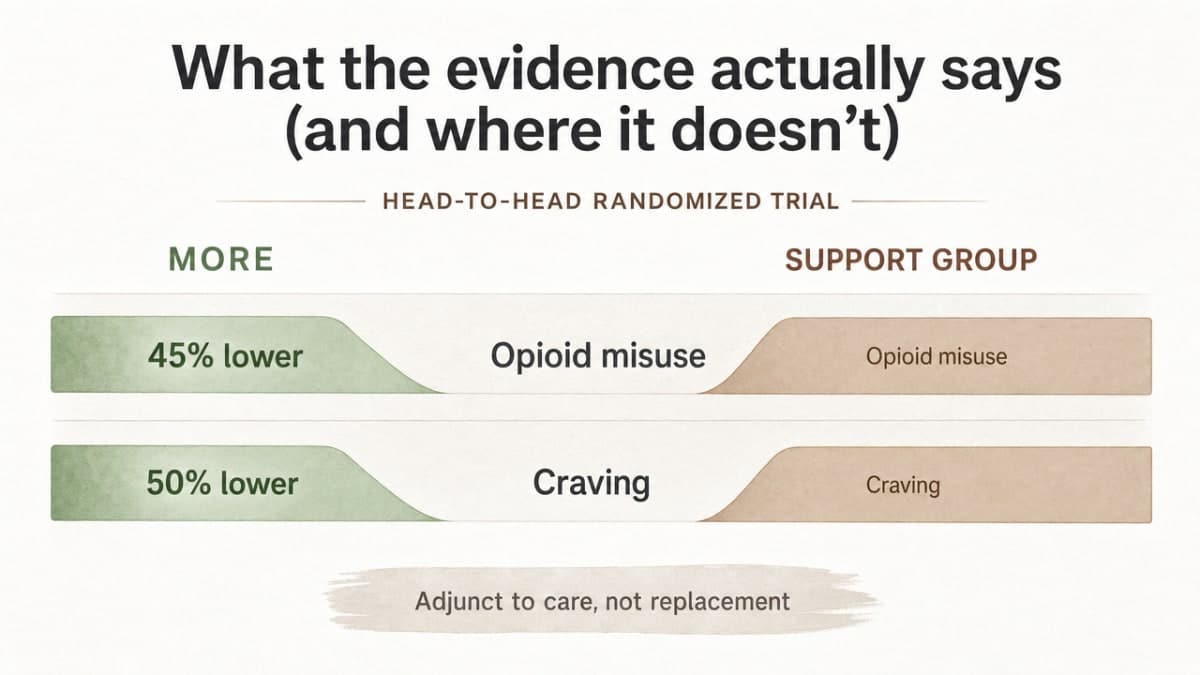
- Structured protocols like MORE show the strongest outcomes when integrated with clinical care, with 45.0% no longer misusing opioids at 9 months versus 24.4% in supportive therapy 13.
- The practices worth focusing on are the portable ones: box breathing, urge surfing, and body scans that travel back into a demanding calendar alongside ongoing aftercare.
You didn’t come here for incense
Let’s be straight with each other. If you’re reading this, you’re probably deciding whether to spend two, three, or four weeks of your life inside a residential program, or you’re weighing that call for someone you love. You want to know if the yoga mat in the schedule is real medicine or a soft-focus prop next to the actual clinical work.
Fair question. You run companies, cases, ORs, deals. You’ve read enough marketing copy to spot filler at a glance. So here’s the honest answer up front: yoga and mindfulness are not the treatment. Medical detox, medication-assisted treatment, psychiatric care, and clinical therapy are the treatment. Yoga and mindfulness are precision tools that sit alongside them, with a growing evidence base for what they actually do well, and clear limits on what they don’t.
What they do well is help you regulate the physical state your body has been stuck in for years. Cravings ease when you can breathe through the peak instead of white-knuckling it. Sleep starts to come back. The 2 p.m. cortisol spike before a hard meeting stops running the show. Those are measurable changes, and at Serenity Park we watch them show up in real time through Huml Health wearable data alongside your clinical care.
The rest of this piece walks through where the evidence is strong, where it’s mixed, and how these practices earn their place in a whole-person plan built for men like you.
What the evidence actually says (and where it doesn’t)
You want the receipts before you commit weeks of your life to anything. Here they are, without the varnish.
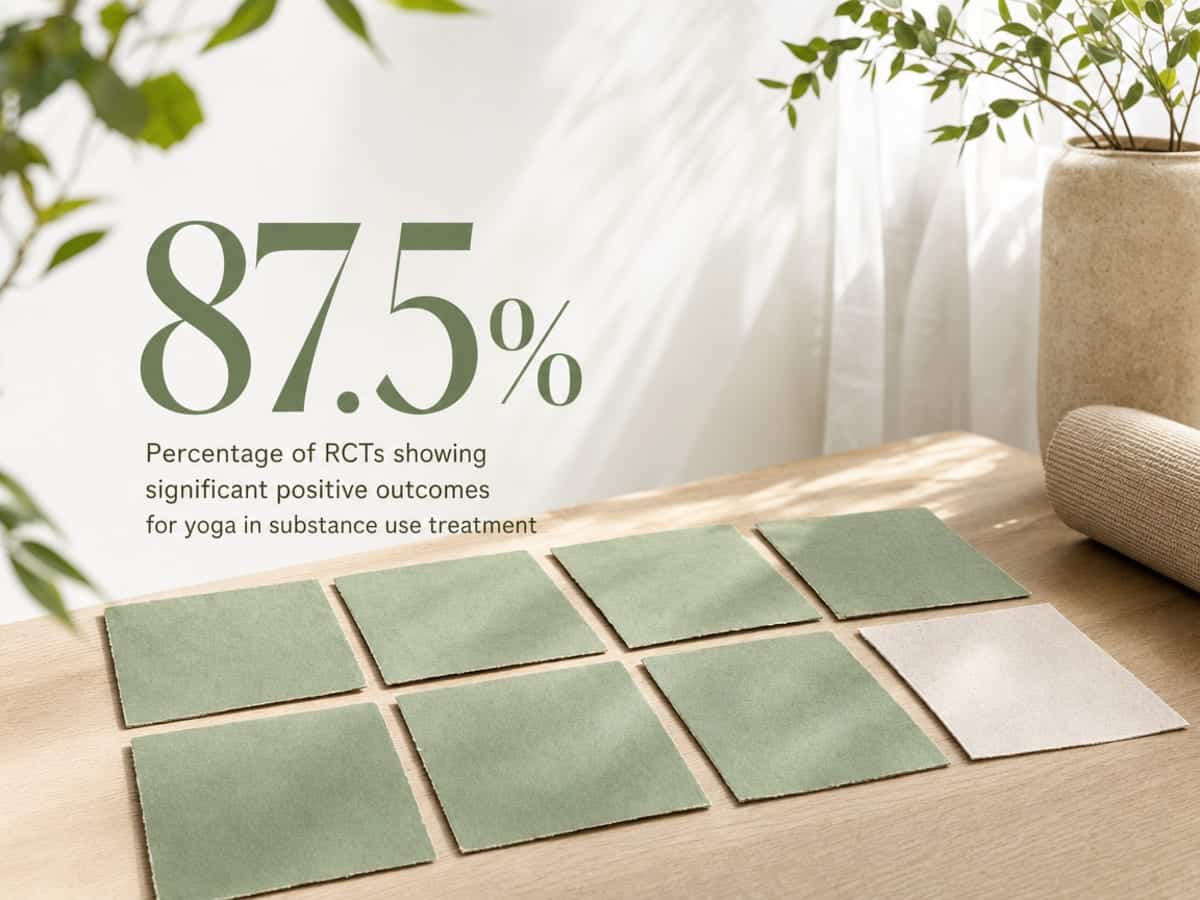
Start with yoga. A 2021 systematic review of randomized controlled trials on yoga for substance use found that 7 out of 8 trials showed significant improvements in primary outcomes like anxiety, pain, or substance use itself1. That’s a strong signal from a small library. The studies covered alcohol, tobacco, opioids, and mixed-substance samples, and yoga was tested as an adjunct to standard care, not a replacement for it. The reviewers were careful to note that trials were small and some had risk-of-bias concerns. So: real signal, honest caveats.
Mindfulness has a bigger evidence base and a more interesting story. A 2018 review of 37 studies covering 3,531 participants found that mindfulness-based interventions significantly reduced craving levels across substances4. NCCIH, which is not a wellness blog, puts it plainly: mindfulness-based approaches may help people reduce their use of alcohol, cigarettes, and opioids6. Craving is not a soft outcome. It’s the physiological event that puts a drink in your hand at 9 p.m. after a brutal Tuesday.
That’s the part most treatment brochures leave out. We’re saying it up front because the rest of what follows only makes sense once you know what these tools actually do and don’t do.
Where the evidence gets stronger is when mindfulness is combined with clinical structure. Mindfulness-Oriented Recovery Enhancement (MORE), a manualized program that integrates mindfulness with cognitive reappraisal and savoring skills, has produced meaningful outcomes in specific populations, particularly people managing opioid misuse alongside chronic pain. Newer trials from 2024 also show that mindfulness-based programs delivered inside inpatient settings improve readiness for change and self-efficacy in men with substance use disorders15. Those are the psychological building blocks that make the rest of a recovery plan stick.
The pattern across every credible source lines up the same way. Yoga and mindfulness earn their place when they’re used the way they were designed: as adjuncts inside a broader clinical plan, aimed at specific physiological and psychological targets, taught by people who know the protocol. Used that way, they help. Used as a substitute for medical care, they don’t. That distinction shapes how a serious residential program builds them into your day, which is what the next sections walk through.
Detox: using breath and movement when the nervous system is on fire
Day two or three of detox is the part nobody prepares you for. Your skin is wrong. Your legs won’t sit still. Sleep comes in ten-minute pieces. Your resting heart rate is running like you’re being chased. That’s not weakness. That’s your autonomic nervous system, which has been medicated into a particular rhythm for a long time, trying to find a new baseline without its usual chemical input.
This is where medical care carries the load. IV fluids, benzodiazepine tapers, MAT protocols, psychiatric assessment, vitals every few hours. At Serenity Park, that clinical spine is non-negotiable, and Huml Health wearables give the medical team a continuous read on heart rate, sleep patterns, and stress markers so the plan can move with your body instead of guessing at it.
Yoga and breath work show up inside that clinical envelope, not around it. A 2026 randomized clinical trial found that yoga significantly accelerated opioid withdrawal recovery and improved autonomic regulation, anxiety, sleep, and pain when added to standard withdrawal care3. Read that carefully. Not instead of. Added to. The mechanism is the part that matters for you: slow, structured breathing and simple postures give the parasympathetic branch of your nervous system a way in. Exhales longer than inhales. Diaphragm doing the work instead of the chest. Ninety seconds at a time.
What that looks like in practice on day three is not a group class. It’s a clinician or a trained instructor sitting next to you for a few minutes, walking you through a box-breath pattern while your hands stop shaking enough to hold a water bottle. It’s a supine posture with a bolster under your knees so your lower back stops screaming. It’s a body scan at 4 a.m. when sleep has bailed on you again, giving your attention something to hold besides the clock.
These are small interventions. They don’t replace the medication or the medical monitoring. What they do is shorten the distance between a symptom and a response you can actually deliver, at the exact moment your body most needs one.
Craving as a physical event, not a moral failure
Here’s the reframe that changes how you fight this. A craving is not a character verdict. It’s a physiological event with a shape, a peak, and a decay curve. It shows up in your body before it shows up in your reasoning, which is why willpower alone keeps losing the argument. You can’t out-think a sympathetic nervous system that’s already three seconds ahead of you.
Follow the arc. Something pulls the trigger: a smell in an airport terminal, a Slack message from the client who used to be your Friday drinking partner, the specific tone your CFO uses when a quarter goes sideways. Your sympathetic branch fires. Heart rate climbs, breath goes shallow and high in the chest, palms get damp, attention narrows onto the object of the craving. The urge builds toward a peak, usually within a few minutes. Then, if nothing feeds it, it decays. That decay is the part active addiction taught you not to trust. You reached for the drink or the pill before the wave crested, every time, for years. Your body has no evidence that the wave breaks on its own.
Mindfulness training is where you gather that evidence. The NCCIH synthesis of the research puts it clearly: a 2018 review of 37 studies covering 3,531 participants found that mindfulness-based interventions significantly decreased craving levels across substances4. The mechanism isn’t mystical. You learn to notice the sympathetic spike as body data instead of destiny. You lengthen the exhale, which pulls the parasympathetic brake. You run a body scan and locate where the craving actually lives: throat, chest, gut. And you watch it move.
A pilot RCT in alcohol-dependent adults showed the same pattern at the physiological level. Mindfulness training significantly reduced stress and thought suppression, and improved autonomic recovery after alcohol cues12. Thought suppression matters here. Trying not to think about a drink is a losing strategy, and the research reflects that. What works is a different move: notice the urge, name it, breathe through it, let the curve do what curves do.
This is what urge surfing looks like in a real week. You feel the pull start at 6:47 p.m. on a Thursday. You put a hand on your sternum. You breathe out for six seconds. You scan from jaw to shoulders to gut and describe what you find, in your head, in specific words. You wait. Ninety seconds later, the peak has moved. Three minutes later, it’s decaying. You didn’t defeat it. You outlasted it, and now you have proof that it ends without you feeding it.
At Serenity Park, the Huml Health wearable makes that arc visible. Your clinicians can see heart rate climb and recover around specific moments in your day, which means the practice you did at 6:47 has a data trail. You stop taking cravings personally. You start reading them like weather.
Stress physiology: what mindfulness does to a body that has been running hot for years
Your body has been operating at a stress setpoint that would concern any cardiologist looking at the raw data. Years of alcohol or opioids or stimulants trained your hypothalamic-pituitary-adrenal axis to run one way: cortisol up, sympathetic tone up, recovery slow. Add a decade of career pressure on top of it, sleep debt from red-eyes and 6 a.m. calls, the quiet dread of a Monday inbox, and you’ve built a body that treats baseline as an emergency. The substance was never the cause of that emergency. It was the tool you found to knock the volume down for a few hours.
Take away the tool without addressing the underlying physiology and you’re left with a nervous system that still runs hot and no reliable way to bring it back to earth. This is where the stress-substance loop lives. Decades of research show stress reliably exacerbates substance use, and mindfulness-based interventions appear to work in part by interrupting that loop through stress-reductive effects10. You don’t need to believe in anything to use them. You need a mechanism that pulls the parasympathetic brake when your sympathetic system is flooring the accelerator.
The pilot RCT in alcohol-dependent adults gave one of the cleaner mechanistic reads on this. Mindfulness training significantly reduced stress and thought suppression, and improved physiological recovery from alcohol cues12. Physiological recovery is the metric that matters. It’s how fast your heart rate returns to baseline after a spike. It’s whether your body drops out of fight-or-flight in three minutes or thirty. Trained, that recovery gets faster. Untrained, it stays slow, and every Sunday-night dread costs you more than it should.
At Serenity Park, the Huml Health wearable turns that abstract physiology into something you can watch. Heart rate variability across a week of practice. Sleep architecture as breath work becomes automatic. Stress markers around specific parts of your day. You stop guessing whether the work is working. You have a data trail that shows a body slowly learning how to stand down.
Relapse prevention: MBRP, MORE, and what a real protocol looks like
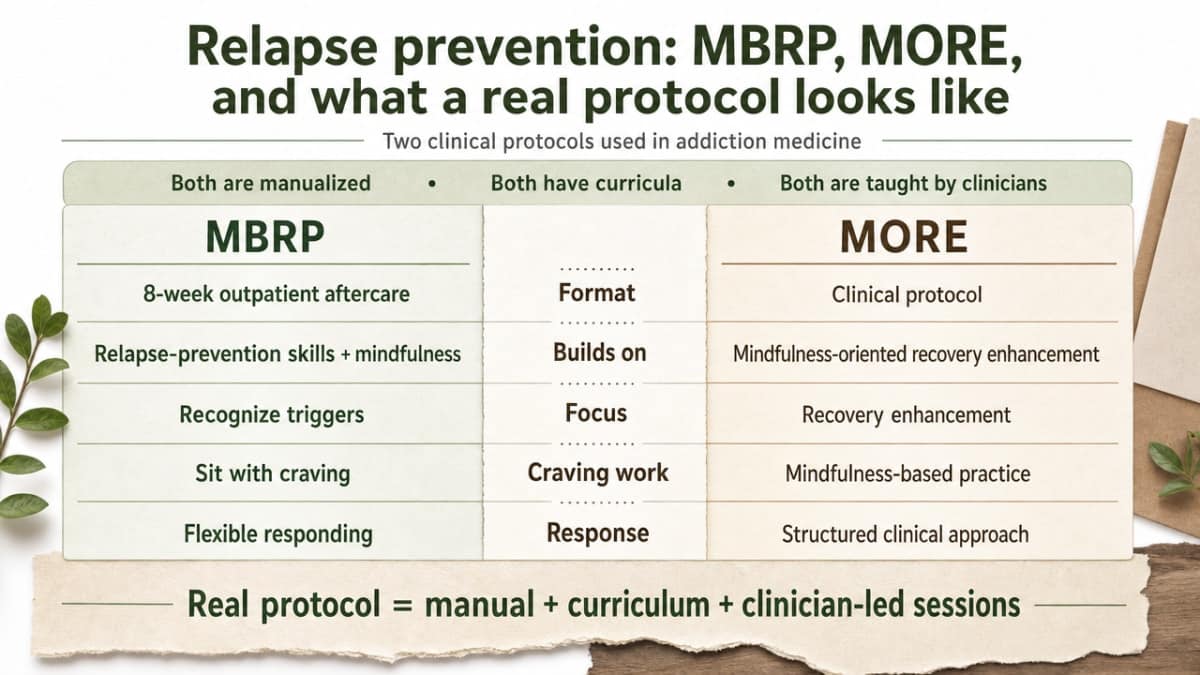
You’ve probably heard the word “mindfulness” used to sell everything from meal delivery to leadership retreats. In addiction medicine, it has a much narrower and more useful meaning. Two protocols do most of the clinical work: Mindfulness-Based Relapse Prevention (MBRP) and Mindfulness-Oriented Recovery Enhancement (MORE). Both have manuals. Both have curricula. Both are taught by clinicians, not influencers.
MBRP was built as an 8-week outpatient aftercare program that fuses traditional relapse-prevention skills with formal mindfulness practice11. Each session has a job. You learn to recognize the specific triggers that pull you toward use. You learn to sit with a craving without either suppressing it or feeding it. You practice flexible responding, which is the clinical way of saying: when the urge hits, you have more than one move available. Homework is a real part of it. Daily practice, journaling, structured exercises between sessions.
MORE takes a different angle. It layers mindfulness with two additional skills: cognitive reappraisal, where you rework the meaning you attach to stressors, and savoring, where you retrain your brain to register natural rewards it stopped noticing years ago. That savoring piece matters more than it sounds. Long-term substance use blunts the reward system’s response to ordinary good things: a solid workout, your kid’s laugh, a well-run meeting. MORE actively rebuilds that.
The strongest outcome data for a mindfulness-based protocol in addiction comes from a randomized trial of MORE in a primary care population managing co-occurring opioid misuse and chronic pain. At 9 months, 45.0% of participants receiving MORE were no longer misusing opioids, compared with 24.4% in supportive group psychotherapy13. That’s roughly double, in a comparison against real therapy, not a waitlist. Read the scope carefully: this was a specific population, adults with both opioid misuse and chronic pain, treated inside primary care. Don’t stretch the number past what it measured. Do notice what it shows when a structured mindfulness protocol goes head-to-head with another active treatment.
MBRP’s story is more mixed, and this is where the earlier honesty pays off. It reliably helps with the components of relapse, particularly craving intensity, withdrawal symptoms, and the negative consequences of use when a slip occurs8. It has not consistently outperformed comparators on relapse itself in the largest reviews7. That doesn’t make it useless. It makes it a component, not a cure. It gives you a set of skills for the moments that precede a relapse, which is exactly where a whole-person plan needs coverage.
A recent 2024 randomized trial reinforced the mechanism side of this in an inpatient male sample. Men who received a mindfulness-based relapse prevention program showed significant improvement in mindfulness, readiness for change, and self-efficacy15. Those are the psychological ingredients that determine whether you actually use the skills you were taught once you’re back in your calendar.
At Serenity Park, protocols like these run in the same week as your medical care, your psychiatric appointments, your individual counseling, and your 12-step work. Not stacked as separate silos. Integrated. The mindfulness practice you built on a Tuesday afternoon becomes something your clinician can reference on a Wednesday morning when a hard conversation with your family surfaces something old. That’s the shape a real relapse-prevention plan takes.
Inside a residential day: how yoga and mindfulness slot next to medical care
A typical day at Serenity Park is not built around the mat. It’s built around your medical and clinical care, with mindfulness and yoga threaded in at the moments they do the most work.
Morning starts with vitals and a quick clinical check-in. Your Huml Health wearable has been logging heart rate, sleep, and stress markers overnight, so the medical team already knows whether you slept in three-hour blocks or forty-minute fragments. That data shapes the day. If your autonomic system is still running hot from detox, the schedule leans on longer breath work and supine, restorative postures rather than anything demanding3. If you’re further along and stable, movement gets a little more active.
Mid-morning is clinical: individual counseling, psychiatric appointments, medication management. Group therapy and 12-step work follow. Somewhere in that block, a 20 to 30 minute mindfulness session sits down next to the rest of it, not as a break from treatment but as a rehearsal for what you just talked about in counseling. If your session surfaced an old trigger, the practice that afternoon is where you feel that trigger move through your body and learn what to do with it.
Yoga runs a few times a week, in small groups of men, taught with clinical language rather than studio language. Postures are chosen for what they do to your nervous system, not how they look. Evening tends to close with a shorter body scan or breath practice, timed to help sleep architecture rebuild.
The point is integration. What you learn on the mat at 2 p.m. is the same skill your counselor references at 9 a.m. the next morning, and the wearable data lets your team see whether it’s landing. That’s what a whole-person plan actually looks like from the inside.
Portable skills for the calendar you go back to
The work you do inside a residential program only matters if it travels. Your calendar is not going to soften when you get home. The board still meets. The deposition still lands. The client dinner still shows up on the Thursday you were hoping to skip.
What you take with you is a small kit of practices, each with a specific job. A four-minute box-breath protocol before you walk into a hard room. Inhale four, hold four, exhale six, hold four. Two rounds and your heart rate has already started coming down. It fits between the elevator and the conference room door.
A 90-second urge surf when the old pull shows up at an airport bar or a 9 p.m. Tuesday. Hand on sternum, longer exhale than inhale, name where the craving lives in your body, watch it move. You already have the evidence from your weeks of practice that the wave breaks.
A body scan on the red-eye when sleep won’t come. A short seated practice on Sunday nights, before the dread has a chance to settle in. A grounded posture sequence you can run in a hotel room in ten minutes without anyone knowing what you’re doing.
These are not lifestyle upgrades. They are the specific skills mindfulness-based protocols are designed to build: awareness of triggers and flexible responding under pressure11. Paired with your ongoing clinical care and aftercare plan, they give you a way to meet a hard moment with something other than the old move.
At Serenity Park, that portability is the point. The whole-person plan you build here, medical care, psychiatric support, counseling, 12-step work, yoga, and meditation, is designed to leave with you. The wearable data keeps a thread to your care team after you go. The practices stay in your body. Your career, your relationships, and your name are still yours. The tools you learned here are how you keep them.
Frequently Asked Questions
Is yoga in addiction treatment just a wellness trend, or is there real clinical evidence?
There’s a legitimate evidence base, and it’s smaller than a marketing brochure suggests but stronger than a skeptic might assume. Systematic reviews of randomized controlled trials on yoga for substance use consistently show favorable results when yoga is used as an adjunct to standard care, not as a replacement for it1. The honest read: yoga helps with anxiety, pain, sleep, and autonomic regulation. It is not a stand-alone cure. Used correctly inside a clinical program, it earns its place.
Can mindfulness actually prevent relapse on its own?
Not on its own, and any program telling you otherwise is overselling. The largest reviews of Mindfulness-Based Relapse Prevention have not shown that it consistently outperforms other treatments at preventing relapse itself7. What mindfulness does reliably improve is craving intensity, withdrawal symptoms, and the negative consequences when a slip happens8. That’s meaningful. It means mindfulness is a component of a relapse-prevention plan, working alongside medical care, therapy, and MAT, not a substitute for any of them.
How do yoga and mindfulness fit alongside medical detox and medication-assisted treatment?
Medical care carries the load. IV fluids, benzodiazepine tapers, MAT protocols, psychiatric monitoring, and vitals are the spine of detox. Yoga and mindfulness thread in around that clinical work at specific moments they help most: a breath protocol when your heart rate is running hot, a supine posture when your back won’t settle, a body scan when sleep bails at 4 a.m. A recent trial found yoga accelerated opioid withdrawal recovery and improved autonomic regulation when added to standard care3.
What’s the difference between MBRP and MORE?
MBRP is an 8-week manualized program that combines traditional relapse-prevention skills with mindfulness practice, focused on trigger awareness and flexible responding to craving11. MORE layers mindfulness with two additional skills: cognitive reappraisal, where you rework the meaning you attach to stressors, and savoring, which rebuilds your reward response to ordinary good things. In a primary care trial with co-occurring opioid misuse and chronic pain, 45.0% receiving MORE were no longer misusing opioids at 9 months versus 24.4% in supportive therapy13.
Will I have to do group yoga classes if I’m not into that?
No one is going to force you into a room full of sun salutations. Yoga at Serenity Park is taught in small groups of men using clinical language, with postures chosen for what they do to your nervous system rather than how they look. Individual work is available. Breath protocols and body scans can be practiced privately in your room. The goal is a skill you’ll actually use at 11 p.m. on a Tuesday, not a class attendance record.
How do I actually use these skills back at work after treatment?
You use them the same way you’d use any tool: in short, specific moments where they earn their keep. A four-minute box-breath protocol before you walk into a hard meeting. A 90-second urge surf when the old pull hits at an airport bar. A body scan on a red-eye. These are the exact skills mindfulness-based protocols are designed to build: awareness of triggers and flexible responding under pressure11. Paired with your aftercare plan, they travel with you into your calendar.
References
- Yoga for Substance Use: A Systematic Review. https://pubmed.ncbi.nlm.nih.gov/34535521/
- Yoga for Substance Use Disorder in Women: A Systematic Review. https://pubmed.ncbi.nlm.nih.gov/33201991/
- Yoga for Opioid Withdrawal and Autonomic Regulation: A Randomized Clinical Trial. https://pubmed.ncbi.nlm.nih.gov/41499110/
- Meditation and Mindfulness: Effectiveness and Safety. https://www.nccih.nih.gov/health/meditation-and-mindfulness-effectiveness-and-safety
- Mind and Body Approaches for Substance Use Disorders. https://www.nccih.nih.gov/health/providers/digest/mind-and-body-approaches-for-substance-use-disorders-science
- 6 Things To Know About Psychological and Physical Approaches for Substance Use Disorders. https://www.nccih.nih.gov/health/tips/things-to-know-about-mind-and-body-approaches-for-substance-use-disorders
- Mindfulness-Based Relapse Prevention for Substance Use Disorders. https://www.rand.org/pubs/research_reports/RR1031.html
- Mindfulness-based Relapse Prevention for Substance Use Disorders. https://pubmed.ncbi.nlm.nih.gov/28727663/
- Effectiveness of Mindfulness-Based Relapse Prevention in Substance Use Disorders: A Systematic Review. https://pmc.ncbi.nlm.nih.gov/articles/PMC8533446/
- Mindfulness meditation in the treatment of substance use disorders: A systematic review and meta-analysis. https://pmc.ncbi.nlm.nih.gov/articles/PMC6247953/
- Mindfulness-Based Treatment to Prevent Addictive Behavior Relapse. https://pmc.ncbi.nlm.nih.gov/articles/PMC5441879/
- Mindfulness training modifies cognitive, affective, and physiological mechanisms implicated in alcohol dependence: Results of a randomized controlled pilot trial. https://pmc.ncbi.nlm.nih.gov/articles/PMC2921532/
- Mindfulness-Oriented Recovery Enhancement vs Supportive Group Therapy for Co-occurring Opioid Misuse and Chronic Pain in Primary Care: A Randomized Clinical Trial. https://www.jamanetwork.com/journals/jamainternalmedicine/fullarticle/2789279
- Telehealth Mindfulness-Oriented Recovery Enhancement vs Usual Care Among People With Opioid Use Disorder and Pain. https://pubmed.ncbi.nlm.nih.gov/38061786/
- Effect of applying mindfulness-based relapse prevention nursing program on readiness for change and self-efficacy among clients with substance use disorders: A randomized control trial. https://pubmed.ncbi.nlm.nih.gov/39615922/