
Key Takeaways
- Same-day admission in Arkansas is legitimate when a program runs the phone assessment, insurance verification, and bed hold on the initial call, with SAMHSA guidance permitting immediate MOUD initiation after screening 1.
- Starting clinical action the same day roughly doubles 30-day treatment engagement compared to referral-only approaches, making speed a clinical variable rather than a convenience 11.
- Arkansas MOUD access is uneven across rural counties, so calling a Little Rock program directly is often faster than routing through a local catchment provider 9.
- Insurance verification, FMLA paperwork, licensing board concerns, and transportation from outside Little Rock are logistics a responsive admissions coordinator handles during the same first call.
You’re Deciding Whether to Make the Call Today
You’ve probably already told yourself you’ll handle it after the deposition, after the quarter closes, after the wedding, after the next negative test. That deadline keeps moving. It’s been moving for a while now.
You already know what today looks like if nothing changes. You know how the evening goes. You know what you’ll tell your spouse, or what you won’t. You know the exact drawer or the exact bottle or the exact hour.
So the real question isn’t whether you need treatment. The question is whether same-day admission to a rehab in Arkansas is actually a thing, or whether it’s marketing language dressed up to sound urgent. That’s a fair question, and it deserves a straight answer.
Here’s the honest version. Same-day admission is real, and federal SAMHSA guidance already allows medication for opioid use disorder to be started immediately once a screening exam confirms eligibility and no contraindications 1. Responsive programs can compress the phone assessment, insurance verification, medical clearance, and bed hold into hours instead of days. Not always. Not for every case. But often enough that calling right now is a legitimate move, not a naive one.
What follows is a plain walk-through of what that day actually looks like, where the friction usually shows up, and how a small, men-only program like Serenity Park in Little Rock handles the call when you make it. Read it. Then decide. You have more room to act today than you think you do.
What ‘Same-Day Admission’ Actually Means in Arkansas
Here’s where language gets slippery. “Same-day admission” can mean three different things depending on who’s saying it, and only one of them is what you actually want.
The honest baseline comes from a 2021 audit of 368 residential addiction programs across the United States. When researchers called those programs posing as someone seeking treatment for opioid use disorder, only 33% offered admission during the call itself. About 64% had a bed available the same day or the next day. The mean wait time was six days 7. That’s the national residential picture, not an Arkansas-specific number, but it tells you something important: a lot of programs use the phrase, and a smaller number actually deliver it.
So when you call a program in Arkansas today, one of three things is happening on the other end of the line.
One is what most people picture: you show up at the door within a few hours, hand over your insurance card, and sleep there tonight. That happens, but it depends on a bed being open at that exact moment and on medical clearance moving quickly.
Two is the more common reality at responsive programs, and it’s the version you should trust. Same-day clinical action starts the moment you call. A licensed clinician does a phone assessment. Admissions verifies your insurance. If you meet criteria for medication for opioid use disorder and there are no contraindications, federal SAMHSA guidance already permits starting that medication immediately after the screening exam 1. Physical arrival at the residential bed follows as soon as transportation, medical clearance, and the bed hold line up, which is usually the same day or the next morning.
Three is the version to walk away from. “We can get you in soon” with no assessment scheduled, no insurance conversation started, and no clear next step. That’s a lead being logged, not admission being arranged.
For a man in Arkansas ready right now, the useful definition is the middle one. Same-day means your care starts today, on the phone, with a real clinician and a real plan, and your bed opens as fast as the medical and financial pieces will allow. That’s what a small, men-only program like Serenity Park is built to do — 20 beds and a Little Rock location mean fewer moving parts and faster coordination than a 200-bed system that has to route your call through three departments.
Don’t accept vague. Do accept a plan you can hear taking shape while you’re still on the phone.
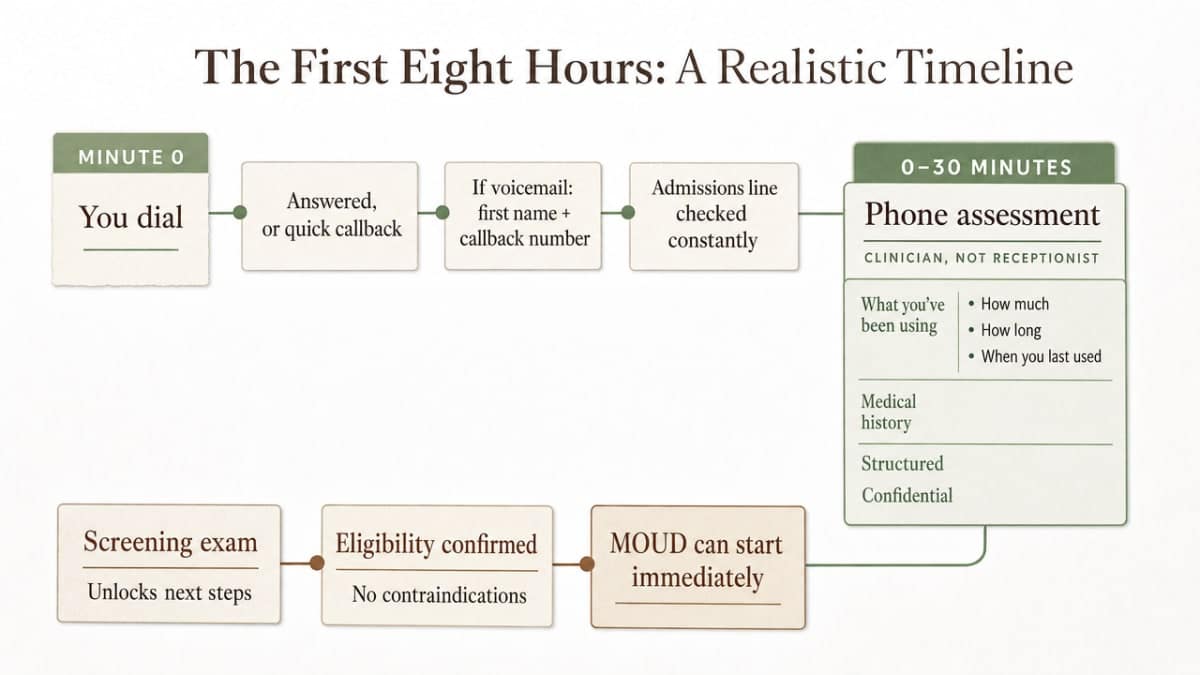
The First Eight Hours: A Realistic Timeline
Here’s what the day actually looks like when you call a responsive Arkansas program in the morning. Not a marketing version. A working version.
Minute 0 — You dial. Someone picks up, or someone calls you back within a short window. If you get voicemail, leave a first name and a callback number. Admissions teams at small programs check that line constantly, including nights and weekends.
0 to 30 minutes — Phone assessment. A clinician, not a receptionist, asks you what you’ve been using, how much, how long, when you last used, and what your medical history looks like. This is the screening exam. It’s structured, it’s confidential, and it’s the piece that unlocks everything else. Federal SAMHSA guidance is explicit: once a screening examination confirms eligibility and no contraindications, medication for opioid use disorder can be started immediately 1. If your situation involves alcohol, the same call determines whether you need medically supervised withdrawal and how urgent it is.
30 to 90 minutes — Insurance verification and medical screening. While you’re still on the phone or shortly after you hang up, admissions runs your benefits. They confirm your plan covers residential treatment, what your out-of-pocket looks like, and whether prior authorization is needed. In parallel, a nurse or medical director reviews your history for red flags: seizure risk, cardiac issues, recent overdoses, dangerous polysubstance patterns. If you’re stable enough for direct residential admission, they say so. If you need a hospital first, they say that too, and they don’t waste your morning pretending otherwise.
90 minutes to 4 hours — Bed hold and transportation. A bed gets held under your name. You get a specific arrival window. Admissions walks you through what to pack, what to leave, what to tell your office, and how to get there. If you can’t safely drive, they help you sort out a ride. This is also the window where a family member, if you’ve told one, can meet you at the door.
4 to 8 hours — Arrival and medical intake. You walk in. You hand over paperwork, ID, medications. A nurse takes vitals. A physician or advanced practice provider does the full medical exam. If you’re presenting with opioid use disorder and no contraindications surfaced, MOUD can be initiated the same evening under federal guidance 1. If alcohol is the primary concern, detox medications and monitoring protocols begin. You get a bed, a room, and the first solid meal you’ve had in a while.
That’s eight hours. Not eight days. Not “we’ll follow up next week.” The pieces exist. What determines whether they line up is whether the program you called is built to move that fast — which, for a 20-bed men’s residence in Little Rock, means fewer handoffs and a shorter path between your call and your bed.
Why Speed of Initiation Changes Whether Treatment Sticks
There’s a reason the clinical world has been pushing hard on “start now, not next week.” The evidence on it is unusually clean.
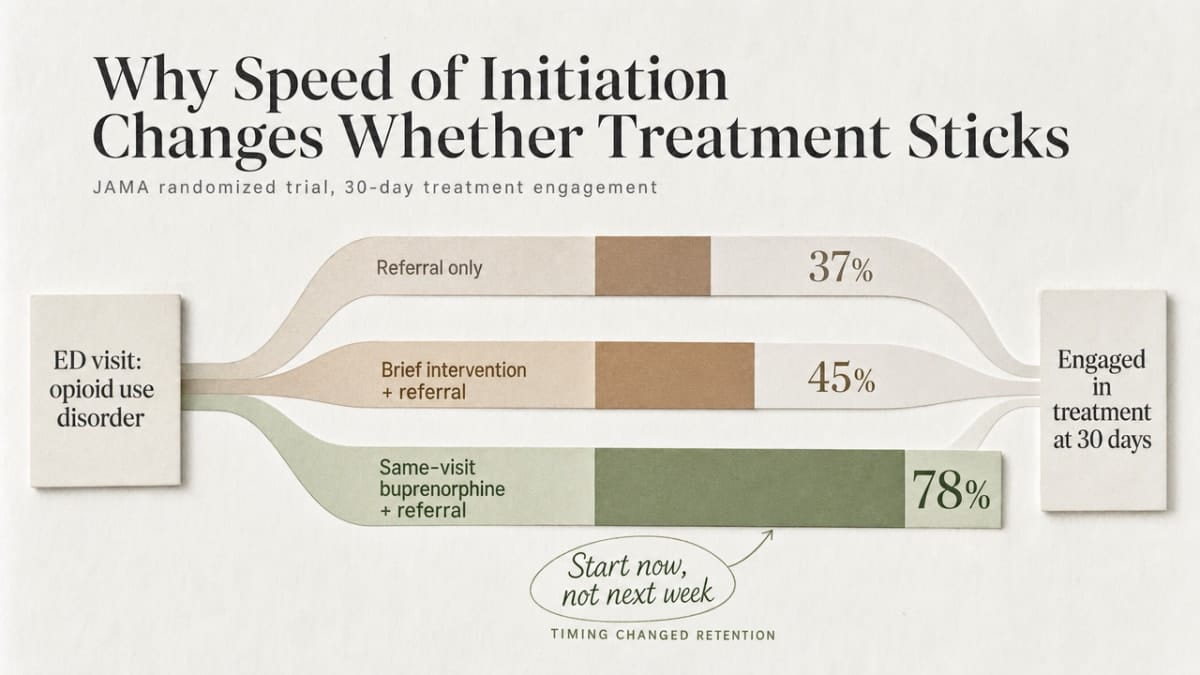
In a randomized trial published in JAMA, researchers compared three approaches for patients presenting to an emergency department with opioid use disorder. One group received a referral only. A second received a brief intervention plus referral. A third received buprenorphine started in the ED that same visit, plus referral to ongoing care. At 30 days, 78% of the patients who got same-visit buprenorphine were still engaged in addiction treatment. In the brief intervention group, that number was 45%. In the referral-only group, it was 37% 11.
Read that again. Doubling the rate of people still in treatment a month later wasn’t a new drug or a new therapy model. It was the timing. It was starting the clinical action the same day the person walked in the door.
That trial was done in emergency departments, not residential programs, and it looked specifically at opioid use disorder. So don’t over-generalize it. But the underlying mechanism is the same one that matters for you today: the window between deciding to get help and actually starting help is fragile. Every hour that window stays open, the odds shift. Fear catches up. The client emails back. The bottle in the drawer starts making its case again. The spouse’s face softens and you tell yourself maybe it’s not that bad.
Same-day clinical action closes the window. A phone assessment today, medication initiated today if it’s indicated, a bed held under your name today — these aren’t just conveniences. They’re the operational reason people who call at 9 a.m. are still in treatment 30 days later at rates the delayed-referral crowd doesn’t touch.
The Friction Points That Slow Admission Down
Same-day admission works when the pieces line up. It stalls when one piece doesn’t. Knowing where the friction usually shows up is the difference between a call that lands you a bed today and a call that turns into a callback next week.
Insurance verification during off-hours. Most commercial plans require a benefits check and, for residential care, prior authorization. If you call at 4 p.m. on a Friday, the verification team on the payer’s side may already be gone. A responsive admissions office can still start the clinical assessment, hold a bed under a single-case agreement, and finish the authorization Monday morning. A less responsive office will tell you to call back.
Medical complexity that needs a hospital first. If you’ve been drinking heavily for weeks, you may need medically supervised withdrawal in a hospital before residential detox is safe. Same is true for benzodiazepine dependence, recent overdose, or serious cardiac history. The phone assessment catches this. It’s not a delay for its own sake — it’s the step that keeps a seizure from happening on night two.
Bed availability at a small program. A 20-bed men’s residence has fewer beds than a 200-bed system, which is the exact tradeoff that makes it move faster on the phone. When a bed is genuinely full, a good admissions team says so directly and helps you sort out the next 24 hours — a hospital detox, a bridge appointment, or a hold for tomorrow’s opening — rather than parking you on a waitlist with no communication.
Cost expectations that surface too late. The 2021 national residential audit found for-profit programs requested an average of $17,434 upfront, versus $5,712 at nonprofits 7. That’s a national range, not an Arkansas quote, but it tells you why financial verification belongs in hour one, not hour six. You want the money conversation on the same call as the clinical one.
Your own hesitation. This is the biggest one, and it’s the one nobody puts on a checklist. The call goes well. The bed is available. Then you look at your calendar and start negotiating with yourself. Every hour you spend rehearsing the reasons to wait is an hour the bed can go to someone else. If the clinical and financial pieces come together today, the last friction point standing is you. That one’s yours to move.
If You’re Outside Little Rock: Arkansas Geography and Access
If you’re reading this from Fayetteville, Jonesboro, Texarkana, El Dorado, or a smaller town in between, the geography matters. Arkansas is divided into eight catchment areas, each with designated providers who handle state-funded substance use treatment for the uninsured 6. The Office of Substance Abuse and Mental Health coordinates that system, and for men without insurance, working through your local catchment provider is a legitimate first door 12.
But here’s what the Arkansas data actually shows. A geographic analysis of medications for opioid use disorder access across the state found that provider distribution is uneven, with rural counties facing meaningful gaps in MOUD availability compared to the Little Rock corridor 9. If you’re two hours from the nearest waivered prescriber, working your local system can add days you don’t have.
That’s the honest case for calling a Little Rock program directly, even if you live three or four hours away. A responsive admissions team can start the phone assessment now, verify your insurance now, and coordinate transportation from wherever you are. Serenity Park is a 20-bed men’s residence in Little Rock — small enough to answer the phone, central enough that most Arkansans can be there before dinner.
Distance is a logistics problem, not a disqualifier. If your car isn’t safe to drive, admissions can help you sort that out. If a family member can drive you, you can be on the road within an hour of hanging up. Geography is real. It’s also solvable in an afternoon.
Career, Reputation, and the Logistics You’re Already Rehearsing
You’ve already run the math. The partners meeting Thursday. The trial prep. The board deck that isn’t finished. The client who only talks to you. The licensing board. The kids’ school pickup. The spouse who doesn’t know how bad it’s gotten, or knows exactly how bad and is waiting for you to say it out loud.
These are not vanity concerns. They’re logistics, and logistics get solved.
Start with the job. The Family and Medical Leave Act protects up to 12 weeks of unpaid, job-protected leave for a serious health condition at employers with 50 or more employees, and substance use disorder treatment qualifies. Your HR contact does not need to know the diagnosis. They need a certification from a healthcare provider. A responsive admissions team handles that paperwork routinely and can have it in your inbox before the end of your first day in treatment. If your company has an Employee Assistance Program, calling it is confidential by law and separate from your personnel file.
On licensing: physicians, attorneys, and other licensed professionals in Arkansas have profession-specific assistance programs designed to keep your license intact while you get care. Self-referral to treatment is almost always treated more favorably than a board complaint that forces the issue later. The version of this story where you handle it yourself, quietly, in a residential setting, is the version your licensing board wants you to write.
On the calendar: 30 days is one billing cycle. It is one court term interrupted, not ended. It is a quarter you can explain. It is not the end of anything you’ve built. What actually ends careers is the DUI, the missed hearing, the malpractice event, the arrest in the parking garage. Those are the outcomes of waiting. Treatment is the outcome of not waiting.
On your family: the conversation you’re dreading gets easier the moment you can say “I have a bed at a men’s program in Little Rock, I go in this afternoon, and here’s the number if you need to reach the admissions coordinator.” That sentence changes the whole room. Try writing it down and see how it reads.
Every one of these logistics is solvable in a few phone calls. The one thing that isn’t solvable is the version of tomorrow where nothing changed.
How Serenity Park Handles a Same-Day Call
Here’s what to expect when you dial. A person answers, not a bot tree. If the line is briefly tied up, you leave a first name and a callback number, and the return call comes quickly — including nights and weekends. Admissions coordinators at a 20-bed men’s residence don’t have the volume that forces bigger systems to batch callbacks.
The first conversation is with someone who knows how to run a screening exam over the phone. Not a script reader. They ask about substances, timing, medical history, and what your day looks like. If your situation points to opioid use disorder and no contraindications surface, MOUD can be initiated the same day under federal SAMHSA guidance 1. If alcohol is the primary concern, they map out medically supervised detox on-site.
While you’re still on the phone, admissions verifies your insurance and gives you a real number on out-of-pocket. If prior authorization is needed, they start it. If you’re uninsured, they tell you honestly what the options are, including the eight-catchment-area system Arkansas runs through OSAMH 12.
A bed goes on hold under your name. You get an arrival window, a packing list, and a direct line back to your coordinator. If you’re driving in from northwest Arkansas or the Delta, they help you plan the trip. If a family member is coming with you, they can meet the coordinator at the door.
Inside, the program is built for men — small enough that the physician, the nurse, and the counselor actually know who you are by dinner. The Huml Health wearable gives clinicians continuous data on heart rate, stress, and sleep, so medication and monitoring adjust to what your body is actually doing, not what an intake form said this morning.
One call. One coordinator. One bed held for you.
Making the Call Now
You’ve read enough. You know what today looks like if you close this tab and go back to what you were doing. You also know what a different version of today could look like: a phone call before lunch, a bed held under your name by dinner, a room in Little Rock tonight.
Call Serenity Park’s admissions line now. If you reach voicemail, leave your first name and a callback number. The return call comes fast, including nights and weekends.
You don’t need to have your insurance card in front of you. You don’t need to have told anyone yet. You don’t need the perfect sentence. You just need to dial.
The partners meeting will get covered. The kids will be fine. The next 20 minutes are the only ones that matter. Make the call.
Frequently Asked Questions
Is same-day admission to rehab in Arkansas actually possible, or is it a marketing promise?
Both, honestly. The phrase gets used loosely, but same-day clinical action is real and legitimate. Federal SAMHSA guidance permits starting medication for opioid use disorder immediately after a screening exam confirms eligibility 1. What you want is a program that runs the assessment, verifies insurance, and holds a bed on the same call — with physical arrival following as medical clearance and logistics allow. Ask for that specific sequence.
What happens in the first phone call to a same-day admission program?
A licensed clinician runs a screening exam over the phone: substances used, timing, medical history, current risks. Admissions verifies your insurance in parallel and gives you a real out-of-pocket number. If criteria are met and no contraindications surface, a bed goes on hold under your name and you get an arrival window. The call usually runs 30 to 45 minutes. You’ll hear the plan taking shape while you’re still on the line.
Do I need to go to the emergency room first, or can I go straight to a residential program?
Most men can go straight to residential if they’re medically stable. The phone assessment determines this. Heavy long-term alcohol use, benzodiazepine dependence, recent overdose, or serious cardiac issues may require a hospital first for safety. The ED is also a legitimate entry point where buprenorphine can be initiated before residential handoff 3. If you’re unsure, call the residential program first — they’ll tell you honestly which door to use.
How does insurance verification work when I need a bed today?
Admissions runs your benefits while you’re on the phone. They confirm residential coverage, out-of-pocket costs, and whether prior authorization is required. If you call during business hours, verification often finishes in under an hour. After hours or weekends, a responsive team holds the bed under a single-case agreement and completes authorization the next business morning. Have your insurance card handy if you can, but don’t wait to call because you can’t find it.
I live outside Little Rock. Can I still get admitted the same day?
Yes. An Arkansas geographic analysis found MOUD access is uneven across the state, with rural counties facing meaningful gaps compared to central corridors 9. Calling a Little Rock program directly is often faster than working through a rural referral chain. Admissions can start your assessment now, verify insurance now, and help coordinate transportation from northwest Arkansas, the Delta, or south Arkansas. Most of the state is a same-day drive to Little Rock.
What about my job, my license, and confidentiality?
FMLA protects up to 12 weeks of job-protected leave for substance use treatment at employers with 50 or more staff, and HR only needs a provider certification — not the diagnosis. EAP calls are confidential by law. Arkansas physicians, attorneys, and other licensed professionals have profession-specific assistance programs designed to protect your license during treatment. Self-referral is almost always viewed more favorably than a board complaint later. Admissions handles the paperwork routinely.
References
- Federal Guidelines for Opioid Treatment Programs. https://library.samhsa.gov/sites/default/files/federal-guidelines-opioid-treatment-pep24-02-011.pdf
- TIP 63: Medications for Opioid Use Disorder. https://library.samhsa.gov/sites/default/files/pep21-02-01-002.pdf
- Multiple Treatment Settings for Receiving Buprenorphine. https://www.cdc.gov/overdose-prevention/hcp/training-modules/buprenorphine/page1169598.html
- Buprenorphine in the Emergency Department (ED) – CDC Training Module. https://www.cdc.gov/overdose-prevention/hcp/training-modules/buprenorphine/index.html
- Initiating Buprenorphine-based MOUD in the ED. https://www.cdc.gov/overdose-prevention/hcp/training-modules/emergency/page1531649.html
- Find Substance Abuse or Mental Health Treatment. https://humanservices.arkansas.gov/divisions-shared-services/shared-services/office-of-substance-abuse-and-mental-health/samh-treatment/
- Admission Practices And Cost Of Care For Opioid Use Disorder At Residential Addiction Treatment Programs In The US. https://www.ncbi.nlm.nih.gov/pmc/articles/PMC8638362/
- Improving Access to Treatment for Opioid Use Disorder: Strategies and Considerations. https://www.ncbi.nlm.nih.gov/pmc/articles/PMC6377670/
- Access to Medications for Opioid Use Disorder in Arkansas: A Geographic Analysis. https://www.ncbi.nlm.nih.gov/pmc/articles/PMC10645396/
- Same-Day Access to Substance Use Treatment: Implementation Lessons from a Statewide Network. https://www.ncbi.nlm.nih.gov/pmc/articles/PMC10873450/
- Emergency Department-Initiated Buprenorphine/Naloxone Treatment for Opioid Dependence. https://www.ncbi.nlm.nih.gov/pmc/articles/PMC4805756/
- Office of Substance Abuse and Mental Health. https://humanservices.arkansas.gov/divisions-shared-services/shared-services/office-of-substance-abuse-and-mental-health/