
Key Takeaways
- A verification call pulls eight specific data points from your carrier, including plan type, in-network status, prior authorization, deductible position, and appeal rights, turning unknowns into concrete numbers.
- Calling to verify benefits is a fact-finding inquiry, not a commitment; no claim is filed, no diagnosis is recorded, and nothing is reported to your employer.
- MHPAEA protects you from stricter quantitative and non-quantitative limits on addiction care than on comparable medical care, and you can request medical-necessity criteria and denial reasoning in writing 1, 5.
- Arkansas Medicaid requires UM vendors to decide rehab-only SUD admissions within two business days of receiving a complete clinical file, so packaging records fully the first time protects the timeline 10.
- Ambetter and other Marketplace plans must cover SUD and inpatient behavioral health as essential health benefits, so verification should focus on network status, deductible, and PA rather than whether coverage exists 11, 13.
- Green flags like in-network status, met deductible, and same-day PA readiness let you set an admission date, while yellow flags like out-of-network residential or mismatched day caps require written follow-up before committing.
- Serenity Park’s verifier confirms the same eight-point picture across Anthem, Arkansas BCBS, Aetna, Cigna/Evernorth, UHC, Ambetter, and QualChoice, giving you one page of real numbers to decide from.
- When results look wrong, request the medical-necessity criteria and denial reasoning in writing, ask for the parity comparative analysis on suspect NQTLs, and file a formal appeal with updated clinical documentation 1, 5.
The call that decides whether treatment starts this week
You already know the hardest part isn’t picking up the phone. It’s the twelve unknowns behind it. Will your plan cover residential care in Arkansas? Will prior authorization eat a week you don’t have? Will something land in a place your employer can see? Those are fair questions, and they deserve real answers before you commit to anything.
Here’s what changes the math: a single verification call, done early, turns most of those unknowns into concrete numbers on a page. Your plan type. Whether Serenity Park is in-network with your Anthem, Arkansas BCBS, Aetna, Cigna/Evernorth, UnitedHealthcare, Ambetter, or QualChoice policy. Where your deductible sits right now. Whether detox and residential require prior authorization, and if so, what documentation moves them fastest. What your parity rights say if a plan tries to apply stricter rules to substance use care than to medical care 1.
None of that requires a decision from you. A verification call is a fact-finding step, not a commitment. You get information; you decide what to do with it.
This guide walks you through what that call actually covers, why each question matters under federal and Arkansas rules, and how to read the answers so admission can happen this week instead of next month. You’re already doing the work. Let’s make the work count.
What a verification call actually checks
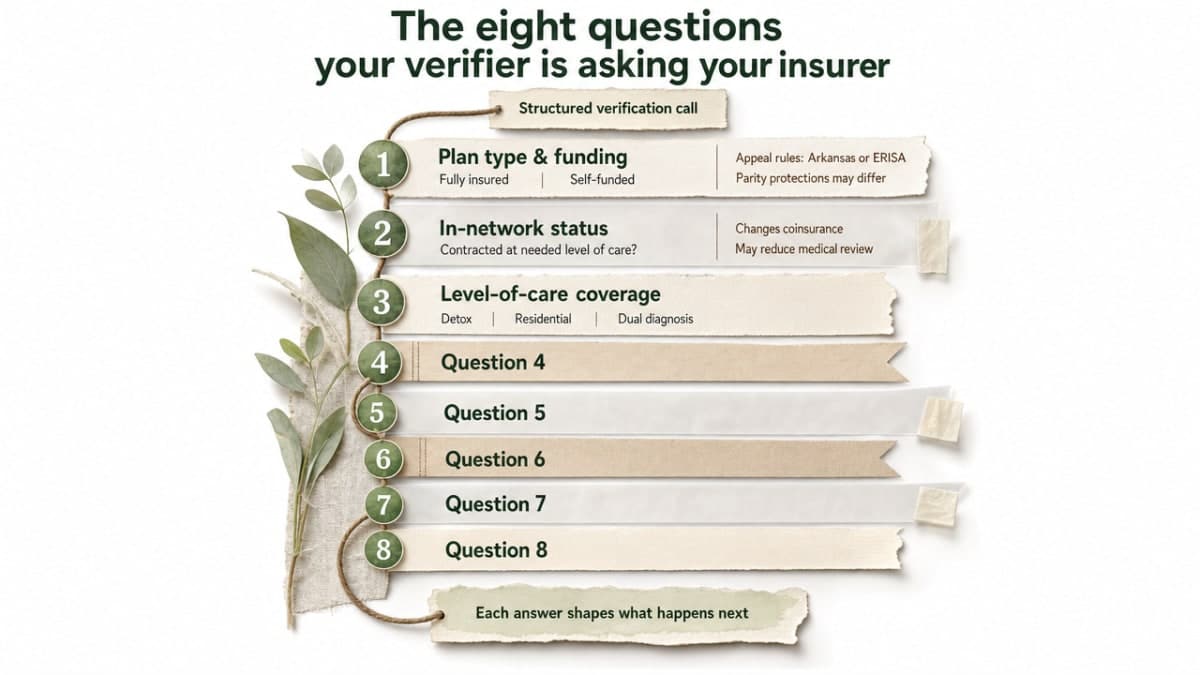
The eight questions your verifier is asking your insurer
When a verifier picks up the phone and calls your carrier, the conversation isn’t a vague inquiry. It’s a structured pull of eight specific data points, and each one shapes what happens next. You can follow along.
Plan type and funding. Is your policy fully insured or self-funded through your employer? That single fact determines whether Arkansas insurance regulators or federal ERISA rules govern your appeal rights, and it changes which parity protections apply 1.
In-network status. Is the treatment facility contracted with your carrier at the level of care you need? In-network changes your coinsurance math and often removes a layer of medical review 3.
Level-of-care coverage. Your verifier confirms coverage separately for medically supervised detox, residential treatment, and dual diagnosis care. Plans routinely cover these at different rates, and some cover one cleanly while flagging another 11, 13.
Prior authorization requirements. Does the plan require pre-approval before you walk in the door? For which levels of care? Prior authorization is the single biggest source of delay, so pinning down what’s needed and who submits it matters more than almost anything else 4.
Medical-necessity criteria on file. Which criteria set does the plan use, ASAM or its own, and can they send it? You have the right to request this document 5.
Deductible and out-of-pocket status. Where do you sit today against your deductible and annual out-of-pocket max? This turns “covered” into a real dollar figure 12.
Quantitative treatment limits. Any day caps, visit caps, or step-therapy requirements. Under parity, these can’t be more restrictive than the limits on comparable medical care 15.
Appeal rights and denial rationale process. If something gets denied, how fast can you appeal, and can you get the denial reasoning in writing? You can 5.
That’s the whole script. Eight questions, one conversation, and you walk away with the map.
Does calling commit you to anything (and what shows up at work)
Short answer: no, and nothing.
A verification call is a benefits inquiry. It’s the same category of transaction as checking whether a knee MRI is covered. Your carrier logs it, the treatment center logs it, and that’s where it ends. You have not signed anything, scheduled anything, or authorized any claim. You can hang up, sit with the numbers for a day, and never call back if that’s what you decide.
The privacy piece matters too. Your employer sees premiums and, on some plans, aggregate claims data long after the fact. A verification call generates no claim. There is no admission, no diagnosis code, no billable event tied to your name in an HR-visible system. Federal privacy rules protect your health information from casual disclosure, and a benefits check isn’t reported to your workplace.
What you get in exchange for one phone call is the actual shape of your coverage: what’s in-network, what your deductible looks like today, and whether prior authorization is going to add days to your timeline. That’s information you own. What you do with it is still entirely yours.
The parity rights you already own
MHPAEA in plain English: quantitative and non-quantitative limits
Here’s the part most people never get told: you already own a set of federal protections that shape what your plan can and cannot do with your substance use benefits. The Mental Health Parity and Addiction Equity Act, MHPAEA for short, is the reason your insurer can’t put stricter rules on addiction care than it puts on comparable medical care 1. Knowing this changes how you listen to a verification call.
Parity splits into two buckets. The first is quantitative treatment limits, the numbers on the page. Copays, coinsurance, deductibles, day caps on residential stays, visit caps on counseling. If your plan pays for thirty inpatient days for a cardiac condition, it can’t quietly cap addiction inpatient care at ten. The math has to line up 1.
The second bucket is where most of the friction lives: non-quantitative treatment limits, or NQTLs. These are the softer levers. Prior authorization, medical management protocols, the medical-necessity criteria a reviewer uses to decide whether you “qualify” for residential care, step-therapy requirements that push you toward outpatient first. Since 2021, plans have to document a comparative analysis showing these NQTLs aren’t applied more strictly to addiction care than to medical care 1, 15.
Two rights follow from this that you can use on the phone. You can ask your insurer for the medical-necessity criteria they’re using. You can ask, in writing, for the reasoning behind any denial 5. Most people never do. You will.
The ‘meaningful benefits’ standard for residential care
Parity got sharper in 2024. The federal omnibus rule clarified that if your plan covers a mental health condition or substance use disorder in a given benefit classification, it has to provide meaningful benefits for that condition in every classification where it covers medical care, including a core treatment for the condition in each relevant classification 6.
Translated for you: if your plan pays for inpatient medical care, it can’t offer a token, unusable version of inpatient addiction care. Residential treatment for alcohol or drug dependence has to actually be there, with a core treatment covered, not buried behind rules that make it functionally unreachable.
This matters during verification because it gives you a specific question to ask. Not just “is residential covered?” but “what core treatment for substance use disorder is covered at the residential level of care?” A vague answer is a signal to ask again, in writing.
Why prior authorization is still the friction point
Even with parity on the books, prior authorization is where treatment stalls. A 2022 qualitative study looking at Medicaid and private plans across three states found that none of them covered every level of care ASAM recommends for substance use disorder, and prior authorization requirements were widespread, including for medications like buprenorphine that treat opioid use disorder 4. The study is narrow in scope, three states and qualitative in method, but the pattern is familiar to anyone who has watched a plan take five business days to answer a straightforward request.
Some states have pushed back. New York, for example, prohibits preauthorization for outpatient SUD treatment at certified facilities and limits concurrent review during the first two weeks of care 9. Arkansas has not adopted a comparable ban, which is why your verification call has to treat prior authorization as the central question, not a footnote.
How Arkansas rules shape your timeline
The Arkansas Medicaid two-business-day decision window
If you or a family member is on Arkansas Medicaid, there’s a specific rule worth knowing before the phone rings. All rehabilitation-only admissions for substance use disorder require prior authorization, and the admitting facility has to send the beneficiary’s clinical records to the current utilization management contractor. Once that contractor has everything it needs, it must approve or deny coverage within two business days 10.
Read that clock carefully. The two-day count starts when the UM vendor or PASSE receives all the required information, not when the facility first faxes a partial packet. That distinction is where days get lost. A missing ASAM assessment, an incomplete history, a lab value the reviewer wants clarified: any of it resets the moment the clock actually starts.
Practically, this means the verification call and the records handoff are the same job. If your verifier confirms Medicaid coverage on Monday and the facility gets a complete clinical package to the UM vendor by end of day, you’re looking at a decision by Wednesday. Sit on the paperwork, and Wednesday becomes next week. The rule is on your side; the sequencing is on you.
From first call to admission: what actually moves the clock
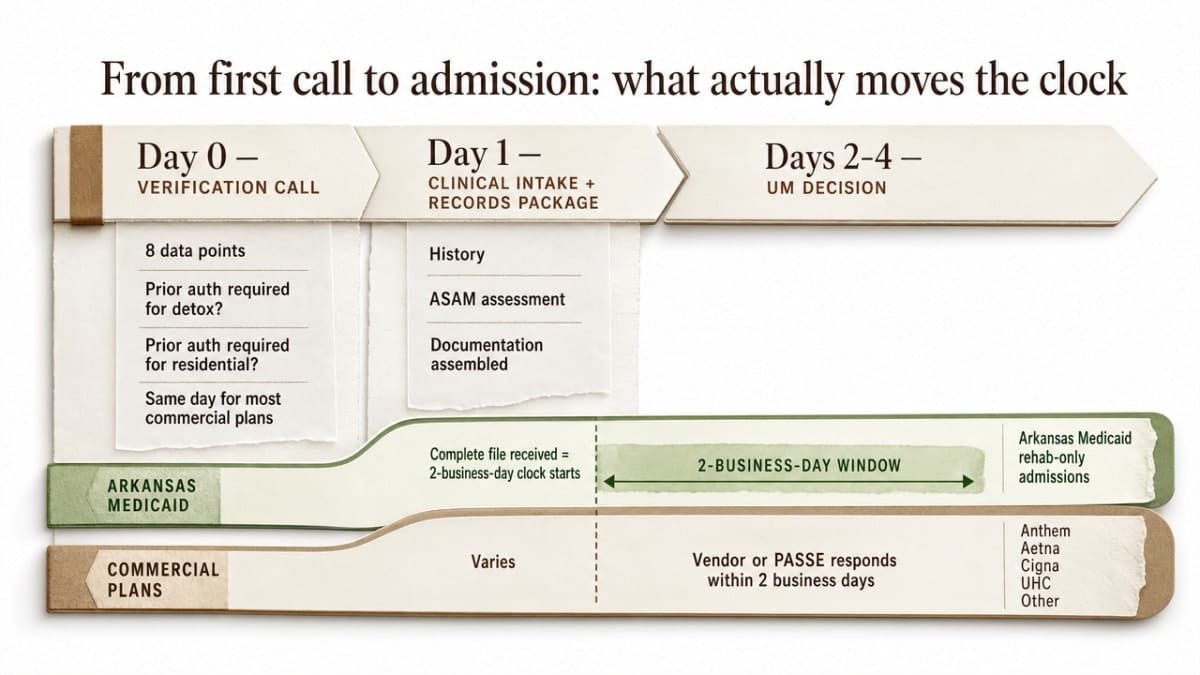
Here’s what the timeline actually looks like when you stack the pieces end to end.
Day zero, the verification call. Your verifier gets on the phone with your carrier, pulls the eight data points, and confirms whether prior authorization is required for detox and residential. This is a same-day step for most commercial plans.
Day one, clinical intake and records package. A clinician gathers your history, does the ASAM-level assessment, and assembles the documentation the plan will want. On Arkansas Medicaid this is the moment the two-business-day clock is preparing to start 10.
Days two through four, the UM decision. For Arkansas Medicaid rehab-only admissions, the vendor or PASSE must respond within two business days of receiving the complete file 10. Commercial plans vary more. Anthem, Aetna, Cigna, UHC, and others typically respond in a few business days for residential SUD requests, but there’s no single statutory ceiling like Arkansas Medicaid’s, and complex cases can drift.
Day five and beyond, admission. With authorization in hand, you set the arrival day. If detox is medically urgent and your plan permits emergent admission, this can compress significantly.
The lesson isn’t that every case takes a week. It’s that every day of the week is either working for you or waiting on someone. A verification call that surfaces the PA requirement early, paired with a clinical team that packages records completely the first time, is the difference between admission this week and admission after the next weekend.
Ambetter and Marketplace plans: what EHB coverage means for you
If you carry Ambetter or another Arkansas Marketplace plan, you have a coverage floor built into federal law. The Affordable Care Act treats substance use disorder treatment, behavioral health treatment, and mental and behavioral health inpatient services as essential health benefits, which means every Marketplace plan sold in Arkansas has to cover them 11.
That’s meaningful because it removes one category of denial before the conversation even starts. Your Ambetter plan can’t simply exclude residential SUD care as a class. What it can still do is apply prior authorization, network rules, deductibles, and medical-necessity criteria to the coverage it provides 13.
So the verification call for a Marketplace plan looks slightly different in emphasis. Coverage-in-concept is not the question. Whether the facility is in-network, what your deductible position looks like, and what the plan needs to see to authorize the level of care you actually need: those are the questions that decide when you walk in the door.
Reading your verification results: green flags and yellow flags
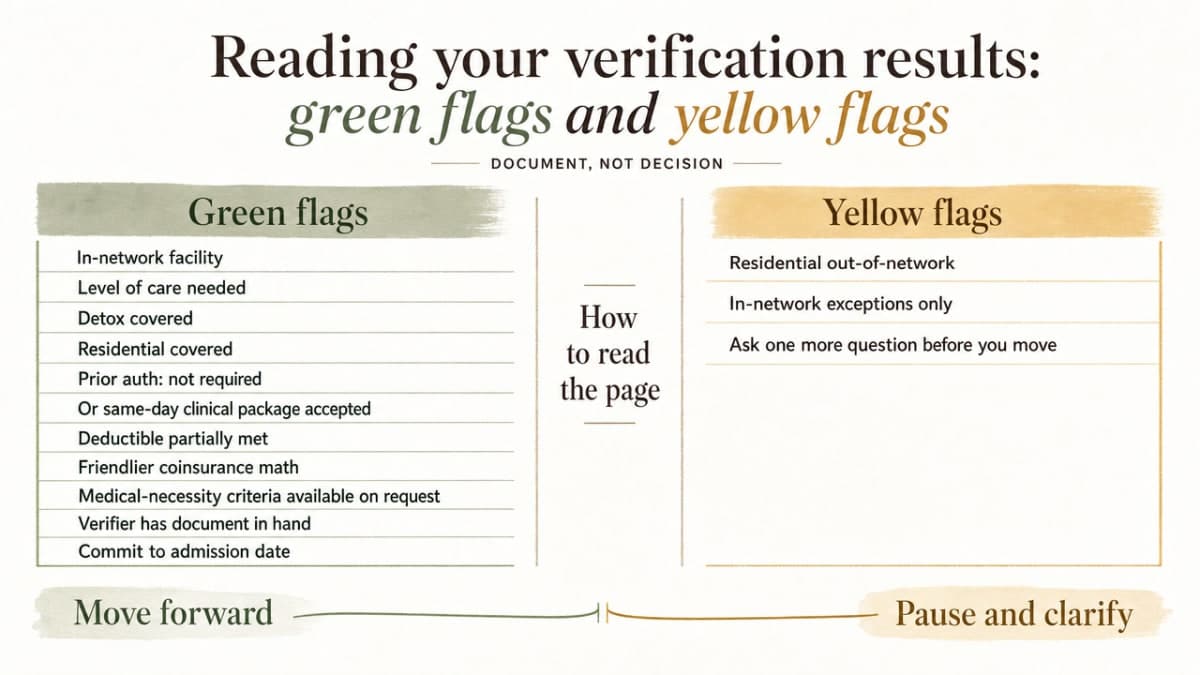
Once the call ends, you’re holding a document, not a decision. The trick is knowing which lines tell you to move and which lines tell you to ask one more question before you do.
Green flags. The facility comes back in-network at the level of care you need. Detox and residential both show as covered. Prior authorization is either not required or the plan accepts a clinical package the treatment team can assemble the same day. Your deductible is already partially met, so the coinsurance math is friendlier than you expected. The plan can send its medical-necessity criteria on request, and the verifier has that document in hand 5. When you see this combination, you can commit to an admission date without holding your breath.
Yellow flags. Residential is listed as out-of-network with in-network exceptions available only through a case-by-case review. Prior authorization is required, and the plan will only accept it from the facility once a full ASAM assessment is complete. Concurrent review kicks in after a set number of days, meaning the plan re-evaluates your stay mid-treatment. A day cap appears on residential that doesn’t match the cap on comparable medical inpatient care, which is a parity question worth flagging 1, 15. None of these kill the admission. Each one adds a step you and the clinical team have to sequence deliberately.
A yellow flag is not a stop sign. It’s a note that says: don’t assume, confirm in writing, and keep the paperwork tight.
A working example: what Serenity Park’s verifier confirms with your carrier
Anthem, Arkansas BCBS, Aetna, Cigna/Evernorth, UHC, Ambetter, QualChoice
Serenity Park works with seven carriers that cover most professional men in central Arkansas: Anthem, Arkansas Blue Cross Blue Shield, Aetna, Cigna/Evernorth, UnitedHealthcare, Ambetter, and QualChoice. When you give the intake team your member ID, that’s the call they’re making.
Here’s what the pattern usually looks like across those plans. Anthem, Arkansas BCBS, Aetna, Cigna/Evernorth, and UHC are commercial group plans that typically cover medically supervised detox and residential SUD care as inpatient behavioral health benefits, subject to prior authorization and medical-necessity review 3. What varies is the specific criteria set the plan uses, how quickly its behavioral health vendor responds, and whether your employer’s plan is self-funded, which changes appeal mechanics 1.
Ambetter sits in a different bucket. As a Marketplace plan, it must cover behavioral health treatment, inpatient mental health services, and substance use disorder treatment as essential health benefits 11, 13. Coverage-in-concept is guaranteed. The verifier’s job is to pin down network status, deductible position, and PA requirements for the specific level of care.
QualChoice operates as an Arkansas-based commercial carrier and follows the same MHPAEA logic: financial requirements and treatment limits on SUD benefits can’t be more restrictive than those on comparable medical care 1.
What Serenity Park’s verifier brings back to you, regardless of carrier, is the same eight-point picture: plan type and funding, in-network status at the residential level, level-of-care coverage for detox and dual diagnosis, PA requirements, medical-necessity criteria on file, deductible and out-of-pocket status, quantitative limits, and appeal rights. You get one page. You get real numbers. And you get it without paying for it or committing to anything.
Turning the answers into an admission decision this week
Once that page is in front of you, the decision compresses fast.
If your carrier came back in-network, detox and residential both authorized (or PA-ready with same-day documentation), and your deductible is partially met, you can set an arrival day. On Arkansas Medicaid, that means the two-business-day UM window starts the moment the clinical package lands complete 10. On commercial plans, it means the clinical team can submit the PA request the same day the verification closes.
If yellow flags surfaced — out-of-network residential, day caps that don’t match medical inpatient caps, a plan that won’t release its medical-necessity criteria — you have a next step, not a dead end. Request the criteria in writing 5. Ask for the parity comparative analysis if a limit looks off 1.
Either way, you’ve moved from unknown to known. That’s the whole point of making the call early.
If your verification comes back wrong: how to push back
Sometimes the page you get back doesn’t match what your plan should be doing. Residential comes back denied for someone who clearly meets ASAM criteria. A day cap on inpatient SUD care looks tighter than the cap on medical inpatient. The plan won’t tell you which medical-necessity criteria it used. Any of these is a signal to push, not to fold.
Start by requesting two documents in writing. First, the medical-necessity criteria the plan applied to your case. Second, the specific reasoning for any denial. Both are your right, and the plan has to produce them 5. Put the request in an email or the plan’s member portal so there’s a timestamp.
If a non-quantitative treatment limit looks off, prior authorization applied to residential SUD care but not to comparable medical inpatient, or a step-therapy rule that pushes you toward outpatient first, ask for the plan’s comparative analysis. Since 2021, plans have had to document how their NQTLs on addiction care compare to their NQTLs on medical care 1. That paper trail exists. You can ask to see it.
File a formal appeal on the plan’s timeline, and let the clinical team send updated documentation with it. Most denials that get overturned get overturned this way: same facts, better package, filed on the record.
Frequently Asked Questions
Does calling to verify my insurance commit me to admission or put anything on my record at work?
No, on both counts. A verification call is a benefits inquiry, the same category of transaction as checking whether an MRI is covered. Your carrier logs it, the treatment center logs it, and nothing gets sent to your employer. No claim is filed, no diagnosis is recorded, and you have not authorized anything. You can hang up, sit with the numbers, and decide later.
What information does the verifier actually need from me to start the call?
Have your insurance card in front of you: member ID, group number, and the plan’s member services phone number on the back. You’ll also give your date of birth and whether your coverage is through an employer or the Marketplace. That’s enough to start. The verifier calls the carrier from there and pulls the coverage details you need 3.
How long does insurance verification and prior authorization take in Arkansas?
Verification itself usually takes a same-day call. Prior authorization is where the clock varies. For Arkansas Medicaid rehab-only SUD admissions, the UM vendor or PASSE must decide within two business days of receiving the complete clinical file 10. Commercial plans (Anthem, BCBS, Aetna, Cigna, UHC) typically respond in a few business days when the ASAM assessment and history arrive complete the first time.
Do commercial plans like Anthem, Arkansas BCBS, Aetna, Cigna, UnitedHealthcare, Ambetter, and QualChoice cover residential rehab?
Generally yes, subject to network status, prior authorization, and medical-necessity review. Ambetter, as a Marketplace plan, must cover SUD treatment and inpatient behavioral health as essential health benefits 11. The other commercial carriers cover detox and residential SUD care as inpatient behavioral health benefits under parity, which means those benefits can’t be more restrictive than comparable medical inpatient coverage 1.
What can I do if my plan denies residential care or says it isn’t medically necessary?
Ask for two things in writing: the medical-necessity criteria the plan applied and the specific reasoning for the denial. Both are your right, and the plan has to produce them 5. Then file a formal appeal with updated clinical documentation from the treatment team. Many denials get overturned this way. If a non-quantitative limit looks stricter than on medical care, request the plan’s comparative analysis 1.
Can I ask my insurer for the exact medical-necessity criteria they use for residential SUD care?
Yes. You have a clear right to request the medical-necessity criteria your plan applies to substance use disorder benefits, and the plan has to disclose it 5. Put the request through the member portal or email so there’s a timestamp. Knowing which criteria set (ASAM or a proprietary version) the plan uses lets your clinical team package documentation that speaks the reviewer’s language.
References
- The Mental Health Parity and Addiction Equity Act (MHPAEA). https://www.cms.gov/marketplace/private-health-insurance/mental-health-parity-addiction-equity
- Parity. https://www.medicaid.gov/medicaid/benefits/behavioral-health-services/parity
- Guide to Mental Health and Substance Use Disorder Services. https://www.cms.gov/files/document/roadmap-behavioral-health-english.pdf
- Insurance barriers to substance use disorder treatment after passage of mental health and addiction parity laws and the affordable care act. https://pubmed.ncbi.nlm.nih.gov/36845978/
- CMS finalizes mental health and substance use disorder parity rule for Medicaid and CHIP. https://www.cms.gov/newsroom/press-releases/cms-finalizes-mental-health-and-substance-use-disorder-parity-rule-medicaid-and-chip
- Requirements Related to the Mental Health Parity and Addiction Equity Act. https://www.cms.gov/files/document/mhpaea-final-rule-omnibus-clean-9424-final-posting508.pdf
- Substance Use Screenings & Treatment. https://www.cms.gov/files/document/mln9560465-substance-use-screenings-treatment.pdf
- SMD# 24-004 RE: Extension of Medicaid Coverage of Substance Use Disorder Treatment. https://www.medicaid.gov/federal-policy-guidance/downloads/smd24004.pdf
- Insurance Circular Letter No. 13 (2018): Preauthorization for Substance Use Disorder Treatment. https://www.dfs.ny.gov/industry_guidance/circular_letters/cl2018_13
- Hospital Treatment for Substance Use Disorder – Arkansas Medicaid Emergency Rule. https://humanservices.arkansas.gov/wp-content/uploads/Hospital-Treatment-for-SUD-Emergency-Rule-A.pdf
- Mental health and substance use disorder coverage. https://www.healthcare.gov/coverage/mental-health-substance-abuse-coverage/
- Making the Most of Your Mental Health and Substance Use Disorder Benefits. https://library.samhsa.gov/sites/default/files/sma16-4992.pdf
- Assisting Individuals with Substance Use or Mental Disorders in the Health Insurance Marketplace and Medicaid Coverage. https://www.cms.gov/marketplace/technical-assistance-resources/substance-use-mental-disorder-insurance-enrollment.pdf
- Arkansas State Plan Amendment AR-19-0011 (CHIP Parity for MH/SUD). https://www.medicaid.gov/medicaid/spa/downloads/AR-19-0011.pdf
- The Essential Aspects of Parity: A Training Tool for Policymakers. https://library.samhsa.gov/product/essential-aspects-parity-training-tool-policymakers/pep21-05-00-001