
What to Expect from Oxycodone Addiction Treatment
Key Takeaways
- Oxycodone dependence is diagnosed as opioid use disorder, a medical condition with evidence-based treatments, not a character flaw or willpower problem that willpower alone can fix.
- Detox by itself is not treatment — the CDC warns it raises overdose risk when medication for OUD does not follow the withdrawal phase 3.
- Buprenorphine, methadone, and naltrexone are all FDA-approved for OUD tied to prescription opioids, and a serious program starts one during residential care rather than withholding it 4.
- Judge programs by concrete answers: medication started inpatient, no group-completion gatekeeping, scheduled family therapy, and discharge with a named outpatient prescriber and first appointment booked 8, 11.
If You’re the One Who Noticed First
You’ve probably been carrying this longer than anyone knows. Maybe you found the extra bottle tucked behind the socks. Maybe the pharmacy called about an early refill and you covered for him. Maybe you’ve watched him sweat through the sheets at 3 a.m. and tell you in the morning that he just slept badly.
Whatever brought you to this page, take a breath. You noticed. That matters more than you realize right now.
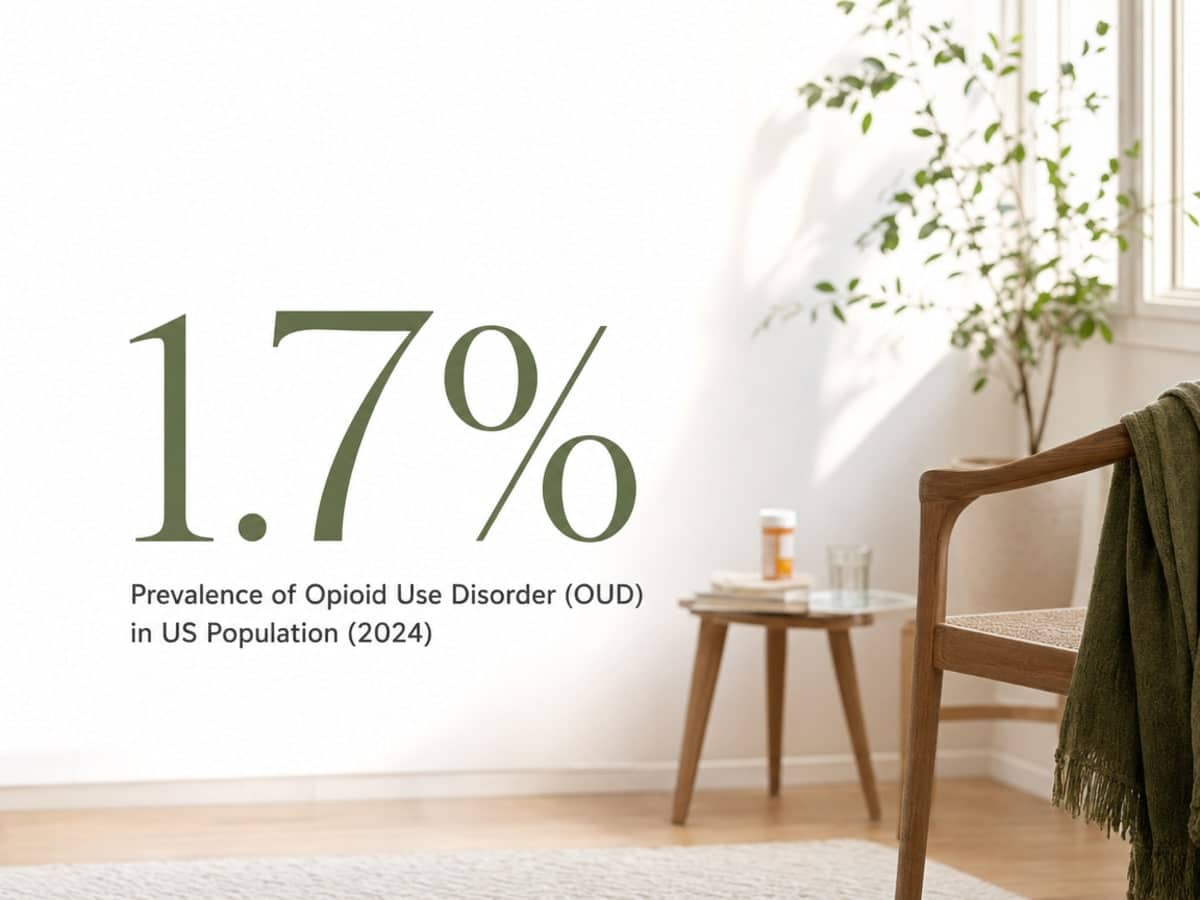
Here’s what you need to know before you read another treatment center website: oxycodone dependence is a medical condition called opioid use disorder, and roughly 4.8 million adults in the U.S. had it in the past year 1. He is not weak. You did not miss a warning sign you should have caught. This is a chronic health problem with real, evidence-based treatments — and the treatment that works is more specific than most marketing pages let on.
This guide walks you through what a serious program actually looks like week by week: the assessment, the medications by name, where you fit in, and how to tell whether an admissions team is telling you the truth or selling you a brochure.
You don’t have to have the answers today. You just have to keep reading.
How Oxycodone Dependence Actually Gets Diagnosed
Why This Is Called Opioid Use Disorder, Not ‘An Oxy Problem’
When you sit down with a clinician, the words on the paperwork will not be “addiction” or “an oxy problem.” They’ll say opioid use disorder, or OUD. That shift matters more than it sounds.
OUD is a formal medical diagnosis based on a checklist of behaviors and physical signs over the past year:
- needing more to get the same effect,
- spending large amounts of time getting or recovering from the drug,
- withdrawal when he tries to stop,
- using more than he meant to,
- wanting to cut back and not being able to.
A clinician doesn’t guess. They walk through the criteria.
Why this matters for you: the diagnosis unlocks a specific set of evidence-based treatments approved for exactly this condition, including for prescription opioids like oxycodone 4. It also stops the conversation from being about willpower. You’re not dealing with a character flaw. You’re dealing with a diagnosable illness that has treatments with decades of research behind them.
The Prescription Origin Story Most Partners Recognize
You may already know the beginning of this story by heart. A back surgery. A rotator cuff. A wisdom tooth extraction that turned into a month of scripts. Somewhere in there, the pills stopped being about pain.
This path is common enough that federal prescribing guidance now explicitly instructs doctors to offer or arrange evidence-based treatment, usually buprenorphine or methadone with behavioral therapy, when a patient develops OUD after being prescribed opioids for pain 13. In other words, the medical system knows this happens. It has a protocol for it.
None of that erases how disorienting it feels. The prescription came from a doctor. The bottle had his name on it. He wasn’t buying anything on a corner. Naming the origin honestly — without blaming him, his surgeon, or yourself — is part of what a good intake team will do in the first conversation.
The Detox-Alone Trap
Here’s the thing most treatment websites won’t put on the front page: getting the drug out of his system is not the same as treating the disorder. Detox is a medical event. Recovery is a longer arc. Programs that stop at withdrawal management leave the actual illness untreated.
The 2024 update to the national clinical practice guideline says the same thing in different words: withdrawal management alone should not be offered as treatment. Methadone and buprenorphine are the preferred first-line options 8.
Now zoom out. Of the 4.8 million adults with OUD in the U.S. in the past year, only about 17.0% received any medication for it 2. That figure is self-reported and covers adults across all care settings, not just residential. But the shape of the gap is unmistakable: most people with this diagnosis never get the treatment with the strongest evidence behind it.
If an admissions counselor tells you their program is a “30-day detox” and stops there, you now know what’s missing. Ask what happens on day eight. Ask what medication he’ll leave with. If the answer is vague, keep looking.
The Three Medications That Do the Real Work
Buprenorphine: The Most Common Starting Point
Buprenorphine is the medication you’ll hear about most often, and for good reason. It’s a partial opioid agonist, which means it activates the same brain receptors oxycodone did — but only partway. Enough to stop the withdrawal, quiet the cravings, and let him think about something other than the next dose. Not enough to produce the high he was chasing.
You may hear it called by brand names like Suboxone (which combines buprenorphine with naloxone) or Sublocade (a monthly injection). It’s typically started as a film or tablet that dissolves under the tongue, often within the first few days of residential care once early withdrawal has begun.
Here’s what surprises most partners: buprenorphine can be prescribed in a regular doctor’s office and continued as part of a comprehensive treatment plan 11. He doesn’t have to go to a specialty clinic every day. That accessibility is a big part of why it’s so often the starting point for men leaving residential treatment. SAMHSA also names it as one of the three FDA-approved medications effective for OUD tied to prescription opioids like oxycodone 4.
If he starts on buprenorphine in residential care, expect it to continue after discharge. That is the plan working, not falling apart.
Methadone: When Structure Helps
Methadone has been used to treat opioid use disorder for more than fifty years. It’s a full opioid agonist — it activates the same receptors more completely than buprenorphine — which is exactly why some men do better on it, especially those with longer histories of use, higher tolerance, or previous attempts on buprenorphine that didn’t hold.
The 2024 clinical practice update names methadone and buprenorphine together as the two preferred first-line options 8. Neither is a fallback. They’re both first-choice medications, and the right one depends on his history, not on which sounds less serious.
The main difference you’ll notice is the setting. Methadone for OUD is dispensed through federally regulated opioid treatment programs — daily visits at first, with take-home doses earned over time. That structure can feel like a lot. For some men, that daily anchor is precisely what they need.
Naltrexone: The Non-Opioid Option
Naltrexone is the outlier of the three, and understanding how it works will save you some confusion. It’s not an opioid at all. It’s an antagonist — it blocks the receptors so that if he took oxycodone, he wouldn’t feel it. No high, no relief, nothing.
The most common form used for OUD is the extended-release injection, given monthly, often called Vivitrol. SAMHSA lists it among the FDA-approved medications for OUD tied to semi-synthetic opioids like oxycodone 4.
The catch: he has to be fully through withdrawal before the first dose, usually seven to ten days opioid-free. Starting it too early causes precipitated withdrawal, which is miserable. That’s why naltrexone often makes the most sense for men who complete residential detox and can start the injection before they walk out the door.
Some men prefer it because there’s no opioid in their system at all. That preference is legitimate, and a good team will respect it.
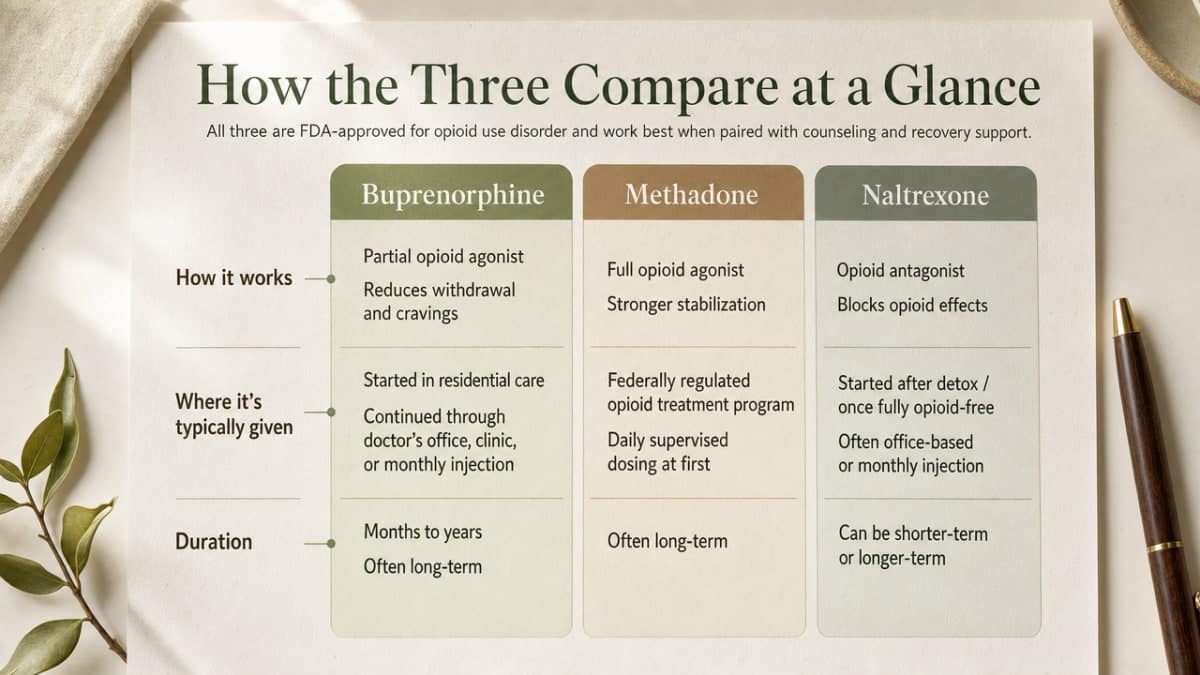
How the Three Compare at a Glance
If you’re trying to keep these straight in your head — especially before a call with an admissions team — here’s the plain-English version. All three are FDA-approved for opioid use disorder, including OUD tied to prescription opioids like oxycodone 4. All three are described in SAMHSA’s treatment protocol as effective options that work best when paired with counseling and recovery support 5.
| Medication | How it works | Where it’s typically given | What to expect for duration |
|---|---|---|---|
| Buprenorphine | Partial opioid agonist — activates receptors partially to reduce withdrawal and cravings | Started in residential care; continued through a doctor’s office, clinic, or monthly injection | Months to years; often long-term |
| Methadone | Full opioid agonist — activates receptors more completely for stronger stabilization | Federally regulated opioid treatment program with daily dosing, then earned take-homes | Months to years; often long-term |
| Naltrexone | Opioid antagonist — blocks receptors so opioids produce no effect | Monthly injection after 7–10 opioid-free days, typically at the end of residential care | Continued as long as it’s helping |
The right medication is the one that fits his history and holds. If a program only offers one, ask why.
What the First Two Weeks in Residential Care Look Like
Assessment and Medically Supervised Withdrawal
The first 24 hours are quieter than most people expect. There’s paperwork, yes, but the real work is a long conversation. A clinician asks him how much he’s been taking, how often, for how long, what he’s tried before, what other prescriptions he’s on, whether he drinks, whether he sleeps. They check his vitals. They order labs. They ask about his mental health history — depression, anxiety, past trauma — because those things shape what medication is safe and what therapy will actually help.
Then withdrawal management begins. This is the part you may have been most afraid of. Medically supervised withdrawal means nurses monitoring him around the clock, medications to ease the muscle aches, nausea, sweats, and restless legs, and a physician adjusting the plan as his body settles.
Here’s the important part: withdrawal management is not the treatment. It’s the doorway. The CDC is explicit that detoxification on its own is not recommended because it raises the risk of return to use and overdose 3. A serious program treats these first days as a stabilization phase — the setup for what comes next.
Starting Medication While Still Inpatient
Somewhere between day two and day five, once the worst of the acute withdrawal has begun to lift, the medication conversation gets concrete. This is when he’ll typically be started on buprenorphine or methadone if he and his care team choose one of those. If the plan is naltrexone, the timeline is longer — he’ll need to be fully opioid-free for seven to ten days before the first injection.
Starting medication inside residential care is not a shortcut or a crutch. SAMHSA’s treatment protocol is clear that medication for OUD should be integrated with residential care, and patients in those settings should have access to it 6. If a program tells you they want him “stable and clean” before considering medication, that is not current practice. Ask them why.
Therapy That Runs Alongside, Not Instead Of, Medication
Once he’s steadier, the days start filling in. Individual counseling. Group sessions with other men working through the same thing. Education about how opioids changed his brain and what recovery physically looks like. Maybe cognitive behavioral therapy, motivational interviewing, or trauma-focused work if his history calls for it.
The order here matters. Therapy runs alongside medication, not instead of it. The 2024 clinical practice update is explicit that psychosocial interventions can be adjunctive but should not be a gatekeeper to medication 8. He shouldn’t have to earn buprenorphine or methadone by completing a certain number of groups first.
What you might notice on a family call around week two is that he sounds more like himself. Slower, tired, maybe emotional — but present. That’s the medication holding the floor steady so the therapy has somewhere to stand.
Where Family Fits In — and What Real Involvement Looks Like
Somewhere in the intake paperwork, there will be a release for him to sign — the one that says the clinical team can talk to you. Whether he signs it is his choice. Whether the program actively encourages him to sign it tells you a lot about the program.
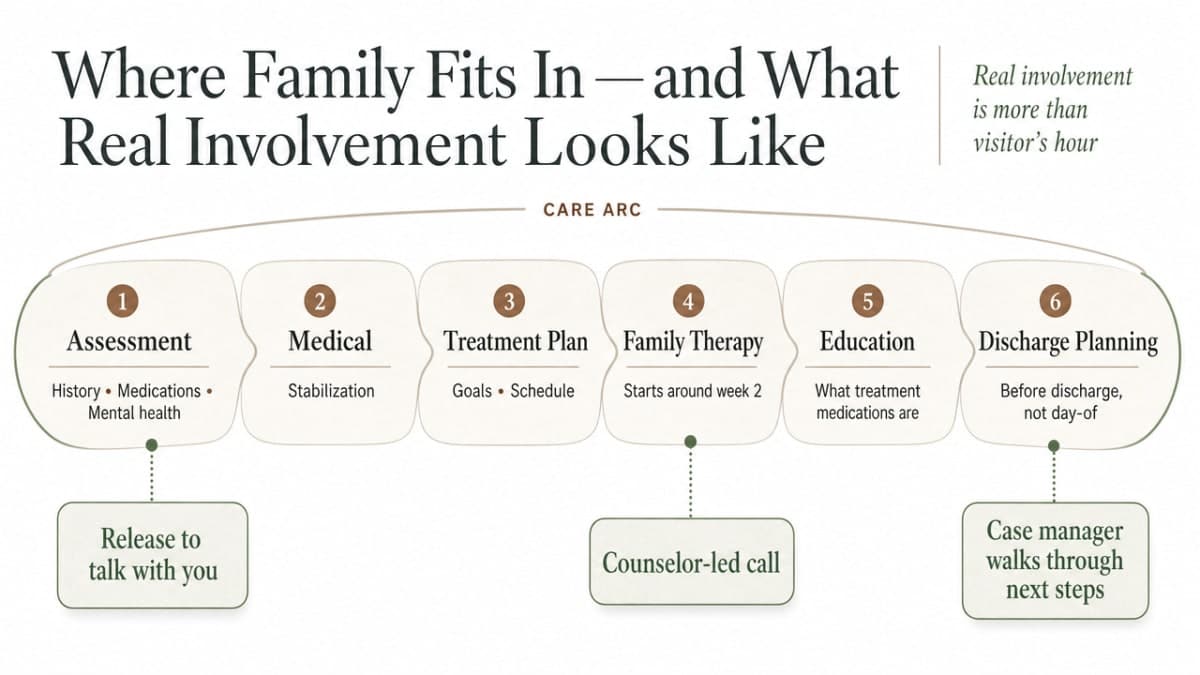
Real family involvement is not a Sunday visitor’s hour. It looks like a scheduled family therapy call, usually starting in the second week, with a counselor in the room. It looks like education sessions where someone explains what buprenorphine actually is so you’re not googling it at midnight. It looks like a case manager who calls you before discharge, not the day of, to walk through what’s coming next.
Here is the arc a good residential program will show you, and where you fit into it:
- Assessment. The clinical intake — his history, his medications, his mental health.
- Medically supervised withdrawal. Around-the-clock monitoring and comfort medications, not treatment on its own 3.
- MOUD initiation. Buprenorphine, methadone, or naltrexone started inside residential care, not withheld until later 6.
- Therapy and family work. Individual counseling, group sessions, and the family calls where your voice belongs 5.
- Discharge planning. A named prescriber, a first outpatient appointment on the calendar, and a plan for you.
- Ongoing MOUD and aftercare. The medication continues. So does the support.
Ask the admissions team where families plug into that arc. If the answer is a single visitor’s day and a discharge phone call, that’s a red flag. If they can name the week family therapy starts and who runs it, that’s a program that expects you to be part of the work.
You are not a bystander here. You’ve been managing this longer than anyone. A serious team will treat that experience as information, not interference.
Discharge Is Not Graduation
Why Medication Often Continues for Months or Years
The day he comes home is not the finish line. It’s the handoff.
One of the hardest expectations to reset — for him and for you — is the idea that residential treatment ends with a clean slate and a wave goodbye. Medication for opioid use disorder is not a bridge you burn on the way out. SAMHSA describes buprenorphine as part of a comprehensive treatment plan that can continue in a doctor’s office for as long as it’s helping, sometimes for months, sometimes for years, sometimes indefinitely 11. Methadone and naltrexone follow the same logic. You continue what works.
This is worth saying plainly because a lot of men come home ready to “be done” with the medication too. Family members sometimes push in that direction as well, quietly, wondering when he’ll be “off everything.” That instinct is understandable. It’s also the moment where a lot of recoveries come apart.
If he’s still on buprenorphine at the six-month mark, or the eighteen-month mark, that is not a plateau. That is treatment working exactly as designed 5.
The Post-Discharge Overdose Risk No One Told You About
Here is the part admissions counselors sometimes skip, and you deserve to hear it directly.
Ongoing MOUD blunts that risk. So does a discharge plan with a named prescriber, a first outpatient appointment already on the calendar, naloxone in the house, and people — including you — who know the plan.
Ask for all of it before he walks out the door.
How to Tell a Serious Program from a Marketing Site
By now you’ve probably clicked through half a dozen sites that all look the same. Soft-focus photos of a lake. Words like “holistic,” “whole-person,” “personalized.” A phone number that goes to someone very warm who never quite answers your question.
Here is the short list of things a serious program will say plainly on the phone. Bring it to your next call.
- “Yes, we offer buprenorphine, methadone, or naltrexone, and we can start it during residential care.” All three are FDA-approved for OUD tied to prescription opioids like oxycodone 4. A program that doesn’t offer at least one, or that will only “discuss it later,” is out of step with current clinical practice 8.
- “He does not have to complete groups or prove himself to earn medication.” Psychosocial care runs alongside MOUD, not as a gatekeeper to it 8.
- “Withdrawal management is medically supervised, and it’s the beginning of treatment, not the whole thing.” If the pitch is a stand-alone detox with a discharge at day seven, that is the exact scenario the CDC warns against 3.
- “Here is when family therapy starts and who runs it.” A specific week and a named clinician. Not “we’re family-focused.”
- “He will leave with a named outpatient prescriber, a first appointment on the calendar, and a plan to continue medication.” Continuation of buprenorphine in a doctor’s office is standard, not a red flag 11.
If an admissions counselor bristles at these questions, that is your answer. If they walk through each one without defensiveness, you’re probably in the right conversation.
What You Can Do This Week
You don’t have to solve this by Sunday. But there are a few things you can do in the next seven days that will change what happens next.
Write down what you’ve seen. Dates, refills, mood shifts, physical signs. Not to build a case against him — to give an intake team accurate information when the time comes.
Make three calls, not thirty. Ask each admissions team the same short question: “Do you start buprenorphine, methadone, or naltrexone during residential care, and how do you handle the handoff to an outpatient prescriber?” The answers will sort themselves quickly.
Learn the name of one medication. Just one. Buprenorphine is a fine place to start 11. You don’t need a pharmacology degree — you need to stop feeling ambushed by vocabulary.
Find one person to tell. A sibling, a friend, a therapist of your own. You’ve been carrying this alone for too long.
If a residential program in Little Rock fits what you’re looking for, Serenity Park Recovery Center is one place to start that conversation.
Frequently Asked Questions
Is detox alone enough to treat oxycodone addiction?
No. Getting the drug out of his body is a medical event, not the treatment. The CDC states plainly that detoxification on its own is not recommended because it raises the risk of return to use, overdose, and overdose death 3. A serious program treats withdrawal as the doorway and starts medication for OUD before he leaves.
How long will he need to stay on buprenorphine or methadone?
Longer than most families expect, and that is normal. SAMHSA describes buprenorphine as part of a comprehensive treatment plan that continues for as long as it is helping — months, years, sometimes indefinitely 11. Methadone follows the same logic. Staying on the medication at six or eighteen months is treatment working, not treatment stalling.
What’s the difference between buprenorphine, methadone, and naltrexone?
All three are FDA-approved for opioid use disorder tied to prescription opioids like oxycodone 4. Buprenorphine partially activates opioid receptors to ease cravings. Methadone fully activates them for stronger stabilization, dispensed through federally regulated programs. Naltrexone blocks the receptors entirely and requires seven to ten opioid-free days before the first monthly injection 5.
How are families included during residential treatment?
If he signs a release, the clinical team can talk with you. Real involvement usually means scheduled family therapy calls starting around week two, education sessions that explain the medication he’s on, and a case manager who walks you through discharge before the day arrives. TIP 63 names family and recovery supports as core to the plan 5.
How can I tell if a treatment program is actually evidence-based?
Ask three questions. Does the program start buprenorphine, methadone, or naltrexone during residential care 6? Is medication offered without requiring him to complete groups first 8? Will he leave with a named outpatient prescriber and a first appointment on the calendar 11? Clear yes answers point to current practice. Vague answers point elsewhere.
Why is the period right after discharge considered high-risk?
After a stretch of abstinence, his tolerance drops fast. The old amount can now be fatal, which is one reason the CDC warns that detoxification alone raises overdose risk 3. Roughly 806,000 people died from opioid overdoses between 1999 and 2023 10. Ongoing MOUD, a named prescriber, and naloxone in the house blunt that risk.
References
- Results from the 2024 National Survey on Drug Use and Health. https://www.samhsa.gov/data/sites/default/files/reports/rpt56287/2024-nsduh-annual-national-report.pdf
- Results from the 2024 National Survey on Drug Use and Health: Detailed Tables. https://www.samhsa.gov/data/sites/default/files/reports/rpt56484/NSDUHDetailedTabs2024/NSDUHDetailedTabs2024/2024-nsduh-detailed-tables-sect5pe.htm
- Guideline Recommendations and Guiding Principles – CDC. https://www.cdc.gov/overdose-prevention/hcp/clinical-guidance/recommendations-and-principles.html
- Treatment Options for Substance Use Disorder. https://www.samhsa.gov/substance-use/treatment/options
- TIP 63: Medications for Opioid Use Disorder. https://library.samhsa.gov/sites/default/files/pep21-02-01-002.pdf
- Executive Summary. https://www.ncbi.nlm.nih.gov/books/NBK574916/
- ASAM National Practice Guideline for the Treatment of Opioid Use Disorder. https://www.samhsa.gov/resource/ebp/asam-national-practice-guideline-treatment-opioid-use-disorder
- Management of opioid use disorder: 2024 update to the national clinical practice guideline. https://pmc.ncbi.nlm.nih.gov/articles/PMC11573384/
- NSDUH Data Spotlight: Medications for Opioid Use Disorder among Adults Who Had an Opioid Use Disorder. https://www.samhsa.gov/data/sites/default/files/reports/rpt56616/2024-nsduh-spotlight-moud.pdf
- Understanding the Opioid Overdose Epidemic. https://www.cdc.gov/overdose-prevention/about/understanding-the-opioid-overdose-epidemic.html
- What is Buprenorphine? Side Effects, Treatment & Use. https://www.samhsa.gov/substance-use/treatment/options/buprenorphine
- 2022-2024 NSDUH: Past Year Marijuana Use or Past Year Opioid …. https://www.samhsa.gov/data/report/nsduh-22-24-marijuana-opioid-use-pop-characteristics
- CDC Guideline for Prescribing Opioids for Chronic Pain. https://www.cdc.gov/mmwr/volumes/65/rr/rr6501e1.htm