
Key Takeaways
- Arkansas men seeking care can access affirming treatment at Serenity Park Recovery Center in Little Rock, where inclusion is built into individualized clinical care rather than offered as a separate LGBTQ track.
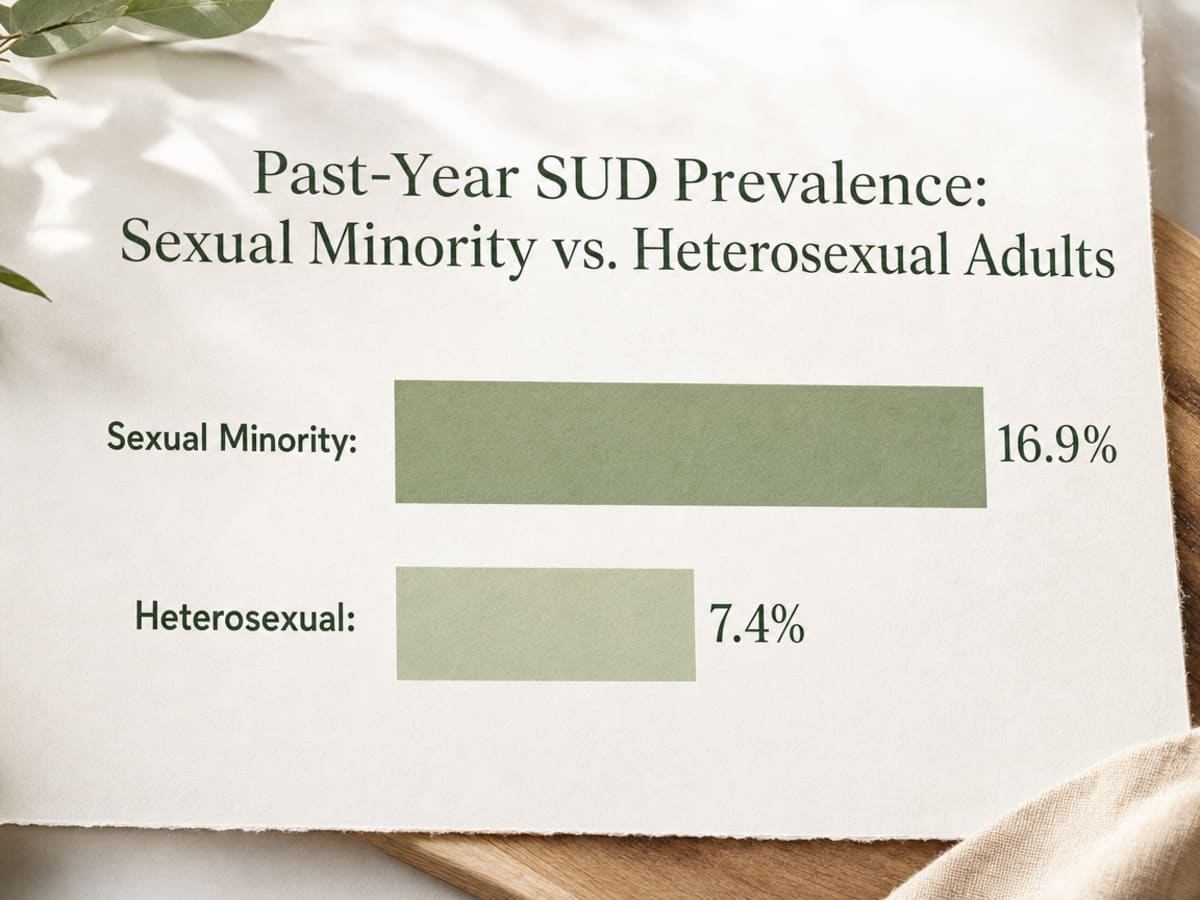
- Past-year substance use disorder affects 16.9% of sexual minority adults versus 7.4% of heterosexual adults 3, making affirming clinical practice a treatment necessity, not a marketing gesture.
- Decision factors include chosen name and pronouns in the chart, staff trained on minority stress, partners included in family therapy, enforced conduct policies, and disclosure controlled by the client 1.
- Before committing, call the intake team and ask specific questions about pronoun handling, counselor training, partner involvement, response to homophobic comments, and records confidentiality to gauge whether practice matches the promise.
What a gay or bi man actually wants to know before he calls a men’s rehab
You are not being paranoid for asking whether a men’s-only residential program in Arkansas will be safe for you. The question sits under every other question you have about detox, cost, and time off work. And it deserves a real answer before you dial the intake line.
Here is the honest version. Yes, Serenity Park Recovery Center in Little Rock is LGBT and gay friendly. Not as a slogan, and not as a separate track bolted onto the men’s program. Inclusion is treated as part of the individualized clinical care every resident receives, which means your identity shows up in your treatment plan the same way your medical history, your career pressures, and your relationships do.
What you probably want to know first is more practical than that:
- Will the counselor running Wednesday’s process group flinch when you mention your husband or your boyfriend?
- Will the other 19 men on the unit know your business only because you had to explain who is on your visitor list?
- Will therapy actually name minority stress and internalized shame as relapse drivers, or will it dance around them?
- If someone says something ugly on the unit, what happens next?
Those are the answers this guide gives you. Direct, specific, and grounded in what affirming addiction care looks like in practice 1. You do not have to come out to get help here. You can, though, and it will be met with care.
Why affirming care is a clinical requirement, not a marketing badge
Here is the number that changes the shape of this conversation. In a recent analysis of National Survey on Drug Use and Health data, past-year substance use disorder ran at 16.9% among sexual minority adults compared with 7.4% among heterosexual adults 3. That is a U.S. adult sample, self-reported, and it captures alcohol and drug disorders together. The gap is more than double.
Read it slowly. It is not a claim that being gay or bisexual causes addiction. It is a signal that something in the environment around sexual minority men keeps producing higher rates of the disease this program treats. Minority stress. Chronic anticipation of rejection. Bars and apps as the default social infrastructure in many towns. The quiet compounding of shame that started in middle school and never fully went away.
If a residential program serving men in Arkansas ignores that context, it is not treating your addiction. It is treating a version of your addiction that leaves out the fuel.
At Serenity Park, inclusion is written into the individualized care model, not held separately as an LGBTQ track. That distinction matters. You are not routed to a specialty group that meets on Tuesdays. You are treated as one of the twenty men on the unit, with a plan that reflects who you actually are. The wearable on your wrist reports the same biometric data whether you are married to a woman or a man. The psychiatrist reviewing your medications asks the same clinical questions. The difference is that no one on the team is going to require you to translate your life into a shape that fits their assumptions before they can help you get sober.
What affirming looks like on a men’s unit at Serenity Park
The concrete practices, not the poster on the wall
Skip the mission statement. Here is what affirming care actually looks like when you walk through the door.
Your chosen name and pronouns go into the chart at intake, not just the legal name your insurance card requires. That means the nurse on the second shift, the counselor running Wednesday’s process group, and the psychiatrist doing your medication review all see the same thing when they pull up your file. You do not have to correct anyone three times a day.
Staff receive training on minority stress, not a single one-hour module from 2016. The counselors know what internalized homophobia sounds like when a man talks about the night his use spiked. They know the difference between a partner and a roommate when you describe who you live with. This training is one of the specific practices LGBTQ+ clients name when they describe treatment that actually worked for them 1.
Partners are included in family therapy sessions when you want them there. Your husband, your boyfriend, the man you have been seeing for eight months. He gets the same seat your father or brother would get. The clinical team does not ask him to sit in the waiting room while a sibling gets to sit in the session.
Therapy names homophobia and biphobia as relapse triggers by their actual names. Not “stress.” Not “life stuff.” If the drinking picked up after your father stopped calling, that goes on the whiteboard.
The conduct policy for residents explicitly covers sexual orientation and gender identity. That gives staff a clear tool if another resident crosses a line.
And disclosure is yours to control. You tell the intake nurse what she needs to know clinically. What the group hears is up to you 1.
Safety on a small men’s-only census: what happens if a resident says something
This is the fear you probably will not say out loud on the intake call. You are sober for the first time in years, sitting in a circle with nineteen other men, and one of them makes a comment about “guys like that.”
What happens next is not left to chance.
The research on residential treatment is blunt about what goes wrong in programs that do not plan for this. Transgender and sexual minority residents have described enacted stigma that ranged from name-calling to violence from other residents, and felt stigma that pushed them to hide their identity or leave treatment early 9. A silent unit is not a safe unit. It is a unit where the target learns to disappear.
At Serenity Park, the small census works in your favor. Twenty men is not a crowd. Staff know who is on the unit, who is struggling that week, and what the room felt like at breakfast. A comment does not get lost in the noise.
If something is said, the clinical team addresses it directly, in the moment when possible. The resident who said it gets a conversation about the conduct policy he agreed to on day one. You get a check-in from your counselor that is not performative and does not require you to relive it in front of the group unless you choose to.
Anticipated discrimination is itself a documented driver of treatment avoidance and worse outcomes 6. The point of a real safety response is not just to correct one man’s behavior. It is to keep you from spending your first week bracing for the next comment instead of doing the work you came here for.
Discretion, disclosure, and who gets to know
Confidentiality is the piece you have probably rehearsed the most. Who has to know you were here. What shows up on paperwork. Whether the guy in group who works two exits down from your office is going to see your name on a sign-in sheet and connect it to something else six months from now.
Here is how disclosure actually works at Serenity Park.
What the intake nurse needs is clinical. Substances, dosages, medical history, medications, prescribers, allergies, psychiatric history, current relationships that matter to your care. Your sexual orientation or the gender of your partner belongs in the record only to the extent it shapes your treatment. If your husband is your emergency contact and family session participant, that goes in the chart. If your identity is relevant to the stressors driving your use, your counselor documents it the way she would document any other clinical factor. It is not gossip. It is your medical record, protected under the same federal rules that protect everything else in it.
What the group hears is different, and it is yours to decide.
You can complete a full residential stay and never disclose your orientation to another resident. You can also mention your boyfriend on day three because pretending otherwise is exhausting and that exhaustion is part of what got you here. Both are legitimate choices. Neither one becomes the unit’s teaching moment. LGBTQ+ clients in the 2024 qualitative research were specific about this: affirming programs let identity disclosure stay a clinical decision between the client and his team, not a group-therapy performance 1.
The small census helps. Twenty men means the front desk is not paging your name across a lobby. Visitor lists are handled quietly. Discharge planning happens in your counselor’s office, not in a shared workspace.
For the professional reader, that discretion extends outward. Records go where you authorize them to go. Your employer, your EAP, your primary care doctor, your attorney, your spouse. Each release is a separate decision you sign. Nothing about your identity travels with a records request unless you say it does.
Intersectional risk and why one gay man’s treatment plan is not another’s
Two gay men can walk into the same intake office with the same drug of choice and need genuinely different treatment plans. Not because one is sicker than the other, but because the pressures pushing on each of them are not identical, and the plan has to name what is actually happening.
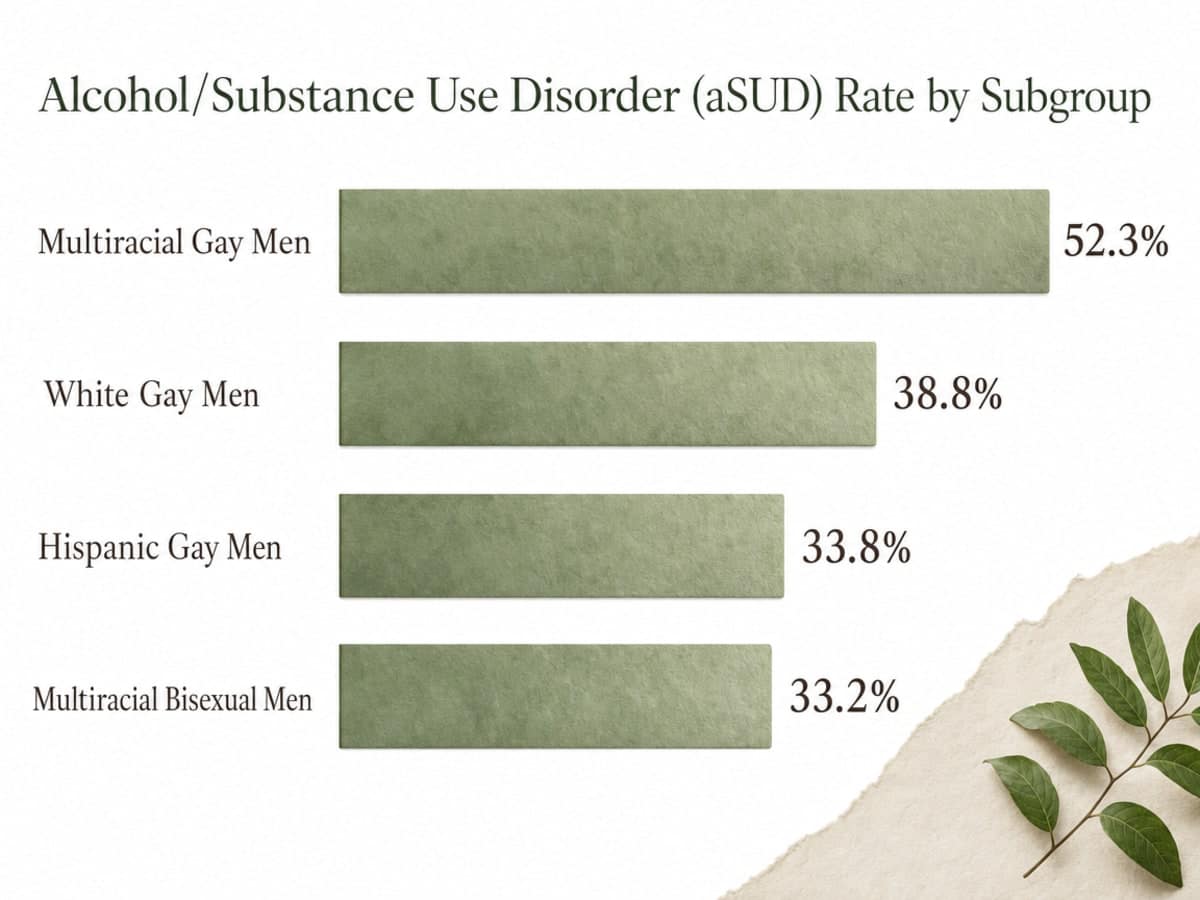
A 2025 analysis of alcohol and substance use disorder among male sexual minority subgroups made this visible in a way that is hard to ignore:
- Multiracial gay men carried an aSUD rate of 52.3%.
- White gay men, 38.8%.
- Hispanic gay men, 33.8%.
- Multiracial bisexual men, 33.2% 4.
Those numbers do not describe individual destiny. They describe the weight of overlapping identities in a country that still hands out different bills to different people.
If you are a Black or multiracial gay man in central Arkansas, the family conversations you have had about your orientation are not the same as the ones your white coworker has had. The church you grew up in, the neighborhood you go home to, the reception you get at a mostly-white gay bar, the second-guessing you do at work about which parts of yourself to show at which meeting. Layered stigma is not a slogan. It is a documented driver of both substance use and the reluctance to trust a treatment provider with the full picture 8.
A bisexual man carries a different set of assumptions into the room. Bisexual erasure is real, and it shows up in therapy when a counselor keeps redirecting the conversation to whichever gender the client is currently dating, as if the other half of his history stopped existing at intake.
At Serenity Park, individualized care means your plan is built from your life, not a template. Your counselor asks about race, faith, family of origin, work environment, and relationship history because those are the pieces that shape what recovery has to hold. The wearable data on your wrist tracks sleep and stress the same way for every resident. What the clinical team does with those readings, and what conversations they open in your one-on-one sessions, gets specific to you.
That is what culturally attuned care looks like on a men’s unit. Not a separate curriculum. A plan that fits the man in front of it.
Trans and nonbinary inquiries: an honest answer about a men’s residential setting
If you are trans or nonbinary and reading this for yourself, or if you are a partner or family member trying to figure out whether to make the call, you deserve a straight answer instead of a brochure.
Serenity Park is a men’s residential program. That is the structure of the facility, from housing to bathrooms to the composition of every group on the schedule. For a trans man who lives as a man, whose identification and daily life reflect that, the program can be a genuine fit, and the same individualized care principles apply: chosen name and pronouns in the chart, staff who do not require you to educate them, therapy that names the specific stressors shaping your use.
For a nonbinary person, or for someone earlier in transition, the honest answer is that a men’s-only residential setting is not automatically the right clinical match. The research on residential treatment is clear about what goes wrong when programs treat sex-segregated housing as neutral: enacted stigma from other residents, felt stigma that pushes clients to hide, and the structural friction of bathrooms and sleeping arrangements that do not match who someone is 9. Provider knowledge gaps compound the problem in programs that have not done the work 10. And the discrimination itself is a documented driver of continued use 6.
The right move is a real conversation with the intake team before you commit. Tell them who you are and what you need. If Serenity Park is a clinical fit, the plan will reflect that from day one. If a different setting would serve you better, an honest intake call will say so and help point you toward one. Either answer is care.
Detox, therapy, and psychiatric care without asking you to hide
Detox is the part most men underestimate. Alcohol withdrawal can be medically serious. Benzodiazepine tapers take real time. Stimulant crashes bring the kind of depression that convinces you nothing was worth it. None of that gets easier by pretending you are someone you are not while a nurse checks your vitals every four hours.
At Serenity Park, medically supervised detox runs on clinical data, not on your willingness to perform. The wearable on your wrist tracks heart rate, sleep, and stress readings around the clock, and the medical team uses those numbers to adjust medications and monitor risk. Your orientation is not a variable in the withdrawal protocol. It is a variable in the conversation your counselor has with you the next morning about what actually got you here.
One-on-one therapy is where the difference shows up most. Your counselor is going to ask about the relationships that shape your use. Not in a checklist voice. In a way that lets you say his name out loud without watching her face for a reaction. Anticipated discrimination is a documented driver of relapse and treatment avoidance, which is a clinical way of saying that if you spend your sessions editing yourself, you are not getting the treatment you paid for 6.
Group therapy runs on the same rules as the rest of the unit. You talk about what you want to talk about. If a process group opens up a conversation about shame, and the shame you carry has a specific shape because of who you have loved and who told you that was wrong, that goes on the table. Therapy that names homophobia and biphobia as relapse triggers by their real names is one of the practices LGBTQ+ clients consistently describe as the difference between treatment that stuck and treatment that did not 1.
Psychiatric care is integrated, not siloed. Depression, anxiety, trauma, and ADHD show up in this population at rates that make dual diagnosis the rule rather than the exception 7. The psychiatrist reviewing your medications knows that a gay or bisexual man walking into detox often carries a psychiatric history that has been managed unevenly for years, sometimes by prescribers who never asked the right questions. Medication management here is a clinical conversation, not a checkbox.
You do not have to hide to get better care. You get better care because you do not have to hide.
The intake call: questions to ask any Arkansas facility
The first phone call is shorter than you think. Fifteen minutes, sometimes less. You can learn a lot about a program from how the person on the other end handles the questions below. Ask them of Serenity Park. Ask them of anyone else you are considering.
- “How does your intake process handle chosen name, pronouns, and orientation in the chart?”
- A program that has done the work answers this in a sentence, not a paragraph of throat-clearing. At Serenity Park, chosen name and pronouns go into the record at intake and follow you through every shift change.
- “What training have your counselors had on minority stress and LGBTQ-specific clinical issues?”
- Listen for specifics. The affirming-care research is clear that generic diversity training does not translate into clinical skill; what LGBTQ+ clients recognize is a counselor who does not need the concept explained to them 1.
- “If I want my partner involved in family therapy, is he treated the same as any other family member?”
- The answer should be yes, without qualification.
- “What happens if another resident makes a homophobic comment during my stay?”
- A vague answer here is the answer. You want to hear about the conduct policy, staff response, and follow-up with you.
- “Who sees my orientation in the record, and what leaves the facility with a records request?”
- Nothing about your identity should travel unless you sign for it.
- “Does therapy address homophobia, biphobia, and internalized shame as relapse drivers by name?”
- If the answer softens the language, the therapy will too.
Call Serenity Park. Ask every question above. You will get straight answers, and you will get them from someone who has heard the questions before.
Staying in Little Rock instead of flying to Denver or Los Angeles
You have probably seen the ads. LGBTQ-specific programs in Denver, Los Angeles, South Florida. Rainbow flags in the hero image, palm trees or mountains in the background, a price tag that assumes you can also afford a plane ticket and two weeks your employer never sees on the calendar.
There is a case for staying closer to home.
A program in Little Rock keeps you inside a drive from the life you are going back to. Your partner can be at family session on Thursday without a red-eye. Your discharge plan connects to a therapist and a physician you can actually see next month. The transition from residential to real life is the part that most often fails, and geography is one of the reasons.
Affirming care is not a coastal zip code. It is a set of practices 1. Serenity Park has them, in Little Rock, at a twenty-client census that gives you the discretion the destination programs also promise. You do not have to leave the state to be treated like yourself. You have to walk into a program that already knows how.
Frequently Asked Questions
Do I have to come out during intake to get affirming care at an Arkansas rehab?
No. You share what is clinically relevant, and your counselor takes it from there. If your relationships, stressors, or history shape your use, naming that helps your plan fit you. If you would rather wait, that is your call. Affirming care means the door stays open on your timeline, not the program’s 1.
Will other men on the unit know I’m gay or bisexual?
Only if you tell them. Your chart is protected under the same federal rules covering every other medical detail. Group conversations belong to you. Some men mention a partner on day three because hiding is exhausting. Others complete a full stay without disclosing. Both are legitimate, and neither turns you into the unit’s topic.
Can my partner be included in family therapy sessions?
Yes. Your husband, boyfriend, or the man you have been building a life with gets the same seat a spouse or sibling would get. Family work is one of the places recovery either holds or falls apart after discharge, and the person you go home to belongs in that room when you want him there.
What happens if another resident says something homophobic to me?
Staff address it directly, using the conduct policy every resident agreed to at admission. The other man gets a real conversation, not a shrug. You get a check-in from your counselor that does not require you to perform the incident for the group. Anticipated discrimination is itself a documented driver of worse outcomes, so the response is clinical, not cosmetic 6.
Does Serenity Park accept trans or nonbinary clients in its men’s residential program?
For a trans man living as a man, the program can be a genuine clinical fit, with chosen name and pronouns in the chart from day one. For nonbinary clients or someone earlier in transition, a men’s-only residential setting is not automatically the right match 9. Call the intake team, describe who you are, and get an honest answer before you commit.
Is it worth staying in Little Rock instead of traveling to a coastal LGBTQ-specific rehab?
Often, yes. Affirming care is a set of practices, not a zip code 1. Staying local keeps your partner reachable for family sessions, your discharge therapist and physician within driving distance, and your return to daily life connected to the plan you built in treatment. Geography is one of the biggest reasons aftercare fails.
References
- Experiences of and recommendations for LGBTQ+-affirming substance use treatment: A qualitative study. https://pmc.ncbi.nlm.nih.gov/articles/PMC10765665/
- Transgressing gender norms in addiction treatment. https://digitalcommons.montclair.edu/cgi/viewcontent.cgi?article=1171&context=social-work-and-child-advocacy-facpubs
- Sexual Minorities and Substance Use Treatment Utilization in the United States. https://pmc.ncbi.nlm.nih.gov/articles/PMC10330745/
- Examining gender, race/ethnicity, and sexual orientation in alcohol, substance, cannabis, and stimulant use disorders. https://pmc.ncbi.nlm.nih.gov/articles/PMC12169232/
- Prevalence, sociodemographic correlates and DSM-5 substance use disorders and other psychiatric disorders among sexual minorities in the United States. https://pubmed.ncbi.nlm.nih.gov/27883948/
- Transgender-related Discrimination and Substance Use, Substance Use Disorders, and Substance Use Treatment. https://pmc.ncbi.nlm.nih.gov/articles/PMC8114322/
- Sexual orientation and gender identity disparities in substance use disorders and multiple substance use disorders among U.S. young adults. https://pmc.ncbi.nlm.nih.gov/articles/PMC7437659/
- Exploring the intersectionality of stigma and substance use among sexual and gender minority people. https://pubmed.ncbi.nlm.nih.gov/37939481/
- A qualitative study of transgender individuals’ experiences in residential addiction treatment settings: Stigma and inclusivity. https://pmc.ncbi.nlm.nih.gov/articles/PMC4432520/
- Barriers to treatment of substance use in transgender individuals. https://nida.nih.gov/international/abstracts/barriers-to-treatment-substance-use-in-transgender-individuals