
Key Takeaways
- 12-Step Facilitation is a manualized clinical protocol delivered session by session in treatment, not a referral to AA, and the distinction is what the Cochrane evidence actually measured 2.
- Little Rock’s dense meeting network across Downtown, Hillcrest, the Heights, and West Little Rock functions as a clinical asset, keeping the handoff from residential care into community recovery short and workable.
- For men with co-occurring diagnoses, TSF pulls people into 12-step involvement but does not replace psychiatric care, so medication management and mental health counseling need to sit alongside it 4.
- Before committing to a residential program, compare whether TSF is truly manualized, whether a psychiatrist is on staff, when aftercare planning begins, and how specific Little Rock meetings get assigned before discharge.
The Difference Between Being Told to Go to a Meeting and Being Walked Into Recovery
You have probably been handed a meeting schedule before. Maybe at a hospital discharge. Maybe from a counselor who ran out of time. Maybe from your brother, who meant well.
And you went. Or you didn’t. Either way, you are reading this because it didn’t hold.
That pattern is not a character problem. It is a design problem. Being told to go to AA is not the same as being clinically walked into recovery, and treating those two things as interchangeable is one of the reasons chronic relapse keeps happening to men who genuinely want to stop.
12-Step Facilitation, or TSF, is the clinical answer to that gap. It is a manualized protocol, studied in Cochrane-level reviews, that a trained clinician delivers session by session inside a treatment program 1. It is not a suggestion to go find a meeting. It is structured work that connects what happens in your counselor’s office to what happens in a church basement in Hillcrest on a Tuesday night.
This guide is for you if you have cycled through detox before, or for the people around you trying to help. It explains what TSF actually is, what the evidence shows, and what to look for in a Little Rock residential program that offers it as more than a line on a brochure.
What 12-Step Facilitation Actually Is (And What It Isn’t)
TSF Is a Manualized Clinical Protocol, Not a Referral
Here is the part most people miss.
12-Step Facilitation is a written, session-by-session treatment method that a trained clinician delivers to you. It comes from a manual. There is an order to it. There are specific topics for each session, specific readings, specific homework between sessions. Your counselor is not just telling you AA exists. Your counselor is teaching you, one meeting at a time, how the 12 steps work, what the language means, what to expect at a meeting, how to pick a sponsor, and how to keep going when the first meeting feels strange.
The evidence base rests on this distinction. The Cochrane review that pushed AA/TSF into mainstream clinical practice specifically found that manualized versions of TSF outperformed other established treatments for producing abstinence, while non-manualized approaches showed a weaker signal 2. In plain terms: the protocol matters. Structured facilitation is what the research measured, not a phone number scribbled on discharge paperwork.
That is why a program’s answer to “do you do 12-step facilitation?” should sound like a curriculum, not a shrug. Sessions have names. Clinicians have training. Progress is tracked. If a program cannot describe what happens in session four versus session eight, you are looking at referral culture with a clinical label pasted on the front.
How a TSF Session Differs From an AA Meeting
An AA meeting is peer-run. People take turns sharing. There is no clinician in the room, no chart, no treatment plan. That is by design, and it is part of why AA works for so many people.
A TSF session is clinical. You sit down with a counselor, one-on-one or in a small group, and you work through material. Session topics might include acceptance, surrender, the role of a sponsor, or how to handle a craving after a meeting ends. You get assignments. You come back the next session and talk about what happened when you tried them.
Think of it this way. AA is where recovery lives. TSF is where a professional teaches you how to move in. One is community. The other is coaching you into that community while you are still in a bed on the treatment side of the door.
That difference is what makes TSF useful for a man who has been to meetings before and did not stick. If “just go to AA” already failed you, the missing piece was probably not more meetings. It was the guided translation between clinical care and the room.
Does It Work? What the Evidence Actually Says
Short answer: yes, and the evidence is better than most people think.
The Cochrane review is the highest tier of evidence in medicine. It pools multiple randomized trials and asks a simple question: compared to other real treatments, does this thing work? For AA and TSF in alcohol use disorder, the answer came back clear. AA and manualized TSF performed at least as well as cognitive behavioral therapy and motivational enhancement therapy on most drinking outcomes, and were superior on continuous abstinence and long-term remission 1. On healthcare cost, AA/TSF tended to reduce spending, largely by shifting some of the work from paid clinicians to free peer support in the community 1.
Read that again, because it matters. The comparison was not TSF versus nothing. It was TSF versus the treatments most residential programs consider their strongest tools. And on the outcome that men who have relapsed care about most, staying stopped, TSF came out ahead.
A few honest limits belong here.
Most of that evidence is on alcohol use disorder, not every substance. The signal is strongest when TSF is delivered from a manual, session by session, rather than as informal encouragement to attend meetings 2. And TSF works partly by getting you into the room and keeping you there, which means the strength of the local recovery community matters. Little Rock has that community. That is a factor in your favor, not a footnote.
What this evidence does not say is that TSF is magic. It says that for alcohol, done as designed, it holds up next to the best treatments medicine has and often outperforms them on the outcome that defines recovery. If you have been told AA is not “real” treatment, the research disagrees, and has for years.
The Chronic Relapse Pattern TSF Is Built to Interrupt
Detox, Discharge, Drift: Why Stabilization Alone Keeps Failing You
You know the shape of this by now.
You get sick enough, or scared enough, or someone loves you hard enough, and you go in. Detox works. It always does, in the short term. Your body clears. You sleep. You eat a real breakfast for the first time in weeks. Around day five, you feel almost human. By discharge, you feel like maybe this time is different.
Then you go home.
The first week is white-knuckle but manageable. The second week, work stress comes back, or your marriage is still your marriage, or the friend who always calls calls again. Someone hands you a meeting list. You mean to go. You go once, maybe twice. The room feels foreign. Nobody there knows you. Your counselor from the facility is three hundred miles of paperwork away. The gap between the bed you slept in during treatment and the folding chair in a church basement turns out to be wider than anyone told you.
That gap is the drift. It is not you being weak. It is what happens when the clinical container ends and nothing replaces it fast enough.
Where TSF Adds a Bridge Instead of a Handoff
This is the specific problem 12-Step Facilitation was designed for.
TSF does not wait until discharge to introduce you to the recovery community. It starts the introduction inside the program. A clinician sits with you, week one, and walks you through what a meeting will feel like, what the words mean, and how to read a room you have never sat in sober. By the time you leave, you have already been to meetings with staff support, worked through step material with a counselor, and started identifying a home group and a sponsor candidate. The pilot RCT on integrated TSF found that structured facilitation produced substantially higher 12-step attendance than referral-style approaches, which is the exact behavior chronic relapse punishes you for missing 6.
The bridge is not a metaphor. It is scheduled sessions, named steps, assigned reading, and a warm handoff to specific people in specific rooms. When you walk out of residential care, you are not walking toward AA. You are already in it, with a clinical spine still holding you upright while the community takes over the weight.
That is the difference between a handoff and a bridge. One ends. The other carries you across.
What TSF Looks Like Inside Residential Care in Little Rock
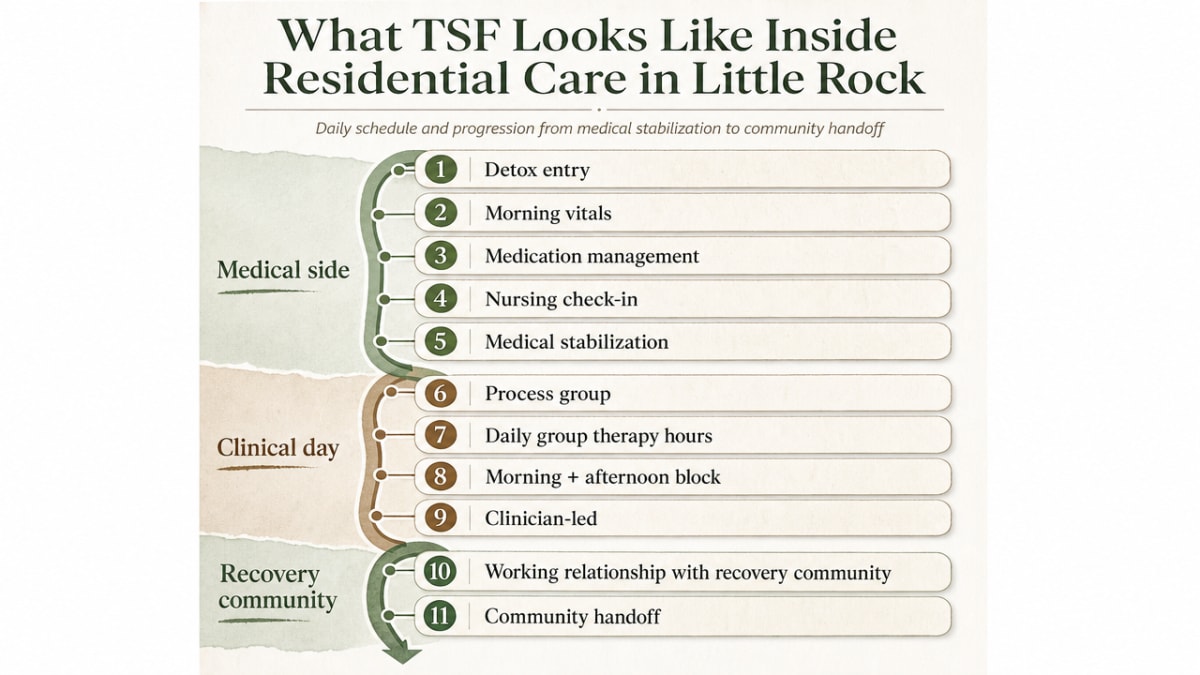
A residential day built around TSF has a shape. It is not therapy scattered between meals. It is a schedule engineered to move you, hour by hour, from medical stabilization into a working relationship with the recovery community.
The day usually opens on the medical side. If you came in through detox, morning vitals, medication management, and a check-in with nursing happen before anything clinical starts. Your body is still doing work. The schedule respects that.
Mid-morning is process group. This is where a lot of the daily group therapy hours live, and in most Arkansas residential settings that block runs several hours across morning and afternoon, consistent with the level-of-care patterns documented in the state’s treatment infrastructure 10. You are in a room with other men. A clinician runs it. The topics track the step you are on, the situations you keep landing in, and what came up in your last individual session.
After lunch, you typically get individual counseling. One counselor. One hour. This is where the private material goes, the things you would not say to eight other men yet. Your counselor is also the person tracking your TSF progress, so the step work you are doing shows up here too.
Late afternoon is often the dedicated TSF session. This is the manualized piece. You sit with a counselor trained in the protocol and work through a specific step, a specific reading, or a specific assignment. Not a discussion of AA. The actual curriculum.
Evening is a community meeting. Often on-site, sometimes off-site with staff, so you are already sitting in the kind of room you will need to sit in after discharge. You practice being there while you still have a team behind you.
Aftercare planning is not a discharge-day event. It runs alongside everything else, week by week, so that by the time you leave, you have a home group identified, a sponsor conversation started, and a schedule of Little Rock meetings mapped to your neighborhood and your work hours. That is what a TSF-integrated day looks like when the pieces are actually connected.
The Local Reality: Arkansas Stakes and Little Rock’s Recovery Infrastructure
The State’s Overdose Numbers Are Improving, But the Treatment Gap Isn’t
Something is finally moving in the right direction here.
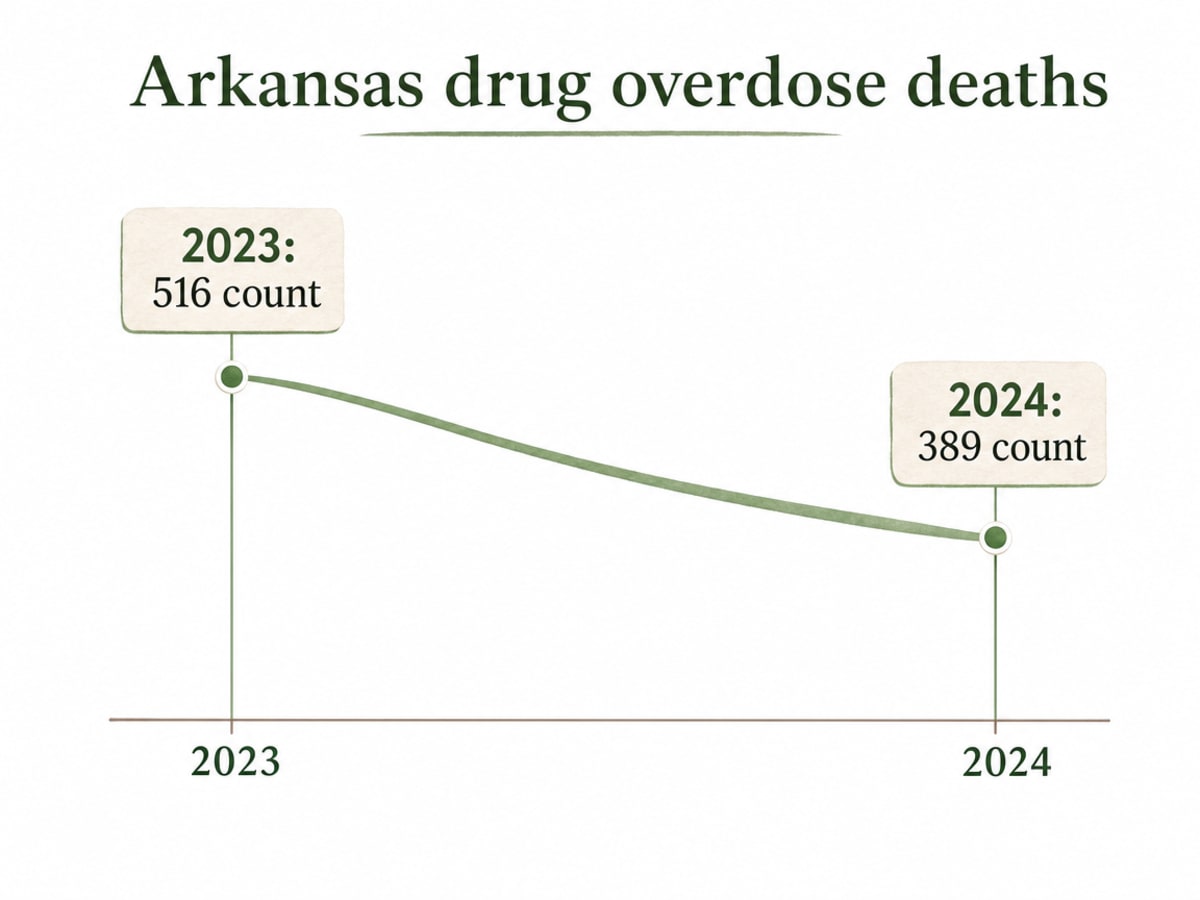
Arkansas recorded 389 drug overdose deaths in 2024, down from 516 in 2023 3. That is a drop of roughly one in four lives, in a single year. Prevention campaigns, naloxone distribution, and better acute care are all doing real work. If you are the man reading this, that number is not abstract. It is people who got another chance.
But a drop in deaths is not the same as a drop in the disease. The 2023 National Survey on Drug Use and Health estimated that most Arkansans classified as needing substance use treatment did not receive it 8. That gap is where chronic relapse lives. Men who never make it into structured care. Men who make it in once, cycle out, and cannot find their way back. Men who count as “treated” because a hospital pulled them through a bad night.
The state’s treatment footprint is real but stretched. On a single reference day in 2019, 167 Arkansas facilities were serving 7,640 clients across every level of care 10. That includes outpatient, intensive outpatient, and residential beds combined. Residential slots, especially ones built around a manualized clinical method like TSF, are a smaller slice of that pie than the headline number suggests.
What that means for you: fewer deaths, same crowded door. Getting into the right kind of program still takes intention, and the sooner you push through that door, the better your odds hold.
Why Little Rock’s Meeting Density Is a Clinical Asset
Here is something the research does not always say out loud. TSF works partly because it hands you off to a living community, and that community has to actually exist near where you sleep. In Little Rock, it does.
Meetings cluster across the city in ways that map cleanly onto how men here live. Downtown has early-morning meetings that fit before a shift starts. Hillcrest has evening groups tucked into church basements and community rooms that draw a mix of ages and professions. The Heights has quieter, smaller rooms that some men prefer when they are still finding their footing. West Little Rock covers the sprawl out toward Chenal and the suburbs, so a commute is not an excuse.
That density is not a lifestyle detail. It is a clinical asset. When your counselor walks you through what a home group is and how to pick one, the map is already drawn. You are not being asked to drive forty minutes at 6 p.m. every day to a room that meets once a week. You have options within ten minutes of most addresses in Pulaski County.
For a man leaving residential care, that geography is what makes the TSF bridge hold. The meeting is close. The people repeat. The habit builds because friction is low.
If You Have a Co-Occurring Mental Health Diagnosis
This is where you deserve a straight answer, not a pitch.
If you carry a diagnosis alongside your substance use — depression, anxiety, bipolar, PTSD, a serious mental illness — the research on TSF gets more nuanced, and any program that tells you otherwise is selling. A randomized trial in an outpatient dual diagnosis population added a 12-session TSF protocol to treatment as usual for adults with alcohol dependence and serious mental illness. TSF did what it was designed to do: it got people into 12-step rooms and kept them there. But at the group level, the intention-to-treat comparison did not show significantly greater improvement in drinking outcomes than usual care alone 4. A parallel analysis found the same pattern, with greater TSF exposure and 12-step involvement predicting better substance use outcomes for the men who actually engaged, even though the overall group difference stayed modest 7.
Read that carefully, because it cuts both ways.
TSF is not a substitute for psychiatric care. Dropping a manual on top of untreated depression or unmedicated bipolar disorder will not fix either problem. But TSF still pulled people into the recovery community at higher rates, and engagement was linked to better outcomes for the men who stayed.
What that means in practice: the residential program you pick needs a psychiatrist on staff, medication management as a real service, and individual counseling that treats the mental health diagnosis as a first-class problem, not a footnote. TSF sits inside that stack. It does not replace any of it.
For Spouses, Adult Children, and Referring Clinicians
A quick note to the people reading this on his behalf.
If you are his wife, his adult daughter, his son, or the primary care doctor who has watched him come back through your office one too many times, the thing you need to know is this: the difference between a program that mentions 12-step work and a program that delivers it as a manualized clinical protocol is the difference between a suggestion and a treatment 2. That distinction matters most for a man who has already tried the suggestion version and it did not hold.
What to ask, in plain terms:
- Is TSF delivered from a manual, session by session, by a trained clinician?
- Is there a psychiatrist on staff for medication management alongside the step work?
- Does aftercare planning start in week one, not on discharge day?
- Does the program map him to specific Little Rock meetings before he leaves, or hand him a printed list?
His history of relapse is not disqualifying information. It is the clinical picture. Bring it into the intake call.
How to Vet a Residential TSF Program Before You Commit
You are going to make a phone call. Maybe your wife will make it. Either way, the intake conversation is where you find out whether a program actually delivers TSF or just lists it on a website.
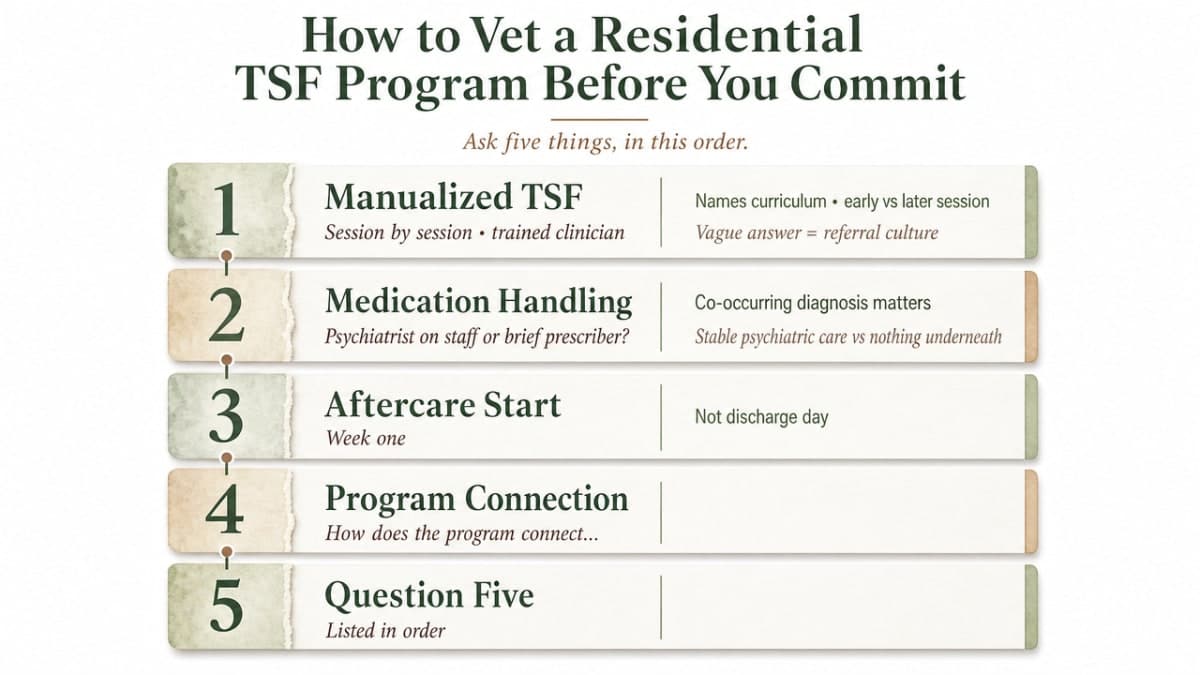
Ask five things, in this order.
Is TSF delivered from a manual, session by session, by a clinician trained in the protocol? A real answer names the curriculum and describes what happens in an early session versus a later one 2. A vague answer means referral culture.
Who handles medication? A psychiatrist on staff, or a prescriber you meet once? For a man with any co-occurring diagnosis, the answer shapes whether TSF sits on top of stable psychiatric care or on top of nothing 4.
When does aftercare planning start? Week one is the right answer. Discharge day is the wrong one.
How does the program connect you to specific Little Rock meetings before you leave? You want names of home groups, not a printout.
What happens if you relapse after discharge? A program that treats relapse as a clinical event, not a failure, has thought this through.
If the answers hold up, you have found the bridge. Serenity Park Recovery Center is one place in Little Rock built around that model.
Frequently Asked Questions
Is 12-Step Facilitation the same thing as going to AA?
No. TSF is a manualized clinical protocol delivered by a trained counselor, session by session, that teaches you how to engage with the 12 steps and use meetings well 2. AA is peer-run community support in the room. TSF is the clinical bridge that gets you into that room and keeps you coming back.
Does TSF work if I’ve relapsed multiple times before?
Yes. In the Cochrane review, manualized TSF performed at least as well as CBT and MET on drinking outcomes and was superior for continuous abstinence and long-term remission 1. Your relapse history is clinical information, not a verdict. It tells the program what to build around, especially the handoff into ongoing community support.
Can TSF help if I also have depression, anxiety, or another mental health diagnosis?
It can help, but with honest limits. A dual diagnosis RCT found TSF increased 12-step participation, and greater participation predicted better substance use outcomes, though the group-level intention-to-treat comparison did not beat usual care 4. Translation: TSF pulls you into recovery, but it does not treat the psychiatric diagnosis. You need medication management and mental health counseling alongside it.
What does a day in a TSF-integrated residential program actually look like?
Mornings start on the medical side with vitals and medication. Then several hours of process group with a clinician. After lunch, individual counseling. Late afternoon is the dedicated manualized TSF session, working a specific step. Evening is a community meeting, often with staff support. Aftercare planning threads through the whole week, not just discharge day.
What should I ask a Little Rock residential program to confirm they actually deliver TSF?
Five questions. Is TSF delivered from a manual by a trained clinician, session by session 2? Is a psychiatrist on staff for medication management? Does aftercare planning start in week one? Will you leave with specific Little Rock home groups identified, not just a printout? And how does the program handle a relapse after discharge?
What happens after residential treatment ends?
You step into the community you have already been practicing in. A home group in Downtown, Hillcrest, the Heights, or West Little Rock. A sponsor conversation already started. Continuing care groups and alumni support on the clinical side. The point of TSF is that discharge is not an ending. It is the handoff you were prepared for.
References
- Alcoholics Anonymous and 12-Step Facilitation Treatments for Alcohol Use Disorder: A Distillate of a Cochrane Review. https://pmc.ncbi.nlm.nih.gov/articles/PMC8060988/
- Alcoholics Anonymous and Other 12-Step Programmes for Alcohol Dependence. https://odphp.health.gov/healthypeople/tools-action/browse-evidence-based-resources/alcoholics-anonymous-and-other-12-step-programmes-alcohol-dependence
- Substance Misuse Education and Prevention. https://healthy.arkansas.gov/programs-services/prevention-healthy-living/substance-misuse-education-and-prevention/
- 12-Step Facilitation for the Dually Diagnosed: A Randomized Clinical Trial. https://pmc.ncbi.nlm.nih.gov/articles/PMC3976999/
- Leave the Past Behind by Recognizing the Effectiveness and Cost-Effectiveness of Alcoholics Anonymous and 12-Step Facilitation. https://pmc.ncbi.nlm.nih.gov/articles/PMC8243271/
- A Pilot Randomized Clinical Trial Testing Integrated Twelve-Step Facilitation (iTSF) for Adolescent Substance Use Disorder. https://pmc.ncbi.nlm.nih.gov/articles/PMC5673563/
- 12-step facilitation for the dually diagnosed: a randomized clinical trial. https://pubmed.ncbi.nlm.nih.gov/24462479/
- ARKANSAS – National Survey on Drug Use and Health: 2023 State Estimates. https://www.samhsa.gov/data/sites/default/files/reports/rpt56188/2023-nsduh-sae-state-tables_0/2023-nsduh-sae-state-tabs-arkansas.pdf
- Behavioral Health Barometer: Arkansas, Volume 6. https://www.samhsa.gov/data/sites/default/files/reports/rpt32820/Arkansas-BH-Barometer_Volume6.pdf
- National Survey of Substance Abuse Treatment Services (N-SSATS): Arkansas, 2019. https://www.samhsa.gov/data/sites/default/files/quick_statistics/state_profiles/NSSATS-AR19.pdf
- Behavioral Health Barometer: Arkansas, Volume 5. https://www.samhsa.gov/data/sites/default/files/cbhsq-reports/Arkansas-BH-BarometerVolume5.pdf
- Behavioral Health Barometer: Arkansas, Volume 4. https://www.samhsa.gov/data/sites/default/files/Arkansas_BHBarometer_Volume_4.pdf
- 2024 TEDS-D Arkansas. https://www.samhsa.gov/data/node/56302