
Key Takeaways
- Arkansas’ Act 964 eliminated prior authorization for buprenorphine, methadone, and naltrexone across insurers and Medicaid, placing these medications on the lowest cost-sharing tiers 2.
- Opioid dependence is a receptor-level biological problem, and abstinence-only 30-day programs carry a documented mortality spike in the weeks after discharge when tolerance drops 9.
- A credible Arkansas program is OADAP-licensed, coordinates MAT during and after residential care, screens for co-occurring psychiatric conditions at intake, and respects 42 CFR Part 2 confidentiality 13, 7.
- Before committing, ask a prospective program specific questions about licensure, MAT handoff, on-staff psychiatric evaluation, discharge prescriber, and experience with your profession — vague answers are a signal to keep looking.
The Physical Grip You’re Trying to Break
You already know something most people around you don’t: opioids don’t loosen their hold because you decide they should.
If you’ve tried to stop and found yourself back at the bottle, the fentanyl-laced pill, the pharmacy run, the friend-of-a-friend text — that isn’t a character defect. Opioids bind to receptors in your brain and gut that regulate pain, mood, sleep, and stress response. When those receptors have adapted to a daily supply, taking it away sets off a physiological cascade: bone-deep aches, sweats, insomnia, gastrointestinal chaos, and a specific kind of dread that makes any other problem feel manageable by comparison. That’s not weakness. That’s neurochemistry doing exactly what it evolved to do.
The stakes are also higher than they were a decade ago. Fentanyl has changed the arithmetic of every relapse, and overdose remains a leading cause of preventable death nationally, with medications for opioid use disorder consistently linked to reduced opioid use and overdose deaths 5. One bad night, one miscalculated dose after a period of not using — that’s how people who were otherwise stabilizing die.
Here’s what matters for you right now: the treatments that work for opioid dependence are not the same as what works for someone who drinks too much or uses stimulants recreationally. Buprenorphine, methadone, and naltrexone exist because willpower alone has a documented failure rate against opioid receptor biology 6. A program built for opioids specifically will start from that fact — not treat it as an inconvenient asterisk.
You don’t need to white-knuckle your way through this. You need care that respects what’s actually happening in your body.
Why Arkansas Rewrote the Rules on Opioid Medications
For years, if a doctor in Arkansas wanted to start you on buprenorphine or Vivitrol, they had to fight your insurance first. Prior authorization forms. Faxed clinical justifications. Days of delay while the person in front of them was still in withdrawal, still at risk. That gap between a good clinical decision and a filled prescription is where people relapsed. It’s where some of them died.
Act 964 closed that gap.
The law requires every health insurer in Arkansas and the state Medicaid program to remove prior authorization for FDA-approved medications used to treat opioid use disorder — buprenorphine, methadone, and naltrexone — and to place them on the lowest cost-sharing tiers of their formularies 2. The American Medical Association called Arkansas’ approach a model for the rest of the country and reiterated what the U.S. Surgeon General has said for years: medication-assisted treatment is the gold standard for opioid use disorder, not a last resort 2.
Arkansas Medicaid put teeth behind the statute. As of January 1, 2020, Suboxone film and buprenorphine tablets no longer require prior authorization, and the Medicaid state plan now assures coverage of naltrexone, buprenorphine, and methadone for any client meeting medical necessity 1, 4. Preferred MAT medications don’t count against monthly prescription limits when they’re part of a treatment plan 12. In plain terms: the paperwork wall came down.
The policy shift was not academic. In 2024, Arkansas recorded 389 drug overdose deaths, down from 516 in 2023 — a real, measurable drop 10. That’s not a victory lap. It’s still more than one Arkansan a day. But it is evidence that expanding access to medication, naloxone, and coordinated treatment moves the number in the right direction.
What this means for you, sitting with the decision in front of you: the legal and coverage barriers your uncle or your college roommate ran into ten years ago are largely gone. If a clinician determines that buprenorphine or naltrexone is the right medication for you, your insurer cannot make you jump through a week of hoops before you start. The state built the on-ramp. You still have to take the exit.
That matters for how you evaluate a residential program too. Any Arkansas treatment center working with opioid use disorder in 2025 should be fluent in this framework — coordinating MAT during your stay, planning for continued medication access after discharge, and treating the medication as part of your recovery, not as a compromise you talked them into.
What MAT Actually Looks Like in Practice
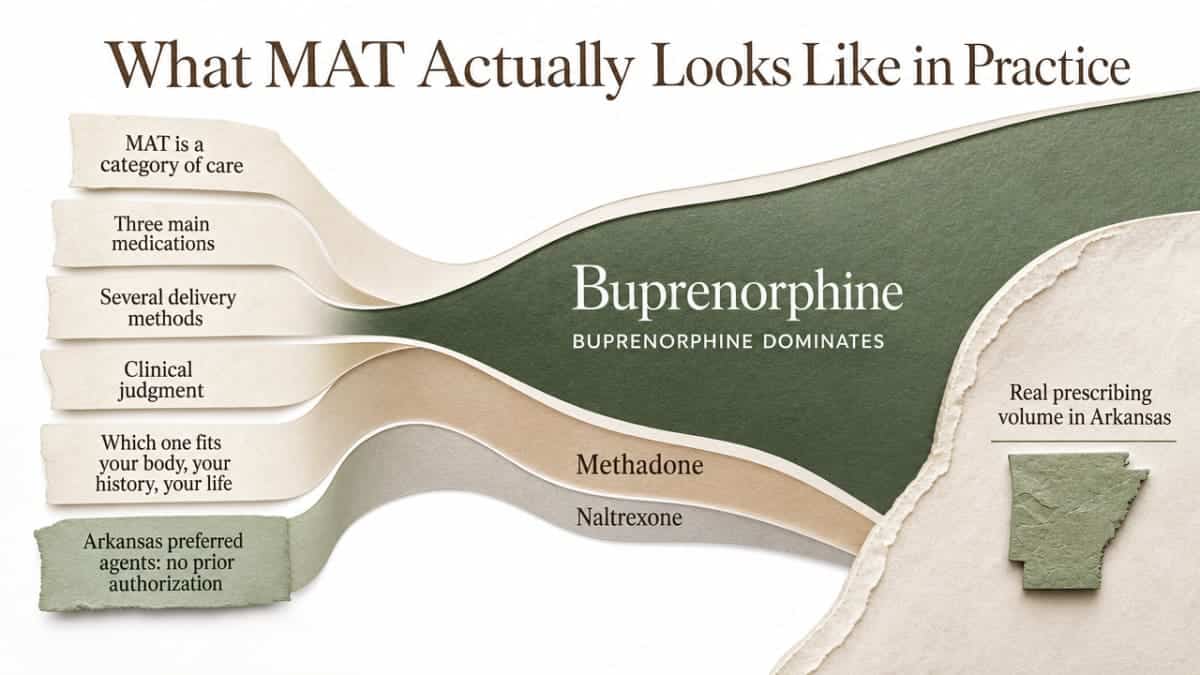
Medication-assisted treatment isn’t a single pill or a single protocol. It’s a category of care with three main medications, several delivery methods, and a lot of clinical judgment about which one fits your body, your history, and your life. If you’ve only ever heard MAT described in passing — usually as “methadone clinics” or “Suboxone” — the actual menu is broader and more flexible than the shorthand suggests. Here’s what a prescriber in Arkansas is likely to walk you through, and how to think about the option that fits.
Buprenorphine, Methadone, Naltrexone: What a Prescriber May Offer
Three medications carry the weight of opioid use disorder treatment in the United States, and all three are covered in Arkansas without prior authorization when they’re the preferred agents 1, 12.
Buprenorphine is the one you’ve probably heard of by its brand names — Suboxone (buprenorphine combined with naloxone) and Sublocade (a monthly injection). It’s a partial opioid agonist, meaning it activates the same receptors as oxycodone or fentanyl, but only partially and with a ceiling effect that makes overdose far less likely. You take it once a day, usually as a film or tablet dissolved under the tongue, and it holds cravings and withdrawal at bay while your brain chemistry recalibrates 6. Prescribers in Arkansas — including primary care physicians who’ve completed the required training — can write for it in an office setting. You do not have to go to a specialty clinic every morning to receive it.
Methadone is a full opioid agonist, longer-acting and more tightly regulated. In Arkansas, methadone for OUD is dispensed only through licensed opioid treatment programs (OTPs) governed by the state’s Office of Alcohol and Drug Abuse Prevention 13. That means daily dosing at a certified clinic, at least at first. It’s the medication with the longest evidence base — decades of data — and it’s often the right call for people with severe, long-duration dependence or a history of failing other approaches.
Naltrexone, sold as Vivitrol in its monthly injectable form, works differently. It’s an opioid antagonist. It blocks the receptors rather than activating them, so if you use while on it, you feel nothing. There’s no physical dependence on naltrexone itself. The catch is that you have to be fully detoxed — typically seven to ten days opioid-free — before your first dose, which is why residential detox often pairs cleanly with a naltrexone start.
These aren’t hypothetical options. Arkansas’ State Opioid Response III grant served 2,131 people with MAT for opioid use disorder between October 2023 and September 2024, with a medication distribution that tells you what’s actually being prescribed at scale: 1,121 clients on buprenorphine, 310 on methadone, and 106 on injectable naltrexone 3, 14. Buprenorphine dominates in Arkansas because it fits into ordinary medical practice — a prescription filled at your pharmacy, follow-ups with a doctor who isn’t running an OTP.
Which medication is right for you is a clinical conversation, not a moral one. It depends on how long you’ve used, what you’ve used, whether you have liver considerations, whether daily clinic visits work with your job, and whether you want the receptor-blocking approach or the receptor-stabilizing one. A good prescriber lays out the trade-offs plainly and lets you weigh in.
The ‘Substituting One Drug for Another’ Myth
You’ve probably heard it, and you may have said it yourself: taking buprenorphine or methadone is just swapping one opioid for another.
It isn’t. And the distinction matters, because believing the myth keeps people out of treatment that would keep them alive.
Here’s what the pharmacology actually shows. MAT medications work by normalizing brain chemistry, blocking the euphoric effects of other opioids, relieving physiological cravings, and restoring normal body functions that opioid dependence has disrupted 6. You don’t get high on a therapeutic dose of buprenorphine. You get to have a morning where your hands don’t shake, your gut works, and your thoughts aren’t hostage to the next dose. That is not the same experience as using — it’s the absence of the physiological chaos that using was trying to fix.
Stigma against MAT is well-documented and operates at individual, social, and structural levels, contributing directly to underuse of the treatments most likely to work 8. Family members repeat the myth. Twelve-step communities sometimes repeat it. Employers repeat it. You don’t have to buy it. The medication is doing a specific pharmacological job, and it’s the job your recovery needs done.
Why 30-Day Abstinence-Only Programs Have a Mortality Problem
Here’s the uncomfortable truth about opioid-specific recovery that a lot of well-meaning programs won’t say out loud: finishing a 30-day abstinence-only stay can leave you more likely to die than when you walked in.
The physiology behind that curve is worth understanding, because it explains why the traditional model fails opioid users specifically.
When you stop using opioids, your tolerance drops fast. The receptors that had adapted to daily fentanyl or oxycodone reset toward baseline within a couple of weeks. What used to be your regular dose is now a lethal dose. If you leave a 28-day program on day 29 without medication in your system and without a plan for one, and you use — because cravings from a still-recalibrating brain don’t respect discharge dates — the amount that felt normal a month ago can stop your breathing tonight 5, 6.
A MAT-informed program changes that math. Buprenorphine keeps enough receptor activity going that cravings quiet down and other opioids can’t produce the same high, so a slip is less likely to become a fatal one 6. Naltrexone blocks the receptors entirely. Methadone stabilizes them at a maintenance level. In each case, the medication is doing work that your prefrontal cortex — the part of you making the decision to stay in recovery — cannot do alone against a brain still asking for the drug.
Compare the two paths honestly:
Willpower-only detox and 30-day abstinence. Withdrawal is managed with comfort medications for a week or so. Cravings are addressed through therapy and group work. Post-discharge, you rely on meetings, resolve, and whatever aftercare you can piece together. Receptor biology gets no direct help. Mortality risk spikes in the weeks after you leave 9.
MAT-informed residential care. Withdrawal is managed with the same medical supervision, but with a clear decision point about whether buprenorphine, naltrexone, or methadone fits your case. Cravings and receptor activity are stabilized pharmacologically alongside the counseling. Discharge planning includes continued medication access — a prescriber lined up, a pharmacy identified, an insurance path clear 6, 9.
The second path is not softer. It’s harder, in the sense that it asks you to stay in treatment longer and treat medication as part of recovery rather than a stepping stone off it. But it’s the path with the evidence behind it. If a program you’re considering treats MAT as optional garnish — or worse, as something you can “try” if abstinence fails — you’re looking at a model built for a different drug than the one you use.
Dual Diagnosis: The Piece Most Programs Underplay
Ask any honest clinician who treats opioid use disorder and they’ll tell you the same thing: the drug is rarely the whole story.
Anxiety that predates the first prescription. Depression that got heavier after the injury, the divorce, the death. Untreated ADHD. PTSD from a deployment, a car accident, a childhood you don’t talk about at work. Chronic pain that started as a real orthopedic problem and turned into a psychiatric one when the pills also started managing your mood. For a lot of high-functioning men, the opioid didn’t create the underlying condition — it just did a better job of numbing it than anything else you’d tried.
That’s why NIDA is explicit that because addiction and other mental illnesses often co-occur, anyone presenting with one should be assessed for the others 7. Not “if symptoms persist.” Not “once you’re stable.” At intake. If a program screens you for opioid use disorder without also taking a serious inventory of your mental health history, they’re treating half the problem and hoping the other half stays quiet. It usually doesn’t.
Here’s where a lot of otherwise decent programs quietly fall short. They’ll manage your withdrawal, run you through group, and hand you a discharge plan — but the psychiatric piece stays thin. No dedicated psychiatric evaluation. No medication management for the depression that comes roaring back once the opioids are gone. No plan for the panic attacks in week three. You leave with your dependence addressed and your underlying anxiety disorder still driving the car.
MAT sits inside this same picture. Buprenorphine or naltrexone can quiet the craving loop, but if a major depressive episode is untreated, the risk of returning to use climbs anyway 6, 7. And stigma compounds it — men who’ve been told that needing medication for their mind is a weakness are often the same men who’ve been told that needing medication for their addiction is cheating 8. Both messages are wrong. Both keep people out of care that works.
What to look for, plainly: a program that pairs medically supervised detox with on-staff psychiatric evaluation, ongoing medication management for co-occurring conditions, and a treatment plan that treats depression, anxiety, trauma, or ADHD as core clinical work — not as a footnote after the drug is out of your system. For opioids specifically, that integration isn’t a premium add-on. It’s what separates a program built for the physiology of your problem from one that’s going to send you home half-treated.
What a Credible Arkansas Program Looks Like for a Working Professional
You have a specific problem the average treatment website doesn’t quite address: you can’t disappear for a month without questions, and you can’t afford to end up in a program that treats your job, your license, or your privacy as somebody else’s concern. The good news is that the policy scaffolding in Arkansas now supports serious, medication-informed opioid care in settings built for adults with something to protect. The next two subsections cover what to actually look for.
Licensure, Discretion, and the PDMP Question
Start with the regulatory floor. In Arkansas, the Office of Alcohol and Drug Abuse Prevention is the state authority governing opioid treatment, and any facility providing substance abuse treatment operates under its licensure standards 13. That’s the baseline. A credible program should be able to tell you, without hesitation, what it’s licensed to do and what it isn’t — for example, whether it’s a full opioid treatment program dispensing methadone on-site (most residential centers are not) or a licensed residential program that coordinates MAT through prescribing partners.
Discretion is a separate question, and a real one. Federal confidentiality rules under 42 CFR Part 2 apply to substance use treatment records with tighter protections than standard HIPAA. That doesn’t make you invisible, but it does mean your treatment file cannot be released to your employer, your board, or your spouse without your written authorization. Ask the program to walk you through their release process before you commit to anything.
The PDMP question comes up often, particularly for physicians, dentists, CRNAs, and pharmacists. Arkansas’ Prescription Drug Monitoring Program logs every Schedule II–V controlled substance dispensed in the state, and certain prescribers are required to check it before writing opioid prescriptions 11. If you’re worried that entering treatment will somehow trigger a flag on you, the mechanics matter: the PDMP tracks dispensing, not diagnosis. Being prescribed buprenorphine as part of your own treatment is a legitimate medical record, not a disciplinary event. Most licensing boards have monitoring programs specifically designed to keep professionals in practice while they get care. A program that works with professionals should already know the pathway.
Residential Setting, Small Capacity, and Coordinated Medication Care
The environment where you detox and stabilize is not a lifestyle preference. It’s a clinical variable.
A small-capacity residential setting — fewer men, more clinical attention per person, quieter days — makes it easier to run a real psychiatric evaluation alongside your withdrawal management, adjust medications in response to how your body is actually responding, and coordinate the piece that decides your first year out: a MAT-informed discharge plan with a prescriber and pharmacy lined up before you leave 6, 9. UAMS’ own MAT program requirements name this as first-line care for moderate-to-severe opioid use disorder, not an alternative track 15.
What to ask, plainly: Does the program have on-staff psychiatric evaluation? Who prescribes the MAT — a physician on-site or a coordinated outpatient partner? What does the handoff look like on discharge day? If those answers are vague, keep looking. If they’re specific, you’re talking to a program built for the drug you’re actually trying to leave behind.
How to Evaluate a Program in a Single Phone Call
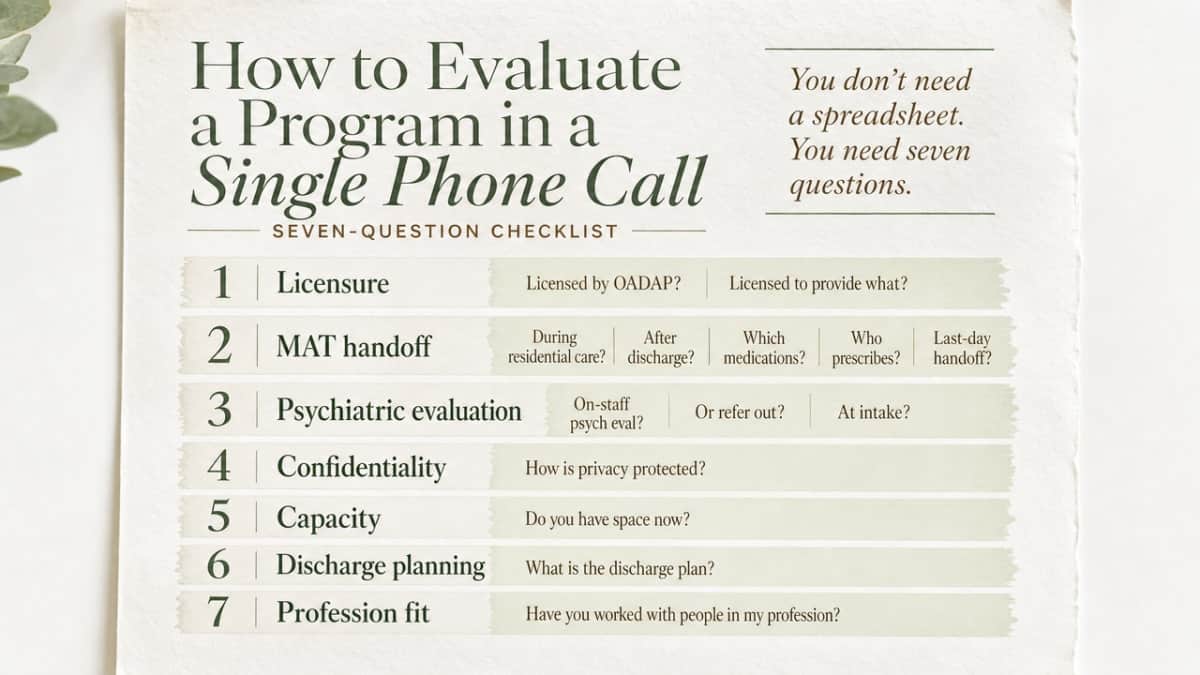
You don’t need a spreadsheet. You need seven questions and the willingness to hang up if the answers wander.
“Are you licensed by OADAP, and what specifically are you licensed to provide?” A serious program answers this in one sentence 13. Vague answers about “accreditation” without naming the state authority are a signal.
“How do you handle MAT during residential care and after discharge?” Listen for specifics: which medications they coordinate, who prescribes, and what the handoff looks like on your last day. If they treat buprenorphine or naltrexone as something you “try” only if abstinence fails, that’s the wrong model for opioids 6, 15.
“Do you have on-staff psychiatric evaluation, or do you refer out?” Co-occurring conditions get assessed at intake in a credible program, not deferred to “once you’re stable” 7.
“What’s your process for releasing information — and not releasing it?” They should describe 42 CFR Part 2 without prompting and walk you through how disclosures to a spouse, employer, or licensing board work.
“How many men are in the program at once?” Small capacity is a clinical variable, not a marketing point. Ask what the clinical-staff-to-client ratio actually is.
“What does discharge planning include — specifically?” You want to hear: prescriber identified, pharmacy identified, follow-up appointment scheduled, insurance path confirmed. The weeks after residential care are the highest-risk window for opioid users 9. A program that treats discharge as a paperwork exercise is not built for the drug you’re trying to leave.
“What have you done for men in my profession before?” You don’t need names. You need to hear that they’ve worked with physicians, attorneys, executives, or tradesmen and understand the licensure and monitoring pathways that go with each.
If a program handles those seven questions with specifics, you’re talking to a team that takes opioid recovery seriously. If they redirect to amenities, testimonials, or how quickly they can admit you, keep dialing.
Frequently Asked Questions
Will my employer or licensing board find out if I go to residential treatment in Arkansas?
Not automatically. Substance use treatment records are protected under 42 CFR Part 2, which is stricter than standard HIPAA and blocks disclosure to your employer, board, or family without your written authorization. Two caveats: if you use employer-sponsored insurance, claim data may show a facility name, and some professional licensing boards require self-disclosure or participate in monitoring programs that keep you working while you get care. Ask the intake team how they handle releases before you commit.
Do I have to take medication like buprenorphine or methadone, or can I detox off opioids without it?
You can medically detox without ongoing MAT, but the evidence is clear that mortality risk climbs sharply in the weeks after opioid substitution treatment stops 9. Your tolerance drops during a drug-free stay, and if you use again, the old dose can be fatal. Choosing not to continue medication is a legitimate personal decision — but it should be an informed one, not a default. A good prescriber walks you through buprenorphine, naltrexone, and methadone honestly and lets you weigh the trade-offs 6.
Does Arkansas Medicaid or private insurance actually cover MAT now?
Yes. Under Act 964, every health insurer operating in Arkansas and the state Medicaid program must cover FDA-approved MAT medications — buprenorphine, methadone, and naltrexone — without prior authorization and on the lowest cost-sharing tiers 2. Arkansas Medicaid removed prior authorization on Suboxone film and buprenorphine tablets effective January 1, 2020, and preferred MAT agents don’t count against monthly prescription limits when they’re part of a treatment plan 1, 12. Call your carrier to confirm your specific formulary and copay.
How long does someone typically stay on buprenorphine or naltrexone after leaving residential care?
There’s no fixed timeline, and anyone who quotes one is guessing. The clinical evidence shows mortality risk is substantially lower during active medication treatment than after it stops, which is why many prescribers recommend staying on MAT for at least a year, and often longer 9. Some people taper off after 18 to 24 months of stable recovery. Others stay on maintenance indefinitely, the same way someone stays on blood pressure medication. The decision belongs between you and your prescriber, not a calendar.
If I’m a prescriber, will the PDMP flag me for seeking my own treatment?
The PDMP logs Schedule II–V controlled substances dispensed in Arkansas — it tracks prescriptions, not diagnoses 11. Being prescribed buprenorphine as a patient shows up as a legitimate medical record, not a disciplinary event. What triggers board attention is usually a pattern of self-prescribing, diversion, or impaired practice — not entering treatment. Most licensing boards (medical, dental, pharmacy, nursing) run confidential physician or professional health programs designed to keep you licensed while you get care. Contact yours directly, ideally through an attorney who knows the pathway.
What’s the difference between an opioid treatment program (OTP) and a MAT-informed residential program?
An OTP is a federally certified clinic licensed to dispense methadone and other MAT medications on-site, typically for daily dosing, and regulated in Arkansas by the Office of Alcohol and Drug Abuse Prevention 13. A MAT-informed residential program is different: it’s a licensed residential treatment center that coordinates MAT through prescribing partners, manages medically supervised detox, and builds discharge plans that keep buprenorphine or naltrexone in place after you leave 15. If you need methadone maintenance, you’ll need an OTP relationship either way.
References
- MAT memorandum – Arkansas Department of Human Services. https://humanservices.arkansas.gov/wp-content/uploads/MATmemo.doc
- Arkansas sets standard for states by removing prior authorization for medication-assisted treatment. https://www.ama-assn.org/press-center/ama-press-releases/arkansas-sets-standard-states-removing-prior-authorization
- Award Number: 5H79TI085733-02 – SOR III Closeout Report. https://humanservices.arkansas.gov/wp-content/uploads/SOR3-Closeout-Report-9.2024-1.pdf
- Final Filing Packet – MAT Rule 133 (Arkansas Medicaid State Plan Amendment). https://humanservices.arkansas.gov/wp-content/uploads/Final-Filing-Posting-Packet-MAT-Rule-133.pdf
- Drug Overdose Deaths – Facts. https://www.cdc.gov/drugoverdose/facts/index.html
- How do medications to treat opioid use disorder work?. https://nida.nih.gov/publications/research-reports/medications-to-treat-opioid-use-disorder/how-do-medications-treat-opioid-use-disorder
- DrugFacts: Treatment Approaches for Drug Addiction. https://nida.nih.gov/publications/drugfacts/treatment-approaches-for-drug-addiction
- Stigma and opioid use disorder: a systematic review. https://www.ncbi.nlm.nih.gov/pmc/articles/PMC7729128/
- Mortality risk during and after opioid substitution treatment: systematic review and meta-analysis. https://www.ncbi.nlm.nih.gov/pmc/articles/PMC8166989/
- Substance Misuse Education and Prevention – Arkansas Department of Health. https://healthy.arkansas.gov/programs-services/prevention-healthy-living/substance-misuse-education-and-prevention/
- Arkansas Prescription Drug Monitoring Program Rules and Regulations. https://www.sos.arkansas.gov/uploads/rulesRegs/Arkansas%20Register/2016/feb2016/007.07.15-003.pdf
- 016.29.23 Ark. Code R. 004 – Medication Assisted Treatment (MAT). https://www.law.cornell.edu/regulations/arkansas/016-29-23-Ark-Code-R-004
- Part 433. Licensure Standards for Substance Abuse Treatment Programs. https://codeofarrules.arkansas.gov/Rules/Rule?levelType=part&titleID=20&chapterID=128&subChapterID=170&partID=666&subPartID=null§ionID=null
- 2024 – Arkansas State Opioid Response (SOR) III Final Evaluation Report. https://humanservices.arkansas.gov/wp-content/uploads/WYSAC-SOR-3-Final-Eval-Report-12162024.pdf
- Improving Access to Treatment for Opioid Use Disorder. https://psychiatry.uams.edu/clinical-care/outpatient-care/cast/improving-access-to-treatment-for-opioid-use-disorder/