
Key Takeaways
- Arkansas requires certified behavioral health programs to be ‘co-occurring capable,’ but that rule only mandates screening and matched interventions, not integrated treatment by one clinical team.3
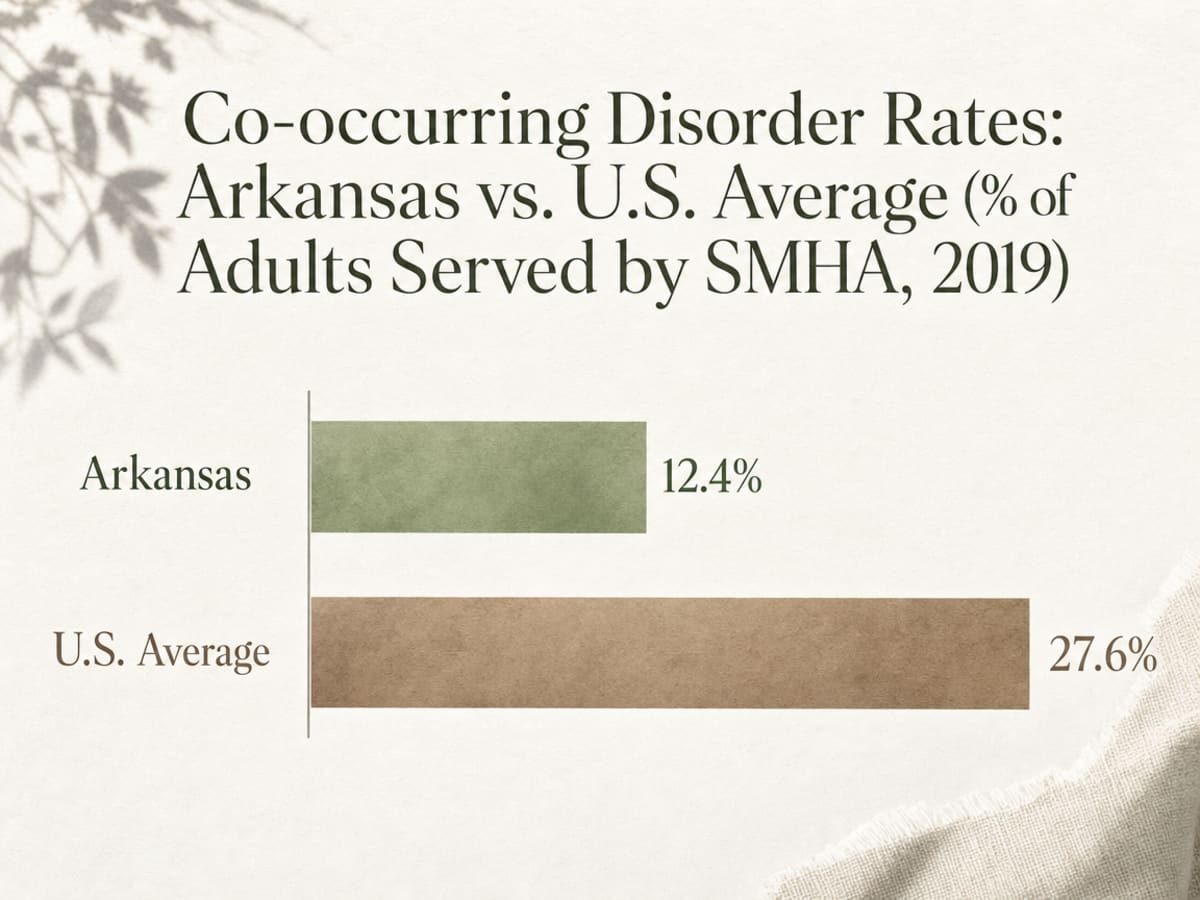
- Only 12.4% of adults in Arkansas’s state mental health system were identified with co-occurring disorders versus a 27.6% national average, pointing to under detection rather than lower prevalence.9
- When comparing Arkansas programs, ask whether the psychiatrist attends weekly rounds, when the psychiatric evaluation happens, and whether both diagnoses live on one chart — those answers separate integrated care from sequential care in new packaging.
- Before admitting anywhere, call and ask the five vetting questions out loud; the phone conversation, not the website, reveals whether a program treats both conditions together or hands the mental health piece off.
The 90-Day Relapse Pattern You Already Recognize
You know the shape of it. Detox goes well. Twenty-eight days feel like a reset. You come home clearer, lighter, ready. Then week six arrives with a flatness you can’t explain. By week ten, the anxiety is louder than it was before you ever picked up a drink. By day ninety, you’re back where you started, and this time you’re also carrying the shame of having tried.
That pattern isn’t a character flaw. It’s a treatment gap. When a program dries you out and sends you home without touching the depression, anxiety, trauma, or attention issues sitting underneath, the substance use tends to come back on schedule. Researchers describe this bluntly: co-occurring disorders are “the rule rather than the exception” in treatment settings, and treating them separately produces worse outcomes than treating them together.16
If you’ve cycled through one or two programs already, you don’t need another lecture on discipline. You need a clinical explanation for why the last round didn’t hold, and a different structure this time. That’s what this article is about: what dual diagnosis actually means in Arkansas, how integrated care differs from what you’ve probably already tried, and what to look for before you admit anywhere.
What Dual Diagnosis Actually Means in Clinical Practice
Dual diagnosis is a plain description of what’s true for most men in treatment: a mental health condition and a substance use disorder living in the same body at the same time. SAMHSA calls it co-occurring disorders and defines it exactly that way — the presence of both a mental illness and a substance use disorder in one person. Depression with alcohol use. PTSD with cocaine. ADHD with cannabis and stimulants. Anxiety with almost anything that turns down the volume.1
The clinical definition matters less than what it rules out. Dual diagnosis is not one condition causing the other in a tidy line. It’s not “the drinking is really the problem” or “treat the trauma and the pills will take care of themselves.” Both diagnoses are real, both are active, and both need treatment on their own terms. Arkansas’s own behavioral health rules use the same framing, defining a co-occurring disorder as “any combination of mental health and substance use disorder symptoms or diagnoses” in a single client.3
That combination is common enough that researchers describe co-occurring disorders as the rule rather than the exception in treatment settings. If you’ve been told your case is unusual or complicated, it isn’t. It’s the majority presentation. What’s unusual is finding a program actually built to treat both sides at once.16
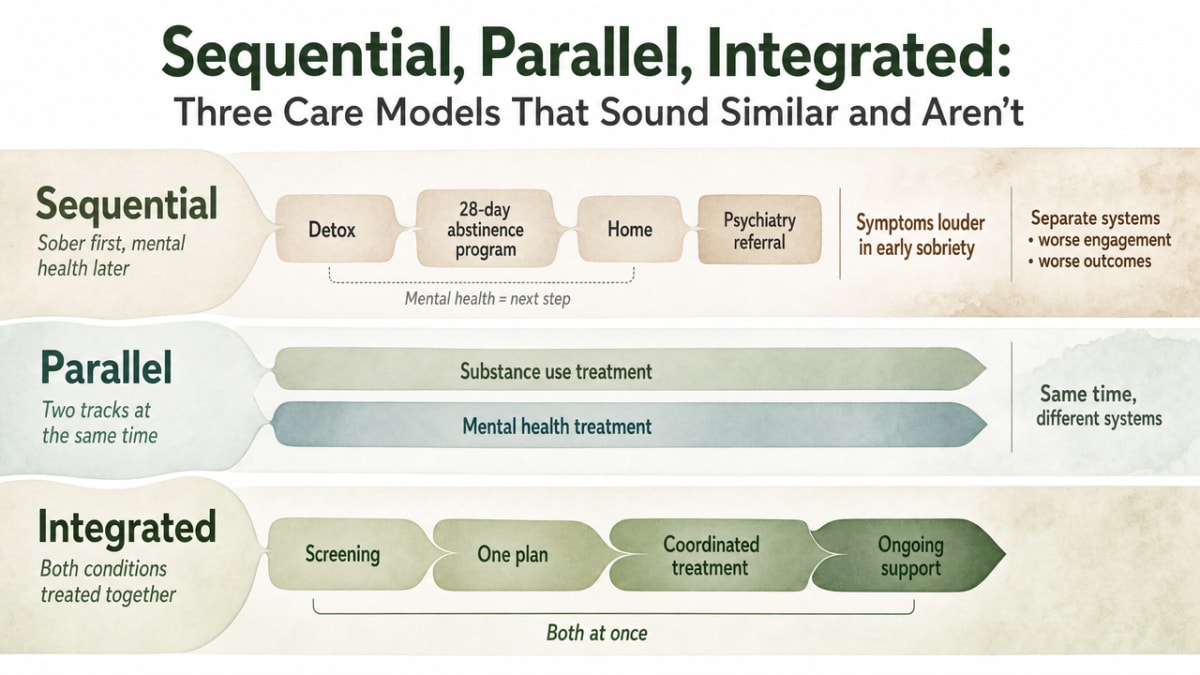
Sequential, Parallel, Integrated: Three Care Models That Sound Similar and Aren’t
Sequential Care: Sober First, Then Maybe Your Mental Health
Sequential care is the model most men in Arkansas have already lived through. You go to detox, then to a 28-day program focused on abstinence, then home with a referral card for a psychiatrist you may or may not call. The mental health piece is treated as a next step, not a current one.
The logic sounds reasonable: get sober, then see what’s really going on underneath. The problem is that untreated depression, anxiety, or PTSD doesn’t wait politely for month two. It gets louder in early sobriety, and the substance that muffled it is gone. SAMHSA’s clinical guideline for co-occurring disorders is direct about this: sequential treatment through separate systems produces worse engagement and worse outcomes than treating both conditions at once.8
Parallel Care: Two Teams, Two Buildings, One Confused Patient
Parallel care looks more sophisticated on paper. You’re in addiction treatment on Monday, Wednesday, Friday. You see a psychiatrist across town on Tuesday. A therapist somewhere else handles the trauma work. Everyone knows about everyone, in theory.
In practice, you become the messenger. You explain your medication list to a counselor who isn’t sure how naltrexone interacts with your SSRI. You describe last week’s group session to a psychiatrist who has fifteen minutes and no chart access. When something goes sideways at 9 p.m., no one owns the response. TIP 42 identifies this fragmentation as the reason parallel treatment underperforms: coordination lives in your head, not in a shared plan, and the seams between systems are where relapse happens.8
Integrated Care: Same Clinicians, Same Room, Same Plan
Integrated care collapses the two systems into one. SAMHSA’s TIP 42 defines it in almost mechanical terms:
“the same clinicians, or team of clinicians, working in one setting, providing appropriate treatment for both mental disorders and substance use disorders… in a coordinated fashion”.8
One chart. One team meeting. One treatment plan that lists your alcohol use disorder and your generalized anxiety on the same page, with interventions matched to both.
What that looks like from your side of the table: the physician who manages your detox medications is the same physician talking to the psychiatrist about your antidepressant. The counselor running your group therapy has read this morning’s psychiatric note. When your sleep collapses in week three, the response is a plan change, not three phone calls between offices.
The outcome data has been consistent for two decades. SAMHSA’s evidence-based practices review concludes that integrated approaches have consistently produced better outcomes than non-integrated care for co-occurring disorders, including reduced substance use and improved psychiatric symptoms. That’s the standard worth measuring any Arkansas program against.7
Arkansas’s ‘Co-Occurring Capable’ Rule and Where It Falls Short
If you’ve called around to Arkansas programs, you may have heard the phrase “co-occurring capable” more than once. It’s not marketing language. It’s a regulatory term, and it sets a floor that every certified behavioral health provider in the state is supposed to meet.
Under the DHS Behavioral Health Provider Certification Standards, “co-occurring disorder capability” means “the organized capacity within any type of program to routinely screen, identify, assess, and provide properly matched interventions to individuals with co-occurring disorders”. Crisis stabilization services carry a parallel requirement: continuous evaluation and intervention for clients presenting with co-occurring disorders, medically supervised screening, co-occurring-capable detoxification, and linkage to ongoing treatment. On paper, the state has written co-occurring care into the operating license.2,3
The gap between the regulatory floor and integrated care is where most Arkansas men get stuck. Both SAMHSA and the state acknowledge this quietly: co-occurring capability is a starting point, not the endpoint, and implementation varies widely between programs. When you evaluate a facility, don’t ask whether it’s co-occurring capable. Assume it is. Ask instead whether the psychiatrist, the addiction physician, and the primary counselor sit on the same treatment team, share one chart, and adjust your plan together in weekly rounds. That’s the question the rule doesn’t answer for you.3
Why Arkansas Men Look ‘Undiagnosed’ in the Data
Here’s a number worth sitting with. In 2019, only 12.4% of adults served by the Arkansas State Mental Health Authority were identified as having a co-occurring mental health and alcohol or other drug disorder, compared with a national average of 27.6% across state systems. On its face, that looks like Arkansas men are less likely to have both conditions than men in other states.9
They aren’t. Nothing about Arkansas biology, geography, or drinking patterns makes dual diagnosis rarer here. What that gap almost certainly measures is identification, not prevalence. Adults moving through the state mental health system in Arkansas are less likely to have both diagnoses recorded on their chart. The substance use side gets flagged, or the depression gets flagged, but the two are rarely captured together and treated as one clinical picture.
That has a direct consequence for you. If you’ve been through Arkansas treatment before and left with a diagnosis for one condition and silence about the other, you weren’t imagining the gap. National research describes co-occurring disorders as the rule rather than the exception in treatment settings. If your chart looked simpler than that, the odds are the assessment missed something, not that you were the unusual case. That under detection is the real reason so many men here describe their prior treatment as “working for a while.” You can’t treat what nobody wrote down.16
How Men Actually Present: Alcohol, Anxiety, and the Symptoms You Learned to Hide
Men don’t usually walk into intake and say they’re depressed. They say they’re tired. They say sleep is a problem. They say the drinking got out of hand after a divorce, a case going sideways, a bad quarter, a diagnosis in the family. The mental health piece shows up in the margins: irritability that’s harder to control, a fuse that used to be longer, a chest that tightens on Sunday nights before the week starts.
Alcohol and anxiety are the pairing you see most often in men who make it to residential care. The clinical literature backs up what most assessment nurses already know: alcohol use disorder and anxiety disorders co-occur at high rates, and the two conditions feed each other in ways that make sequential treatment fail predictably. You drink to quiet the anxiety. The drinking makes the anxiety worse the next morning. You drink again. When someone finally pulls the alcohol out, the anxiety that was always there gets louder, not quieter, and it has nowhere to go.12
Gender research adds another layer. Men with co-occurring disorders tend to show different substance profiles and different patterns of service use than women, which is why one-size-fits-all programming often misses them. Men underreport depression. They frame trauma as a bad stretch. They describe panic attacks as “a weird thing that happened at work.” A good intake doesn’t take those framings at face value. It asks the second and third questions, and it treats what shows up on both sides of the chart.14
What Integrated Residential Care Looks Like Day to Day
Assessment That Doesn’t Split the Diagnosis in Half
Integrated assessment starts with one intake, not two. On day one, a single clinical team documents your drinking history, your medication list, your sleep, your trauma history, your family psychiatric background, and the timeline of when the anxiety or depression showed up relative to the substance use. Nothing gets deferred to “after detox.”
SAMHSA’s TIP 42 frames this as non-negotiable: assessment for co-occurring disorders happens together, not in sequence, because separating them produces incomplete pictures and mismatched treatment plans. You should leave your first 72 hours with two working diagnoses on one chart, a shared problem list, and interventions matched to both. If the intake nurse tells you the psychiatric evaluation happens “once you’re stable,” that’s the sequential model in different clothes.8
Medication for SUD and Psychiatric Conditions, Coordinated on the Same Chart
Medication is where fragmented care shows up fastest. Naltrexone for alcohol use disorder. Buprenorphine for opioids. An SSRI for depression. A non-stimulant for the ADHD you were diagnosed with at 42. Prazosin for the nightmares you stopped mentioning years ago. In a parallel model, three prescribers write these without seeing each other’s notes. In integration, one prescribing physician holds the full picture and adjusts across categories in the same visit.
SAMHSA is direct that medications for opioid and alcohol use disorders work best when combined with counseling and coordinated with other behavioral treatment. That coordination is not automatic. It requires that the addiction medicine physician and the psychiatrist share a chart, a treatment plan, and a scheduled time each week to reconcile. Ask specifically how medication decisions get made. If the answer involves faxes or outside referrals, the coordination lives in your bloodstream instead of in the plan.11
The Clinical Team Structure That Makes Integration Real
Integration is a staffing model before it’s anything else. On a truly integrated team, an addiction medicine physician, a psychiatrist or psychiatric provider, a primary counselor with dual-diagnosis training, and nursing staff all sit in the same weekly case review and adjust your plan together. Not a hand-off. A conversation.7
What that means for you: when your mood drops in week two, the counselor who noticed it in group can raise it in Wednesday’s team meeting, and your medication or therapy plan changes by Thursday. Ask any Arkansas program you’re considering who attends weekly clinical rounds, how often those rounds happen, and whether the psychiatrist is a member of the team or a consultant across town. The answer tells you which model you’re actually buying.
Career, Licensure, and Discretion: The Questions You Haven’t Asked Out Loud
You’ve read this far without asking the thing that’s actually keeping you up. What happens to your license. Whether the hospital privileging committee finds out. How you explain a 30-day gap on a matter that’s been on your calendar for six months. Whether your carrier flags a psychiatric diagnosis differently than an addiction diagnosis when the renewal packet lands.
These aren’t questions a website can answer for you, because the answers depend on your state board, your employer’s policies, your insurance product, and the specifics of your case. What a good intake conversation can do is walk through them concretely instead of reassuring you in the abstract. A few worth raising by phone before you admit:
Who documents what. In integrated care, both diagnoses land on one chart, which is clinically correct but also means both are visible to anyone with legitimate release-of-information access. Ask how records are structured, what shows up on a discharge summary versus the full record, and what the program’s default is when an insurance auditor requests documentation.
Medication and monitoring. If you’re a physician, attorney, or pilot in a monitoring program, some medications are treated differently than others. The addiction physician should know your board’s rules before writing, not after. SAMHSA’s guidance on medications for alcohol and opioid use disorders is clear that pharmacotherapy pairs with counseling, but the specific agent choice is a conversation that includes your professional context.11
Length of stay and return-to-work planning. Arkansas’s funded residential structure runs 30 to 60 days, which is a window most professional calendars can absorb with planning. The discharge plan, not the admission date, is what determines whether the return holds.10
Serenity Park’s Little Rock Program in Context
Serenity Park is one Little Rock option that fits the integrated model this article describes, not the only one, and worth understanding on its own terms. It’s a men’s residential facility that caps at 20 beds, runs medically supervised detox, and holds psychiatric care, individual counseling, group therapy, and medication management inside the same clinical team rather than farming pieces out. The small census matters clinically: the same physician, psychiatrist, and primary counselor see you across the stay, which is the staffing pattern SAMHSA describes as the mechanical requirement for integrated treatment.8
A few specifics worth noting when you weigh it against other Arkansas programs. The stay length sits inside the 30- to 60-day residential structure the state funds and expects. Medication decisions for alcohol or opioid use disorder are made alongside psychiatric prescribing on one chart, which is the coordination SAMHSA identifies as most effective. The men-only setting is designed around how men actually present — often with alcohol and anxiety, often underreporting the mental health side — which the gender research suggests requires tailored engagement rather than mixed-gender programming.10,11,14
None of that makes Serenity Park the right call for every man reading this. It makes it a credible one to put on your short list.
How to Vet a Dual Diagnosis Program Before You Admit
You don’t need a checklist that sounds clinical. You need five questions that expose the model behind the brochure. Ask them by phone before you fill out any paperwork.8,11
- Who runs weekly clinical rounds, and is the psychiatrist in the room? If the psychiatrist consults from outside, you’re in parallel care.
- How are medications for alcohol or opioid use disorder coordinated with psychiatric prescribing? The answer should involve one chart and one physician-to-physician conversation, not a fax.
- When does the psychiatric evaluation happen — during detox or after? “After” means sequential, no matter what the website says.
- What does the discharge summary actually contain, and who receives it? This is the licensure and privacy question you’re allowed to ask directly.
- How does the plan change mid-stay when something shifts? If the answer is a case conference this week, you’re closer to integrated care than most Arkansas programs will get you.

A Phone Call, Not a Form
If you’ve read this far, you already know the questions worth asking. You don’t need a contact form. You need a conversation with someone who can talk through how psychiatric care and addiction treatment sit inside one plan, what your first week actually looks like, and how the discharge summary gets handled given your role. Serenity Park’s admissions line in Little Rock is set up for exactly that call. Ask the five questions from the last section out loud. The answers will tell you whether integrated care is what’s on offer, or something less.
Frequently Asked Questions
What’s the difference between dual diagnosis treatment and regular rehab?
Regular rehab treats the substance use. Dual diagnosis treatment addresses the substance use and the mental health condition together, on one plan, by one clinical team. SAMHSA’s TIP 42 defines that integrated standard as the same clinicians in one setting treating both disorders in a coordinated fashion, which produces better outcomes than treating them separately.8
Why did my last rehab work for a few months and then fall apart?
The most likely reason is that the mental health side went untreated. When the substance that muffled anxiety, depression, or trauma is gone, those symptoms get louder in early sobriety, and relapse follows. Researchers describe co-occurring disorders as the rule rather than the exception in treatment settings, which is why single-focus programs often lose men around day 90.16
Will dual diagnosis treatment in Arkansas be reported to my medical or professional licensing board?
Reporting depends on your board’s rules, your employer’s policies, and whether you’re already in a monitoring program. Treatment itself isn’t automatically reported. Ask any Arkansas program specifically what shows up on the discharge summary, who receives records under a release of information, and how documentation is structured for insurance auditors before you admit.
Can I stay on my psychiatric medication during residential treatment?
Yes, and in integrated care your psychiatric medication is reviewed alongside any medication for alcohol or opioid use disorder on the same chart by a coordinated team. SAMHSA notes that medications for SUD work best when combined with counseling and coordinated with other treatment. Bring your full medication list, prescribers, and doses to intake.11
How do I know if a program is truly integrated or just ‘co-occurring capable’ on paper?
Arkansas rules define co-occurring capability as the capacity to screen, identify, assess, and match interventions. That’s a floor, not integration. Ask whether the psychiatrist attends weekly clinical rounds, whether both diagnoses live on one chart, and when the psychiatric evaluation happens. If it’s scheduled after detox, you’re looking at sequential care in new packaging.3
How long does dual diagnosis residential treatment typically last?
Arkansas’s funded adult residential structure runs 30 to 60 days. The right length for you depends on the severity of both conditions, your detox needs, and how the discharge plan hands off to ongoing psychiatric and addiction care. Length of stay matters less than whether both diagnoses are actively treated across the entire admission.10
References
- Co-Occurring Disorders and Other Health Conditions | SAMHSA. https://www.samhsa.gov/substance-use/treatment/co-occurring-disorders
- 20 CAR § 705-203. Crisis stabilization, psychiatric, substance use …. https://codeofarrules.arkansas.gov/Rules/Rule?levelType=section&titleID=20&chapterID=187&subChapterID=232&partID=798&subPartID=3266§ionID=20340
- 016.23.17 Ark. Code R. § 002 – DHS Behavioral Health Provider Certification Standards. https://www.law.cornell.edu/regulations/arkansas/016-23-17-Ark-Code-R-SS-002
- Programs for Mental Health & Substance Abuse Issues. https://humanservices.arkansas.gov/learn-about-programs/programs-for-mental-health-substance-abuse-issues/
- Substance Use Disorder Treatment for People with Co-Occurring Disorders: Based on TIP 42 | SAMHSA Advisory. https://www.samhsa.gov/resource/ebp/advisory-substance-use-disorder-treatment-people-co-occurring-disorders-based-tip-42
- Integrated Treatment for Co-Occurring Disorders: How to Use the Evidence-Based Practices KITs. https://library.samhsa.gov/sites/default/files/ebp-kit-how-to-use-the-ebp-kit-10112019_0.pdf
- Integrated Treatment for Co-Occurring Disorders Evidence-Based Practices (EBP) KIT. https://library.samhsa.gov/product/integrated-treatment-co-occurring-disorders-evidence-based-practices-ebp-kit/sma08-4366
- Substance Abuse Treatment for Persons With Co-Occurring Disorders (TIP 42). https://library.samhsa.gov/product/substance-abuse-treatment-persons-co-occurring-disorders/sma10-4531
- Arkansas 2019 URS Output Tables. https://www.samhsa.gov/data/sites/default/files/reports/rpt27932/Arkansas%202019%20URS%20Output%20Tables/Arkansas%202019%20URS%20Output%20Tables.pdf
- Sanders, DHS Announce $15 Million to Support Arkansans with Substance Use Disorder, Mental Illness, and Intellectual Disabilities. https://governor.arkansas.gov/news_post/sanders-dhs-announce-15-million-to-support-arkansans-with-substance-use-disorder-mental-illness-and-intellectual-disabilities/
- Medications for Substance Use Disorders | SAMHSA. https://www.samhsa.gov/medications-substance-use-disorders
- Co-occurring Alcohol Use Disorder and Anxiety: Bridging Psychiatric, Psychological, and Neurobiological Perspectives. https://www.ncbi.nlm.nih.gov/pmc/articles/PMC3753025/
- Co-occurring mental health and substance use disorders: Epidemiology and treatment. https://www.ncbi.nlm.nih.gov/pmc/articles/PMC2851027/
- Gender differences in co-occurring substance use and mental disorders and their treatment. https://pubmed.ncbi.nlm.nih.gov/30548805/
- Integrated treatment of substance use and psychiatric disorders. https://pubmed.ncbi.nlm.nih.gov/31433328/
- The Epidemiology of Co-occurring Substance Use and Mental Disorders: Implications for Prevention and Treatment. https://www.ncbi.nlm.nih.gov/pmc/articles/PMC4146435/
- Other Mental Health Programs – Arkansas Department of Human Services. https://humanservices.arkansas.gov/divisions-shared-services/shared-services/office-of-substance-abuse-and-mental-health/other-mental-health-programs/