
Key Takeaways
- Arkansas relies on federal FMLA rules rather than a state-specific statute, giving professionals the same job-protected leave framework used nationwide when treatment comes through a licensed provider 7.
- FMLA protects clinical treatment, not active use, so getting a health care provider’s evaluation before performance issues surface is what separates protected leave from disciplinary exposure 8, 12.
- The ADA extends protection past FMLA’s 12-week cap, covering additional leave, modified schedules for outpatient care, and treatment against bias tied to recovery status 1, 3.
- Sequence the steps in order: clinical evaluation first, then HR and the medical certification, then a limited handoff to your manager, keeping licensing board and compensation timing in view.
The Question Underneath the Search: Will I Still Have a Job?
You already know what FMLA stands for. That is not what you are actually searching for at 11 p.m. on a Tuesday.
What you want to know is whether the career you spent twenty years building can survive thirty or sixty days away. Whether the partners, the board, the crew, or the sales team will still be there when you come back. Whether the mortgage keeps getting paid. Whether your kids notice.
The fact that you are reading this at all is a real step. Most men in your position stall out here for months, sometimes years, running the same loop of what-ifs. You are already past that.
Here is the honest short answer: for most professional men in Arkansas, job-protected leave for residential treatment is more available than you think, and the mechanics are more predictable than the fear suggests. The federal Family and Medical Leave Act can protect your position while you get treatment from a licensed provider 7, and the Americans with Disabilities Act can add a second layer once you are back at your desk 1.
The rest of this piece walks through how that actually plays out for someone in your position, and where the traps are.
How Arkansas Actually Handles Leave for Rehab
Arkansas does not have its own state-level version of FMLA layered on top of the federal law. What you get here is what Congress wrote: the federal Family and Medical Leave Act, applied the same way it is applied in Dallas or Kansas City 7. That is actually good news. It means the rules are national, well-documented, and not subject to the quirks of a state statute your HR team may not know well.
The practical picture in Arkansas is that a lot of men are already using these protections. In 2022, men made up the majority of Arkansas substance use treatment discharges across primary substance categories, with the male share often exceeding 60 to 70 percent in the state’s TEDS-D data 5. Alcohol, methamphetamine, opioids, cannabis, the categories that show up most often on treatment intake forms in this state are dominated by men.
You are not the first professional in Little Rock, Fayetteville, or Rogers to sit with this decision. You are joining a group of men whose employers have processed this paperwork before, whose HR departments have templates for it, and whose leave administrators have seen the codes on the form.
That familiarity works in your favor when you make the call.
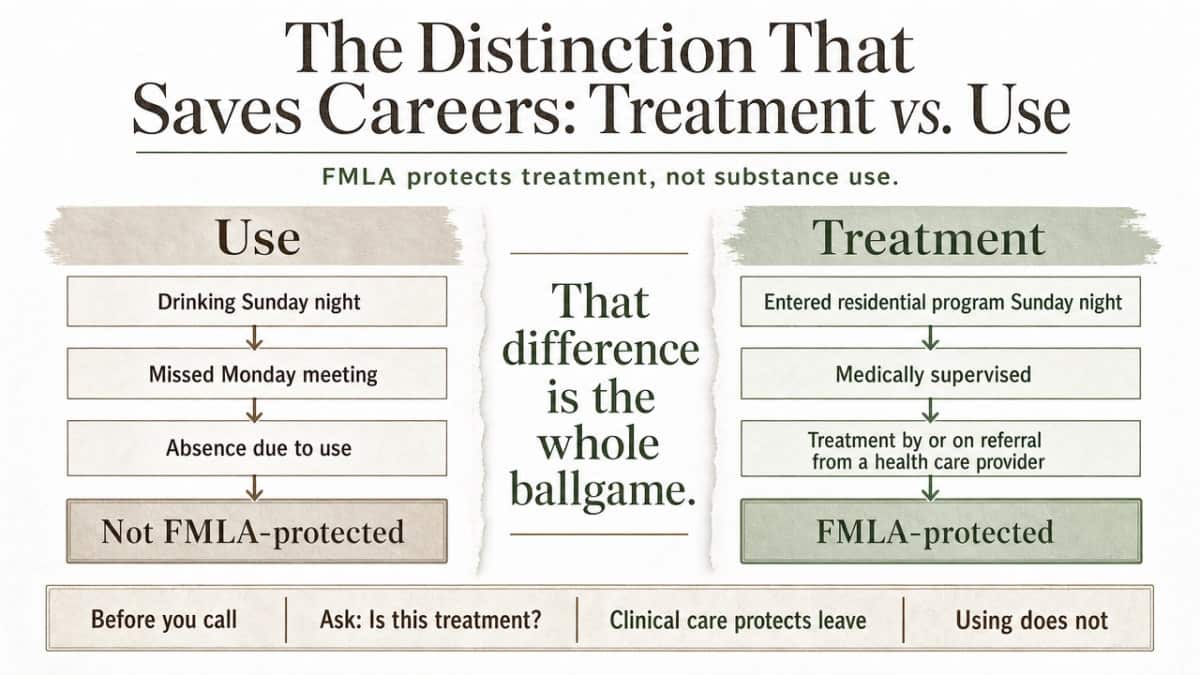
The Distinction That Saves Careers: Treatment vs. Use
This is the single most important thing to understand before you make any calls. It is where men either protect their jobs or accidentally hand their employer a reason to end them.
Read that again. The Department of Labor puts it plainly: treatment for substance abuse can qualify as a serious health condition, but leave is only protected when the treatment is provided by, or on referral from, a health care provider 8. An absence because you were drinking Sunday night and could not make Monday’s meeting is not FMLA-protected. An absence because you checked into a medically supervised residential program on Sunday night is 11.
That difference is not a technicality. It is the whole ballgame.
Here is how it plays out in practice. If you keep calling in sick, showing up late, missing deadlines because of what is really happening, and then get disciplined, that discipline generally stands. Your employer can enforce a neutral, pre-existing substance-abuse policy without violating FMLA 12. If you have a bad performance review or a positive test before you request leave, FMLA does not erase it. The EEOC is direct on this point too: an employer can still discipline poor performance or misconduct that results from addiction 2.
But if you route the same situation through a health care provider first, the picture changes. A clinician evaluates you, recommends residential treatment, and the leave you take to attend that treatment is job-protected 8. Same person. Same underlying condition. Very different legal footing.
The practical lesson for a man in your position: get the clinical assessment before the wheels come off at work. Not after. The men who lose their jobs are usually the ones who waited until a crisis forced HR’s hand. The men who keep their jobs are the ones who called a treatment provider first, got the paperwork started, and then walked into HR with a health-care-backed leave request in hand.
You still have that choice available to you right now. That is worth sitting with for a moment.
Do You Qualify? The Eligibility Math Most Professionals Skip
Most men assume they are covered because they have a good job and a long tenure. That is not how FMLA works. The math is specific, and it is worth running before you make any calls.
Three conditions have to line up:
- Your employer has to be covered, meaning private employers with 50 or more employees within a 75-mile radius, or a public agency.
- You have to have worked there for at least 12 months.
- You need at least 1,250 hours of service in the 12 months before your leave starts 7.
That last number trips people up. It works out to about 24 hours a week. If you are a salaried partner, a physician, or a sales leader logging serious hours, you almost certainly clear it. If you are a contractor, work for a small firm, or run a small crew, you may not be covered at all.
A few situations worth sitting with:
- If you own the business or you are a 1099 contractor, FMLA generally does not apply to you, though the ADA still may once you are back at work 1.
- If your company has fewer than 50 employees within 75 miles of your worksite, you fall outside FMLA even if the parent company is huge.
- If you switched jobs eight months ago, your 12-month clock has not run yet.
None of this means you are out of options. It means you need to know your actual footing before you decide how to sequence the conversation.
What Counts as a Serious Health Condition for Substance Use
The phrase “serious health condition” sounds like something reserved for cancer or major surgery. It is not. Under FMLA, addiction that requires inpatient care or continuing treatment by a health care provider fits squarely inside that definition.
The Department of Labor spelled this out directly in 2022: a serious health condition includes an overnight stay in a treatment center for addiction, or continuing treatment by a clinical psychologist or other qualified provider 10. That is the exact profile of medically supervised residential rehab. If you check into a licensed facility for detox and residential care, you are inside the definition on day one.
A few things follow from that. Alcohol use disorder counts. Opioid, stimulant, and sedative use disorders count. Co-occurring conditions like depression or anxiety alongside a substance use disorder count as well, and DOL treats mental health and addiction under the same serious-health-condition umbrella 13.
What does not automatically count is a self-directed break from drinking or a weekend of trying to detox at home. The protection attaches to clinical treatment, not to willpower. That is why the intake evaluation matters so much. It converts what you have been managing privately into a documented medical condition your employer has to treat like any other.
That reframe alone changes the conversation.
How Treatment Leave Actually Gets Approved
The mechanics are less mysterious than the fear suggests. There is a paper trail, and once you know the shape of it, the process is mostly predictable.
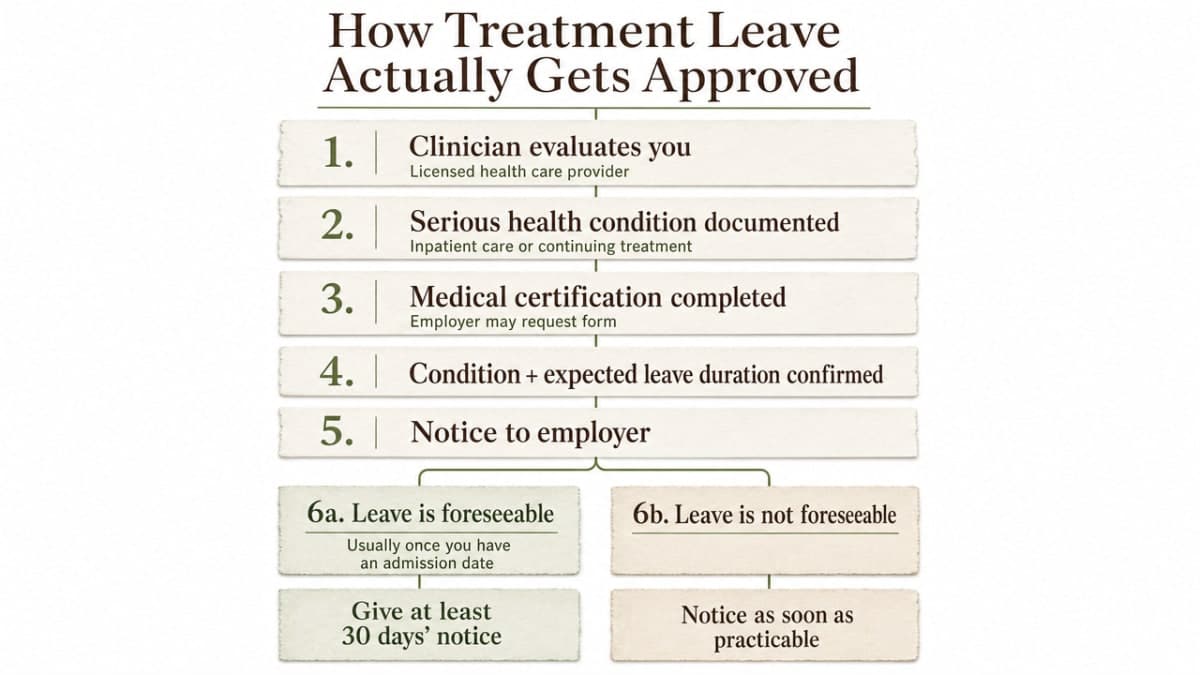
It starts with a clinician. A licensed health care provider evaluates you and documents that you have a serious health condition requiring inpatient care or continuing treatment 7. For a man entering medically supervised detox and residential rehab, that documentation is straightforward. The provider fills out a medical certification form, which your employer is entitled to request, confirming the condition and the expected duration of leave 8.
Next comes notice to your employer. When leave is foreseeable, which it usually is once you have an admission date, you are expected to give at least 30 days of advance notice. When it is not foreseeable, notice as soon as practicable is enough 7. In practice, most men give notice a week or two out, once the intake date is locked. That is still workable.
After you notify them, your employer has its own paperwork obligations. They must tell you in writing whether you are eligible, whether the leave will be designated as FMLA, and how much of your 12-week annual entitlement it will use 7. If they drag their feet on this, the delay is on them, not you.
Your leave can run continuously, which is the typical shape for a 30 to 60 day residential stay, or intermittently, which becomes relevant for outpatient follow-up, therapy appointments, or medication management after discharge 11. Both are protected when tied to treatment by a health care provider.
One last step often catches men off guard: the return-to-work certification. Your employer can require a fitness-for-duty note from your provider before you come back, as long as they require it consistently for other medical leaves 12. Your treatment team handles this as a routine part of discharge planning.
The sequence looks like this:
- Clinical evaluation
- Medical certification
- Written notice to HR
- Employer eligibility response
- Leave designation
- Treatment
- Return-to-work certification, back to your desk
Six or seven discrete steps, most of them on paper, most of them handled by people whose job it is to handle them. None of them require you to explain your life story to your manager.
The ADA Layer: Protection That Kicks In When FMLA Runs Out
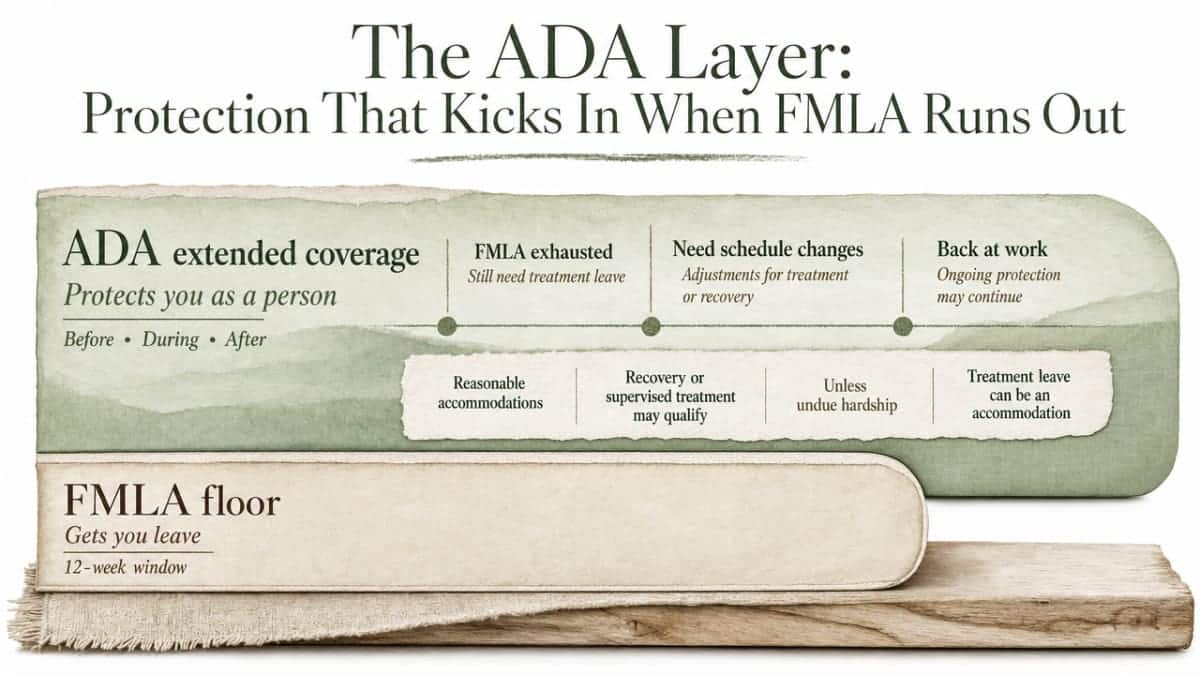
FMLA gets you the leave. The Americans with Disabilities Act does something different, and often more useful for a professional man: it protects you as a person with a treatable medical condition, before, during, and long after that 12-week window closes.
Here is the practical value. Addiction, when you are in recovery or engaged in a supervised treatment program, can qualify as a disability under the ADA 3. That status opens the door to reasonable accommodations, which is legal shorthand for adjustments your employer must consider unless they cause undue hardship. The EEOC lists substance abuse treatment directly in its examples of medical treatment that can support a request for leave as an accommodation 1.
That matters in three specific situations you may face.
- If you exhaust your 12 weeks of FMLA and still need a few weeks of step-down care, additional unpaid leave can itself be a reasonable accommodation under the ADA 1. FMLA is not the ceiling. It is the floor.
- When you come back to work, you can request a modified schedule for outpatient therapy, IOP sessions, medication management appointments, or 12-step commitments during early recovery 6. Your employer has to engage in what the EEOC calls the interactive process, meaning a real conversation about what would work, not a reflexive no.
- The ADA protects you from being treated differently because of your history of addiction once you are in recovery 3. FMLA protects the leave itself; the ADA protects the man who took it.
The limit is real and worth naming. The EEOC is clear that employers can still discipline poor performance or misconduct, even when addiction is the underlying cause 2. Accommodations are forward-looking. They do not erase what happened before you asked for help. That is one more reason the sequence matters: get the clinical evaluation, request the leave, and stack the ADA protections on top before a bad quarter turns into a termination file.
Current Use vs. Recovery: The Line the ADA Draws
The ADA draws a hard line between two situations that can look identical from the outside. If you are currently using illegal drugs and your employer takes action based on that use, the ADA does not protect you 3. If you are in recovery, or actively participating in a supervised rehabilitation program and no longer engaging in illegal use, protection can attach 3.
That second category is where you are heading the moment you walk into a licensed treatment program.
The wrinkle is how “current” gets defined. EEOC guidance interprets current use broadly. It is not limited to the day you used or even the past week. Courts and investigators look at it case by case, asking whether the use is recent enough to suggest an ongoing problem 14. A positive test from three months ago while you were still drinking heavily reads differently than a positive test from three weeks into a residential program.
Alcohol sits in a different lane. Alcoholism is treated as a covered condition under the ADA whether you are drinking or in recovery, though employers can still hold you to the same performance and conduct standards as anyone else 2. You cannot show up impaired and expect the ADA to shield you. You can be an employee with alcohol use disorder who is getting treatment and expect the ADA to protect that treatment 6.
The practical read for a professional man: the sooner you move from active use to documented, supervised treatment, the sooner the ADA starts working in your favor. That transition is not just clinical. It is legal footing.
Confidentiality, Managers, and What HR Actually Tells People
One of the loudest fears in your head right now probably sounds like this: if I file the paperwork, the whole company will know. That fear is understandable, and it is mostly not how the process actually works.
Medical information tied to FMLA leave is confidential. Your employer is required to keep certifications and related medical records separate from your general personnel file 7. The clinician’s certification does not typically state “substance use disorder” in plain language, and it does not need to include a diagnosis for your manager to see. It confirms a serious health condition, expected duration, and treatment schedule.
Your direct manager usually gets told two things: that you are on approved medical leave, and when you are expected back. That is it. The specifics live with HR or a third-party leave administrator, not on the floor.
The people who need to know for coverage, payroll, and benefits continuation are a small circle. The people who do not need to know, including peers, direct reports, and clients, are not entitled to your medical file.
You control more of the narrative than the fear suggests. Most men in your position tell colleagues they are dealing with a health matter and leave it there. That is a complete sentence.
Licensure Boards, Bonuses, and the Professional-Specific Traps
The generic FMLA article stops here. Your situation does not.
If you hold a professional license, whether it is a bar card, a medical license, an accounting credential, or a broker registration, your board likely has its own reporting rules that operate independently of FMLA. FMLA protects your job. It does not resolve your obligations to a licensing body. Most states have physician and lawyer assistance programs designed to keep confidential a voluntary self-referral for treatment before impairment becomes a disciplinary matter. Getting into treatment on your own initiative, before a client complaint or a positive test, is almost always viewed more favorably than being pushed there. Talk to a health-professional assistance program or an attorney familiar with your board before you file anything.
Compensation timing is the other trap. Bonuses, commissions, RSU vesting, partnership draws, and profit-sharing distributions often tie to being actively employed on a specific date. FMLA protects your job and continues your group health benefits 7, but it does not require your employer to pay you during leave or guarantee a discretionary bonus. If you can time your intake around a vesting date or a commission payout without delaying care in a medically unsafe way, that is a legitimate conversation to have with your admissions team and your clinician.
Sequence protects everything you have built.
If Your Spouse Is the One Entering Treatment
The search that brought you here may not be about you. It may be about the person you sleep next to.
FMLA covers that too. If your spouse is admitted for inpatient substance abuse treatment, you can use your own FMLA leave to care for them and to attend family counseling that is part of their treatment 9. The Department of Labor is unambiguous on the family-counseling question: yes, an eligible employee may use FMLA leave to attend counseling sessions tied to a spouse’s inpatient program 13.
That protection matters more than most men realize. Family sessions are often built into week two or three of a residential stay, and missing them can undercut the whole clinical arc. Your leave to attend them is job-protected on the same terms as leave for your own condition.
One practical note: the same eligibility math applies to you, and the same medical certification process runs through your spouse’s provider 7. Ask the treatment team early about scheduling family work, and route the paperwork through your own HR the same way you would for any other qualifying leave.
How to Sequence the Conversation with Your Employer
Order matters more than script. The men who protect their positions almost always run the sequence in the same direction, and the ones who lose ground almost always run it backwards.
- Start with the clinician, not with HR. Get an evaluation from a licensed provider and let them document the serious health condition and the recommended level of care 8. That single document changes what you are asking your employer for. You are no longer confessing a problem. You are requesting a medical leave that is already backed by a treating provider.
- Only then do you contact HR or your leave administrator directly. Skip your manager for this first call. Ask for the FMLA packet, confirm your eligibility, and get the medical certification form sent to your provider 7. Keep the language clinical: serious health condition, inpatient treatment, expected duration.
- When you tell your manager, tell them the shape, not the diagnosis. Approved medical leave, start date, expected return. Offer a brief handoff plan for open matters. That is enough.
One call, in the right order, is often the difference between a protected leave and a scramble.
Where a Treatment Team Fits in the Logistics
A good treatment team does more than clinical work. They know that a man calling from a parking lot outside his office is not just asking about detox protocols. He is asking whether he can be admitted before the quarterly close, whether the medical certification can move fast enough to hit an intake date, and whether discharge can line up with the end of his FMLA window.
Serenity Park’s admissions team handles that side of the conversation. That means coordinating the provider certification your employer needs 8, timing intake around the notice you owe HR, and planning discharge so your return-to-work certification is ready when your leave ends 12. It also means routing family sessions so your spouse can use their own FMLA leave to attend 13.
If you are sitting with this decision right now, the logistics are not the reason to wait. Call and ask how the paperwork and the clinical work fit together for someone in your position.
Frequently Asked Questions
Can my employer fire me for taking FMLA leave to go to rehab in Arkansas?
No. If you are eligible and your leave is properly certified by a health care provider for treatment, your employer cannot fire you for using FMLA leave itself 8. What they can still do is act on legitimate, pre-existing issues, like a documented performance problem or a violation of a neutral substance-abuse policy that predates your leave request 12. The order you handle this in matters.
Does my manager have to know I’m in rehab, or just that I’m on medical leave?
Just that you are on approved medical leave. Medical certifications and diagnostic details are confidential and stay with HR or the leave administrator, kept separate from your general personnel file 7. Your manager typically learns two things: you are out on protected leave, and your expected return date. Nothing on the certification form requires the words “substance use disorder” to reach anyone on your team.
What if I need more than 12 weeks of leave to complete treatment and aftercare?
FMLA caps at 12 weeks per year, but that is not the end of your options 7. Additional unpaid leave can itself be a reasonable accommodation under the ADA when addiction qualifies as a covered condition, and the EEOC lists substance abuse treatment as an example of medical treatment that can support such a request 1. Talk to HR about extending leave as an accommodation before the 12 weeks expire.
Will entering rehab trigger a report to my professional licensing board?
FMLA and the ADA do not require your employer to report you to a licensing board. Reporting obligations run through your board’s own rules, and most states have confidential physician, lawyer, or professional assistance programs designed for voluntary self-referral before impairment becomes a disciplinary matter. Boards generally treat self-initiated treatment more favorably than treatment forced by a complaint. Ask a health-professional assistance program or an attorney familiar with your board.
Can I use FMLA leave to attend family counseling while my spouse is in treatment?
Yes, if you meet FMLA eligibility. The Department of Labor confirms directly that an eligible employee may use FMLA leave to attend counseling sessions tied to a spouse’s inpatient substance abuse treatment 9. That includes the family sessions built into most residential programs 13. Route the medical certification through your spouse’s provider and file the paperwork through your own HR the same way you would for any other qualifying leave.
What if my employer has a substance-abuse policy that says using or testing positive is a fireable offense?
Those policies survive FMLA. The Department of Labor is explicit that FMLA does not override an employer’s lawful substance-abuse policy 12, and the EEOC confirms employers can discipline poor performance or misconduct tied to addiction 2. The protection attaches to treatment initiated through a health care provider, not to use itself 8. That is why sequencing the clinical evaluation before a positive test or a documented incident matters so much.
References
- Enforcement Guidance on Reasonable Accommodation and Undue Hardship under the ADA. https://www.eeoc.gov/laws/guidance/enforcement-guidance-reasonable-accommodation-and-undue-hardship-under-ada
- Applying Performance and Conduct Standards to Employees with Disabilities. https://www.eeoc.gov/laws/guidance/applying-performance-and-conduct-standards-employees-disabilities
- Substance Abuse under the ADA. https://www.usccr.gov/files/pubs/ada/ch4.htm
- NSDUH Behavioral Health Barometer: Arkansas, Volume 8. https://www.samhsa.gov/data/report/nsduh-behavioral-health-barometer-arkansas-volume-8
- 2022 TEDS-D Arkansas. https://www.samhsa.gov/data/node/51427
- The Mental Health Provider’s Role in a Client’s Request for Reasonable Accommodation at Work. https://www.eeoc.gov/laws/guidance/mental-health-providers-role-clients-request-reasonable-accommodation-work
- Fact Sheet #28: The Family and Medical Leave Act. https://www.dol.gov/sites/dolgov/files/WHD/legacy/files/whdfs28.pdf
- elaws – Family and Medical Leave Act Advisor: Treatment for Substance Abuse. https://webapps.dol.gov/elaws/whd/fmla/10c9.aspx
- FMLA Frequently Asked Questions. https://www.dol.gov/agencies/whd/fmla/faq
- Law allows leave for mental health conditions under the Family and Medical Leave Act. https://www.dol.gov/newsroom/releases/whd/whd20220525
- Field Operations Handbook – Chapter 39 (FMLA). https://www.dol.gov/agencies/whd/field-operations-handbook/Chapter-39
- FMLA-27: Impact of the Family and Medical Leave Act on Other Laws. https://www.dol.gov/sites/dolgov/files/WHD/legacy/files/FMLA-27.pdf
- Mental Health and the FMLA. https://www.dol.gov/agencies/whd/fmla/mental-health
- The Americans with Disabilities Act, addiction, and recovery. https://pmc.ncbi.nlm.nih.gov/articles/PMC10961953/