
7 Day Detox Centers Near Me: Immediate & Safe Care
Key Takeaways
- Seven days is a clinical stabilization window backed by federal guidance and inpatient research, wide enough to carry most men through peak alcohol withdrawal safely 1, 7.
- Medically supervised means CIWA-Ar scoring every 1 to 4 hours in the first 24 hours, with symptom-triggered benzodiazepine dosing and a clinician escalating fast if vitals shift 2, 10.
- Do not drive yourself — call the intake nurse directly, have someone else bring you, or go to the nearest emergency room if symptoms are already severe 12.
If Your Hands Are Shaking Right Now
You’re reading this on your phone. It’s early, or it’s late, and your hands are doing that thing they’ve been doing for a few days now. Your heart is going too fast. You might have thrown up already. The sheets are damp. You typed “7 day detox centers near me” because part of you already knows.
Here’s what you need to hear first: you are not crazy, and you are not being dramatic. What you are feeling is your body coming off a substance it got used to. That’s a medical event. It has a name, and it has a treatment, and there are people whose entire job is to walk you through it safely.
The second thing: seven days is a real clinical window, not a marketing pitch. It comes from decades of research on what it actually takes to stabilize a body in withdrawal and get you to the other side of the worst of it 1. It isn’t the whole answer. But it is a door you can walk through today.
You don’t have to have your life figured out to make the next call. You don’t need a bag packed. You don’t need to know what to say. You just need to keep reading for another few minutes, because the rest of this piece tells you exactly what happens when you walk in, who’s watching you through the first night, and what “medically supervised” actually looks like at 3 a.m.
Why the Number Seven Actually Means Something
If you’ve been scrolling past detox center pages, you’ve probably noticed something: almost every one of them mentions seven days. That isn’t a coincidence, and it isn’t a sales pitch someone dreamed up in a marketing meeting. It comes from the clinical literature, from federal treatment guidance, and from what withdrawal actually does to the human body on a predictable timeline.
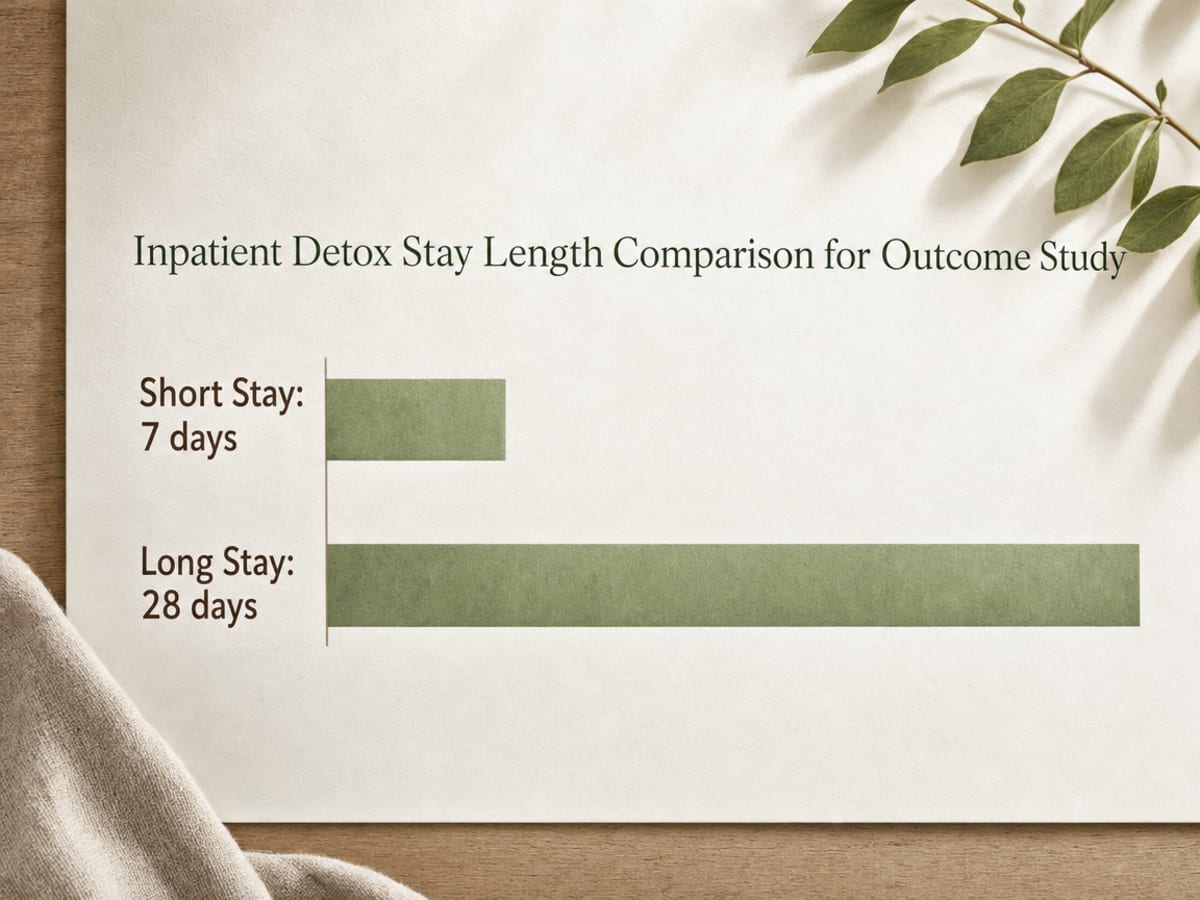
Here is the study that matters most for your situation. Researchers followed men and women admitted to an inpatient alcohol detox unit and compared two groups: those who stayed seven days or less, and those who stayed a full 28. Same unit. Same clinicians. The naturalistic comparison found that extending the inpatient stay beyond about a week did not clearly improve long-term outcomes 1. That result is specific — it’s about inpatient alcohol detox, not opioids or benzodiazepines, and it’s about what happens after the medical piece is done. But the point holds: for alcohol stabilization, roughly seven days is where the medical work of detox tends to land.
Federal guidance echoes this. SAMHSA’s Treatment Improvement Protocol 45, the reference document most American detox programs are built around, reported an average length of stay of 7.7 days for people going through detoxification and treatment, and framed residential treatment as typically running 7 to 30 days 7. Public payers land in the same neighborhood from a different angle — one state Medicaid manual defines inpatient detox as a 2-to-6-day service with 24-hour supervision, meaning the medically necessary withdrawal window is often shorter than a full week, and the extra days are stabilization and handoff 11.
So when you see “7 day detox” attached to a program, read it this way: it’s a clinical window, wide enough to get you through the dangerous part and steady enough on the other side to make a real plan. The number isn’t magic. Your body isn’t going to check a clock on day seven and be finished. But it is the frame doctors have used, tested, and defended for a long time — because for most men in alcohol withdrawal, it’s about how long the acute medical work takes.
What matters more than the number is what fills it. A week of sitting in a room doesn’t stabilize anyone. A week of assessments, medication, monitoring, sleep, food, and a plan for day eight does. That’s the version of seven days worth walking into.
What ‘Medically Supervised’ Looks Like in the First 24 Hours
The phrase gets used so much it stops meaning anything. “Medically supervised.” “24/7 care.” What does that actually look like from the bed you’ll be in tonight?
Here is the concrete version. When you walk in, a nurse takes your vitals — blood pressure, pulse, temperature, oxygen. Someone asks you when your last drink was, how much, how long you’ve been drinking at that level, whether you’ve had a seizure before, whether you’re on any other substances. This part is not judgment. It’s triage. The answers tell the medical team how bad your withdrawal is likely to get and how fast.
Then comes CIWA-Ar. That stands for the Clinical Institute Withdrawal Assessment for Alcohol, revised. It’s a ten-item scoring tool a nurse walks through with you — questions about nausea, tremor, sweating, anxiety, headache, whether you’re hearing or seeing things that aren’t there. Each item gets a number. The numbers add up. That total score is what determines how much medication you get and how often someone comes to check on you.
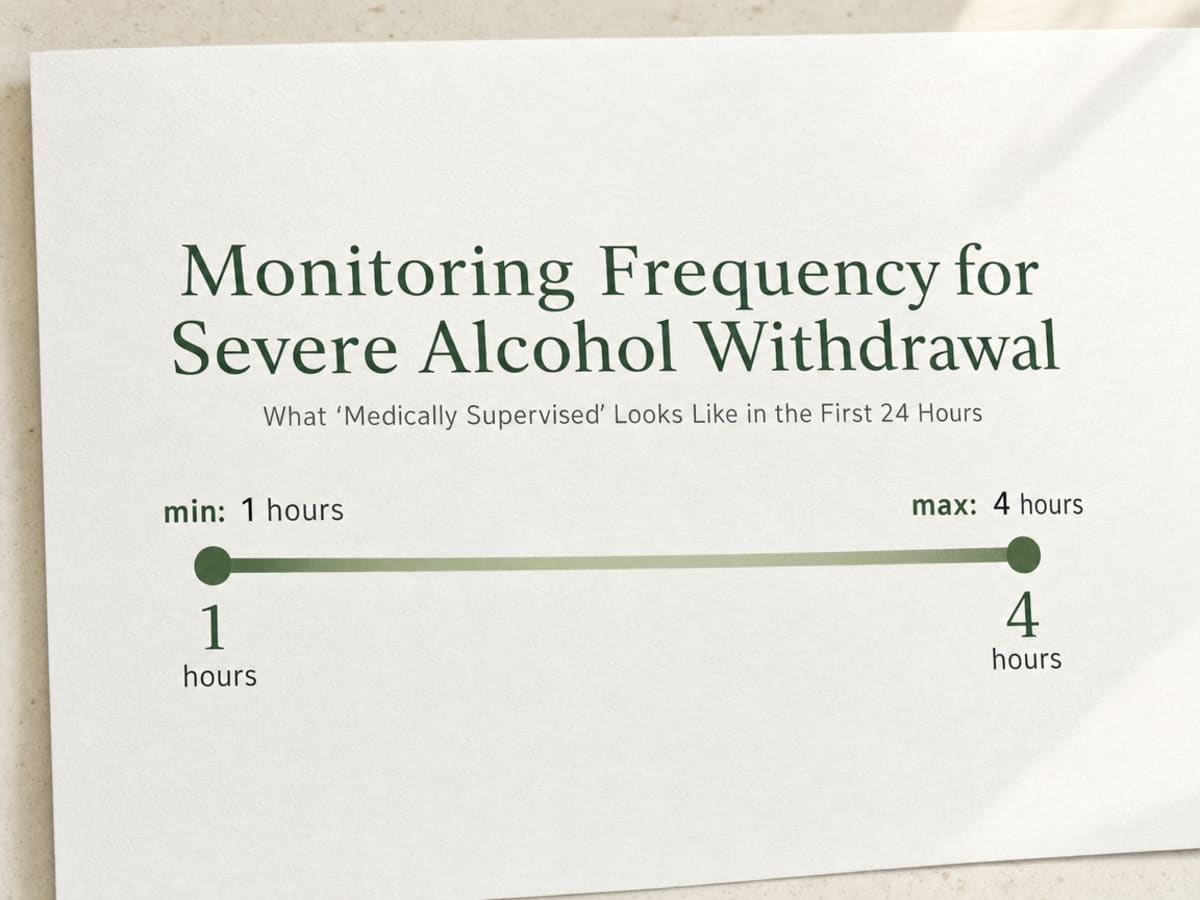
For men whose scores land in the severe range, the monitoring is intense in a way that surprises most people. The federal guidance is specific: patients with severe alcohol withdrawal should be assessed every 1 to 4 hours for the first 24 hours in an inpatient setting 2. Read that again. Every one to four hours. Through the night. A nurse comes in, wakes you if you’re sleeping, runs through the scale, checks your vitals, adjusts your medication if the score moved. That is what “24/7” means when the words are honest.
The medication itself is usually a benzodiazepine — something like lorazepam or diazepam — given on what’s called a symptom-triggered schedule. Instead of a fixed dose every six hours no matter what, you get more when your CIWA-Ar score climbs and less when it drops. Your body sets the pace. That approach is the current standard of care for alcohol withdrawal, and it’s what the American Society of Addiction Medicine guideline recommends for adults with syndrome of varying severity 10.
There are also things the team is watching for that you won’t feel until they’re already happening:
- blood pressure spikes
- heart rate over 120
- a rising temperature
- confusion that wasn’t there an hour ago
- the earliest signs of a seizure
Delirium tremens — the DTs — typically shows up 48 to 96 hours in, which is exactly why someone is in the room with a stethoscope on hour 30 and hour 54 and hour 78.
None of this hurts. Most of it, you’ll barely remember. That is the point. The first day is not about you being brave or gritting through anything. It’s about medicine doing its job while you sleep as much as your nervous system will let you.
The Week, Day by Day
Here is what the week actually looks like from inside a bed. Not every hour of every day — bodies vary, and your timeline will look a little different from the man in the next room — but the shape holds.
Day 1: Intake and the first assessments. You arrive. Vitals, medical history, a full CIWA-Ar walkthrough. Someone draws blood. A physician or nurse practitioner writes your medication orders. You get water, a bed, and — if your score warrants it — your first dose. If you came in already deep into withdrawal, the first hours can blur; that’s expected. What matters is that a clinical team now owns the timeline.
Days 2 and 3: The peak. This is when alcohol withdrawal typically climbs to its worst. Tremor, sweating, anxiety, blood pressure and heart rate running high, insomnia even when you’re exhausted. The window for delirium tremens sits in here too, roughly 48 to 96 hours in. Assessments are frequent, medication is adjusted around your scores, and you may not remember large chunks of these two days. That’s not a failure. That’s the medicine working.
Days 4 and 5: The turn. The peak breaks. CIWA-Ar scores start coming down. Benzodiazepine doses taper. You sleep in longer stretches. You can taste food again. This is usually when men start asking the questions they were too sick to ask on day two: What happened to me? What comes next? Counselors begin one-on-one conversations. Your treatment team starts building the plan for day 8 — because they’ve been building it since intake, and now you can participate in it.
Days 6 and 7: Transition. Medication is mostly off or nearly so. You’re eating, sleeping, walking, talking. The work shifts from stabilizing your body to stabilizing your next step: residential treatment, an outpatient program, a sober living bed, a discharge appointment with a physician who will keep you on relapse-prevention medication. Family calls happen. Insurance authorizations get finalized. You pack a bag.
This shape isn’t arbitrary. SAMHSA’s federal detox guidance documented a 7.7-day average length of stay for detoxification and treatment and frames residential treatment as typically running 7 to 30 days 7. State Medicaid policy defines the inpatient detox window itself as 2 to 6 days with 24-hour supervision 11— meaning the strictly medical piece often finishes before day seven, and the last day or two are stabilization and handoff. That gap between “medically detoxed” and “ready to walk out” is the whole reason a full week exists.
Who Gets Admitted, and Where: Residential, Hospital, or Ambulatory
Not every man in withdrawal ends up in the same kind of bed. The clinical question — the one a doctor is answering in the first ten minutes of talking to you — is which setting matches how sick you are right now.
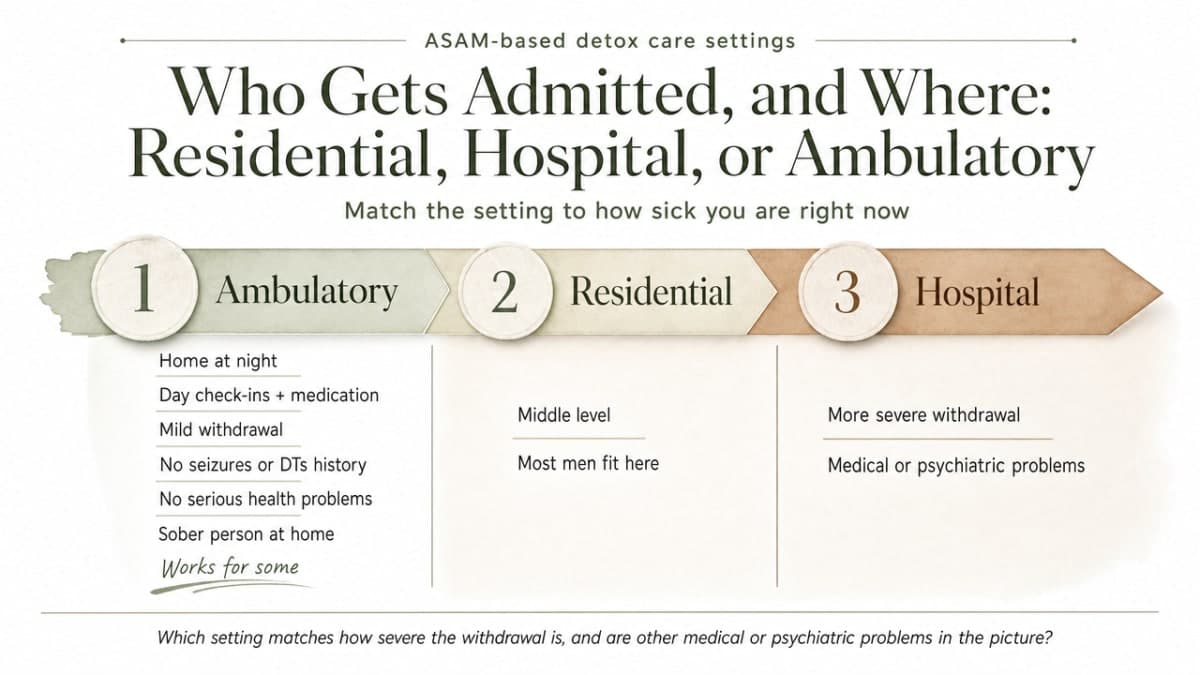
There are three levels, and the American Society of Addiction Medicine guideline sorts people into them based on how severe the withdrawal is and whether other medical or psychiatric problems are in the picture 10.
- Ambulatory detox
- Going home at night, coming back during the day for check-ins and medication — is for men with mild withdrawal, no history of seizures or DTs, no other serious health problems, and a sober person at home who can watch them. It works for some. It is not what most men typing “7 day detox centers near me” at 5 a.m. need.
- Residential detox
- The middle level, and it’s where most men in real trouble land. You sleep there. A medical team runs your CIWA-Ar scores, your medication, your vitals around the clock. There’s a doctor on call. If your withdrawal gets worse than expected, they can escalate you fast. This is the setting a 7-day program is usually describing — 24-hour supervision in a structured environment 11, with the clinical intensity to handle moderate-to-severe alcohol withdrawal but without the full apparatus of a hospital floor.
- Hospital-based detox
- For the top of the risk pyramid: severe withdrawal with signs of DTs, a history of withdrawal seizures, unstable heart or lung problems, active suicidal thinking, or a mixed picture with opioids or benzodiazepines that needs an ICU-capable team. If you walked into an emergency room first, the hospitalist is using the same ASAM logic to decide whether you get admitted to a medical floor or transferred to a residential detox once you’re stable 12.
Here’s the honest part: you probably don’t know which level you need. That’s fine. When you call, describe what your body is doing — the shaking, the last drink, the seizures if you’ve had them, any other pills — and let the intake nurse decide. That is literally the phone call they take every day.
Why Day 8 Has to Be Planned on Day 1
Here is the part most detox pages don’t tell you plainly: seven days of medically supervised care, by itself, is not treatment for addiction. It’s stabilization. Your body gets safe. Your head clears. And then, if there is no plan for what happens next, the same brain that walked in walks out — back to the same apartment, the same phone, the same triggers. That’s not a moral failure. That’s the math.
The relapse literature is blunt about this. Detoxification alone, without structured aftercare, is associated with high rates of return to drinking; sustained recovery tracks with continued residential or outpatient treatment after the medical piece is done 6. The broader evidence-based review of detox and rehabilitation makes the same point from a different angle: detox is one component of a system, and the systems that work are the ones that connect the acute stabilization week to psychosocial treatment and continuing care 3. When those links are missing, the week you just spent getting your vitals back to normal doesn’t hold.
This is why good detox programs treat discharge planning as day-one work, not day-seven paperwork. On the day you’re admitted, someone on the team is already asking questions the sick version of you can’t answer yet:
- What does your insurance cover for residential?
- Is there a bed available for the handoff?
- Do you have a safe place to sleep if outpatient is the right level?
- Is there a psychiatric piece — depression, anxiety, trauma — that needs its own clinician lined up?
- Who’s picking you up, and where are they driving you?
The reason it happens on day one is timing. Insurance authorizations take days. Residential beds don’t always open on demand. A prescriber who will keep you on naltrexone or acamprosate needs an appointment on the calendar before you walk out, not after. If the team waits until you feel better to start that work, day seven arrives and the plan isn’t ready — and you go home to wait, which is the highest-risk place you could possibly be.
So when you’re evaluating what a 7-day program actually offers, the question isn’t just “is there a doctor.” It’s whether day 8 is on the whiteboard when you arrive on day 1. That single detail — a real, funded, scheduled next step — is what separates a detox week that holds from one that doesn’t.
Getting There: What ‘Near Me’ Means When You Can’t Drive Yourself
“Near me” usually means the closest place. When you’re shaking, it means the closest place you can actually reach without being behind a wheel. Those are two different searches.
Here is what “near me” actually looks like in the Little Rock area when you can’t drive. Someone else drives you — a partner, a sibling, a friend, a parent, a coworker who won’t ask questions on the way. If there is no one, call the detox center directly before anything else; intake staff can talk you through options for transportation, and many programs coordinate a ride when a family member cannot. If your symptoms are already severe — repeated vomiting, a racing pulse you can feel in your neck, hallucinations, a history of withdrawal seizures — call 911 or go to the nearest emergency room. Hospitalists are trained to stabilize alcohol withdrawal on arrival and hand you off to a residential detox bed once you’re safe 12.
One thing to know before the phone rings: distance matters less than the door being open. A center twenty minutes farther that can admit you this afternoon beats a closer one with a three-day wait. The intake nurse will ask when your last drink was, how much, and what your body is doing right now. Answer honestly. That call is the hardest part. You already did the thinking. Now you just have to dial.
What to Bring, What to Say, What Happens When You Walk In
Keep this simple, because your brain is not at full strength right now. Bring:
- an ID
- your insurance card if you have one
- a list of every medication and substance you’ve used in the last week (be honest about amounts and timing — the intake nurse has heard worse and needs the truth to dose you safely)
- a phone charger
- comfortable clothes for a few days
- any regular prescriptions in their original bottles
Leave the laptop, the work bag, the whiskey in the trunk. You don’t need them.
When you call, say the sentence out loud before you dial if you have to: “I need help. I’ve been drinking, and I think I’m in withdrawal.” That’s it. The intake nurse will take it from there. She’ll ask when your last drink was, how much you’ve been drinking daily, whether you’ve ever had a seizure or the DTs, what other substances are in your system, and whether you’re having thoughts of hurting yourself. Answer straight. Every question has a clinical reason — the answers decide your medication, your monitoring level, and whether they’re sending an ambulance or asking your brother to drive.
When you walk in, someone meets you at the door. You sit down. Vitals, paperwork, a CIWA-Ar score, a bed. The plan for day 8 starts getting written before you’ve finished your first cup of water. You are not alone in a hallway. You are inside now.
Frequently Asked Questions
Is 7 days really enough time to detox safely?
For most men in alcohol withdrawal, yes — seven days is a real clinical window for medical stabilization, not a shortcut. The naturalistic comparison of inpatient stays of seven days or less against 28-day stays did not show clear long-term advantages for the longer stay 1. What matters more than the number is what fills the week: continuous monitoring, symptom-triggered medication, and a scheduled next step. Detox alone is not treatment.
Can I get admitted today if I’m already in withdrawal?
Often, yes. Residential detox programs take same-day intake calls and admit when a bed is open and your clinical picture fits. Call the center directly, describe when your last drink was and what your body is doing, and let the intake nurse triage you. If your symptoms are severe — seizures, hallucinations, chest pain, repeated vomiting — go to the nearest emergency room. Hospitalists can stabilize you and hand you off to residential care 12.
What does ‘medically supervised’ actually mean once I’m inside?
It means a nurse takes your vitals and walks you through a CIWA-Ar assessment on arrival, a physician writes medication orders, and someone comes to check on you around the clock. For severe alcohol withdrawal, that check happens every 1 to 4 hours through the first 24 hours 2. Medication — typically a benzodiazepine — is dosed based on your symptom scores, not a fixed schedule. The team escalates fast if anything shifts.
How do doctors decide if I need residential, hospital, or ambulatory detox?
They use the ASAM alcohol withdrawal guideline logic: how severe your symptoms are, your history of seizures or DTs, other medical or psychiatric conditions, and whether someone sober can watch you at home 10. Mild cases with strong support may qualify for ambulatory detox. Moderate to severe withdrawal usually needs 24-hour residential supervision 11. Top-of-pyramid risk — DTs, unstable vitals, mixed substances — goes to a hospital floor. The intake nurse decides based on your answers.
What happens on day 8 when the detox week ends?
Day 8 is the handoff — and it should be planned starting day 1. Most men step down into residential treatment, an outpatient program, or structured aftercare, because detox alone is associated with high relapse rates without continuing care 6. A prescriber for relapse-prevention medication, a bed at the next level, a psychiatric appointment if needed — those pieces get lined up while you’re still in the detox bed. Walking home to nothing is the risk.
What should I bring, and what do I say when I call?
Bring an ID, your insurance card, a list of every substance and medication used in the last week with honest amounts, a phone charger, comfortable clothes for several days, and any prescriptions in their original bottles. When you call, say: “I need help. I’ve been drinking, and I think I’m in withdrawal.” The intake nurse takes it from there. Answer every question straight — dosing and monitoring decisions depend on the truth.
References
- Outcome after in-patient detoxification for alcohol dependence: a naturalistic comparison of 7 versus 28 days stay. https://pubmed.ncbi.nlm.nih.gov/11093965/
- Veterans Health Administration Needs More Written Guidance to Manage Patients’ Risk of Alcohol Withdrawal Syndrome. https://www.vaoig.gov/sites/default/files/reports/2024-02/vaoig-21-01488-44_0.pdf
- Detoxification and Rehabilitation for Substance Use Disorders: Evidence-Based Approaches. https://pubmed.ncbi.nlm.nih.gov/27036600/
- Detoxification from Alcohol: Historical and Contemporary Perspectives. https://pubmed.ncbi.nlm.nih.gov/20569652/
- Length of stay in alcohol detoxification. https://pubmed.ncbi.nlm.nih.gov/1459482/
- Relapse After Alcohol Detoxification: Impact of Aftercare. https://pubmed.ncbi.nlm.nih.gov/1459479/
- TIP 45: Detoxification and Substance Abuse Treatment. https://www.govinfo.gov/content/pkg/GOVPUB-HE20_400-PURL-gpo124442/pdf/GOVPUB-HE20_400-PURL-gpo124442.pdf
- Detoxification Services (Indiana Department of Child Services Medicaid Manual). https://www.indiana.gov/dcs/files/Detoxification-Services.pdf
- The ASAM Clinical Practice Guideline on Alcohol Withdrawal Management. https://pubmed.ncbi.nlm.nih.gov/32511109/
- Executive Summary of the American Society of Addiction Medicine Clinical Practice Guideline on Alcohol Withdrawal Management. https://pubmed.ncbi.nlm.nih.gov/32909985/
- Detoxification Services (Indiana Department of Child Services Medicaid Manual). https://www.in.gov/dcs/files/Detoxification-Services.pdf
- Clinical Guideline Highlights for the Hospitalist: 2020 American Society of Addiction Medicine Clinical Practice Guideline on Alcohol Withdrawal Management. https://pubmed.ncbi.nlm.nih.gov/34910619/