
Key Takeaways
- Arkansas funds two recovery philosophies side by side: a $21 million clinical grant and $2.5 million split across five explicitly faith-based residential centers 2, 3.
- Explicitly faith-based centers fit men who already have a working faith life, while clinical programs that welcome spirituality tend to fit those who want faith honored without being required 3.
- Peer-reviewed evidence supports integration over choosing one lane, with medical, psychological, and spiritual strategies working better combined than any single approach on its own 7, 11.
- Before committing to any Arkansas program, ask directly about on-site medical services, detox supervision, required versus optional spiritual programming, meeting options, and what aftercare begins on day 31 5.
What you’re really asking when you search for a faith-friendly rehab
You typed those words into a search bar for a reason. You want help. You also want to keep something that matters to you, whether that’s a quiet prayer life, a sense of purpose, or just the belief that recovery should mean more than white-knuckling sobriety. And you don’t want a program that hands you a doctrine on day one.
That’s a fair thing to ask for. It’s also more common than the search results make it look.
Most men researching this quietly are weighing three things at once: whether the clinical care is real, whether faith will be respected without being required, and whether their job, marriage, and reputation can survive the process. You’re not shopping. You’re triaging.
Arkansas has more than one answer here. The state funds explicitly faith-based residential centers and broader clinical programs side by side 3, 2, and the strongest research points toward integration rather than choosing a single lane 7. The rest of this article maps that ground so you can find your place on it.
Spiritual is not the same as religious
This distinction matters more than it sounds. Religion usually points to a specific tradition: a church, a text, a set of practices, a community that shares them. Spirituality is broader. It’s the sense that your life has meaning, that you are connected to something outside yourself, that the way you live has weight. You can hold one without the other. Plenty of men do.
Why say this out loud? Because a lot of recovery language mashes the two together, and if you’re not sure where you land, you can walk away thinking the whole conversation isn’t for you. It is.
Clinical research on addiction has treated spirituality as its own variable for years, separate from religious affiliation. Spirituality tends to be protective against the start and progression of alcohol and drug use, even for people who don’t identify with a particular faith 11. And when treatment integrates spiritual practice with medical and psychological care, the combination is stronger than any one strand on its own 7.
So when you tell a program you want faith honored in your recovery, you’re allowed to define what that means. Prayer. Meditation. A Higher Power as you understand it. Sitting quietly at 5 a.m. and asking a bigger question. All of it counts.
How Arkansas funds recovery: two grants, two philosophies
Follow the money and you’ll see the state’s actual stance. Arkansas doesn’t pick one philosophy of recovery. It funds two, on purpose.
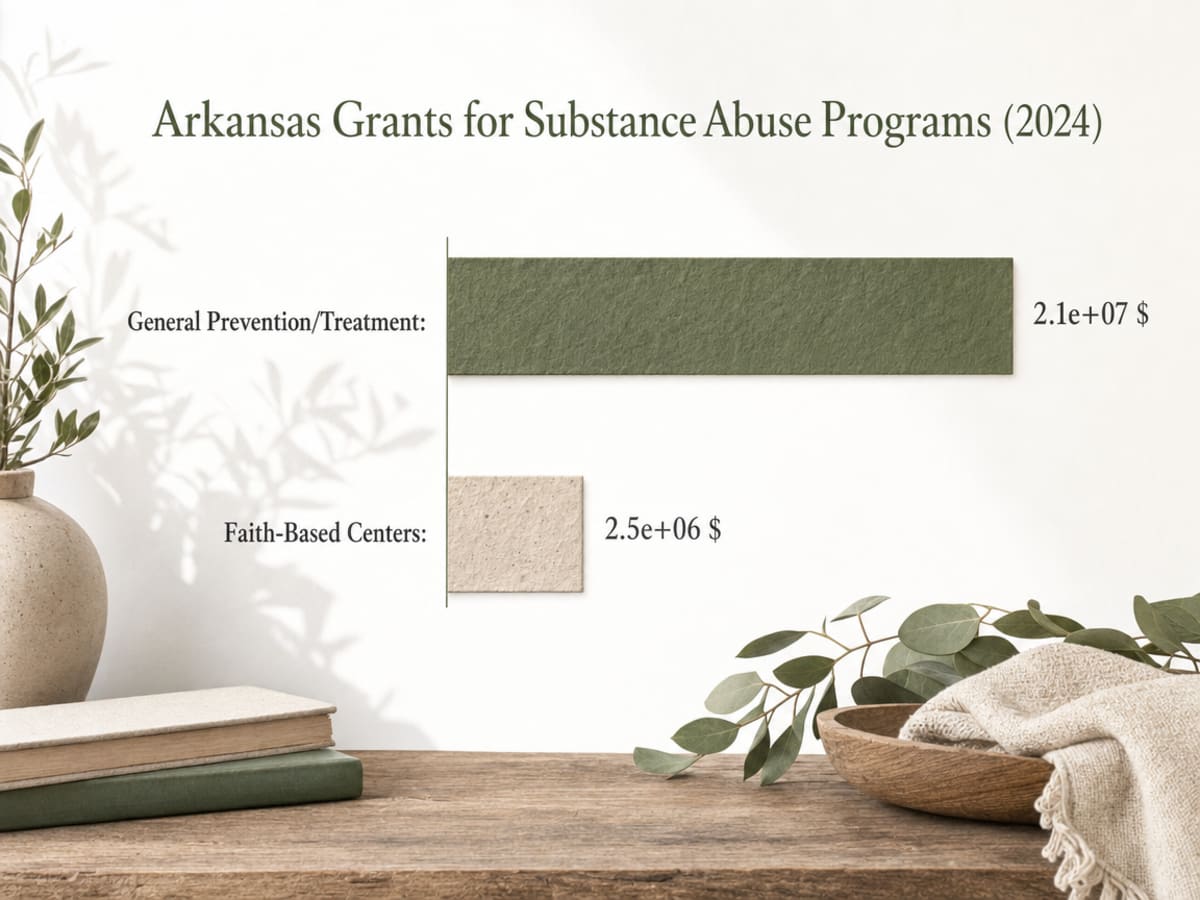
In 2024, the Arkansas Department of Human Services announced a $21 million grant to expand general substance abuse prevention and treatment, with a focus on medication-assisted treatment and reducing overdose deaths 2. That’s the clinical lane: medically supervised care, evidence-based practice, broad access. Around the same window, DHS and the Office of the Arkansas Drug Director announced a separate $2.5 million in federal grants split evenly among five faith-based treatment centers, $500,000 each, to run explicitly faith-centered residential and recovery services statewide 3. That’s the faith lane: programs where, in the state’s own words, faith is the base of the treatment and recovery plan 3.
Two grants. Two philosophies. One state.
The dollar figures tell you something about scale, not about which path is better for you. The clinical investment is roughly eight times larger, because it has to cover a wider infrastructure: eight catchment areas, providers for uninsured and underinsured Arkansans, MAT capacity, crisis response 1. The faith-based investment is smaller and more targeted, funding a specific set of programs for people who want spiritual formation woven into their care 3.
That middle ground is where a lot of men land once they think it through. Keep reading. We’ll map who each lane actually fits.
The Arkansas faith-based residential landscape
The five state-funded faith-based centers
When Arkansas put federal dollars behind explicitly faith-based residential care, it named names. Five centers, $500,000 each, all charged with running statewide faith-based substance abuse treatment programs 12. Knowing who they are helps you understand what “explicitly faith-based” actually looks like on the ground here.
The five recipients are:
- Better Community Development
- SOZO Recovery Center
- Safe Haven
- Arkansas Recovery Ministries (ARM) 180
- Daughters of the Other Side 12
Between them, they cover men and women, urban and rural, residential and outpatient supports. Daughters of the Other Side, as the name suggests, focuses on women. The others serve different populations and geographies across the state.
What ties them together is the shared philosophy the state described in its own announcement: faith is the base of the treatment and recovery plan, and the goal is to strengthen the spiritual foundation so a person can maintain sobriety through residential services, faith services, education, prevention, harm reduction, recovery support, life skill development, employment readiness, and both clinical and non-clinical services 3.
Read that list again. It’s broad. These are not chapel-only programs. They braid faith formation with practical recovery scaffolding, including some clinical services. But faith is not one component among many. Faith is the frame.
That’s the honest description. If you want a program where every group, every reflection, every meal blessing points back to spiritual formation, one of these five is worth calling. If you want something else, this is not the lane for you, and that’s okay too.
Who these programs fit, and who they don’t
Be honest with yourself here. It saves time and heartache.
Explicitly faith-based residential centers tend to fit men who already have a working faith life and want it deepened, not introduced. If prayer is already part of your day, if scripture already speaks to you, if you would feel at home starting a group with a devotional, these programs can meet you where you are and take you further. Research on Judeo-Christian interventions is thin, but what exists suggests the fit matters more than the model 9.
They fit less well if you’re spiritually curious but not committed, if you’re recovering from religious harm, if you’re not Christian, or if you want faith to be a room you can enter and leave rather than the whole house. That’s not a criticism of the programs. It’s a match issue.
You also want to ask about the clinical piece. The state announcement lists both clinical and non-clinical services across these five centers 3, but the depth varies. If you need medically supervised detox, psychiatric medication management, or dual diagnosis care, ask specifically what’s onsite, what’s referred out, and who holds the medical license. A good program will answer plainly. Your job is to ask.
The spectrum: from strictly clinical to strictly faith-based
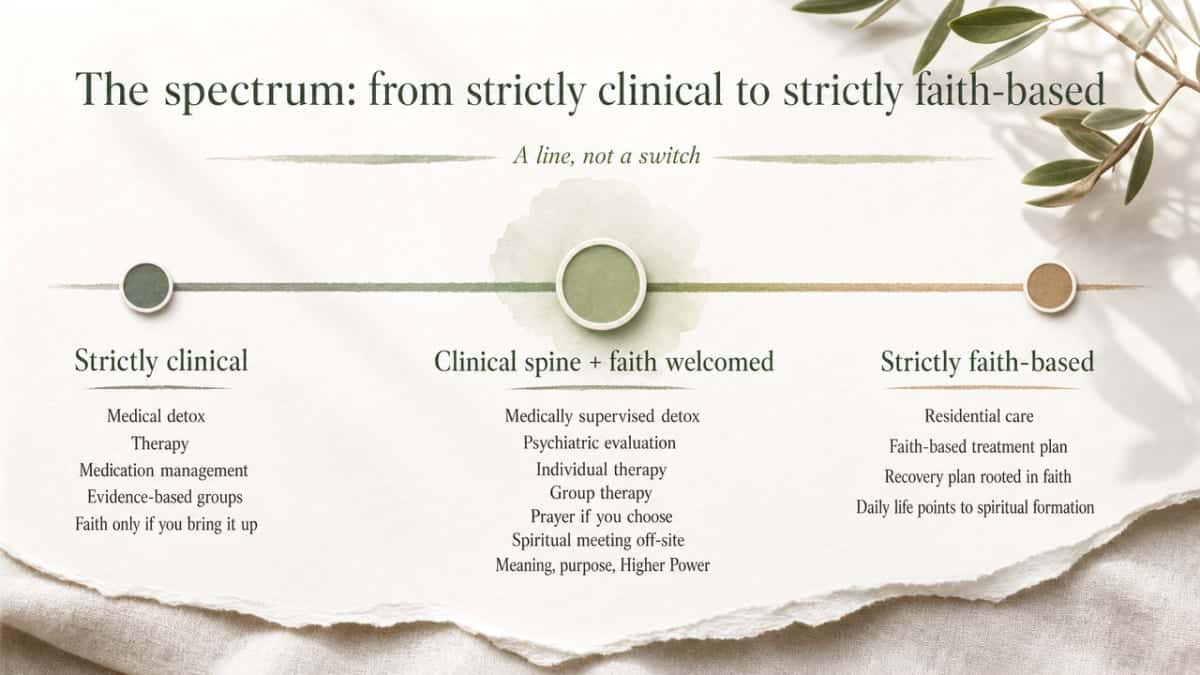
Picture a line, not a switch. On one end sits fully secular clinical care: medical detox, therapy, medication management, evidence-based groups, no reference to faith unless you bring it up. On the other end sits explicitly faith-based residential care, where faith is the base of the treatment and recovery plan and every part of the day points back to spiritual formation 3. Most Arkansas programs live somewhere between those two poles.
The middle of the line is where a lot of men find their footing. Clinical care stays the spine of the program, medically supervised detox, psychiatric evaluation, individual and group therapy, but faith is welcomed as part of your own recovery work. You can pray. You can attend a spiritually oriented meeting off-site. You can talk to a counselor about meaning, purpose, or a Higher Power without being talked out of it or into it. The peer-reviewed argument for this middle position is straightforward: comprehensive addiction care combines medical, psychological, and spiritual strategies rather than treating them as competing options 7.
Where does Serenity Park sit on that line? Left of center, closer to the clinical end, with the door to faith held open. The program is medically led, built around detox, residential treatment, psychiatric care, and evidence-based therapy for men. Celebrate Recovery is one of several off-site meeting options, alongside traditional 12-step meetings and other peer supports. If faith matters to you, it has a place in your week. If it doesn’t, the clinical work stands on its own.
Neither end of the spectrum is wrong. The question is which one fits the man you are today, and where you want to be a year from now. Read the next two sections before you decide.
What the research actually says about faith in recovery
Spirituality as a protective factor, not a prescription
Here’s what the clinical literature has quietly said for years: spirituality tends to help, and it doesn’t have to be tied to a specific religion to do it. A review written for healthcare professionals put it plainly, spirituality is generally protective against the initiation and progression of alcohol and drug use 11. Not a cure. Not a requirement. A protective factor, like sleep or social connection or a sense of purpose.
A broader review of religious and spiritual interventions in addiction recovery reached a similar place. Religious involvement and spirituality are generally associated with lower substance use and better recovery outcomes, though the authors were careful to say specific faith-based programs still need more rigorous evaluation 13.
Read that carefully. The research is not telling you that you need to become religious to recover. It’s telling you that if a spiritual dimension already means something to you, or if you’d like it to, that’s a real ingredient. Not a garnish. Not the whole meal either. An ingredient worth including on purpose, alongside the medical and psychological work.
The limits of the evidence for faith-based programs
Now the honest part. The research on explicitly faith-based programs, the kind where faith is the treatment model itself, is thinner than the marketing suggests. That doesn’t mean these programs don’t help people. It means we should be careful with claims.
The strongest look at this came from a 2019 systematic review and meta-analysis of randomized controlled trials on spiritual and religious interventions for substance use problems. When these programs were compared to other active treatments, the relative effects were statistically significant. But when they were compared to inactive controls, the effects were moderate and not statistically significant 8. Translated: faith-based interventions can hold their own against other active treatments in some studies, but the evidence they beat doing nothing is weaker than you’d expect.
A more recent review focused on interventions built specifically on Judeo-Christian principles found only a small number of studies and limited consistency in the positive results those studies reported 9. The authors were essentially asking for better trials before anyone draws big conclusions.
Celebrate Recovery: what it is, who it helps, what it doesn’t do
Celebrate Recovery, usually shortened to CR, is a Christ-centered mutual-help program that borrows the 12-step frame most people recognize and reworks it around scripture and small-group sharing. Meetings happen at churches, community centers, and sometimes inside treatment programs as an off-site option. Anyone can walk in. You don’t have to be a member. You don’t have to speak.
Who does CR tend to help? A 2025 study looking at who actually shows up gave a useful answer. Compared with people in other mutual-help groups, CR attendees were more likely to have already tried other faith-based services, suggesting the room fills with people who are already open to a Christian framework 10. That’s not a knock. It’s a fit signal. If prayer and scripture already speak to you, CR gives you a room full of people who share that vocabulary.
Here’s the part the marketing usually skips. That same study found no meaningful difference between CR attendees and other mutual-help participants on quality of life, happiness, self-esteem, psychological distress, or recovery capital 10. Translated: CR is a solid mutual-help option for the right person, not a shortcut to better outcomes than AA, NA, or SMART Recovery.
What CR doesn’t do is replace clinical care. It’s a peer support meeting, not detox, not therapy, not medication management. Treat it like the community piece of a bigger plan, which is exactly how Serenity Park offers it, as one off-site meeting option among several. If it fits you, go. If a different room fits better, go there instead.
Where Serenity Park fits: clinical care that welcomes faith
Serenity Park is a clinical program. Say that clearly, because it matters. Medically supervised detox, residential treatment for men, psychiatric care, individual and group therapy, medication management when it’s the right call. That’s the spine. It is not a faith-based program, and it doesn’t market itself as one.
What it does is hold the door open. If faith is part of who you are, or part of who you’re trying to become, that comes with you into treatment. Counselors talk about meaning and purpose when you raise them. You can pray on your own time. You can bring a Higher Power, as you understand it, into your recovery work without anyone reframing it for you.
The off-site meeting options are where this gets concrete. Celebrate Recovery is one of them, alongside traditional 12-step meetings and other peer supports. Pick the room that fits. If CR speaks your language, go. If AA or NA or a secular alternative feels more like home, that’s the meeting on your schedule. The point is options, not obligation. That mirrors the integrated approach the research actually supports, medical, psychological, and spiritual strategies woven together rather than one substituted for the others 7.
For a professional man weighing his choices, that middle position is often the honest fit. You get clinical care that will hold up under scrutiny, and you get room for the parts of yourself that aren’t strictly clinical.
How to choose a program without losing yourself in the process
Questions to ask any Arkansas program before you commit
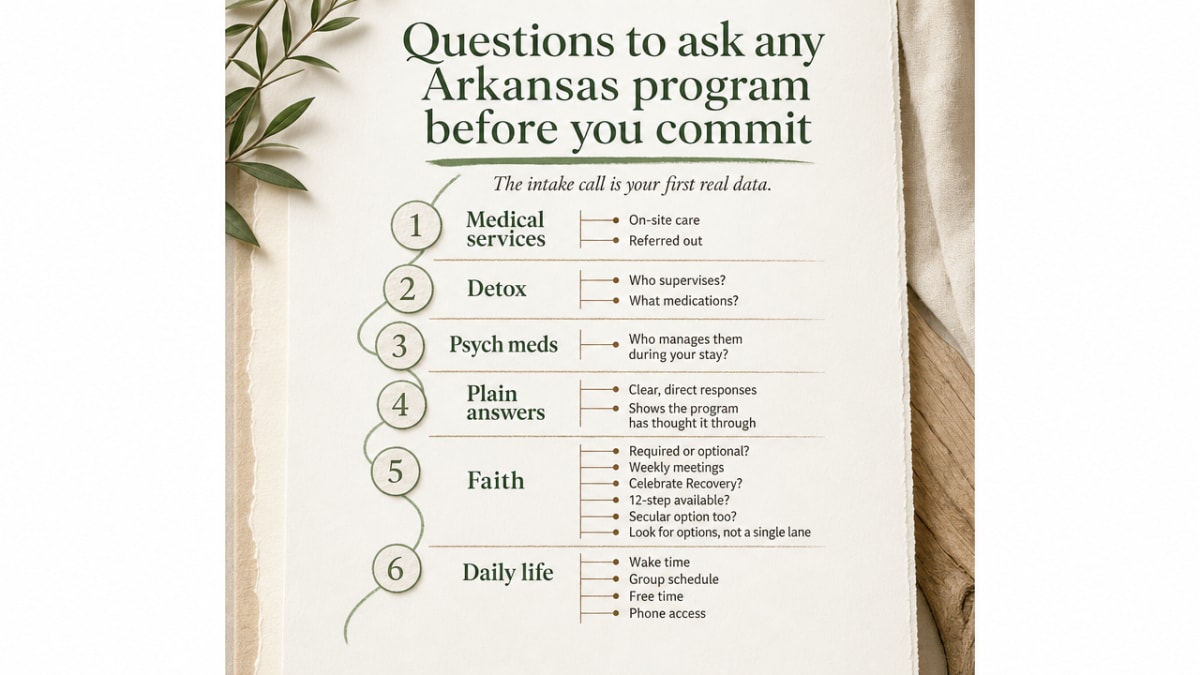
You’re allowed to interview them. In fact, you should. The intake call is not a formality. It’s the first data you get about how a program actually operates.
- Ask what medical services are on-site and which ones get referred out. If you might need detox, ask who supervises it and what medications are available. If you take psychiatric medication, ask who manages it during your stay. A program that answers plainly is a program that has thought about it.
- Ask about faith directly. Is spiritual programming required or optional? Which meetings are on the weekly schedule? If you want Celebrate Recovery, is it available? If you want a traditional 12-step meeting or a secular alternative, is that available too? You’re looking for options, not a single lane.
- Ask what the day actually looks like. Wake time. Group schedule. Free time. Phone access. Family contact. Whether you can step out for a work call in a true emergency, and how they define emergency.
- Ask about aftercare. What happens on day 31? Who follows up? Is there an alumni group? Arkansas’s state resources point to recovery as a longer arc than the residential stay itself 5, and any program worth your time will already have that plan drafted.
Protecting your career, your privacy, and your people
You’ve built something. A practice, a company, a team, a reputation. Treatment shouldn’t cost you that, and it usually doesn’t have to.
Federal privacy rules for substance use treatment are strict. Ask any program to walk you through how they handle records, who can be told you’re there, and what a release of information actually authorizes. Nothing leaves without your signature.
Plan the work handoff before you go, not from the parking lot. Pick one person who needs to know a version of the truth, and decide together what that version is. Medical leave is a real category. You don’t owe anyone a diagnosis.
Bring your family in on your terms. Most programs offer family sessions and education, and you get to say what’s shared and when. If your faith life differs from theirs, that’s a conversation the program can help you hold, not a reason to leave anyone out.
Every question you ask before you commit is progress. That’s the work already starting.
Frequently Asked Questions
Do I have to be Christian to attend a faith-based recovery program in Arkansas?
At the five state-funded faith-based centers, faith is the frame of the treatment plan, so a working openness to Christian practice matters 3. You don’t have to arrive with a polished belief system, but you should expect scripture and prayer as part of the daily rhythm. If that’s not where you are, a clinical program that welcomes spirituality without mandating it will fit you better.
Can I attend Celebrate Recovery meetings without being enrolled in a faith-based residential program?
Yes. CR meets at churches and community centers across Arkansas, and anyone can walk in. You don’t have to be enrolled anywhere. At Serenity Park, CR is one of several off-site meeting options during residential treatment, alongside 12-step and other peer supports. After discharge, you can keep attending on your own. Research shows CR tends to attract people already open to a Christian framework 10.
What’s the difference between a clinical program that welcomes faith and an explicitly faith-based program?
An explicitly faith-based program builds treatment on a spiritual foundation, with faith services woven into the daily plan 3. A clinical program that welcomes faith keeps medical care, therapy, and psychiatric services as the spine, and holds space for prayer, meditation, or a Higher Power as you understand it. Peer-reviewed guidance supports this integrated approach, combining medical, psychological, and spiritual strategies rather than substituting one for another 7.
How do I protect my career and privacy while in residential treatment?
Federal privacy rules for substance use records are strict. Nothing leaves without your signature on a release. Before you go, pick one trusted person at work, agree on the language you’ll use, and file for medical leave. You don’t owe anyone a diagnosis. Ask the program directly how they handle calls, mail, and outside contact. A serious clinical program will walk you through the specifics without hesitation.
Can my family be involved in my recovery, even if we don’t share the same faith?
Yes, and difference in belief doesn’t have to be a barrier. Most residential programs offer family sessions and education, and you control what’s shared. If your spouse practices a different faith, or none, a counselor can help you name what you each need without making anyone convert or defend themselves. Arkansas DHS also points families toward recovery resources beyond the residential stay itself 5.
What questions should I ask before committing to any Arkansas recovery program?
Ask what medical services are on-site versus referred out, who supervises detox, and how psychiatric medication is managed. Ask whether spiritual programming is required or optional, and which meetings are offered weekly. Ask what a typical day looks like, how family contact works, and what aftercare begins on day 31. Arkansas has real options across its eight catchment areas 1, so plain answers are reasonable to expect.
References
- Find Substance Abuse or Mental Health Treatment. https://humanservices.arkansas.gov/divisions-shared-services/shared-services/office-of-substance-abuse-and-mental-health/samh-treatment/
- State Awarded $21 Million Grant to Grow Substance Abuse Prevention Treatment Programs. https://humanservices.arkansas.gov/news/state-awarded-21-million-grant-to-grow-substance-abuse-prevention-treatment-programs/
- $2.5M in federal grants awarded to fund substance abuse treatments at 5 statewide faith-based treatment centers. https://humanservices.arkansas.gov/news/2-5m-in-federal-grants-awarded-to-fund-substance-abuse-treatments-at-5-statewide-faith-based-treatment-centers/
- Programs for Mental Health & Substance Abuse Issues. https://humanservices.arkansas.gov/learn-about-programs/programs-for-mental-health-substance-abuse-issues/
- Recovery Resources – Arkansas Department of Human Services. https://humanservices.arkansas.gov/learn-about-programs/recovery-resources/
- Residential Substance Abuse Treatment For State Prisoners Program (RSAT). https://www.dfa.arkansas.gov/office/intergovernmental-services/grant-programs/residential-substance-abuse-treatment-for-state-prisoners-program-rsat/
- Integrating spirituality into the treatment of substance use disorders. https://pmc.ncbi.nlm.nih.gov/articles/PMC12077615/
- The efficacy of spiritual/religious interventions for substance use problems: A systematic review and meta-analysis of randomized controlled trials. https://pubmed.ncbi.nlm.nih.gov/31349206/
- A Systematic Review of Interventions Based on Judeo-Christian Principles. https://pubmed.ncbi.nlm.nih.gov/37369880/
- Who participates in the ‘Celebrate Recovery’ mutual-help …. https://pubmed.ncbi.nlm.nih.gov/39805217/
- Spirituality and treatment of addictive disorders. https://pubmed.ncbi.nlm.nih.gov/24596929/
- $2.5M in federal grants awarded to fund substance abuse treatments at 5 statewide faith-based treatment centers – Arkansas.gov. https://portal.arkansas.gov/news/2-5m-in-federal-grants-awarded-to-fund-substance-abuse-treatments-at-5-statewide-faith-based-treatment-centers/
- Religious and Spiritual Interventions in Addiction Recovery: Current Evidence. https://www.ncbi.nlm.nih.gov/pmc/articles/PMC4155562/