
Key Takeaways
- Programs pitching rapid five-to-seven-day benzo detox often apply fixed templates driven by bed turnover, not pharmacology, and rapid dose reduction can trigger life-threatening seizures and delirium 5.
- Intake calls that skip questions about your specific benzodiazepine, dose history, duration, and prescribers produce guesswork tapers, since prescription exposure is the strongest correlate of misuse 1.
- Facilities that treat benzo use in isolation miss the alcohol, opioid, or stimulant overlap common in men, under-medicating withdrawal when multiple CNS-active substances come offline together 1.
- Detox-only programs that discharge after seven to ten days leave the hardest transition unsupported, since medically assisted detoxification alone does little to change long-term drug use 2.
- Men show significantly better abstinence outcomes in residential care versus outpatient, so choosing lower-intensity treatment for discretion or scheduling trades measurable clinical benefit for convenience 7.
- Vague answers about state licensing, accreditation, and overnight on-site clinical coverage signal a program that cannot manage the acute risk window, missing SAMHSA’s baseline quality markers 3.
- A safe program pairs an individualized taper with structured monitoring, physician-led overnight coverage, dual-diagnosis capacity, and aftercare planning built in from day one, not layered on at discharge 5.
- Solving for privacy or career continuity before clinical adequacy backfires when a rushed taper lands you in an ER with a withdrawal seizure that becomes permanent medical record 5.
The Detox That Can Actually Kill You
You’re already doing the right thing by reading this. Most men in your position don’t slow down long enough to vet the program before they walk in the door — they call the first number they find, hear something reassuring, and hand over their week. That instinct is the exact one this article is built to interrupt.
Benzo withdrawal belongs to a small club of detoxes that can actually kill you. Abrupt discontinuation or overly rapid dose reduction can cause life-threatening seizures and delirium, which is why the 2025 joint clinical practice guideline on benzodiazepine tapering steers complicated cases toward inpatient or residential medically managed settings with structured monitoring and formal seizure risk assessment 5. This isn’t a cautious hedge. It’s the reason the wrong rehab is not just a bad experience — it’s a medical event waiting to happen.
The red flags that matter here are clinical, not cosmetic. A polished website means nothing. What matters is how a program answers specific questions about tapering, seizure protocol, overnight medical coverage, prescription history, and what happens on day eight, when the acute risk window is still open and the marketing brochure has stopped mattering. That’s what the rest of this piece gives you: a filter you can use on the first phone call, before you commit to anything.
Why Benzo Withdrawal Sits in a Category of Its Own
Most drugs punish you on the way in. Benzos punish you on the way out. That’s the piece that changes how you should evaluate a program.
Here’s the clinical reality worth carrying into every intake call you make. Any patient who has taken a benzodiazepine for longer than three to four weeks is likely to have withdrawal symptoms if the drug is stopped abruptly, and abrupt cessation after one to six months of use can cause life-threatening seizures — which is why the dose has to come down gradually over weeks, not days 11. That’s not a worst-case caveat buried in a review article. That’s the baseline pharmacology any program treating you should be built around.
The risk window is also broader than most people assume. Withdrawal seizures have been documented with short-, medium-, and long-half-life benzodiazepines when they’re stopped abruptly, and they’ve been reported after less than 15 days of use and even at therapeutic doses. Severity ranges from a single episode to coma and death 6. Translation: you don’t need to be a high-dose, long-term user to be at real risk. If you’ve been on a prescribed benzo for a few weeks and someone offers to “clear it out fast,” the pharmacology doesn’t care that your dose was modest.
This is what puts benzo detox in a different category than most substances a residential program handles. Alcohol shares some of this danger. Opioids, for all their misery, generally don’t kill you in withdrawal. Benzos can. A program that treats them like just another line item on the detox menu — same intake, same taper template, same overnight staffing — is a program that hasn’t reckoned with what it’s actually managing. That’s the frame you need before we get to the specific answers that should end a phone call.
The Rapid-Detox Promise Is the First Warning Shot
When a program’s pitch centers on how quickly they can get you through detox, that’s the single loudest signal you’ll hear on an intake call. It sounds like a feature. It’s not. It’s the moment you should slow down and start asking harder questions.
The 2025 joint clinical practice guideline on benzodiazepine tapering is direct about this: rapid dose reduction can cause life-threatening withdrawal symptoms, including seizures and delirium, and severe or complicated withdrawal should be managed in inpatient or residential medically managed settings with structured monitoring and formal seizure risk assessment 5. That’s not a soft recommendation buried in an appendix. That’s the current consensus position of the field, and any program worth your time is either building around it or ready to explain in specific clinical terms why your particular case allows a faster course.
Here’s what “we can detox you in five to seven days” usually means in practice. It means a fixed template applied to whoever walks in, without an individualized taper schedule. It means the program is optimizing for bed turnover, insurance authorization windows, or the professional-man fantasy of being back at the office Monday. None of those are clinical inputs. All of them are business inputs dressed up as convenience.
You should also be skeptical of the mirror version of this pitch: the program that promises a specific number of days without ever asking what you’re actually taking, how long you’ve been on it, or what else is in your system. A taper plan built before the assessment is a marketing plan, not a medical one.
The uncomfortable truth is that a slower, more deliberate taper is often harder to sell. It requires longer stays, more nursing hours, and a program willing to tell a paying client that the timeline he wants isn’t the timeline his nervous system can survive. When you hear a facility push back gently on your “how fast” question — when they say the honest answer depends on your medication, your dose history, your co-occurring use, and how your body responds in the first few days — that’s the tone of a program that has read the guideline and taken it seriously. Speed, offered as a selling point before anyone has looked at your chart, is the first warning shot. Treat it that way.
What to Ask on the Intake Call
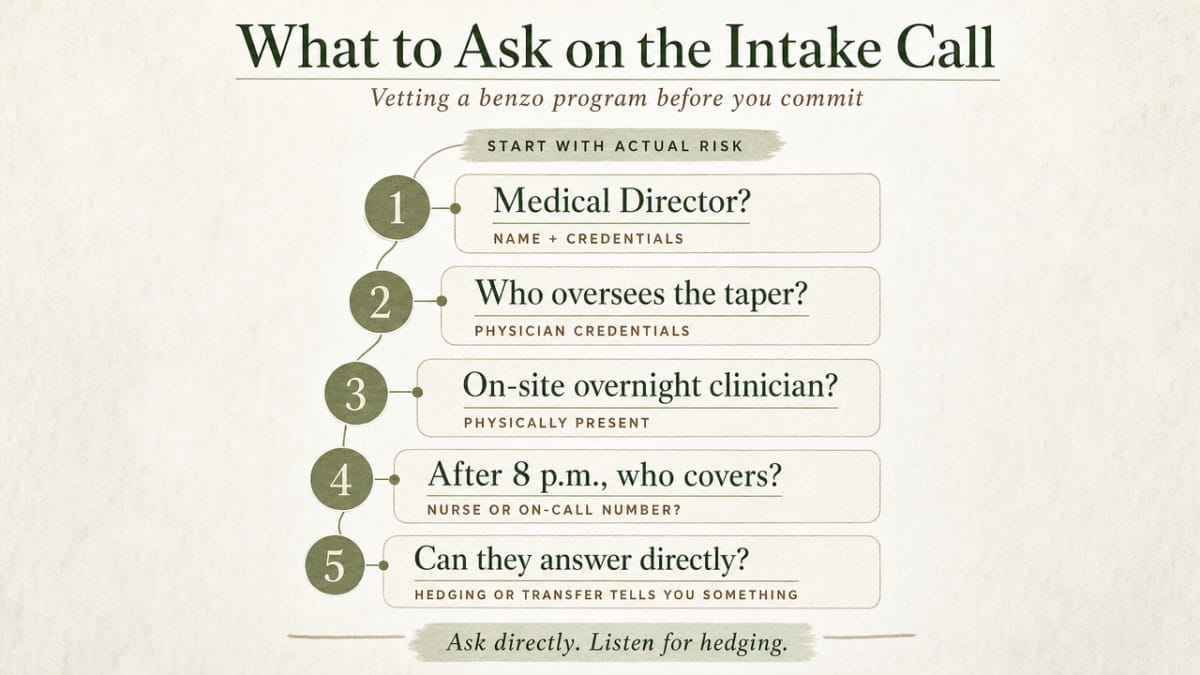
You don’t need a clinical degree to run a decent screen on a benzo program. You need a short list of questions and the willingness to hear an answer you don’t like. The intake call is where you learn whether a facility has actually built its detox around the pharmacology or just wrapped a fixed template in soothing language. Ask directly. Listen for hedging. If the person on the other end of the line can’t answer these without transferring you to someone who can, that itself tells you something about how the program is staffed.
Questions About Medical Coverage and Seizure Protocol
Start with the questions that map to the actual risk. Who is the medical director, and what are the credentials of the physician overseeing your taper? Is there a licensed clinician physically on-site overnight, or does coverage shift to a nurse with an on-call number after 8 p.m.? What is the formal seizure risk assessment they perform at intake, and what monitoring is in place during the first 72 to 96 hours? A program managing complicated withdrawal in a residential setting should describe structured monitoring and seizure risk assessment without hesitation, because that’s the current standard the 2025 tapering guideline sets for medically managed care 5. If those answers are vague, the program is telling you what it doesn’t have.
Questions That Should End the Call
Some answers are disqualifying.
- “We can get you through detox in five days” without seeing your dose history.
- “We don’t need your current prescriptions — just bring what you’re taking.”
- “Our nurse covers overnight from home.”
- “We treat benzos the same way we treat everything else.”
- “Aftercare? We can talk about that at discharge.”
Any one of these is a signal the program isn’t built for what benzo withdrawal actually requires. Two of them together and you’re already past the point where politeness serves you. Thank them, hang up, and call the SAMHSA National Helpline at 1-800-662-HELP for a neutral referral if you need a second opinion outside a facility’s sales funnel 14. You are not being difficult. You are doing the exact vetting a physician would do for a family member.
Programs That Ignore Your Prescription History
If the intake coordinator doesn’t ask what you’ve been prescribed, for how long, at what dose, and by whom — you are talking to a program that is guessing. That’s the plain version. A benzo taper built without a full prescription audit isn’t a plan; it’s a starting point pulled from a template.
Prescription exposure is the single most consistent correlate of benzodiazepine misuse in the epidemiologic literature 1. That matters clinically because your taper schedule, your seizure risk, and your realistic timeline all depend on specifics a template can’t infer:
- which benzo you’re on (short half-life vs. long half-life changes everything),
- how long you’ve been taking it,
- whether the dose has crept up,
- whether prescriptions have overlapped from more than one prescriber,
- and what else is currently in your system.
A program that shrugs at those details and says “we’ll figure it out when you get here” is telling you the taper is going to be a rough approximation of what your nervous system actually needs.
Ask directly: will a physician review your full prescription history before admission, or after? Will they call your prescribers? If the answer is “we handle that on day one,” you’re being asked to start withdrawal management before anyone has looked at the pharmacology driving it.
The Polysubstance Blind Spot Common in Men
Here’s the pattern that gets missed most often: you’re not just on benzos. You’re on benzos and a bottle of wine most nights. Or benzos and a hydrocodone prescription from a knee surgery two years ago that never really ended. Or benzos and a stimulant to keep the workday moving. If the intake coordinator asks about your Xanax and stops there, they’re building a taper around a fraction of the actual chemistry in your body.
This matters clinically for a specific reason. Prescription exposure combined with concurrent substance use is one of the most consistent patterns in the epidemiology of benzodiazepine misuse, and men show up in these datasets at equal or higher rates than women 1. The polysubstance overlap isn’t a character flaw — it’s a common presentation. But a program that treats your benzo use in isolation is going to under-medicate the withdrawal that’s coming from the alcohol you also stopped, or miss the opioid taper you also need, or fail to anticipate the autonomic instability that happens when two or three CNS-active substances come offline at once.
Ask the program directly: how do you assess and manage concurrent alcohol use during benzo detox? What’s your protocol if I’ve been taking opioids alongside? If the answer is a shrug, a vague reference to “we handle that,” or a suggestion that you’ll deal with the other substances later, you’re hearing the sound of a program that isn’t equipped for the case you actually have.
The counterweight is easier to spot than you’d think. SAMHSA lays out five markers of a quality treatment program:
- accreditation,
- evidence-based therapies,
- appropriate use of medications,
- family involvement,
- and strong support networks with aftercare planning 3.
A program that meets those five markers is a program built to handle complexity — including the polysubstance picture — rather than one built to handle a single clean diagnosis that most men in your position don’t actually have. Use that list as the positive filter. If a facility can walk you through all five without deflecting, you’ve found something worth a second call.
Detox Without a Real Residential Follow-Through
Here’s the sales pitch that catches a lot of men: a clean, discreet, self-contained detox. Seven to ten days, then home. It sounds efficient. It fits the calendar. It also misses the point of what detox actually accomplishes.
Ask what happens on day eight. Ask what the residential programming looks like after acute withdrawal is managed — individual counseling, behavioral therapy, dual-diagnosis capacity for the anxiety or depression underneath the benzo use, structured aftercare planning before you walk out. Treatment should be tailored to your drug use pattern and the medical, mental, and social problems around it 9. If the answer is “we discharge after detox and refer you out,” you’re being handed the hardest transition in recovery — the first week off substances, no structure, back in your own environment — with no clinical scaffolding in place. That’s not a program. That’s a hotel with a nurse.
The Sex-Specific Case for Adequate Medical Intensity
Here’s a piece of the evidence that doesn’t get enough airtime when men are evaluating programs. In one analysis, residential treatment compared with outpatient treatment was associated with significantly better abstinence outcomes for men, but not for women, which suggests the structured residential setting is doing real clinical work for male patients that a lower level of care may not replicate 7. If you’re a man weighing outpatient detox against a residential program because outpatient is more discreet or easier to schedule around work, that finding is worth sitting with.
There’s a second thread worth pulling, with a caveat attached. In the scoping review of alcohol withdrawal, males were more likely than females to develop complicated withdrawal — including delirium tremens and seizures — and in one included study received diazepam more frequently and at higher doses during inpatient treatment 8. That data is from alcohol withdrawal, not benzo withdrawal, and the review itself calls for more sex-specific research. But alcohol and benzos act on the same GABA system, and the pattern is consistent enough to raise the question: if male CNS-depressant withdrawal tends to run harder, an under-medicalized detox is a worse bet for you than the brochure suggests.
The operational takeaway is simple. A residential program that markets itself to men should have the medical intensity to match the clinical picture men actually present with — not just the amenities.
Accreditation, Licensing, and the Staff You Never See at 2 a.m.
Accreditation is boring to read about and easy to fake enthusiasm for on a website. It also happens to be the first item on SAMHSA’s short list of quality markers, alongside evidence-based therapies, appropriate medication use, family involvement, and aftercare planning 3. Ask directly whether the program is state-licensed and independently accredited, and ask who accredits it. A program that answers with a vague “we’re fully certified” and moves on is a program hoping you don’t press.
Licensing matters even more at the staffing level. The SAMHSA quick guide for evaluating treatment programs puts it plainly: ask whether the program is run by state-accredited, licensed, and trained professionals, and whether it provides gender-appropriate services 4. For a men’s residential program managing benzo withdrawal, that means physicians, nurses, and licensed therapists — not just recovery coaches with lived experience, however valuable that experience is elsewhere in the continuum.
The 2 a.m. question is the one that matters most for you specifically. Withdrawal doesn’t observe business hours. Ask what the overnight clinical coverage actually looks like — is a nurse physically on-site every night, who assesses vitals and seizure risk between midnight and 6 a.m., and how quickly can a physician be reached and on-site if something changes? If the honest answer is that overnight coverage relies on a phone tree, that program is not equipped to manage the acute risk window you’re paying it to manage.
What a Safe Program Actually Looks Like
You’ve read a lot of what to avoid. Here’s the positive template — the one you can hold up against any facility’s website or intake call and see what’s actually there.
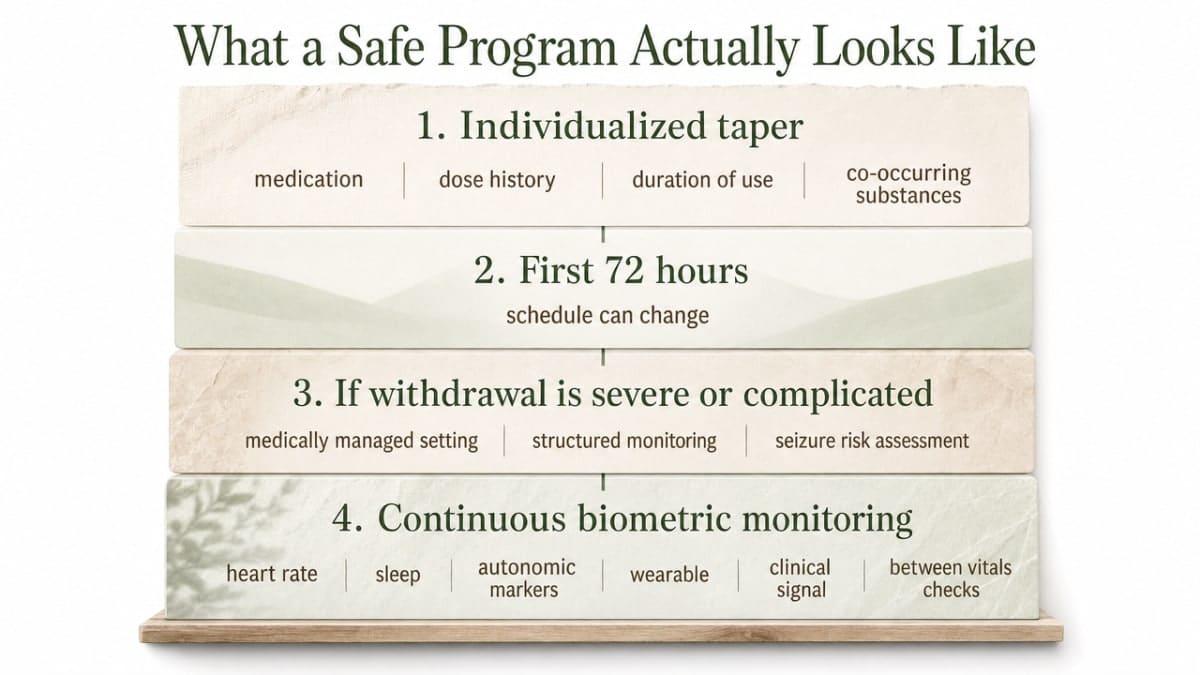
A safe benzo program starts with an individualized taper, not a template. Your medication, dose history, duration of use, and co-occurring substances shape the schedule — and the schedule is allowed to change based on how you respond in the first 72 hours. The 2025 tapering guideline is explicit that severe or complicated withdrawal belongs in a medically managed setting with structured monitoring and seizure risk assessment, not on a fixed calendar 5. Continuous biometric monitoring — heart rate, sleep, autonomic markers picked up by a wearable — is a legitimate clinical signal, not a gimmick, because it gives the medical team a view of your nervous system between vitals checks.
Underneath the detox, the program should meet the five markers SAMHSA uses as its baseline: accreditation, evidence-based therapies, appropriate use of medications, family involvement, and strong aftercare planning built in from day one 3. Add a physician-led team with overnight clinical coverage on-site, dual-diagnosis capacity for anxiety and depression, integrated management of concurrent alcohol or opioid use, and a residential arc that continues after acute withdrawal is behind you.
You’ll notice these are not amenities. They’re the clinical spine. A program that can walk you through each of them without deflecting — before you’ve committed to anything — is a program that has read the evidence and built around it. That’s the standard worth holding out for.
Protecting Career and Privacy Without Cutting Clinical Corners
Here’s where the pressure gets specific for you. You have a job that doesn’t pause. You have partners, clients, or a board who don’t need the full story. You have a phone that will keep ringing whether you answer it or not. The temptation is to solve for those constraints first — pick the shortest program, the most discreet location, the one that promises minimal disruption — and let the clinical questions fall in line behind them.
The programs worth your time understand this. They can talk about confidentiality, communication protocols with family, and how they handle the outside world without treating those as substitutes for an individualized taper, overnight medical coverage, and the residential arc that follows acute withdrawal 5. If you’re weighing options and need a neutral second opinion outside any facility’s sales funnel, SAMHSA’s National Helpline is free, confidential, and available around the clock 14. The right program will not be threatened by you making that call.
Frequently Asked Questions
How long should a safe benzo taper actually take?
Weeks, not days, is the honest answer. Any use beyond three to four weeks creates real withdrawal risk on abrupt cessation, and after one to six months of use the dose needs to come down gradually over weeks to lower the risk of life-threatening seizures 11. The exact schedule depends on your specific benzodiazepine, dose history, and how your nervous system responds in the first days. A program that quotes a fixed timeline before reviewing any of that is quoting a template.
Is a 5-to-7-day rapid benzo detox ever appropriate?
For most people on benzos long enough to develop dependence, no. The 2025 joint tapering guideline is direct that rapid dose reduction can cause life-threatening seizures and delirium, and that complicated withdrawal belongs in a medically managed setting with structured monitoring 5. There are narrow inpatient scenarios where a faster hospital taper is used for specific clinical reasons, but that’s a physician’s call based on your chart, not a package sold at intake.
What should I ask on the first intake call to rule out unsafe programs?
Five direct questions. Who is the medical director and what is the overnight clinical coverage? What formal seizure risk assessment do you perform at intake? How is my taper individualized to my specific benzodiazepine and dose history? How do you manage concurrent alcohol or opioid use? What does the residential arc and aftercare look like after acute withdrawal? A program built around the pharmacology can answer all five without transferring you. Hedging on any of them is the answer.
I’m also drinking heavily or using opioids. Does that change which program I need?
Significantly. Prescription benzo use combined with concurrent substance use is one of the most consistent patterns in the misuse literature, and men appear in these datasets at equal or higher rates than women 1. A dual alcohol-and-benzo picture in particular can require hospital-level monitoring, since patients with withdrawal seizures should be admitted and observed for 36 to 48 hours 13. Programs that treat your benzo use in isolation are not equipped for the case you actually have.
Is detox alone enough, or do I need residential treatment after?
Detox alone is not treatment. Medically assisted detoxification is only the first stage of addiction treatment and by itself does little to change long-term drug use 2. Clearing the substance doesn’t touch the anxiety, sleep patterns, or professional habits underneath the prescription. A program that discharges you at the end of acute withdrawal without a real residential arc and structured aftercare is handing you the hardest week of recovery with no scaffolding.
How do I protect my career and privacy while still getting adequate medical care?
Reverse the order you’re tempted to solve in. Pick the clinically adequate program first, then work through confidentiality and communication protocols with them — a good men’s residential program handles both without cutting the taper short. If you want a neutral second opinion outside any facility’s sales funnel, SAMHSA’s National Helpline is free, confidential, and available 24/7 14. The right program will not push back on you making that call before admission.
References
- The epidemiology of benzodiazepine misuse: A systematic review. https://pmc.ncbi.nlm.nih.gov/articles/PMC6639084/
- Principles of Drug Addiction Treatment: A Research-Based Guide (Third Edition). https://nida.nih.gov/sites/default/files/podat-3rdEd-508.pdf
- Finding Quality Treatment for Substance Use Disorders. https://library.samhsa.gov/product/finding-quality-treatment-substance-use-disorders/pep18-treatment-loc
- A Quick Guide to Finding Effective Alcohol and Drug Addiction Treatment. https://www.michigan.gov/-/media/Project/Websites/mdhhs/Folder2/Folder62/Folder1/Folder162/SAMHSA_Quick_Guide_Find_Treatment.pdf
- Joint Clinical Practice Guideline on Benzodiazepine Tapering. https://pmc.ncbi.nlm.nih.gov/articles/PMC12463801/
- Benzodiazepine withdrawal seizures and management. https://pubmed.ncbi.nlm.nih.gov/21815323/
- Treatment Modalities and Settings (NCBI Book chapter). https://www.ncbi.nlm.nih.gov/books/NBK144286/
- Sex difference in alcohol withdrawal syndrome: a scoping review. https://pmc.ncbi.nlm.nih.gov/articles/PMC10556532/
- Treatment and Recovery (NIDA). https://nida.nih.gov/publications/drugs-brains-behavior-science-addiction/treatment-recovery
- Meta-Analyses of Seven of NIDA’s Principles of Drug Addiction Treatment. https://pmc.ncbi.nlm.nih.gov/articles/PMC3290709/
- Management of benzodiazepine misuse and dependence. https://pmc.ncbi.nlm.nih.gov/articles/PMC4657308/
- Inpatient Management of Benzodiazepine Withdrawal. https://pubmed.ncbi.nlm.nih.gov/42294745/
- Alcohol Withdrawal Syndrome: Benzodiazepines and Beyond. https://pmc.ncbi.nlm.nih.gov/articles/PMC4606320/
- National Helpline for Mental Health, Drug, Alcohol Issues | SAMHSA. https://www.samhsa.gov/find-help/helplines/national-helpline