
Key Takeaways
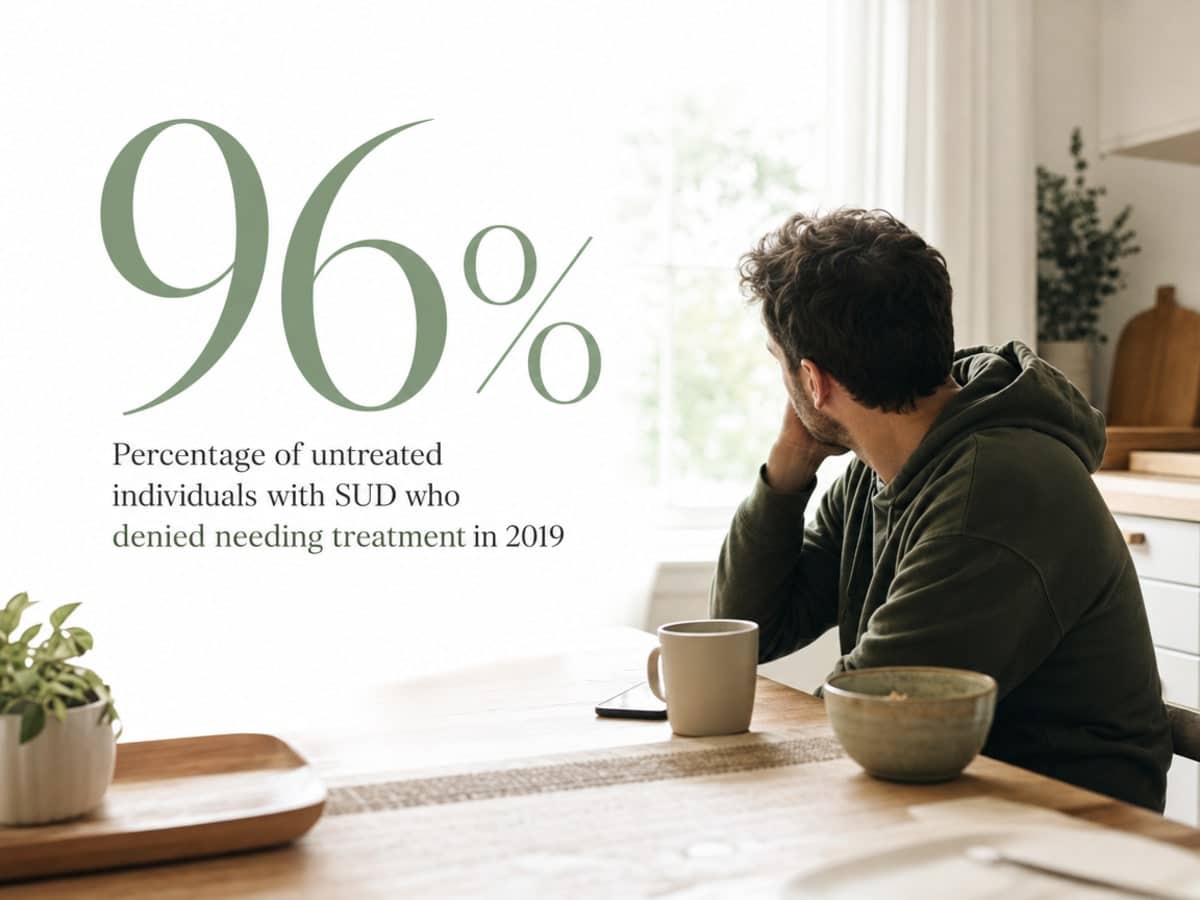
- Denial is the default response, not a personal failure of your delivery: 96% of adults with untreated substance use disorder don’t believe they need help 1.
- High-functioning men treat career success and daily productivity as proof of control, so denial protects identity rather than hides dishonesty, requiring a lower-threat approach.
- CRAFT engages 64% of resistant drinkers in treatment versus 30% for surprise interventions, making skills-based family training far more effective than confrontation 7.
- Practical CRAFT shifts include timing conversations during sober moments, reinforcing healthy choices, and letting natural consequences unfold instead of covering for him.
- Prepared scripts focus on your experience and specific observations rather than labels, so he cannot deflect with career wins, blame-shifting, or claims of control.
- Phrases like ‘you’re an alcoholic,’ ultimatums, or shame-based appeals backfire because they target identity, which is exactly what he is defending most fiercely.
- For partners, behavioral couples therapy outperforms individual treatment for both drinking outcomes and relationship satisfaction, giving spouses a valid role in treatment planning 4.
- You can contact a treatment center and protect your own wellbeing before he is ready; coaching and support directed at family members has its own evidence base 9, 10.
Why the Kitchen-Table Confrontation Keeps Failing
You’ve probably rehearsed the conversation in your head a hundred times. Maybe you’ve had it out loud, more than once. You picked a calm moment, said the thing you’d been holding back for months, and watched him shut down, laugh it off, or turn the whole thing into an argument about something else. And nothing changed.
Here’s what almost nobody tells you at the start: that outcome is not a sign you said it wrong. It’s not a sign he’s uniquely stubborn, or that your marriage is broken, or that he’s a lost cause. Denial is the default setting, not the exception.
In a 2019 U.S. national survey of adults with a substance use disorder who were not in treatment, 96% said they didn’t feel they needed any 1. This figure represents individuals who met clinical criteria for a diagnosable problem within the past year, yet nearly all did not perceive themselves as having one. This highlights that the man across the kitchen table is not behaving unusually when he dismisses your concerns; he is acting precisely like the vast majority of people in his situation.
This understanding should reshape how you approach future conversations. If denial were uncommon, a heartfelt speech might be effective. However, because denial is the norm, the goal of a single sit-down cannot be to make him admit he has a problem. He almost certainly won’t, at least not that day.
Instead, you can shift from attempting to force insight to employing strategies that clinicians know are effective over weeks and months. This guide will walk you through these approaches, which you can begin implementing on your own, even before he acknowledges any issue.
Understanding Denial in a High-Functioning Life
The denial you’re encountering likely doesn’t fit the typical portrayal. He might not be stumbling in late or missing work; he could even be excelling professionally. This discrepancy can be disorienting for you and makes it easy for him to dismiss concerns.
When a man’s identity is rooted in competence, denial manifests as evidence of control. This includes recent business successes, promotions, or maintaining early morning workouts despite heavy drinking the night before. Each functional day serves as proof he can present to you.
Observe the specific ways this denial appears in a high-functioning individual. He might:
- Compare his drinking to others who are visibly worse off,
- Rationalize daily use as a reward for high-pressure work, or
- Engage in public self-negotiations like “no liquor on weeknights” that are rarely sustained.
His defensiveness often centers not on the act of drinking itself, but on any suggestion that he lacks control.
This isn’t dishonesty; it’s his mind protecting a self-image reinforced by his professional life. Recognizing this distinction is crucial because it reframes your challenge. You’re not trying to catch him in a lie; you’re aiming to reduce the perceived threat so he can safely examine what he already, on some level, knows. This reframe is the foundation for all subsequent strategies in this guide.
The Skills-Based Approach That Outperforms Confrontation
CRAFT vs. the Intervention You’ve Seen on TV
You might envision a dramatic intervention: loved ones gathered, emotional letters read, a packed bag by the door, and a counselor present. This scenario often suggests that cornering someone with love will lead to a breakthrough.
However, there’s a more effective, evidence-based alternative that looks nothing like this.
A significant randomized trial compared three methods for engaging unmotivated problem drinkers in treatment through their family members:
- Community Reinforcement and Family Training (CRAFT) successfully engaged 64% of these individuals.
- A Johnson-style intervention, the classic surprise confrontation, engaged 30%.
- Al-Anon facilitation engaged 13% 7.
CRAFT achieved more than double the engagement rate of the dramatic, confrontational approach, without the ambush.
Consider the impact of that statistic: nearly two out of three men who initially resisted help entered treatment when their family member was trained in CRAFT skills. This is not a minor difference; it represents a fundamentally different level of outcome.
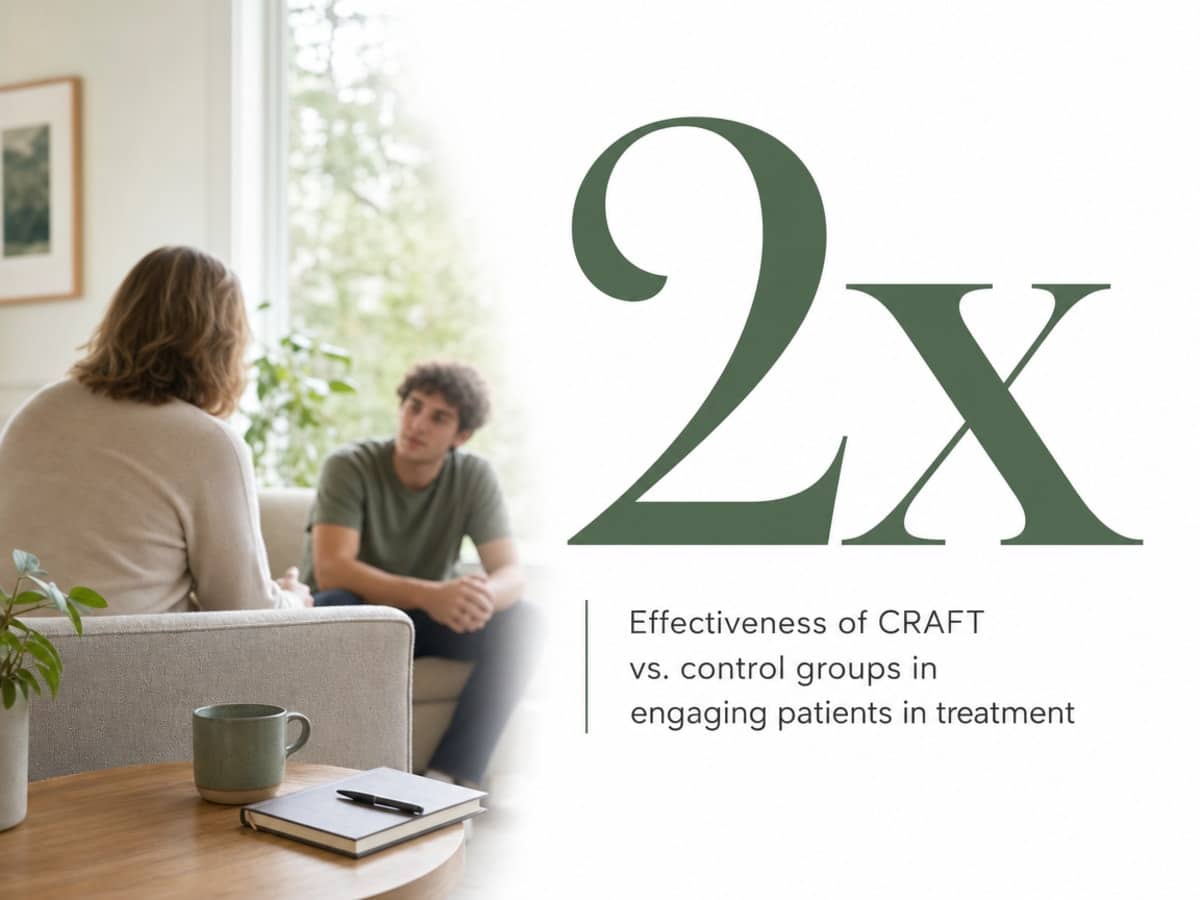
A subsequent meta-analysis further supported this pattern, showing CRAFT to be approximately twice as effective as control conditions in getting a resistant loved one into treatment 2. The effectiveness of CRAFT isn’t magical; it teaches family members how and when to communicate, how to recognize and reinforce healthier behaviors, how to allow natural consequences to occur, and how to identify opportune moments when their loved one might be receptive to help.
CRAFT intentionally foregoes theatricality. There are no surprise confrontations, no pre-written scripts, and no ultimatums delivered under pressure. Instead, it provides practical habits you can begin using immediately in everyday settings.
Practical Application of Family Skills at Home
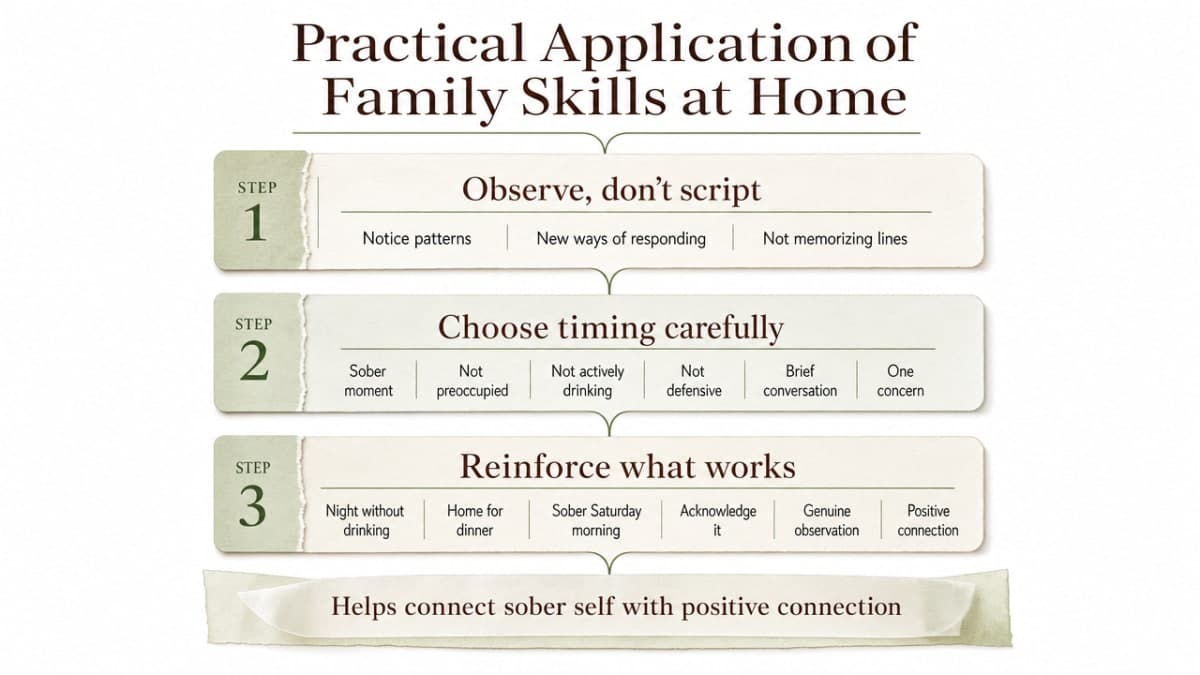
In practice, CRAFT skills are often more subtle than anticipated. The focus isn’t on memorizing lines but on developing new ways of observing and responding.
The first key shift is timing. Avoid discussing his drinking when he’s actively drinking or already defensive. Instead, choose a sober, unhurried moment when he’s not preoccupied. Keep conversations brief, focusing on one concern rather than a lengthy monologue.
The second shift involves reinforcement. This can feel counterintuitive when you’re feeling frustrated. When he chooses a night without drinking, comes home for dinner instead of a client event, or spends a sober Saturday morning with the children, acknowledge it. Frame it as a genuine observation, such as “It was good to have you here tonight.” Over time, this helps his brain connect his sober self with the positive connection he desires.
The third shift is allowing natural consequences to unfold. This means stopping behaviors like calling in sick for him, covering his expenses, making excuses for missed commitments, or explaining his absence to others. This isn’t about punishment, but about allowing the disparity between his self-perception and reality to become apparent, a gap you may have inadvertently been closing for years.
Even simplified versions of these skills are effective: one analysis found treatment entry rates of 62% for full CRAFT and 63% for a streamlined version, compared to 37% for non-family controls 8. You don’t need to master everything at once; starting the process is more important than achieving perfection immediately.
Scripts for Common Conversations
When He Says ‘I Have It Under Control’
This phrase is common. When you bring up his drinking, he perceives an accusation of weakness and responds to that perceived accusation rather than your actual concern. He might say, “I have it under control,” or “Babe, I know my limits.”
Avoid arguing with this statement. If you tell him he’s not in control, you give him something to defend, and he will defend it at length.
Instead, try something like:“I hear you. I’m not saying you’re out of control. I’m telling you what it’s like for me. When you fell asleep on the couch again Tuesday, I didn’t feel close to you. I miss you.”
This approach avoids diagnosis or comparison. It focuses on your personal experience in a specific, relatable moment and expresses what you desire more of, rather than what you want less of.
Then, stop talking. Allow the silence to linger.
He might deflect, promise to cut back, or change the subject. Any of these responses are acceptable for a single conversation. Your goal isn’t to win today, but to become someone who can speak truth without initiating a fight, so that when an opportunity arises, he thinks of you first.
When He Cites His Career as Proof of Well-being
He might say, “I just landed the biggest account of the year. Does that sound like someone with a problem?”
He genuinely believes his professional success is a valid counter-argument. You already know that challenging his career achievements is a losing battle, as his work is where his denial finds tangible support.
Therefore, do not engage on that ground. Shift the focus.
“I’m proud of your accomplishments at work. My concern isn’t about your career; it’s about you. There’s a difference between what you can produce and how you’re truly doing. You’ve been struggling on Sunday nights. That’s what I’m asking about.”
Be specific about observations only the two of you would know: the 3 a.m. awakenings, his shorter temper with your oldest child, or the way he pours his first drink immediately upon arriving home. He cannot use his professional achievements to refute these personal observations, as they are unrelated to his work life.
A more challenging aspect is that you may need to entirely avoid discussing his career, even privately. Threats to his professional standing are often perceived as attacks on his core identity, causing him to become more entrenched. For now, preserving that area as safe is a strategic move, not enabling.
When He Shifts Blame to You
He might say, “You know, you’ve been drinking more too,” or “Maybe if you weren’t so critical, I wouldn’t need a drink when I get home.” Or, the most hurtful, “You’re the one with the problem, not me.”
This is often the point where conversations escalate. He makes an accusation, you defend yourself, and the discussion devolves into an argument about you.
Do not take the bait or argue within his framework. You don’t need to justify your own drinking, your perceived nagging, or your current mood.
Try this:“That might be worth discussing another time. Right now, I’m telling you something about my experience, not about you. I’m scared. I love you. I’m going to keep bringing this up because I’m not willing to pretend I don’t see what I’m seeing.”
Say it calmly and then let the conversation end. If necessary, move to another room. Refusing to escalate the argument does not mean you’ve lost the conversation.
Your consistent refusal to be the reason he can dismiss your concerns will eventually leave him to confront the issue himself. This is the ultimate objective.
Phrases to Avoid and Why They Backfire
Certain phrases, though seemingly truthful and spoken with love, can trigger defensiveness and reinforce denial. Here’s what to omit from your next conversation and the underlying reasons.
“You’re an alcoholic.” This label provides him with a category to reject, and rejecting the label becomes easier than examining his behavior. Instead, describe specific observations: the four drinks, the Tuesday nap on the couch, or his tone with the children on Sunday morning.
“If you loved me, you’d stop.” While this sentiment may be honest due to your exhaustion, it backfires. It reframes his drinking as a test of your marriage, causing him to defend the relationship rather than consider his alcohol use. Love is not the variable; his relationship with alcohol is.
“Look at what you’re doing to this family.” Shame is an ineffective motivator for change; it often leads to increased drinking or hiding use, rather than self-reflection. Speak from your personal experience, not from a position of judgment.
“I’m done. I mean it this time.” Ultimatums you are unwilling to enforce teach him to wait you out. If you’re not prepared to follow through, do not make the statement. If you are ready, there’s no need to announce it as a threat.
“Everyone has noticed.” Even if true, this shifts the conversation to his reputation, which is precisely the door you want to keep open for future dialogue.
For Partners: The Evidence for Couple-Level Involvement
This section is specifically for spouses and long-term partners. If you are a parent, sibling, or adult child, the CRAFT skills discussed earlier remain applicable. The evidence presented here pertains to situations where the relationship itself becomes an integral part of the treatment process.
When a man in a committed relationship enters treatment, research strongly supports including his partner, particularly for alcohol use disorder. A randomized trial comparing behavioral couples therapy (BCT) with individual therapy for men with alcohol use disorder found BCT to be more effective for both drinking outcomes and relationship functioning 3. A meta-analysis of 12 trials reported an overall effect size of d = 0.54 for BCT versus individual treatment, with sustained advantages in frequency of use, consequences, and relationship satisfaction 4. A 2023 synthesis further confirmed BCT’s superiority on these measures at a 12-month follow-up 11.
For you, this means that when he is ready to consider help, you have a valid reason to inquire with the admissions team about partner involvement in treatment planning and family sessions. You are not overstepping; the evidence indicates that your presence positively influences both his outcome and yours.
Keep this information in mind for the future. It’s a resource you can utilize when he is ready, not necessarily today.
Seeking Help Before He’s Ready
Many family members are unaware that they can contact a treatment center for themselves, today, without their loved one’s knowledge or agreement. This is not a workaround; it’s how evidence-based approaches often begin.
CRAFT research focuses on what happens when the family member receives coaching, not solely on the resistant individual’s decision to change. A recent trial demonstrated that concerned significant others receiving group or individual CRAFT reported a 29% treatment engagement rate at three months, compared to 15% for those using self-directed materials alone 9. Coaching is beneficial; isolation makes the process unnecessarily difficult.
Such a call is simpler than you might imagine. You don’t need a diagnosis, a detailed drinking log, or a decision about inpatient care. You call, explain your situation, and ask for guidance on next steps. The admissions team at Serenity Park, a men’s residential treatment center in Little Rock, regularly consults with family members even before their loved one is ready for treatment. They can advise on how to approach conversations, what to say if he asks about your calls, and outline the intake process should he become open to help.
Calling does not commit him to anything. It provides you with a coach and a trusted resource. When opportunities arise, and they often do, you’ll already have a contact and someone familiar with your situation.
Self-Protection While Awaiting Change
Denial can persist for a significant period. While you diligently apply new communication skills, it’s crucial to maintain a life that isn’t entirely dictated by his choices.
Begin with small, practical steps. Maintain a regular sleep schedule, even if he doesn’t. Keep your standing appointments: your walk with your sister, your book club. Your nervous system requires activities during the week that are independent of him.
Cultivate at least one relationship where you can be completely honest. A therapist specializing in substance use disorders and family systems is ideal. A trusted friend who offers support without panic or judgment is also a valuable option. Research on affected others clearly shows that support directed at you, not just at him, has its own evidence base and benefits 10. You are not a passive observer; you are carrying a significant burden, and that burden is real.
Frequently Asked Questions
Can I call a treatment center before my loved one agrees to get help?
Yes, and it’s one of the smartest early moves you can make. You don’t need his permission, a diagnosis, or a plan for what happens next. Serenity Park’s admissions team in Little Rock talks with family members regularly before the man in question is anywhere close to ready. You’re getting yourself a coach and a phone number you already trust, so you’re ready when a window opens.
Should I stage an intervention if he keeps denying he has a problem?
Probably not, at least not the surprise-confrontation version. In a randomized trial comparing family approaches, a Johnson-style intervention engaged 30% of unmotivated drinkers in treatment, while CRAFT-coached family members engaged 64% 7. The quieter, skills-based approach outperforms the ambush by a wide margin. If you want a dramatic moment, save that energy for learning the CRAFT skills or calling for coaching.
How do I bring up his drinking without threatening his career or reputation?
Keep the conversation off his job entirely. Speak only about what happens between the two of you at home, in specific moments he can picture: the Tuesday night on the couch, the shorter fuse with the kids, the missed Saturday morning. His career is the one place denial has real evidence on its side, so you don’t take that ground. You stay on your side of the street.
What do I do when he turns the conversation around and blames me?
Don’t defend yourself, and don’t argue the frame. Say something like, “That might be worth talking about another time. Right now I’m telling you something about me, not about you.” Then let it end. Walk to the other room if you need to. You haven’t lost the conversation by refusing to escalate it. You’ve refused to be the reason he gets to dismiss the concern.
Is it okay to set limits if he still won’t admit there’s a problem?
Yes, and setting limits is part of what makes the family skills work. Decide privately what you will and won’t tolerate around the kids, money, and driving, and follow through quietly when a line is crossed. You’re not issuing threats or ultimatums you can’t enforce. You’re stopping the small daily rescues that have been closing the gap between his self-image and his reality for years.
What if nothing I say works and he never accepts help?
That’s a real possibility, and you deserve honesty about it. Denial can be stubborn for a long time, and no phrase guarantees he’ll come around. What the research is clear about is that support aimed at you has its own evidence base and its own benefits 10. Your wellbeing, your sleep, your friendships, your therapist, your limits, all of that matters even if he never walks through a treatment door.
References
- Denial and Diagnosis of Methamphetamine Dependence Severity. https://pmc.ncbi.nlm.nih.gov/articles/PMC9647299/
- Community reinforcement and family training and rates of treatment engagement: A meta-analysis. https://pubmed.ncbi.nlm.nih.gov/31770469/
- A Randomized Clinical Trial of Behavioral Couples Therapy versus Individual Therapy for Men with Alcohol Use Disorder. https://pmc.ncbi.nlm.nih.gov/articles/PMC4244232/
- Behavioral couples therapy (BCT) for alcohol and drug use disorders: A meta-analysis. https://pubmed.ncbi.nlm.nih.gov/18374464/
- Behavioral couples therapy (BCT) for alcohol and drug use disorders (Cochrane-type review). https://www.ncbi.nlm.nih.gov/books/NBK76353/
- Individual cognitive-behavioral therapy and behavioral couples therapy in alcohol use disorder: A randomized clinical trial. https://pubmed.ncbi.nlm.nih.gov/18560253/
- Engaging the unmotivated in treatment for alcohol problems. https://pubmed.ncbi.nlm.nih.gov/10535235/
- Analyzing Components of Community Reinforcement and Family Training. https://pmc.ncbi.nlm.nih.gov/articles/PMC5690811/
- Primary Outcome from a cluster-randomized trial of three formats for delivering Community Reinforcement and Family Training (CRAFT) to the significant others of problem drinkers. https://pubmed.ncbi.nlm.nih.gov/35538465/
- Affected other interventions: a systematic review and meta-analysis across addictions. https://pmc.ncbi.nlm.nih.gov/articles/PMC9543616/
- The Effect of Behavior Couples Therapy on Alcohol and Drug Use Disorder: a Systematic Review and Meta-Analysis. https://pubmed.ncbi.nlm.nih.gov/36208184/
- Couple and family involvement in adult mental health treatment: a systematic review. https://pubmed.ncbi.nlm.nih.gov/23321286/