
Key Takeaways
- Arkansas recognizes family therapy as a reimbursable service, with Medicaid covering CPT codes 90846, 90847, and 90849 for substance use diagnoses in outpatient care 2.
- Qualified providers hold LMFT, LCSW, or LPC credentials, and Arkansas LMFTs must complete 3,000 client contact hours and pass the AMFTRB national exam before delivering family work 4.
- Residential programs typically bundle family sessions into their daily rate, then transition to Medicaid- or insurance-billable outpatient family therapy after discharge as continuing care.
- Ask any Arkansas program who leads family sessions, what license they hold, and how involvement is structured week by week — vague answers deserve follow-up questions.
When Addiction Belongs to the Whole House
You already know something is wrong. The late texts that don’t get answered. The excuses that stopped making sense a while ago. The bank statements. The bottles. Or maybe just the way his shoulders look when he thinks nobody is watching.
If you’re reading this, you’re probably not the person using. You’re the wife, the partner, the mother, the adult daughter, the brother. You’ve been carrying this quietly, and you’re tired. That exhaustion is real, and it deserves to be named before anything else.
Here’s what the research keeps pointing to, and what most rehab marketing quietly skips: addiction rarely lives inside one person. It moves through a household. The way you talk about it, avoid it, cover for it, or push back against it all become part of the pattern. That’s not blame. It’s how family systems work, and it’s exactly why effective treatment often requires the family in the room, not just the client 10.
This guide is written for you first. You’ll learn what family therapy actually looks like inside addiction treatment in Arkansas, which clinicians are qualified to deliver it, how Medicaid and insurance pay for it, and what real family involvement looks like week by week in a residential program. There’s also a short note for the man himself, if he’s the one quietly reading over your shoulder.
You don’t have to do this alone. You shouldn’t have to.
What Family Therapy Actually Is Inside Addiction Treatment
Family therapy inside addiction treatment is not a group hug on visiting day. It’s a structured clinical intervention, delivered by a licensed therapist, where the family is treated as part of the case, not as an audience for the client’s progress.
The federal guidance most Arkansas programs work from is SAMHSA’s 2021 Advisory based on TIP 39, which frames family therapy in substance use disorder care as an integrated approach where treatment and family work happen together rather than in separate lanes 1. The goals are practical. Change the patterns in the household that keep the substance use going. Improve communication so the man in your life can ask for help without it turning into a fight. Build a family that can hold a boundary without collapsing into one.
You’ll hear a few model names in Arkansas intake conversations. Three come up most often in the evidence base:
- Brief Strategic Family Therapy (BSFT) — short-term work that targets the specific interaction patterns in the family that maintain the substance use 1.
- Multidimensional Family Therapy (MDFT) — a more intensive systems model that works across the individual, the family, and outside influences like peers and work 6.
- Family Behavior Therapy (FBT) — combines behavioral contracting and contingency management, and is one of the few family models with documented results in both adults and adolescents 6.
What these share is a systems lens. The client isn’t the only person being helped, and the family isn’t there to be blamed. Everyone in the room is looking at the same pattern together, with a clinician who can name what’s happening without taking sides. That reframe alone — from “fix him” to “look at us” — is often the first thing that shifts.
Does Family Therapy Actually Change Outcomes?
Yes. And you deserve to see the receipts, not just the reassurance.
The strongest randomized controlled trial evidence for family therapy in addiction comes from adolescent studies. In a family-based treatment trial for adolescent substance abuse, teens who received structured family therapy showed greater reductions in drug use and conduct problems than those in comparison conditions 8. In the Multidimensional Family Therapy trial, adolescents in MDFT showed greater reductions in substance use and greater improvements in family functioning than participants in group-based or other treatments 9. NIDA’s research-based guide goes further, noting that family-based approaches are highly efficacious, with some studies suggesting they can equal or exceed individual and group approaches for adolescent SUD 6.
Here is the honest scope note, because you’re a careful reader and you’ll notice: most of that RCT evidence is in teenagers, not middle-aged men. That matters. The reason clinicians still apply these principles to adult treatment is that the underlying mechanism — changing the interaction patterns in the family system that maintain the substance use — isn’t age-specific. Peer-reviewed work on family systems and SUD in adults describes the same dynamic: dysfunctional patterns in the household raise relapse risk, and addressing them tends to lower it 10. Broader reviews of family-based interventions across developmental stages conclude that they produce clinically meaningful reductions in substance use and improvements in family communication and cohesion 11.
So the accurate way to hold this: the gold-standard trials are in adolescents. The conceptual and clinical foundation for using family therapy with adults is solid, and the field treats it as one of the more effective tools available, even where the RCT literature is thinner.
What does that mean for you, sitting at your kitchen table trying to decide? It means that when a program tells you family involvement matters, they aren’t selling you a feeling. They’re describing something the research has been pointing at for two decades. Your presence in the room, done well and with a clinician guiding it, is one of the levers that actually moves.
The Arkansas Infrastructure: Who’s Licensed, Who’s Paid, Who’s in the Room
Before you can trust a program’s family therapy claim, it helps to know what the state actually requires and reimburses. Arkansas has more infrastructure here than most families realize — and knowing it protects you from providers who use “family involvement” as a marketing phrase without the credentials or clinical structure behind it.
Who Is Qualified to Deliver Family Therapy in Arkansas
The person sitting across from you in a family session should be more than a caring listener. In Arkansas, family therapy for addiction is typically delivered by a Licensed Marriage and Family Therapist (LMFT), a Licensed Clinical Social Worker (LCSW), or a Licensed Professional Counselor (LPC) with appropriate training. Each of these credentials carries real weight.
For the LMFT path specifically, the Arkansas Board of Examiners in Counseling’s July 2026 rule revision sets the bar clearly. An applicant must document 3,000 client contact hours and 175 hours of supervision in marriage and family therapy, pass the Association of Marital and Family Therapy Regulatory Boards (AMFTRB) national exam, and pass the Arkansas jurisprudence exam 4. That’s not a weekend certificate. That’s years of supervised clinical work with couples, families, and systems before someone can sit in your living room, so to speak, and guide the conversation.
If your loved one’s care will be billed through Arkansas Medicaid, there’s an additional layer. The Arkansas Department of Human Services requires LMFTs participating in Medicaid to be licensed and in good standing with the Board, carry two years of post-licensure experience treating children and adolescents with mental illness, and maintain an affiliation agreement with a physician or psychiatrist for medication management when a Medicaid recipient needs it 3.
How Arkansas Medicaid Pays for Family Therapy
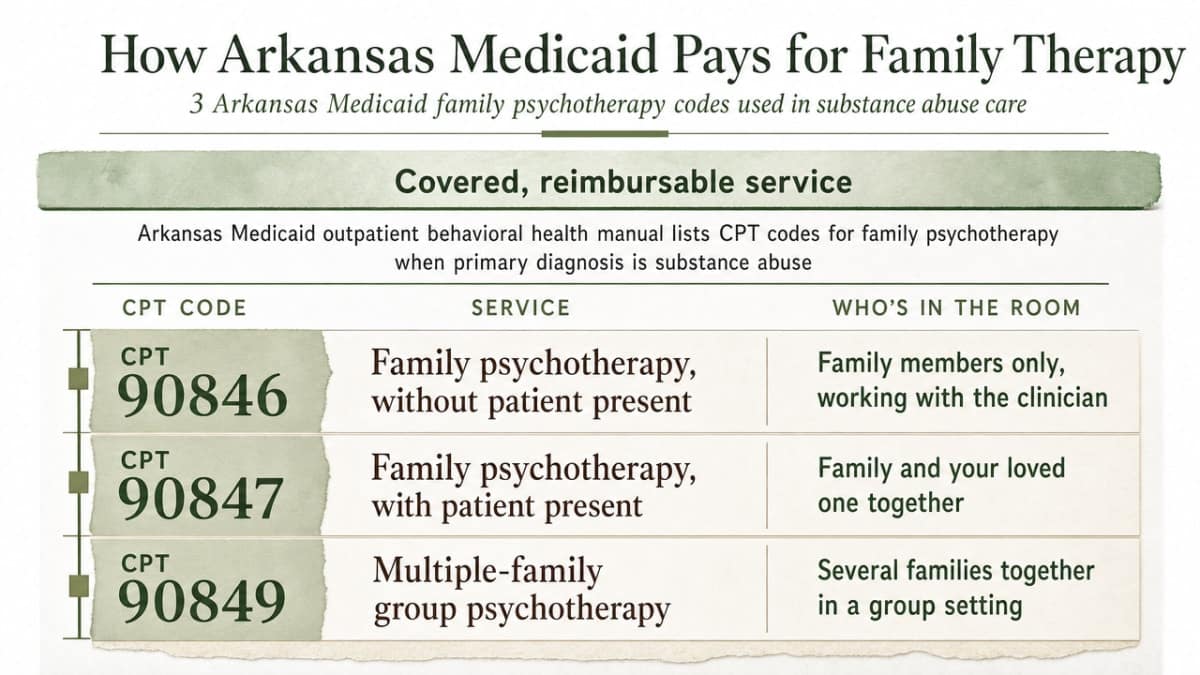
Family therapy for addiction is a covered, reimbursable service in Arkansas — not a courtesy add-on. The Arkansas Medicaid Outpatient Behavioral Health Services Manual lists specific CPT codes for family psychotherapy in cases where the primary diagnosis is substance abuse, which is unusual clarity for a state Medicaid program and worth knowing about even if you’re using commercial insurance, because most commercial carriers follow the same coding conventions 2.
Here are the codes your case manager or billing office will use:
| CPT Code | Service | Who’s in the Room |
|---|---|---|
| 90846 | Family psychotherapy, without patient present | Family members only, working with the clinician |
| 90847 | Family psychotherapy, with patient present | Family and your loved one together |
| 90849 | Multiple-family group psychotherapy | Several families together in a group setting |
Notice that 90846 exists at all. That code means Arkansas Medicaid recognizes something clinicians have long known: sometimes the most useful family work happens without the person with the addiction in the room. You need space to talk honestly with a therapist about what you’ve been carrying. That’s not going behind his back. It’s building the skills you’ll bring back into joint sessions.
One important limit to hold in mind: the manual specifies these are outpatient services 2. Residential and inpatient family therapy is often delivered as part of a program’s bundled level-of-care rate rather than billed under these outpatient codes. That’s why, when a loved one is in a residential program, you’ll often see family therapy included in the program’s daily rate and then transition to Medicaid-billable outpatient family sessions after discharge as part of continuing care. Ask the intake team to walk you through both phases so you know what’s included, what’s billed separately, and what continues after he comes home.
What Family Involvement Looks Like Week by Week in a Residential Program
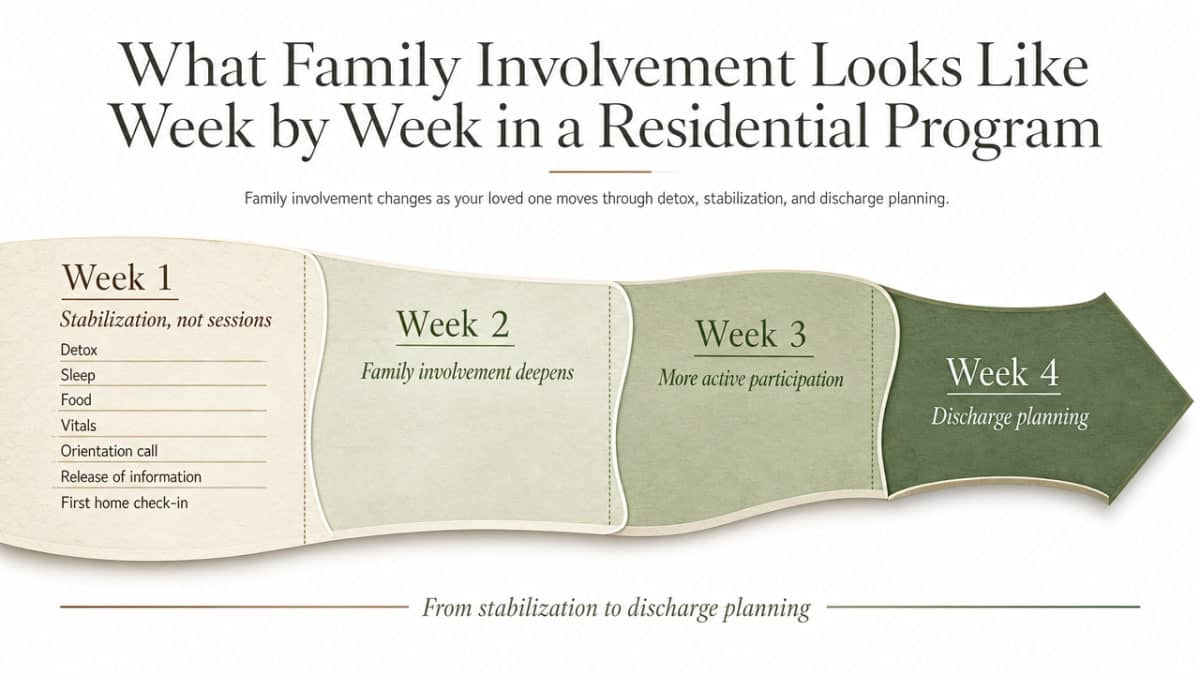
One of the most useful questions you can ask an intake coordinator is simple: what will I actually be doing, and when? Family involvement in a good residential program isn’t a single event. It’s a rhythm that changes as your loved one moves through detox, stabilization, and discharge planning.
Week one: stabilization, not sessions. The first few days are usually medical. Detox, sleep, food, vitals. Your loved one may be too physically depleted for meaningful family work, and pushing it too early tends to backfire. What you can expect in this window is a family orientation call with a case manager, a written release of information you’ll be asked to sign so the clinical team can speak with you, and a first check-in about what’s been happening at home. This is where your therapist starts building the picture of the family system.
Week two: family education and your own work. Now the clinical team begins to engage you directly. Expect psychoeducation about how substance use disorders reshape family patterns, a session or two focused just on the family (billed under something like the 90846 code in outpatient settings, or included in the residential rate) 2, and honest conversation about the behaviors you’ve been doing to cope. Not to shame you. To name them, so they can be shifted.
Week three: joint sessions with your loved one. This is where the work gets real. A clinician-guided conversation, with him in the room, using a family-systems frame 1. Communication is coached in real time. Old patterns get interrupted gently. You might practice a conversation about money, or trust, or what happens on a Friday night. It won’t be perfect. A session that ends with one honest sentence spoken out loud is a win worth naming.
Week four and discharge planning: alignment for what comes next. The last stretch is about the runway home. Who does what when he walks back through the door. What boundaries the household will hold. Which outpatient family sessions continue after discharge, and whether alumni programming keeps the family connected to the community he’s built. This is where residential care either lands or unravels, and it’s why family alignment before discharge matters as much as any single therapy hour.
The Hard Parts Nobody Names
Most articles on this topic will not tell you what is about to be said here, so read it slowly.
You might not like him very much right now. That’s allowed. Loving someone and being furious with them are not opposites, and sitting in a family therapy room does not require you to pretend otherwise. Good clinicians expect the anger. They know the resentment is data, not a character flaw.
You might also be tired of being the responsible one. The person who called the doctor, hid the keys, made the excuses to his boss, kept the kids on schedule. Family therapy will, at some point, ask you to put some of that down. That can feel more threatening than doing all of it forever, because the doing has become how you know you’re helping. Peer-reviewed work on family systems is direct about this: some of the patterns families develop to cope with a loved one’s substance use end up maintaining the very behavior they’re trying to stop 10. Interrupting those patterns is uncomfortable. It’s also the work.
Then there is the fear of being used again. Of showing up, opening up, and finding out in six months that nothing changed. That fear is reasonable. You are allowed to bring it into the room. A skilled therapist will not talk you out of it. They’ll help you build boundaries that survive contact with reality, not just the ones that sound good in a session.
None of this is failure. It’s what the hard work of a family in recovery actually feels like from the inside.
A Note to the Person Considering Treatment
This part is for you. The man reading this over her shoulder, or on your phone at 2 a.m. in the driveway, or in a hotel room between meetings. You already know why you’re here.
You’ve probably heard “family therapy” and felt something tighten. Maybe it sounded like a room full of people telling you what you already tell yourself. Maybe it sounded like losing the last piece of privacy you still had. Both reactions make sense. Neither is what this actually is.
Family therapy in a good program is not a tribunal. It’s a clinician-led conversation where the patterns in your household get named out loud, including the ones that aren’t yours to carry. The people who love you are not there to prosecute. They’re there because effective addiction treatment often needs the family in the room, not because you’re weak, but because the system around you shapes what recovery has to survive 10.
You don’t have to walk in fixed. You don’t have to have the right words. You have to show up, and let a trained person help translate what’s been unspoken for a long time.
The people at your kitchen table are already doing the reading. You’re allowed to let them help.
Serenity Park’s Family-Oriented Model in a Men’s Residential Setting
Everything above is the case for family therapy in general. Here’s what makes it operationally possible at Serenity Park, and why the model looks the way it does.
Serenity Park is a 20-bed men’s residential program in Little Rock. That number matters more than it might sound. When a residential program is running 80 or 120 clients at a time, family involvement has to be scheduled in batches — a family day, a group weekend, a quarterly event. When the census is 20, family work can be individualized. Your family session is your family session, not a slot in an assembly line. That’s a design choice, not a marketing flourish.
The clinical spine here is the same family-systems logic SAMHSA outlines in its TIP 39 guidance: treatment and family work happen together, with the family understood as part of the case rather than an audience for the client’s progress 1. That means the men’s residential structure is built to bring the household into the room — through joint sessions, communication coaching, discharge planning that includes the people he’s going home to, and alumni programming that keeps the family connected after he leaves.
The other piece worth naming plainly: Serenity Park treats men specifically. That’s not incidental. High-functioning professional men often carry a particular kind of shame about needing help — the kind that makes them go quiet at exactly the moment their family needs them to speak. A men’s residential setting, small enough that the clinical team knows him, gives the family therapy work a fighting chance at moving past that silence.
You are not being asked to visit. You are being asked to participate. If you’re the wife, the mother, the adult daughter, the brother — the invitation is to sit in the room with him and a trained clinician and do the work alongside him. That’s what family-oriented means here.
If You’re Uninsured or Underinsured in Arkansas
Serenity Park is a private-pay and commercial-insurance program, and it isn’t the right fit for every family’s financial reality. If you’re reading this without coverage, or with a plan that won’t stretch to residential care, you still have paths forward in Arkansas.
The Arkansas Department of Human Services provides state-funded substance use disorder treatment for residents without insurance, organized across eight regional catchment areas with a central helpline that can route you to a provider closer to home 5. Ask specifically about family therapy availability when you call. Not every state-funded provider structures family involvement the same way, and it’s a fair question to raise up front.
Once your loved one is stabilized and moves to outpatient care, Arkansas Medicaid does reimburse family psychotherapy for a substance abuse diagnosis under the codes named earlier in this guide 2. That means the family work can continue even when the residential budget can’t.
Frequently Asked Questions
Does insurance or Arkansas Medicaid cover family therapy for addiction?
Yes. Arkansas Medicaid reimburses family psychotherapy tied to a substance abuse diagnosis under specific outpatient CPT codes, including 90847 (with the beneficiary present), 90846 (without), and 90849 (multiple-family group) 2. Commercial insurers generally follow the same coding. Residential family sessions are usually bundled into the program’s daily rate rather than billed separately, then transition to Medicaid- or insurance-billable outpatient sessions after discharge.
Can family therapy happen while my loved one is in residential treatment, or only outpatient?
Both. Residential programs commonly include family sessions as part of the level-of-care rate, guided by the same family-systems approach federal guidance recommends 1. The Arkansas Medicaid family psychotherapy codes are outpatient-specific 2, which means the billable, ongoing family work usually continues after discharge as part of continuing care. Ask the intake team what’s included during residential and what shifts to outpatient billing when he comes home.
What if my loved one refuses to include the family in treatment?
This happens, and it doesn’t end the conversation. Under the 90846 code, family psychotherapy without the beneficiary present is a covered service in Arkansas 2. You can meet with a licensed therapist yourself, work on the patterns you’ve been carrying, and build the skills you’ll bring in later if he agrees to joint sessions. Peer-reviewed work suggests changing family responses can shift the dynamic even before the client engages 10.
Is family therapy actually effective for adults, or is the evidence only about teenagers?
The strongest randomized controlled trial evidence is in adolescents, including the MDFT trial and family-based treatment studies 9. For adults, the case rests on family-systems research showing that dysfunctional household patterns raise relapse risk and addressing them lowers it 10, plus broader reviews finding clinically meaningful reductions across developmental stages 11. Clinicians apply the same principles because the mechanism — shifting household interaction patterns — isn’t age-specific.
Who is qualified to provide family therapy for addiction in Arkansas?
Look for a Licensed Marriage and Family Therapist (LMFT), Licensed Clinical Social Worker (LCSW), or Licensed Professional Counselor (LPC) with family-systems training. Arkansas LMFTs must document 3,000 client contact hours, 175 supervision hours, and pass the AMFTRB national exam plus the state jurisprudence exam 4. For Medicaid participation, LMFTs also need two years of post-licensure experience with children and adolescents and an affiliation with a prescribing physician 3.
What should I expect at my first family session?
Less confrontation than you might fear. A first session is usually the clinician gathering the story from everyone in the room, naming the patterns they’re hearing, and setting a working focus. You won’t be asked to fix anything on day one. Federal guidance frames these sessions as integrated clinical work, not performances of progress 1. If you cry, that’s fine. If nobody speaks for a minute, that’s fine too.
References
- The Importance of Family Therapy in Substance Use Disorder Treatment (Advisory). https://library.samhsa.gov/product/advisory-importance-family-therapy-substance-use-disorder-based-tip-39/pep20-02-02-016
- Arkansas Medicaid Outpatient Behavioral Health Services Manual. https://humanservices.arkansas.gov/wp-content/uploads/SP-19-0054_Attachment_S_-_Arkansas_Medicaid_Outpatient_Behavioral_Health_Manual.pdf
- Arkansas Department of Human Services: Licensed Mental Health Practitioner (LCSW, LMFT, LPC) Certification Requirements. https://humanservices.arkansas.gov/wp-content/uploads/110208_LMHP_II.doc
- Arkansas Board of Examiners in Counseling: Rule Revision (July 2026). https://healthy.arkansas.gov/wp-content/uploads/ARBOEC-Rule-Rev.-July-2026.pdf
- Arkansas DHS: Find Substance Abuse or Mental Health Treatment. https://humanservices.arkansas.gov/divisions-shared-services/shared-services/office-of-substance-abuse-and-mental-health/samh-treatment/
- Principles of Adolescent Substance Use Disorder Treatment: A Research-Based Guide (NIDA). https://health.uconn.edu/sbirtacademy/wp-content/uploads/sites/101/2018/03/NIDA-Principles-of-Adolescent-Substance-Use-Disorder-Treatment-A-Research-Based-Guide_2016.pdf
- Evidence-based family prevention programs for substance use disorders. https://pubmed.ncbi.nlm.nih.gov/22201019/
- Family-based treatment of adolescent substance abuse: A randomized controlled trial. https://pubmed.ncbi.nlm.nih.gov/12514496/
- Multidimensional family therapy for adolescent substance abuse: Results of a randomized clinical trial. https://pubmed.ncbi.nlm.nih.gov/14738195/
- The Family and Substance Use Disorders. https://www.ncbi.nlm.nih.gov/pmc/articles/PMC3185299/
- Family-based interventions for substance use and related problems. https://www.ncbi.nlm.nih.gov/pmc/articles/PMC2928224/