
Key Takeaways
- Driving a few hours from Texarkana to Little Rock removes the daily triggers and social exposure that make outpatient treatment fail for professional men whose reputation is tied to their livelihood.
- Federal rule 42 CFR Part 2 blocks release of substance use treatment records — including the fact of attendance — without written consent, and shields those records from standard subpoenas 1, 4.
- Before choosing a program, verify Arkansas licensure basics: at least 28 structured treatment hours weekly, 24/7 services, gender-separated quarters, private counseling space, and a controlled visitor log 12.
- Compare length of stay against NIDA’s three-month threshold for meaningful improvement, and weigh small-census, men-only design against larger mixed facilities where individual attention gets rationed 10, 11.
Why Distance From Texarkana Is a Clinical Feature, Not a Luxury
If you’re reading this at 11pm with the office door closed, you already know what this is about. You’ve done the math on trying to get sober while running your life from the same seat you’ve been running it from. It hasn’t worked. That isn’t a character problem. It’s a location problem.
Texarkana sits at a corner where four states almost touch. That geography is doing you a favor right now. You can leave. You can drive a few hours in any direction and be somewhere your car isn’t recognized in the parking lot, your name isn’t on a hospital board’s referral list, and the receptionist isn’t your neighbor’s sister-in-law. For a man whose reputation is part of his livelihood, that isn’t cosmetic. That’s clinical.
The research on residential addiction treatment is honest about this: outcomes depend on staying in care long enough to actually change something, and on being in an environment that supports that stay 10. If your environment is one where every grocery run risks a conversation you can’t have, you will not stay. You will find a reason to leave on day nine. Distance removes that exit ramp.
There’s also a legal layer most people don’t know about. A federal rule called 42 CFR Part 2 puts a specific wall around substance use disorder treatment records — one that goes further than the HIPAA protections you’re used to 1. We’ll get into what that actually means in the next section. For now, understand this: choosing to travel for treatment isn’t running. It’s using the tools the system already gives you. Geography and federal privacy law are on your side. The question is whether you’ll use them.
What Federal Law Actually Blocks: 42 CFR Part 2 in Plain Terms
The Records That Cannot Follow You Home
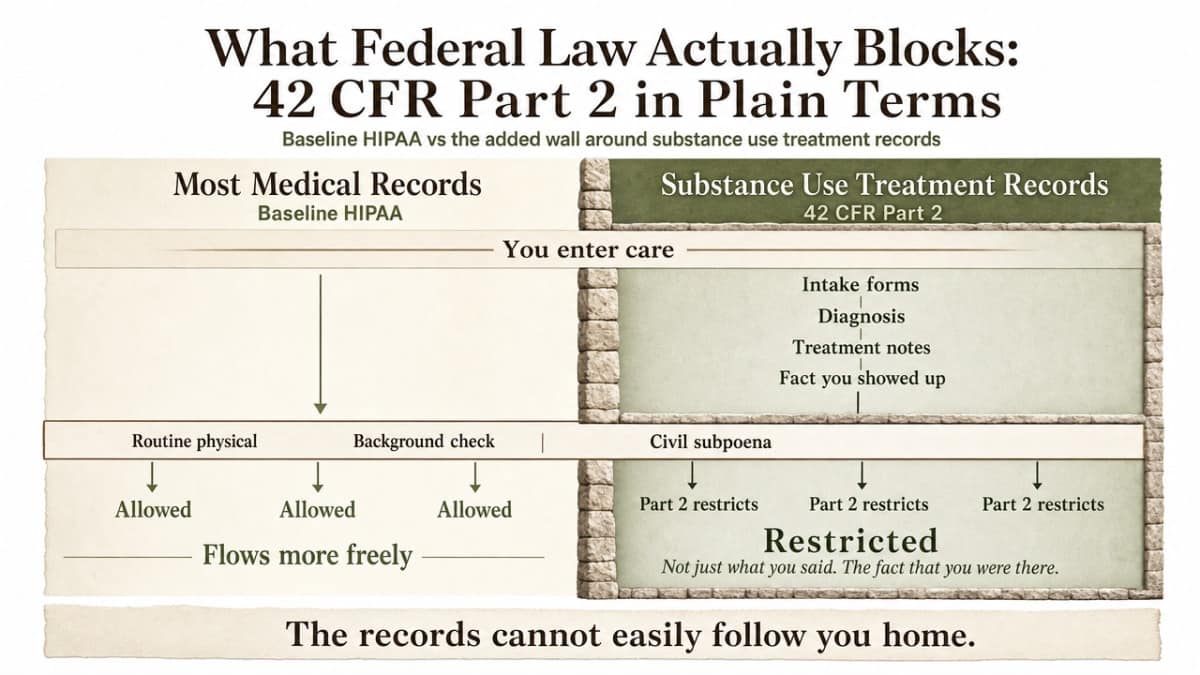
Here’s the part most men don’t know when they start looking. When you walk into a licensed substance use treatment program, the records that get created — your intake forms, your diagnosis, your treatment notes, even the fact that you showed up at all — fall under a specific federal rule that most of your other medical records don’t. It’s called 42 CFR Part 2, and it applies to any records that would identify you as someone who has or had a substance use disorder in a federally assisted program 1.
Read that again. Not just what you said in group. The fact that you were there.
That’s the doorway most professional men are worried about. If someone pulls your medical file for an unrelated reason — a routine physical, a background check, a subpoena in a civil matter — Part 2 restricts what a treatment program can hand over, and to whom, without your written consent or a specific court order 3. General medical providers operating under HIPAA can share information for treatment, payment, and healthcare operations with relatively broad latitude. Part 2 programs cannot. The default answer to almost every outside request is no.
What this means practically: your insurance company, your primary care doctor, your employer’s HR system, and your state licensing board do not automatically receive notice that you entered residential treatment in Arkansas. They get what you sign a release for. Nothing more. That’s not marketing language from a rehab website. That’s the rule.
Part 2 vs. HIPAA: The Extra Wall Around Addiction Records
HIPAA is the privacy rule you already know about — the form you sign at every doctor’s office. It’s real protection, but it has real gaps. Providers can share your records with other providers for treatment coordination. Insurance can access them for payment. In litigation, HIPAA-covered records can often be pulled with a standard subpoena.
Part 2 closes the gap that matters most to you. The regulation specifically bars the introduction of a covered record — or testimony about its contents — as evidence in any criminal prosecution or civil action against the patient, absent your written consent or a court order issued after a special showing 4. A regular subpoena from opposing counsel in a divorce, a custody dispute, or a professional complaint doesn’t clear that bar. Neither does a routine law enforcement request. That’s the extra wall.
Think of it as two locks on the same door. HIPAA is the first lock. Part 2 is the second, and it was written specifically because Congress recognized that addiction records get weaponized in ways other medical records don’t — in courtrooms, in employment disputes, in licensing hearings. The updated final rule keeps those protections while aligning consent processes more closely with HIPAA, and programs must be in full compliance with the new framework 2.
You are not asking for a favor when you expect this level of confidentiality. You are asking a licensed program to do what federal law already requires of it.
Little Rock Within Driving Range: What Reachable Actually Means
Reachable isn’t the same as convenient. Convenient is the outpatient clinic ten minutes from your office, the one you can’t actually use. Reachable is a place you can get to in a single unremarkable drive, check into for the number of weeks it takes to do this properly, and return from without a paper trail in your hometown.
Little Rock is that place from where you’re sitting. It’s a straight run up I-30 from Texarkana, the kind of drive you’ve probably made for a Razorbacks game or a client meeting without anyone thinking twice about it. You leave in the morning. You’re checked in before dinner. Your car doesn’t sit in a lot anyone you know drives past.
Compare that to the alternative. Staying in Texarkana means outpatient at best — a few evenings a week, still living in the same house, still driving the same route to the same job, still keeping the same bottle in the same drawer. NIDA is direct that no single treatment fits everyone, and that setting has to match what the patient actually needs 11. For a man whose environment is part of the problem, outpatient in that environment is a plan designed to fail.
Flying somewhere for treatment introduces its own risks. Boarding passes, TSA lines, corporate travel systems, the explanation you’d owe about being out of the country for a month. A drive to Little Rock avoids all of it. No flight manifests. No expense reports to reconcile. If someone asks where you were, “Arkansas” is a complete sentence.
There’s a second thing driving distance gives you that flight distance doesn’t: your family can visit without producing an itinerary. A weekend drive up for a family session is easier to arrange, and easier to keep private, than a coordinated flight with two connections. If your kids are old enough to notice absences, a weekend that looks like a business trip is a lot easier to hold together than one that requires an airport.
Reachable, in the sense that matters here, means three things at once:
- Close enough that leaving feels possible instead of dramatic.
- Far enough that no one you owe an explanation to will run into you at the pharmacy.
- Ordinary enough — a highway you already know — that the trip itself doesn’t become another thing to hide.
Little Rock clears that bar from Texarkana. That’s the whole point.
What a Legitimate Arkansas Residential Program Must Deliver
Before you evaluate any program’s website, know what the state of Arkansas already requires it to do. That way, when a facility tells you what it offers, you can tell whether it’s describing something impressive or just describing the floor.
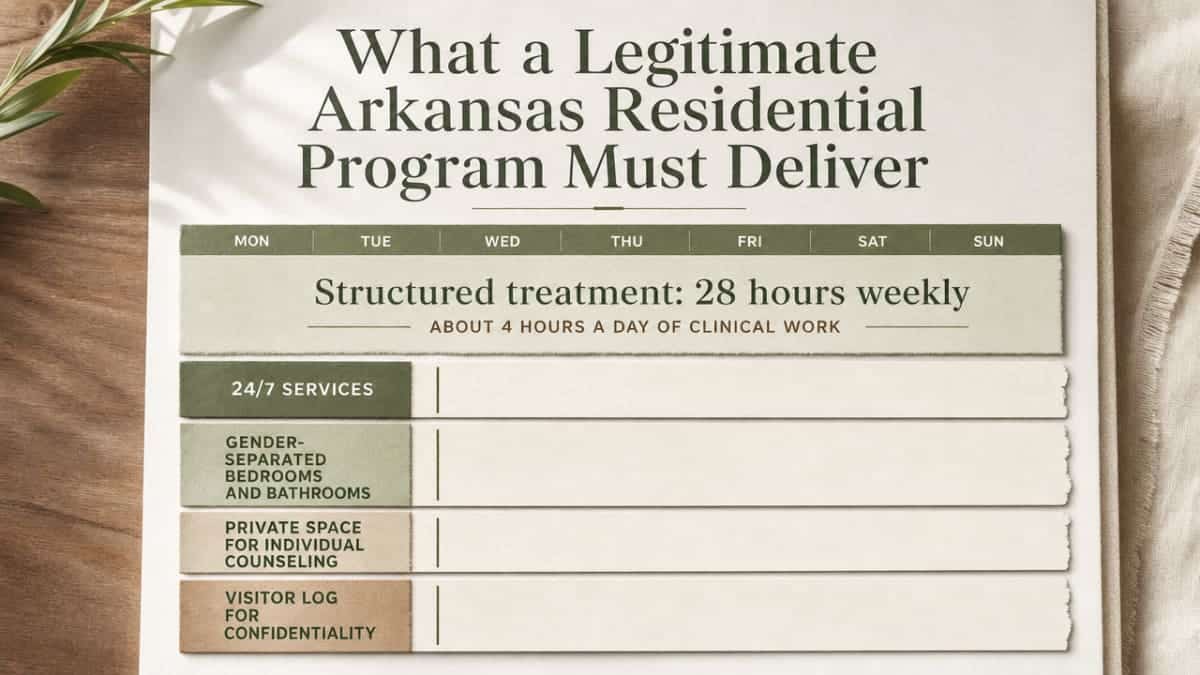
Arkansas licensure standards for alcohol and drug abuse treatment programs set concrete, non-negotiable minimums for any licensed residential facility. The manual requires at least 28 hours of structured treatment weekly, gender-separated bedrooms and bathrooms, 24/7 services, private space for individual counseling, and a visitor log maintained to protect the confidentiality of everyone on the property 12. Those aren’t perks. They’re the license.
Read what that actually means for your week. Twenty-eight hours of structured treatment is roughly four hours a day of clinical work — group, individual, education, therapy — not a schedule of unstructured downtime with a check-in tacked on. If a program is quoting you “a few sessions a week” in a residential setting, something is off. The Arkansas Department of Health rule reinforces the same baseline: residential treatment provides for a minimum of 28 hours of structured treatment weekly, and residential facilities must have separate bedroom areas and bathrooms for males and females 5.
Gender separation matters more than it sounds. In a small men’s program, it isn’t just a compliance line — it’s the whole clinical design, which the next section unpacks. But at the licensure level, the state is telling you: a legitimate residential program will not be housing a mixed population in shared quarters. If a facility hedges on that, you’re not looking at a licensed residential setting.
The private counseling space and visitor log requirements are where the confidentiality piece gets physical. Your individual sessions happen behind a closed door, in a room designed for privacy — not at a table in a common area. And when someone visits you, their name goes into a log that the facility controls under its own confidentiality obligations, not into a public sign-in sheet anyone can flip through.
So when you’re comparing programs from Texarkana, use the state’s floor as your first filter. Ask directly:
- How many structured treatment hours per week?
- Is this a licensed residential facility under Arkansas DHS standards?
- Are the living quarters men-only?
- Where do individual sessions happen?
A program that answers those questions cleanly, with specifics, is a program that has read its own licensure manual. One that dodges is telling you something too.
The Evidence on Residential Care — and Where It Actually Helps
What the Research Says, Honestly
You didn’t get here by ignoring data. So here’s the data, without the sales spin.
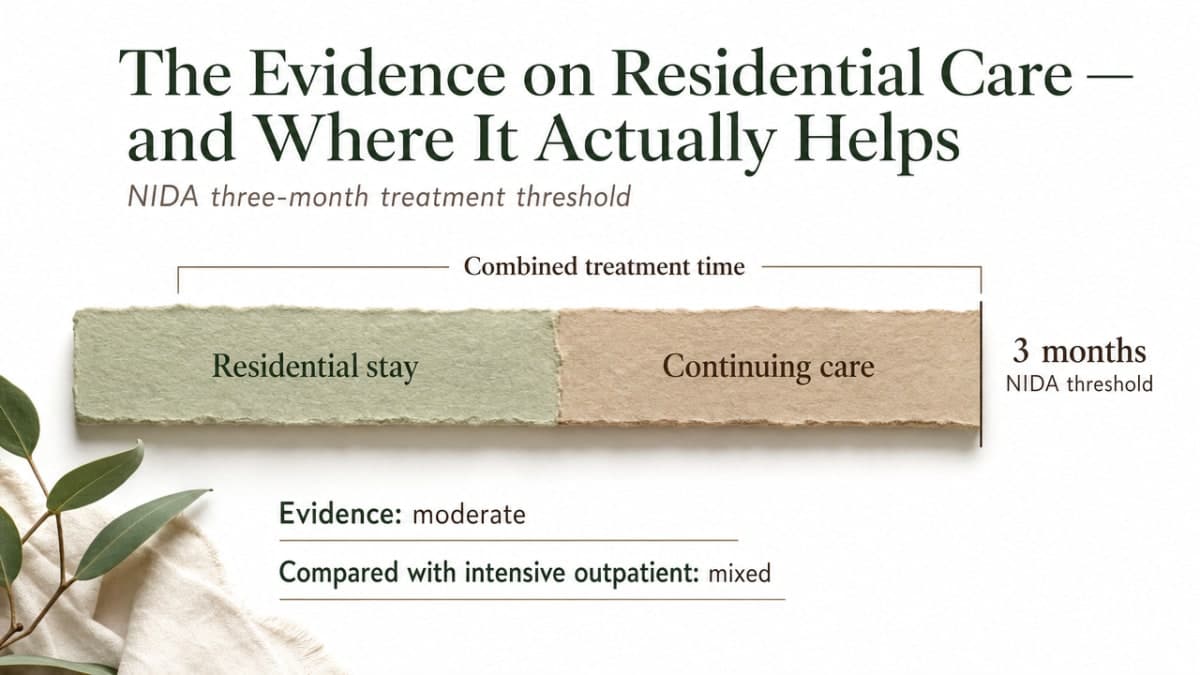
The best systematic review of residential substance use treatment concludes that the evidence for effectiveness is moderate — real, replicable improvements in substance use and life-functioning outcomes across studies, but not the miracle-cure numbers you sometimes see in glossy brochures 6. Moderate is a scientific word. It means the effect is there, it shows up across multiple studies, and it isn’t explained away by chance or by a single flashy trial.
The honest complication is this: when researchers compare residential care head-to-head against intensive outpatient programs, results are mixed. Sometimes residential shows an advantage. Sometimes the two produce similar outcomes 8. That doesn’t mean residential is a waste. It means the setting matters more for some men than for others, and choosing correctly is a clinical decision, not a marketing one.
Here’s where residential earns its keep. If your home environment is part of what’s keeping the drinking or the pills in place — if the bar is on your commute, if the cabinet is in your bathroom, if the client dinners are the trigger — then intensive outpatient asks you to change behavior while sitting inside the environment that shaped it. Residential removes that environment for long enough to build something different. A more recent realist review found that completion of residential treatment is associated with improvements in both substance use and mental health, and that the mechanism has to do with belonging, meaning, and structured time away from cues 14.
Translation: residential works when the removal itself is doing therapeutic work. If your life is stable and your triggers are narrow, outpatient may be enough. If neither of those is true, the case for leaving town gets stronger, not weaker.
The Three-Month Threshold
The question you’re probably already asking is how long. How many weeks can you be gone before something breaks at work, at home, in the accounts you’re managing. It’s a fair question. It also has a research-based answer you may not want to hear.
NIDA’s position, based on decades of treatment outcome research, is direct: remaining in treatment for an adequate period of time is critical, and for most patients the threshold of significant improvement is reached at about three months in treatment. Longer stays are often needed for durable outcomes 10. Three months. Not three weeks.
That number isn’t a residential-only figure — it includes the full continuum, so a stretch of residential followed by structured outpatient and continuing care all count toward the clock 15. But it reframes the math. If you’re picturing a 14-day stay as the whole answer, the research says you’re picturing a bridge that ends halfway across the river. Two weeks of medically supervised detox and early stabilization is a real thing, and it matters. It just isn’t the same thing as treatment.
Most men in your position land somewhere in a workable middle: several weeks of residential care to break the cycle and establish new patterns, followed by structured continuing care once you’re back in your life. That combination is what the three-month figure actually describes in practice. It also happens to be logistically survivable for a professional who plans it right — closer to a medical leave than a disappearance.
The point of the number isn’t to scare you into a longer stay. It’s to keep you from booking a stay that’s too short to do the work and then wondering why it didn’t hold.
The Small-Census, Men-Only Structure Explained
Twenty men. That’s a design choice, not a capacity limit.
When a residential program houses forty, sixty, or a hundred people at once, the math changes what’s actually possible. Individual counseling time gets rationed. Groups grow to a size where the quiet man in the corner can disappear for a week. Clinicians know your file, not you. The building runs like a small hospital because it has to.
A census of twenty runs differently. The clinical staff can hold every man on the unit in their heads. Your primary counselor has seen you eat breakfast, sit through group, and handle the phone call from home that didn’t go well. That continuity is the point. It’s also how a program actually individualizes care in the way NIDA describes when it says no single treatment is appropriate for everyone 11.
Men-only is the second half of the design. Arkansas licensure already requires gender-separated bedrooms and bathrooms in any residential facility 12. A men-only program takes that separation further — the entire clinical milieu is built around what men in recovery actually talk about when women aren’t in the room. Shame around fatherhood. Anger they’ve never named. What it cost to keep the performance running. In mixed groups, a lot of that goes unsaid, and the work goes with it. The realist review of residential treatment ties outcomes specifically to belonging and shared meaning built inside the setting itself 14. Twenty men who know each other’s stories by week two produce that. Two hundred strangers cannot.
What this means for you: you will be known here. That’s the trade for privacy outside — inside, there is no anonymity to hide behind. For most men who make it work, that turns out to be the part that actually did the work.
The Fears You Haven’t Said Out Loud
Your License, Your Employer, Your Client List
You’ve probably run this scenario in your head a hundred times. What happens if the board finds out. What happens if a client sees a charge on a statement. What happens when HR has to sign off on a medical leave. The fear isn’t irrational. It’s just working with incomplete information.
Here’s what actually happens when you enter a licensed residential program under 42 CFR Part 2:
- Your licensing board does not get a notification.
- Your employer does not get a call.
- Your clients do not appear anywhere on a disclosure list.
The program cannot release your identifying information — including the fact that you are a patient — without your written consent 3. If you sign a limited release so a family member can coordinate a leave with HR, that release covers only what you specify. Nothing else moves.
The medical leave itself is a separate document from your treatment record. Your primary care physician or the program’s medical director can provide the paperwork your employer needs — a dated leave for a medical condition — without naming the condition. That’s ordinary FMLA practice, not a special accommodation. The details of what you were treated for stay behind the Part 2 wall 1.
Your Family and the Story You Tell
The harder conversation isn’t with the board. It’s at your own kitchen table.
You get to decide what your family knows and when. A spouse who needs to help hold things together for four to six weeks will need more than “I’m handling something.” Kids need a version of the truth calibrated to their age. Parents may or may not be part of this — that’s your call, not the program’s.
What a good program does is give you a container to figure that out. Family sessions, when you choose to include them, happen inside the same confidentiality framework that protects everything else 3. Nothing gets shared with a family member without your written consent, and consent can be scoped narrowly — one session, one topic, one person.
The story you tell the wider world is yours to write. Some men come home and stay private about it for years. Some tell one trusted friend. Some, eventually, become the person another man calls at 11pm. There’s no correct version. There’s just the one you can live with, built on ground you actually chose. That freedom is what the drive to Little Rock buys you.
One Phone Call From a Private Number
You’ve read this far. That tells you something.
The next move isn’t dramatic. It’s a phone call from a number no one at your office recognizes, made on your own time, to admissions staff who are trained to answer without asking you to identify yourself before you’re ready. Ask what a first conversation covers. Ask how they handle intake, what the medical detox looks like on day one, and how family communication is scoped. Ask what happens if you need to step out to sign a document during your stay. Ask how the discharge plan connects back to structured care once you’re home in Texarkana.
Little Rock is a few hours up I-30. Serenity Park Recovery Center runs a small men’s residential program there — up to twenty men at a time, licensed under the Arkansas standards described earlier, operating under the same federal privacy rule that keeps your records where they belong. Reachable from where you are. Separate from where you live.
One call. Private number. That’s the whole ask tonight.
Frequently Asked Questions
Can my employer or licensing board find out I went to rehab in another state?
Not without your written consent. A licensed substance use program operates under 42 CFR Part 2, which restricts release of any records that would identify you as a patient — including the fact that you attended 1. Employers, licensing boards, and background-check services do not get automatic notice. Your medical leave paperwork can document a leave for a medical condition without naming the diagnosis.
How far is Little Rock from Texarkana, and is the drive worth it for treatment?
Little Rock is a straight run up I-30 from Texarkana in a single unremarkable drive. The value isn’t the mileage — it’s what the distance buys. You get access to a licensed residential program outside your professional circle, family can visit on weekends without airline itineraries, and no one at your local pharmacy or country club runs into you on the way in.
How long does residential treatment actually need to last to work?
NIDA’s guidance is that the threshold for significant improvement is reached at about three months in treatment, with longer stays often needed for durable outcomes 10. That figure counts the full continuum, so several weeks of residential care followed by structured continuing care once you’re home in Texarkana can add up to the three-month benchmark 15. Two-week stays rarely hold on their own.
What makes a men-only residential program clinically different from a mixed-gender one?
Arkansas licensure already requires gender-separated bedrooms and bathrooms in any residential facility 12. A men-only program extends that separation to the whole clinical environment. Groups can address shame, fatherhood, anger, and the exhaustion of holding a career together — topics that often go unsaid in mixed rooms. Peer-reviewed work on residential care ties outcomes to belonging and shared meaning built inside the setting itself 14.
Can my treatment records be used against me in a court case or custody dispute?
Federal regulation specifically bars introduction of a Part 2 record — or testimony about its contents — as evidence in any criminal prosecution or civil action against you, absent your written consent or a court order issued after a special showing 4. A standard subpoena from opposing counsel in a divorce, custody matter, or civil complaint does not clear that bar. That protection is stronger than baseline HIPAA.
What should a legitimate Arkansas residential program look like on paper?
Ask for specifics against the state’s licensure floor: at least 28 hours of structured treatment weekly, 24/7 services, gender-separated living quarters, private space for individual counseling, and a controlled visitor log 12. A licensed program will answer those questions cleanly. A serious one will exceed the minimums with smaller groups, more individual time, and medical oversight through detox. Vague answers on any of those points are their own signal.
References
- 42 CFR Part 2 — Confidentiality of Substance Use Disorder Patient Records. https://www.ecfr.gov/current/title-42/chapter-I/subchapter-A/part-2
- Fact Sheet 42 CFR Part 2 Final Rule. https://www.hhs.gov/hipaa/for-professionals/regulatory-initiatives/fact-sheet-42-cfr-part-2-final-rule/index.html
- Understanding Confidentiality of Substance Use Disorder (SUD) Patient Records. https://www.hhs.gov/hipaa/part-2/index.html
- 42 CFR § 2.12 – Applicability. https://www.law.cornell.edu/cfr/text/42/2.12
- Arkansas Department of Health – Rules for Alcohol and Drug Abuse Treatment Programs. https://www.sos.arkansas.gov/uploads/rulesRegs/Arkansas%20Register/2004/jan_2004/016.02.03-001.pdf
- The effectiveness of residential treatment services for individuals with substance use disorders: A systematic review. https://pubmed.ncbi.nlm.nih.gov/31254749/
- Residential Treatment for Substance Use Disorder: A Review of Clinical Effectiveness and Guidelines. https://www.ncbi.nlm.nih.gov/books/NBK541232/
- Residential treatment for individuals with substance use disorders: assessing the evidence. https://pubmed.ncbi.nlm.nih.gov/24445598/
- Drug Overdose Deaths – CDC WONDER / National Vital Statistics System (State-level data). https://data.cdc.gov/resource/xkb8-kh2a.csv
- Principles of Drug Addiction Treatment: A Research-Based Guide (Third Edition). https://www.drugabuse.gov/publications/principles-drug-addiction-treatment-research-based-guide-third-edition
- Treatment Approaches for Drug Addiction DrugFacts. https://www.drugabuse.gov/publications/drugfacts/treatment-approaches-drug-addiction
- Licensure Standards for Alcohol and Other Drug Abuse Treatment Programs. https://humanservices.arkansas.gov/wp-content/uploads/Licensure_Standards_for_Alcohol_and_Other_Drug_Abuse_Treatment_Programs.pdf
- 2024 – Arkansas State Opioid Response (SOR) III. https://humanservices.arkansas.gov/wp-content/uploads/WYSAC-SOR-3-Final-Eval-Report-12162024.pdf
- A realist review of residential treatment for adults with substance use disorder. https://pubmed.ncbi.nlm.nih.gov/36747370/
- Treatment | National Institute on Drug Abuse (NIDA). https://nida.nih.gov/research-topics/treatment
- Drug Overdose Mortality | Stats of the States. https://www.cdc.gov/nchs/state-stats/deaths/drug-overdose.html
- National Institute on Drug Abuse (NIDA) – Arkansas Opioid Summary. https://nida.nih.gov/sites/default/files/21948-arkansas-opioid-summary.pdf