
Key Takeaways
- Call 988 or SAMHSA’s 1-800-662-HELP immediately when opioid withdrawal begins, since one phone call connects you to confidential 24/7 crisis support and licensed detox referrals.1,2
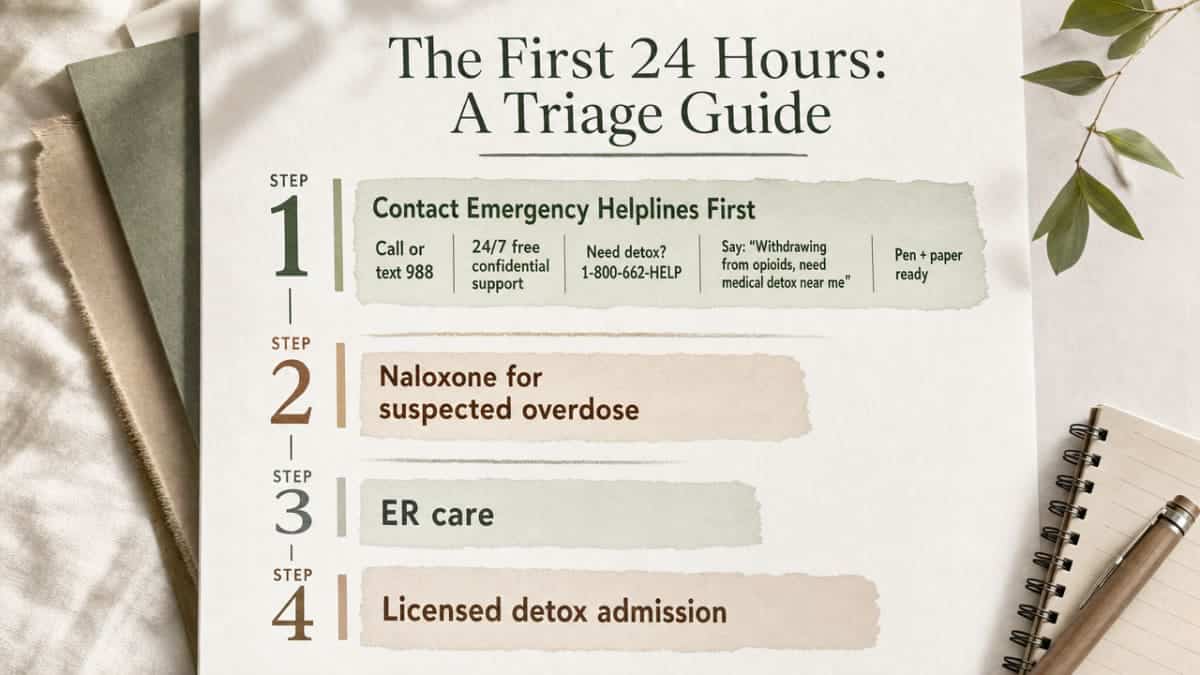
- Within the first 24 hours, triage by contacting helplines, using naloxone for suspected overdose, going to the ER for severe symptoms, then securing a licensed detox bed.9,12
- Medically supervised detox uses methadone, buprenorphine, naltrexone, or lofexidine to manage withdrawal safely, while unmedicated cessation and ultra-rapid anesthesia detox carry serious risks and higher relapse-related overdose rates.7,8
- Verify any Arkansas facility holds a DHS Substance Abuse Detoxification license, employs prescribers with X-DEA waivers for MAT, and offers 24/7 medical supervision before admission.11,12
- Detox is a bridge, not an endpoint; confirm your next prescriber, medication plan, and follow-up appointment before discharge to prevent relapse during the lowered-tolerance window.4,7
- Family and friends can call helplines on someone’s behalf, ask about DHS licensing and bed availability, and keep naloxone accessible to protect a loved one during withdrawal.3,9
Immediate Steps for Opioid Withdrawal
If you are experiencing opioid withdrawal, immediate action is crucial. You do not have to face this alone. Medically supervised detox offers the safest path through withdrawal, providing professional support when your body reacts to cessation. Asking for help is a sign of strength, not weakness.
Begin by making a single phone call. In the United States, you can reach the Suicide & Crisis Lifeline by calling or texting 988. Alternatively, SAMHSA’s National Helpline, 1-800-662-HELP, offers free and confidential referrals to detox and treatment services 24/7. If a friend or family member is with you, ask them to make the call so you can focus on breathing.1,2
The First 24 Hours: A Triage Guide
Contact Emergency Helplines First
Prioritize calling for help. Do not delay. If you are experiencing intense distress or suicidal thoughts, call or text 988. This lifeline operates 24/7, offering free and confidential support for substance use crises and other mental health emergencies. If your immediate need is to find a detox facility, call 1-800-662-HELP, SAMHSA’s National Helpline, which provides referrals to treatment services around the clock.1,2,3
When you connect with someone, state clearly:
“I am withdrawing from opioids and need help finding a medical detox near me.”
This concise statement provides the necessary information without requiring you to recount your full history. Keep a pen and paper ready to note down any contact information or instructions they provide.
Administer Naloxone for Suspected Overdose
If you or someone nearby shows signs of an opioid overdose—such as blue lips, slow or absent breathing, unusual snoring, or unresponsiveness—call 911 immediately. If available, administer naloxone (Narcan). Naloxone reverses the effects of an opioid overdose. In Arkansas, it can be obtained from some pharmacies, and qualifying organizations can receive it free after training from the Department of Human Services. Many college campuses in the state are also mandated to have rescue kits readily accessible. If you are at risk or live with someone who is, acquire naloxone proactively.9,10
After administering naloxone, position the person on their side and await emergency medical services. A second dose of naloxone may be necessary as its effects can wear off before the opioid’s. Paramedics will focus on ensuring the person’s breathing and will not involve law enforcement regarding drug use.
When to Seek Emergency Room Care
While not all withdrawal symptoms necessitate an ambulance, certain conditions warrant immediate emergency room attention. Go to the ER if you are experiencing severe, uncontrollable vomiting, a persistently racing heart, chest pain, difficulty breathing, or if you are pregnant. Emergency care is also critical if you are withdrawing from opioids concurrently with benzodiazepines or heavy alcohol use, have recently experienced an overdose, or are having suicidal thoughts that 988 cannot adequately address at that moment.
Emergency rooms can stabilize your condition and initiate buprenorphine treatment, which offers a rapid transition from acute withdrawal to ongoing care. The National Institute on Drug Abuse (NIDA) highlights emergency department buprenorphine initiation post-overdose as an effective pathway to treatment. Inform the triage nurse about your last opioid use, the substances involved, and your desire for help. Bring identification and any current medications if possible, but do not delay seeking care if these are unavailable.5
Transition to a Licensed Detox Facility
Once stabilized, or after contacting a helpline, the objective is to secure a bed in a licensed medical detox facility. This means a facility equipped with medical professionals, appropriate medications, and 24/7 supervision, distinct from support houses or sober living environments.
The process generally follows this sequence:
- Contact SAMHSA’s 988 or 1-800-662-HELP for crisis support and referrals.1
- Use naloxone if there is any risk of overdose.9
- Proceed to the ER if your physical condition is unstable.
- Seek admission to a facility licensed by Arkansas DHS as a Substance Abuse Detoxification provider.12
This licensing is crucial in Arkansas, as it distinguishes legitimate medical withdrawal management from unregulated settings.12
When contacting facilities, ask two specific questions:
“Are you licensed by Arkansas DHS as a detox provider?” and “Do you have a bed available tonight?”
If both answers are affirmative, inquire about what to bring and how to get there. If not, contact the next facility on your list; the helpline can provide additional numbers.
Understanding Medical Detoxification
The Risks of Unmedicated Opioid Withdrawal
Attempting opioid withdrawal without medical support is not only intensely difficult but also dangerous. Opioid withdrawal can lead to severe physical symptoms such as elevated heart rate, inability to retain fluids, and fluctuating blood pressure. A significant risk is the rapid decrease in opioid tolerance, which makes relapse particularly lethal; a dose that was once routine can become fatal after a period of abstinence.
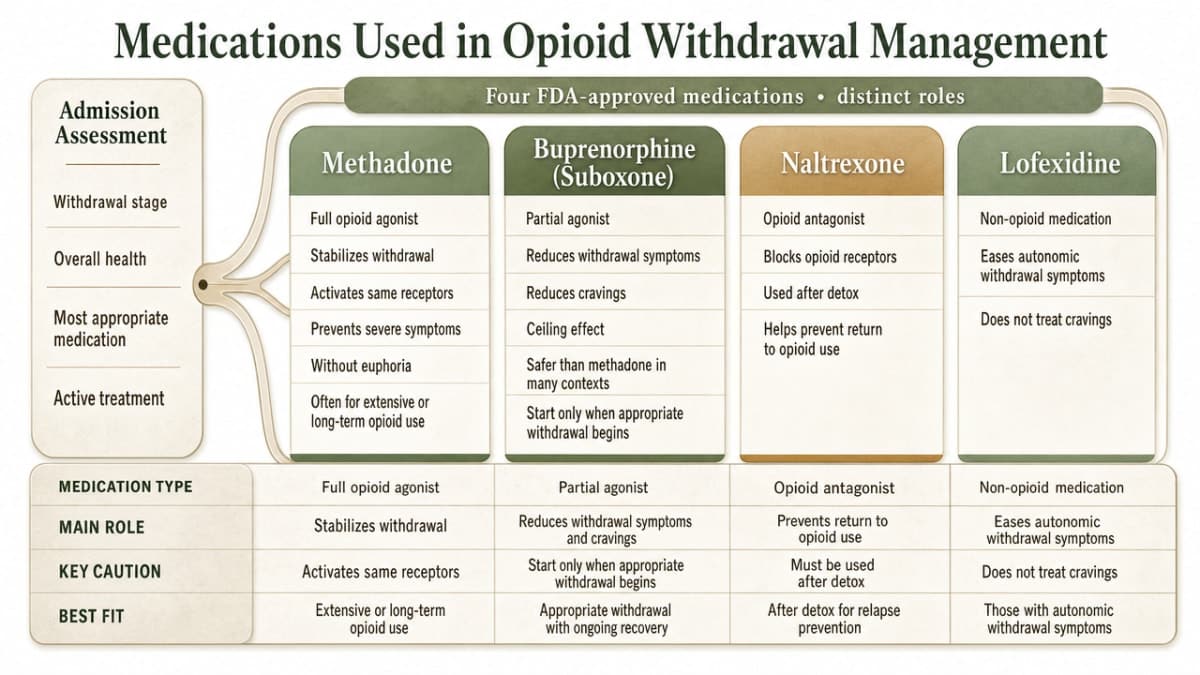
Medications Used in Opioid Withdrawal Management
Upon admission to a licensed detox facility, medical staff will assess your withdrawal stage and overall health to determine the most appropriate medication. The goal is active treatment, not just observation.
Four FDA-approved medications are commonly used in opioid withdrawal management, each serving a distinct purpose:5,7
- Methadone: A full opioid agonist used in detox or opioid treatment programs to stabilize withdrawal by activating the same receptors as other opioids, preventing severe symptoms without inducing euphoria. It is effective for individuals with extensive or long-term opioid use.
- Buprenorphine (often combined as Suboxone): A partial agonist that alleviates withdrawal symptoms and cravings. It has a ceiling effect, making it safer than methadone in many contexts. However, buprenorphine must only be initiated when objective withdrawal signs are present; starting it too early can trigger precipitated withdrawal, a severe and uncomfortable condition.
- Naltrexone: An opioid blocker used post-detoxification to prevent relapse. It is not for acute withdrawal. Extended-release naltrexone is an option once a person has been opioid-free for a sufficient period to ensure safety.
- Lofexidine: A non-opioid medication that manages the autonomic symptoms of acute withdrawal, such as sweating, cramping, anxiety, and blood pressure spikes. It is particularly useful for individuals who cannot or prefer not to start an opioid agonist immediately.
When inquiring about a facility’s approach, ensure their response includes one of these medically recognized options, rather than vague assurances.
Avoid ‘Ultra-Rapid’ Detox Programs
You may encounter advertisements for “ultra-rapid” detox programs, which typically involve anesthesia to flush opioids from the system while the patient is unconscious, promising a quick and painless recovery. These programs are not recommended.
The ASAM guideline explicitly warns against ultra-rapid opioid detoxification due to the significant risks involved, including serious adverse events during and after the procedure. Furthermore, this method does not address the critical issue of reduced tolerance post-detox, which increases the risk of fatal overdose upon relapse. A slower, medication-supported detox followed by a structured transition to ongoing treatment is a safer and more effective approach for long-term recovery.7
Identifying a Legitimate Arkansas Detox Facility
Verifying DHS Licensing
Not all facilities claiming to offer detox services are legitimate medical detox centers. Some may be sober living homes, treatment centers that outsource detox, or simply unregulated environments. It is your right to ask critical questions.
The primary question to ask is:
“Are you licensed by Arkansas DHS as a Substance Abuse Detoxification provider?”
In Arkansas, Medicaid’s behavioral health regulations mandate that substance abuse detoxification services must be delivered within a facility holding this specific DHS license. This license is a legal requirement, not merely a marketing claim. If a facility hesitates, redirects, or mentions partnering with another entity for detox, it likely is not a standalone medical detox provider.
Beyond the DHS license, a true medical detox in Arkansas should also possess:11,12,13
- X-DEA registration for prescribers to administer Medication-Assisted Treatment (MAT).
- Adherence to Arkansas opioid treatment program standards if methadone is offered.
- 24/7 on-site medical supervision.
Inquire about all four criteria to ensure comprehensive care.
The Importance of MAT and X-DEA Certification
Medication-Assisted Treatment (MAT) refers to the use of FDA-approved medications like buprenorphine, methadone, or naltrexone in conjunction with counseling and behavioral therapies to treat substance use disorders. A facility offering MAT demonstrates a commitment to evidence-based care beyond just comfort medications.
For Medicaid beneficiaries in Arkansas, MAT is covered when provided by clinicians with an X-DEA waiver on file. This waiver specifically authorizes a prescriber to administer buprenorphine for opioid use disorder. Therefore, when asking about MAT, follow up with:11
“Do your prescribers have an X-DEA waiver on file?”
This question confirms whether the facility can provide effective, medically supported withdrawal treatment.
Methadone treatment follows a distinct regulatory path. In Arkansas, methadone-based withdrawal management is typically provided by Opioid Treatment Programs (OTPs), which operate under specific Arkansas DHS standards. Not all licensed detox facilities are OTPs. If methadone is a necessary component of your treatment, inquire if the facility operates an on-site OTP or provides referrals to one.13
Addressing Cost and Insurance Coverage
Concerns about cost are valid. Arkansas Medicaid covers medication-assisted treatment for opioid use disorder when delivered by qualified providers with an X-DEA waiver. If you are Medicaid-eligible, the medication aspect of your care may be covered through a licensed provider. If you lack insurance or are unsure of your coverage, SAMHSA’s National Helpline (1-800-662-HELP) can provide referrals to state-funded or sliding-scale programs, as can the federal HHS resource hub.6,11
While cost is important, the immediate priority is securing a safe detox bed. Discuss coverage and financial options after confirming the facility’s licensing and bed availability.
Detox as a Bridge to Ongoing Treatment
Planning for Post-Detox Care
The period immediately following detox discharge is often the most vulnerable. Your opioid tolerance will have significantly decreased, and without a clear plan for continued care, the risk of relapse and overdose is high. Clinical guidelines consistently emphasize that detox is a transitional phase, not the end of treatment. SAMHSA’s TIP 63 explicitly states that withdrawal management should lead directly into ongoing treatment, ideally with medication, rather than concluding at stabilization. The ASAM guideline similarly advocates for methadone or buprenorphine maintenance over abrupt cessation to improve long-term survival rates.4,7
Before leaving detox, ensure you have a concrete plan. Ask these three questions:
- “Who will be my prescriber next week?”
- “What medication will I be taking, and how do I get refills?”
- “What is my appointment date for follow-up care?”
Do not sign discharge papers until these questions are clearly answered. This proactive approach is essential for ensuring continuity of care and preventing relapse.
Post-Detox Treatment Options
After detox, several treatment pathways are available, and the best choice depends on individual needs, living situation, and required level of support:13
- Residential Treatment: Involves living at a facility 24/7, continuing MAT and counseling. This is suitable if your home environment is unstable, if you’ve relapsed in outpatient settings, or if you need a structured environment away from triggers.
- Outpatient Care: Allows you to live at home while attending appointments, counseling, and medication management. This option works well if you have a stable living situation and a strong support system.
- Opioid Treatment Program (OTP): A specialized clinic that dispenses methadone under Arkansas DHS standards and provides integrated counseling. If methadone is your chosen maintenance medication, an OTP is the appropriate setting for continued care.
Consult with your detox team to determine the most suitable option for your circumstances. Financial assistance is available; Arkansas Medicaid can cover MAT through X-DEA certified providers, and SAMHSA’s helpline can assist in finding resources. For men in Little Rock seeking residential care with integrated MAT, Serenity Park Recovery Center is one option. The key is to establish a follow-up plan before discharge.1
Guidance for Supporting Someone in Withdrawal
If you are assisting a loved one in opioid withdrawal, your support is invaluable. You are not expected to solve their problem alone, but to connect them with professional help. Start by calling 1-800-662-HELP, SAMHSA’s National Helpline, which is available 24/7 for confidential referrals. If the person is in immediate danger—unresponsive, struggling to breathe, or expressing suicidal intent—call 911 or 988 first.2,3
When speaking with helpline staff or a facility, provide essential information:
“My [relationship] is withdrawing from opioids, last used [timeframe], and needs a licensed detox bed near [location] tonight. They want help but are scared.”
You don’t need to provide their full history; focus on securing a bed and directions.
Ask the critical questions: Is the facility licensed by Arkansas DHS as a Substance Abuse Detoxification provider? Can they admit your loved one tonight? Document the address and the name of the contact person. Additionally, ensure naloxone is accessible in your home or car. Arkansas DHS facilitates access through pharmacies and offers free kits to qualifying organizations after training. This preparedness is a crucial safety measure.9,12
It is normal to feel overwhelmed or frustrated. Acknowledge these emotions, but prioritize making the call. Your action can make a life-saving difference.
Taking the First Step
You have taken a significant step by seeking this information. Now, take the next one: make the call. For immediate crisis support, text or call 988. If you need to find a licensed detox bed, call 1-800-662-HELP and simply state,
“I need a medical detox near me tonight.”
The helpline staff will guide you through the process.1
Remember to inquire about the facility’s DHS license, bed availability, and MAT options. Write down all pertinent information, including the address. For men in Little Rock seeking residential care with medically supervised detox, Serenity Park Recovery Center is a resource to consider.
You don’t need to feel entirely ready to make this call; you just need to make it.
Frequently Asked Questions
Can I detox from opioids at home by myself?
No, it is not safe to detox from opioids at home without medical supervision. Clinical guidelines strongly advise against unmedicated opioid withdrawal due to risks such as severe dehydration, dangerous blood pressure fluctuations, and a critical drop in tolerance that significantly increases the risk of overdose if relapse occurs. Contact 1-800-662-HELP to connect with a licensed medical team for safe, professional detox.8
How long does opioid detox usually take?
The duration of opioid detox varies depending on the type of opioid used, the dosage, and the length of use. Acute withdrawal from short-acting opioids typically peaks within two to three days and subsides over approximately a week. Withdrawal from longer-acting opioids like methadone can take longer. The most critical aspect is not just the length of detox, but the post-detox plan, including ongoing medication and follow-up care, which ensures sustained stabilization.4
What should I bring with me to a detox facility?
Pack minimally. Essential items include a photo ID, your insurance or Medicaid card, a list of all current medications and known allergies, and a phone charger. Bring comfortable clothing for a few days. Leave valuables, large amounts of cash, and any sharp objects at home. If you have naloxone at home, inform a family member of its location before you leave. The most important thing is to arrive.9
Will I have to stop opioids completely before I can start buprenorphine?
You do not need to stop opioids completely, but you must be in a state of active withdrawal before buprenorphine can be initiated. The ASAM guideline specifies that buprenorphine should only be started when objective withdrawal signs are present. Administering it too early can induce precipitated withdrawal, which is a more severe and uncomfortable experience than natural withdrawal. The medical team at the detox facility will use a standardized withdrawal scale to determine the correct timing for buprenorphine induction.7
What if I don’t have insurance or can’t afford detox?
Do not let financial concerns prevent you from seeking help. Call SAMHSA’s National Helpline at 1-800-662-HELP; they can connect you with state-funded and sliding-scale programs. The federal HHS resource hub also provides information on these options. If you are eligible for Medicaid in Arkansas, medication-assisted treatment is covered when provided by qualified providers with an X-DEA waiver. Discuss coverage and payment options after you have confirmed bed availability.6,11
Can my family member call a detox center on my behalf?
Yes, family members frequently make initial calls to detox centers and the SAMHSA helpline. A family member can inquire about bed availability, licensing, and MAT options before you directly engage. While they can gather information and facilitate the process, as an adult, you must consent to and physically present yourself for admission. Allowing someone else to make the first contact is a common and acceptable way to begin the process.3
References
- Mental Health and Substance Use Helplines. https://www.samhsa.gov/find-help/helplines
- 988 Suicide & Crisis Lifeline. https://www.samhsa.gov/mental-health/988
- National Helpline for Mental Health, Drug, Alcohol Issues. https://www.samhsa.gov/find-help/helplines/national-helpline
- TIP 63: Medications for Opioid Use Disorder. https://library.samhsa.gov/sites/default/files/pep21-02-01-002.pdf
- Medications for Opioid Use Disorder. https://www.nida.nih.gov/research-topics/medications-opioid-use-disorder
- Mental Health & Substance Use Disorder. https://www.hhs.gov/programs/prevention-and-wellness/mental-health-substance-use-disorder/index.html
- The ASAM National Practice Guideline for the Treatment of Opioid Use Disorder: 2020 Focused Update. https://www.dhcs.ca.gov/wp-content/uploads/2025/10/ASAM2B20202BOUD.pdf
- Quick Guide For Clinicians Based on TIP 45—Detoxification and Substance Abuse Treatment. https://nida.nih.gov/sites/default/files/samhsa_detoxification_and_substance_abuse_treatment.pdf
- Naloxone Request – Arkansas Department of Human Services. https://humanservices.arkansas.gov/divisions-shared-services/shared-services/office-of-substance-abuse-and-mental-health/prevention-ar/narcan-request/
- 6 CAR § 372-109. Opioid overdose rescue kits – Code of Arkansas Rules. https://codeofarrules.arkansas.gov/Rules/Rule?levelType=section&titleID=6&chapterID=56&subChapterID=75&partID=1213&subPartID=6798§ionID=44152
- MAT-Revised-Website-posting-12.14.pdf. https://humanservices.arkansas.gov/wp-content/uploads/MAT-Revised-Website-posting-12.14.pdf
- SECTION II – COUNSELING AND CRISIS SERVICES …. https://codeofarrules.arkansas.gov/Rules/PartDocument?partID=1354
- 20 CAR § 433-323. Opioid treatment – Code of Arkansas Rules. https://codeofarrules.arkansas.gov/Rules/Rule?levelType=section&titleID=20&chapterID=128&subChapterID=170&partID=666&subPartID=3988§ionID=24551