
Key Takeaways
- Milestones at 30, 60, and 90 days function as clinical checkpoints because relapse risk concentrates heavily in the first three months after treatment ends 7.
- Day 90 is the highest-leverage window: more than half of post-treatment recurrence happens within 90 days of discharge, making it a planning moment rather than an exhale 10.
- A slip resets the count but not the identity—42% of people who relapsed in one longitudinal study later returned to abstinence and maintained it through follow-up 2.
- Engagement compounds over years: among people three years into remission, only 42.9% of those with formal help later relapsed, versus 60.5% without it 6.
Why 30, 60, and 90 Days Became Clinical Checkpoints
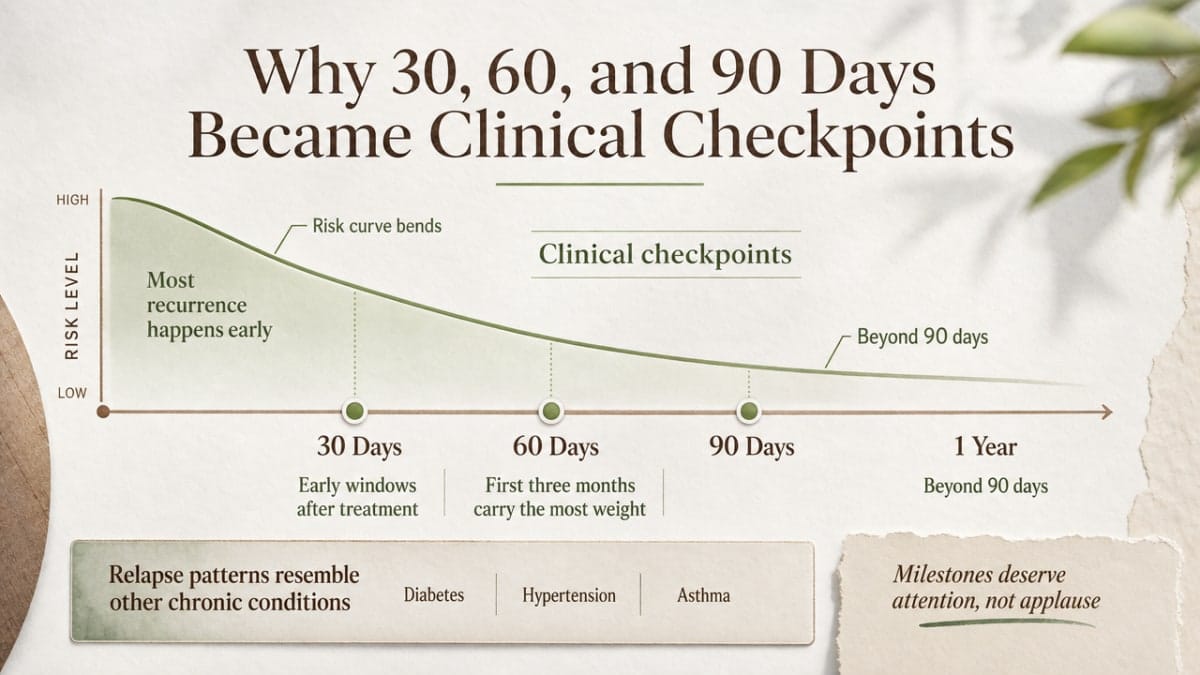
You’ve likely noticed that recovery culture is obsessed with numbers. Thirty days. Sixty. Ninety. A year. On paper, they look arbitrary—round figures pulled from a calendar. In practice, they became clinical checkpoints because that’s where the risk curve bends, and where the people who study relapse keep finding the same patterns.
Here’s the reframe worth starting with: addiction is a chronic condition, and its relapse rates resemble those of other chronic diseases such as diabetes, hypertension, and asthma.8 You’re managing a condition that has a documented tendency to recur, and the early windows after treatment are when it recurs most often. Milestones exist because those windows deserve attention, not applause for its own sake.
The first three months carry the most weight because that’s where the concentration of risk lives. Research on relapse prevention consistently finds that recurrence tends to happen early in recovery, particularly within the first several months after treatment ends.7 Your body is still recalibrating. Your routines are unfamiliar. The scaffolding of residential care has been removed, and you’re testing whether the coping skills you built can hold weight in an environment that hasn’t changed just because you did.
That’s why 30, 60, and 90 became the shorthand. They’re not trophies. They’re intervals short enough to catch a drift before it becomes a slide, and long enough to signal that something durable is forming underneath. Each one is a place to check the instruments—sleep, mood, cravings, connection, honesty with the people around you—and to reinforce the skills that make the next interval more likely.15
If you’re someone used to measuring performance at work, this framing should feel familiar. You’re not chasing a feeling. You’re watching a curve, and giving yourself real credit for staying on the right side of it.
The First 30 Days: Physiological Reset
The first month is often misread as a test of grit. It isn’t. It’s a physiological reset that happens whether you feel strong or not, and understanding that changes what you should expect from yourself.
In the first 30 days, sleep architecture starts to reorganize, appetite and hydration cues come back online, and the acute inflammatory noise from heavy use begins to quiet. None of that is under your conscious control. What is under your control is showing up to the appointments, taking the medications as prescribed, eating the meals, and telling someone the truth about how you’re doing. That’s the work of month one, and it’s plenty.
Expect the ground to feel uneven. Cravings tend to arrive in waves rather than a steady pressure. Mood can swing sharply, especially in the evenings. Concentration is often the last function to come back, which is disorienting if your professional identity is built around sharp thinking. Relapse-prevention research is clear that early recovery is the window where the risk is most concentrated, which is exactly why the supports around you are structured the way they are.7
Thirty days is not a graduation. It’s a marker that says your body has begun to trust that the substance isn’t coming back, and your nervous system is starting to build a baseline it can work from. If you’re used to measuring output at work, treat this month as data collection. What times of day are hardest? Which conversations drain you? Where does craving show up in your body before it shows up in your thoughts? That information becomes the raw material for the next 60 days.
Mark day 30 quietly if that’s your instinct. A phone call to your sponsor. A note in a journal. A meal with the one person who’s watched you closely enough to know what this took. It doesn’t need to be more than that to count.
Day 60: Building Routine and Momentum
Day 60 doesn’t get a lot of airtime. It’s not the first month, when everyone around you is still checking in. It’s not 90, when the language of milestones sharpens back into focus. It sits in the middle, which is exactly what makes it interesting—and precarious.
By this point, the acute physical work is largely behind you. Sleep is more consistent. Meals are less of a project. The novelty of being sober has worn off, and so has the attention that came with it. Coworkers have stopped asking. Family has stopped hovering. You’re expected to be functioning, and mostly you are. That vacuum is where the second month lives.
What’s actually being built in this window is routine, and routine is fragile before it becomes automatic. The coping skills you learned in treatment—naming a craving instead of arguing with it, calling one person before the second thought lands, protecting sleep like it’s part of your job—only work if you rehearse them when nothing dramatic is happening.15 Day 60 is that rehearsal. It’s the strength training between the events.
Day 90: Navigating the Highest-Leverage Window
If there is one milestone that deserves the weight recovery culture gives it, this is the one. Ninety days is where the research and the lived experience finally line up, and it’s the point at which a lot of men either quietly disappear from care or dig in for something longer.
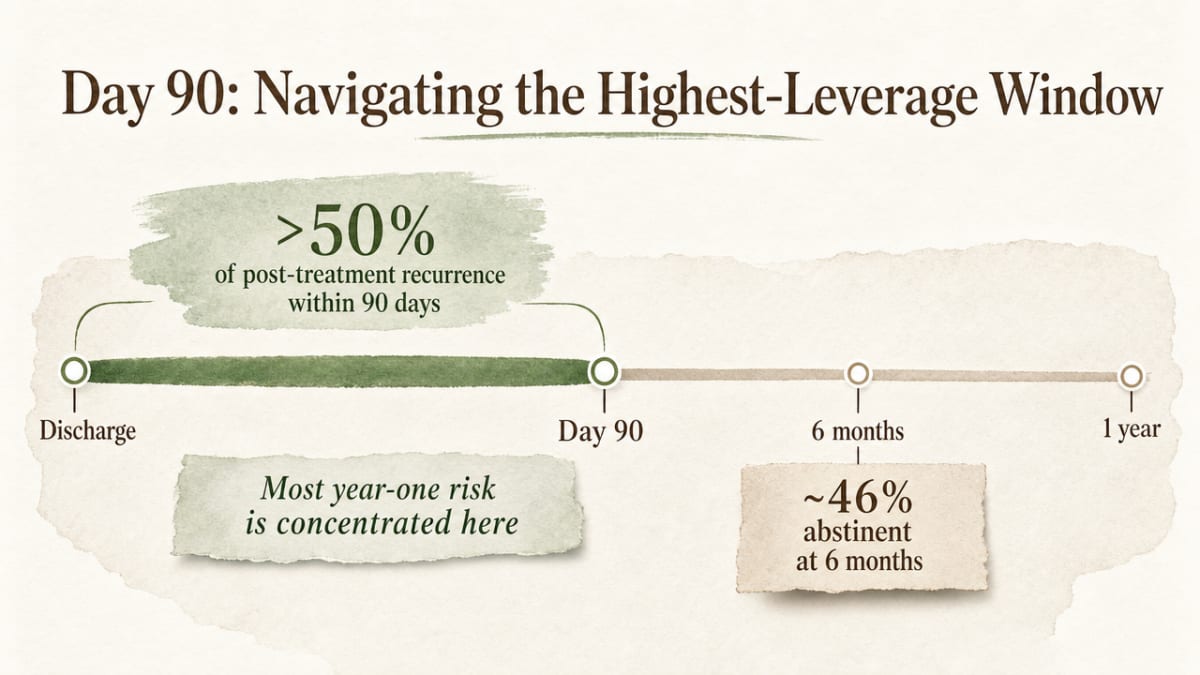
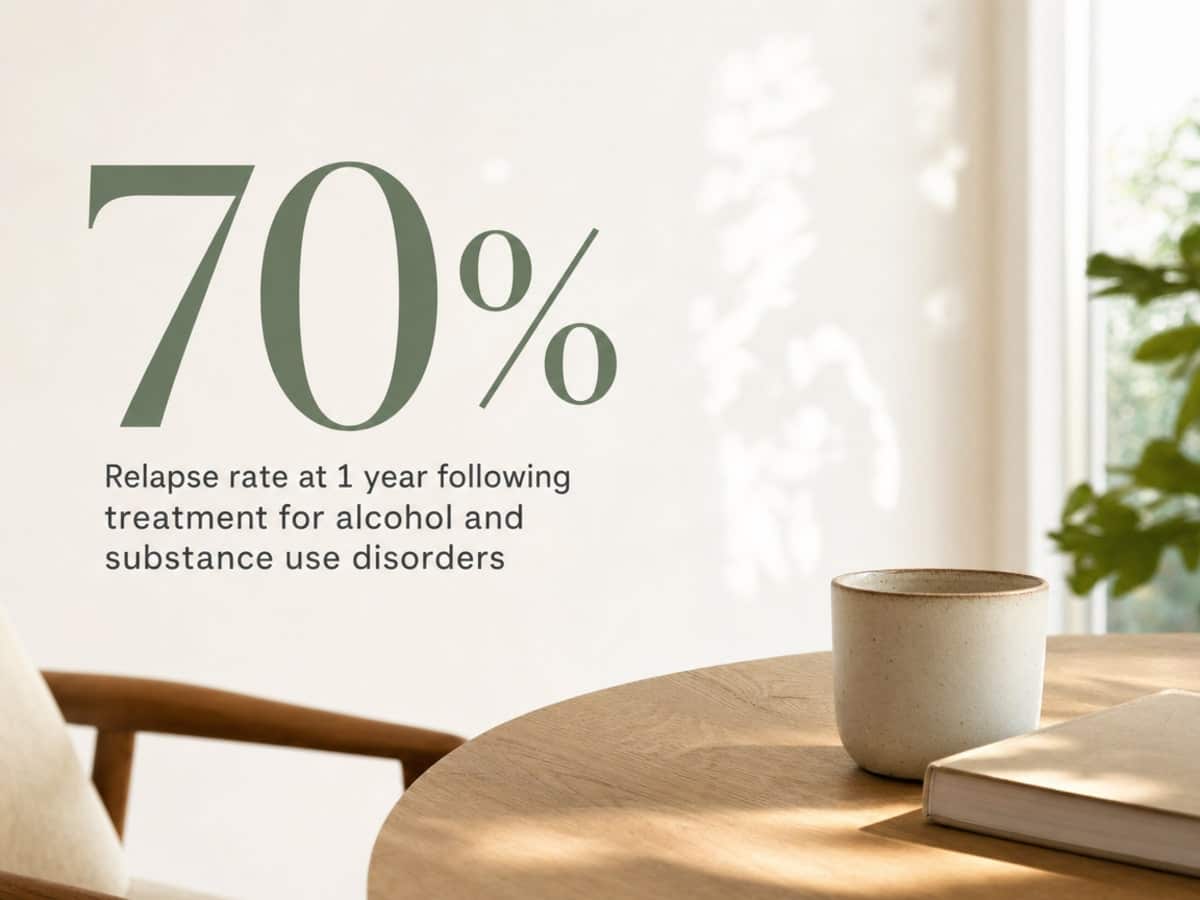
Here’s the number that should shape how you think about this window. A national study of U.S. adults who resolved an alcohol or drug problem found that more than 50% of post-treatment recurrence happens within 90 days of discharge.10 Put another way: the majority of the risk you’re navigating in year one is concentrated in the first three months, before most people around you have adjusted to the idea that you’re doing this seriously. For context on the wider curve, roughly 46% of adults remain abstinent at six months after intensive residential treatment for alcohol,1 and review-level estimates put one-year relapse rates around 70% across alcohol and substance use disorders.3 The 90-day window is where the steepest part of that slope lives.
Knowing that changes what day 90 should mean to you. It isn’t the moment you exhale. It’s the moment you notice you’ve cleared the densest patch of risk and decide, deliberately, what the next 90 days will look like. What’s coming off your calendar. What’s going on it. Who gets to know where you are on a Friday night.
By this point, something quieter has usually shifted too. You’ve been sober long enough that people at work have stopped noticing the change, which means the identity work moves inward. You start describing yourself differently to yourself. Mutual-help research points to exactly this mechanism—social support, recovery role models, and the slow reinforcement of a recovery identity are among the reasons sustained participation is linked to better long-term outcomes.14 Ninety days is when that identity is real enough to build on, and fragile enough that isolation can still undo it.
Mark it in a way that matches how you actually work. A private review with your sponsor or therapist. An honest conversation with your spouse about what the last three months have cost and given you. If you’re the kind of man who resists ceremony, treat day 90 as a planning meeting with yourself: what stays, what tightens, what you’ll ask for that you haven’t been asking for.
Six Months: When the Peak Passes and Shame Tries to Move In
Six months is a strange milestone. The risk curve is actually starting to bend in your favor, and yet this is often the point where men feel worst about themselves. That mismatch is worth understanding before it becomes a reason to disappear.
Here’s the clinical picture at this window. A classic longitudinal study found that relapse rates peak around six months after treatment and then begin to decline.2 Read that finding and something important comes into focus: if you’re still counting at six months, you’re already on the far side of the steepest part of the curve, even though the ground under you may not feel any more solid.
The problem is that six months tends to be when the story you tell yourself gets harsh. The novelty has worn off. Sleep is better, but life isn’t magically easier. You may have had a hard week, a near miss, or an actual slip, and the internal narrator gets loud: you should be further along by now. That voice is not evidence. It’s shame trying to move into the space that early motivation used to fill.
The research offers a specific antidote here. In that same longitudinal work, 42% of people who did relapse later returned to abstinence and maintained it through the rest of the follow-up.2 A return to drinking or using is not the end of your recovery arc. It’s a data point in a longer sequence, and the sequence keeps going if you do.
Mark six months by looking at what has actually changed. Not the wins you can post about, but the small structural facts: who you call when a Tuesday goes sideways, what you do with the first hour after work, how you sleep on a Sunday night. If shame is loud, that’s a signal to bring one more honest voice into the picture—a therapist, a sponsor, or the alumni contact you’ve been meaning to call. This is not the moment to go quiet.
One Year: A Significant Marker in Recovery Literature
One year is the milestone that carries actual weight in the research, not just in the ceremony. When systematic reviewers try to define what recovery even means, sustained abstinence for six or twelve months is one of the criteria that keeps showing up across studies.13 That’s not accidental. Twelve months is long enough to demonstrate that the changes you’ve made have survived a full cycle of holidays, birthdays, work pressures, family conflicts, and the ordinary Tuesday nights that used to be the hardest.
What’s actually different at a year? The relapse curve has flattened considerably from where it was at 90 days. You’ve navigated at least one version of every seasonal trigger. Your identity has had time to shift from someone who is not drinking to someone who lives sober, and those are not the same thing. The first is a behavior. The second is a self-concept, and it tends to consolidate somewhere in this window.
That said, don’t overread the marker. A year of abstinence is not the same as a year of recovery in the fuller sense, and the literature is honest about this tension. Systematic reviews note that recovery is defined variably across studies, with some emphasizing time-based abstinence and others emphasizing functional improvement—work, relationships, mental health, purpose.13 Both matter. If you’ve been sober for twelve months but your marriage is quietly failing and you haven’t touched the underlying reasons you drank, the calendar is telling you one thing and your life is telling you another.
Mark a year in whatever register you can actually inhabit. For some men that’s a dinner with the two or three people who saw the worst of it. For others it’s showing up to an alumni gathering where someone reads your name and hands you a coin without a speech attached. The point is that the moment is witnessed by someone who understands what a year has cost.
Years Two, Three, and Beyond: Why Engagement Compounds
Somewhere in year two, the milestone conversation gets quieter. The people who called on your 90-day mark are mostly not calling on your 700th day. The intensity has faded, which is exactly what you wanted, and also exactly what makes this stretch worth taking seriously. The question shifts from whether you can stay sober to whether you’ll stay engaged with the practices that got you here.
This is where the long-term math starts to matter. A longitudinal study that tracked people over 16 years compared those who got formal help for their alcohol problem with those who remitted on their own. By the three-year follow-up, 62.4% of the helped group were in remission, compared with 43.4% of the no-help group.6 More striking: among those who had already reached three years of remission, only 42.9% of the helped group later relapsed over the next 13 years, versus 60.5% of the no-help group.6 Engagement doesn’t just help you get to three years. It changes what happens after you get there.
Read that carefully, because it’s easy to miss. Even after you’ve done something as significant as three sober years, whether you stay connected to some form of ongoing support is still moving the odds meaningfully in one direction or the other over the following decade. That’s not a scare tactic. It’s a compounding effect, and it looks a lot like the way any long-term investment behaves.
Continuing care research supports the same conclusion from a different angle. Reviews of aftercare, follow-up contacts, and recovery management check-ins find that ongoing care of adequate duration improves long-term outcomes and reduces relapse, particularly when it stays active well past the initial treatment episode.12 SAMHSA’s guidance on recovery management frames this explicitly as a longitudinal process, not a discharge event.11 The mechanism isn’t mysterious. Sustained connection keeps recovery identity active, keeps a name on the list of people you’d tell if something wobbled, and keeps the coping skills from becoming museum pieces.
What changes at year two and beyond is the register of the work. You’re not white-knuckling anymore. You’re maintaining, which sounds unglamorous and is. The men who do this well tend to keep one or two threads live: a monthly call with a sponsor, a standing meeting they don’t skip, an alumni gathering they show up to whether or not they feel like it that week. The threads are thin. That’s fine. Thin threads, kept intact over years, are what the long-term data is describing.
Mark year two, and three, and the ones after, by asking a single honest question: what am I still connected to? If the answer is nothing, that’s the milestone telling you something worth listening to.
How to Mark a Milestone Without Feeling Like You’re at a Pep Rally
If the idea of standing in a circle while someone announces your day count makes you want to reschedule the whole evening, you’re not alone. A lot of men in recovery—especially the ones who spent decades being the person in the room with the plan—find public recognition genuinely uncomfortable. The good news is that the research on what makes milestones stick has nothing to do with volume. It has to do with being witnessed by someone who understands the weight of what you did.
Think of milestone recognition as a spectrum, and choose the register you can actually inhabit. On the quiet end: a private note in the same notebook you’ve been using since detox. A walk with your dog on the anniversary date and a phone call to the one person who watched the worst of it. A dinner with your spouse where you both name, out loud, what the last 90 days actually cost and gave. None of that is performative, and all of it counts.
In the middle: a standing coffee with your sponsor timed to the date. A single line in a text thread with two men from your treatment cohort—day 180, still here—and their two-word responses back. Mutual-help research consistently finds that the mechanism doing the work is social support and the slow reinforcement of a recovery identity, not the ceremony itself.14 A three-person text thread activates the same mechanism as a room of thirty. Pick the version that gets you to actually mark the day.
On the more visible end: showing up to an alumni gathering where your name gets read and a coin gets handed over without a speech attached. If that sounds tolerable once a year but excruciating monthly, that’s useful information. Go to the ones that matter to you, skip the ones that don’t, and let the structure do its job without demanding you perform gratitude on cue.
One practical rule that helps: pair every milestone with a specific check on the coping skills you actually use, not just a look backward. Relapse-prevention work is clearest on this point—maintaining change requires ongoing rehearsal of the skills, not just accumulation of clean days.15 So on day 90, day 180, day 365, do the private version of a performance review. What’s tightened up? What have you let slide? Who did you stop calling? The milestone becomes a working meeting with yourself, not a monument. That’s the version that holds.
When the Count Resets: Slips, Returns, and What the Research Actually Says
The question nobody wants to ask out loud, especially at day 200-something, is what happens if you drink. Or use. Or both. The recovery community’s answer has traditionally been that the count goes back to zero, and for good reason—counting from the last drink is honest, and honesty is what this whole thing runs on. But the way you interpret that reset matters as much as the reset itself.
Here’s what the longitudinal research actually shows about slips. In a classic year-long follow-up of alcohol abusers after treatment, 42% of the people who relapsed later returned to abstinence and maintained it through the rest of the follow-up period.2 That’s not a small number. Nearly half the people who thought they’d blown it kept going and got their footing back. The MATCH and COMBINE studies looked wider and found that people commonly cycle through multiple episodes of remission and relapse in the first year after treatment, and that those cycling patterns—not a single clean stretch—predict long-term outcomes.5 The count resetting doesn’t mean the identity resets.
That distinction is where the shame either takes over or gets put in its proper place. If a slip means you’ve failed as a person, you disappear from care, and the next stretch gets much harder. If a slip means one of your coping skills didn’t hold under a specific pressure, you have information. You call the people you should have called before it happened. You go back to the meeting. You tell your therapist what actually preceded the drink—the argument, the flight delay, the anniversary, the night you didn’t sleep.
Start counting again from the last drink. Keep the internal record of what you’ve built. Both things can be true, and the research says they usually are for the men who make it long-term.
Where Serenity Park’s Alumni Program Fits
Everything above points to the same practical problem: the milestones that matter most clinically are also the ones most likely to pass without anyone noticing. The 90-day mark lands right when family has stopped hovering. The one-year mark lands when the friends who checked in at 30 days have quietly moved on. That gap between when you need to be witnessed and when the people around you remember to witness you is the discharge cliff, and it’s where continuing care research consistently says outcomes are won or lost.12
Serenity Park’s alumni program exists to close that gap for the men who came through the residential program in Little Rock. It’s the place where day 90 gets acknowledged by someone who was there on day 3. Where the one-year coin gets handed over by a peer who understands what a year of this actually costs. Where the two-year check-in isn’t a form email but a standing invitation to keep a thin thread live, which is exactly what the long-term data says holds.11
If you’re marking a milestone soon, or one has quietly slipped past you, that’s a reason to come back to the room, not to stay away.
Frequently Asked Questions
Why do 30, 60, and 90 days get treated as sobriety milestones?
Those intervals became shorthand because relapse risk is heavily concentrated in the first three months after treatment, and shorter abstinence duration is itself a predictor of higher relapse risk.3 Marking 30, 60, and 90 days gives you natural checkpoints to review sleep, cravings, routines, and the coping skills you actually use, before drift becomes a slide.15
Is the 90-day mark really more important than other milestones?
Clinically, yes. A national study of U.S. adults resolving an alcohol or drug problem found that more than 50% of post-treatment recurrence happens within 90 days of discharge.10 Clearing that window doesn’t mean you’re finished, but it does mean you’ve moved past the densest patch of risk. Treat day 90 as a planning moment: what tightens, what stays, who you’ll ask for more support from.
If I slip, do I have to reset my sobriety count to day one?
Most recovery communities count from the last drink or use, and that honesty matters. But the count resetting doesn’t mean your identity resets. In one longitudinal study, 42% of people who relapsed later returned to abstinence and maintained it through follow-up.2 A slip is information about which coping skill didn’t hold. Call the people you should have called, go back to the meeting, and keep going.
How should I mark a milestone if I don’t want a public celebration?
Milestone recognition is a spectrum, not a chip ceremony requirement. A note in your journal, a walk on the anniversary date, a dinner with the one person who watched the worst of it—all of it counts. Mutual-help research finds that the mechanism doing the work is social support and reinforcement of recovery identity, not the volume of the room.14 Pick the register you’ll actually inhabit.
Does hitting one year mean the hardest part of recovery is over?
The steep part of the relapse curve has flattened by twelve months, but a year of abstinence isn’t the same as a year of recovery in the fuller sense. Systematic reviews note that recovery is defined variably—some studies emphasize time-based abstinence, others emphasize functional improvement in work, relationships, and mental health.13 If the calendar looks good but your life doesn’t, the milestone is telling you where to look next.
Why does staying connected to an alumni program matter after the first year?
Because engagement compounds. A 16-year study found that among people who had already reached three years of remission, only 42.9% of those who received formal help later relapsed, compared with 60.5% of the no-help group.6 Continuing care research supports the same conclusion: ongoing support of adequate duration improves long-term outcomes.12 A thin thread kept intact over years is what the data is describing.
References
- Determinants of relapse and re-admission among alcohol abusers after intensive residential treatment. https://pmc.ncbi.nlm.nih.gov/articles/PMC3436679/
- Relapse by alcohol abusers. https://pubmed.ncbi.nlm.nih.gov/3893196/
- Factors Associated with Relapses in Alcohol and Substance Use Disorders. https://pmc.ncbi.nlm.nih.gov/articles/PMC11075040/
- The Efficacy of Aftercare for Adolescents with Alcohol Use Disorders: A Randomized Controlled Study. https://www.ncbi.nlm.nih.gov/pmc/articles/PMC2597424/
- Patterns of transitions between relapse to and remission from heavy drinking over 10 years in the MATCH and COMBINE studies. https://pmc.ncbi.nlm.nih.gov/articles/PMC7900838/
- Rates and predictors of relapse after natural and treated remission from alcohol use disorders. https://pmc.ncbi.nlm.nih.gov/articles/PMC1976118/
- Relapse Prevention. https://www.ncbi.nlm.nih.gov/books/NBK553090/
- Principles of Drug Addiction Treatment: Effectiveness of Treatment. https://nida.nih.gov/publications/principles-drug-addiction-treatment-research-based-guide-third-edition/effectiveness-treatment
- Predicting Relapse After Alcohol Use Disorder Treatment in a High-Risk Sample: The Roles of Anhedonic Depression and Smoking. https://pmc.ncbi.nlm.nih.gov/articles/PMC8476113/
- How Many Recovery Attempts Does it Take to Successfully Resolve an Alcohol or Drug Problem? Lessons from a National Study of U.S. Adults. https://pmc.ncbi.nlm.nih.gov/articles/PMC6602820/
- Continuing Care and Recovery Management for Substance Use Disorders. https://store.samhsa.gov/sites/default/files/d7/priv/sma12-4688.pdf
- The Role of Continuing Care in Substance Use Disorder Treatment. https://www.ncbi.nlm.nih.gov/pmc/articles/PMC3860460/
- Recovery from alcohol use disorder: A systematic review. https://www.ncbi.nlm.nih.gov/pmc/articles/PMC5757405/
- Mutual-help groups for alcohol and drug problems: Two decades of research. https://www.ncbi.nlm.nih.gov/pmc/articles/PMC3358685/
- Relapse prevention and the maintenance of change in substance use disorders. https://www.ncbi.nlm.nih.gov/pmc/articles/PMC3320617/