
Key Takeaways
- Ketamine withdrawal is a real, treatable pattern of cravings, low mood, anxiety, sleep collapse, and sometimes physical symptoms like shaking, sweating, and palpitations in heavy daily users 4, 14.
- Symptoms follow a shape rather than a strict clock: physical peaks in the first 72 hours, relapse risk stays high through two weeks, and mood can tail for weeks 2, 4, 8.
- The danger isn’t seizures — it’s the mood crash, bladder pain, and relentless cravings that drive relapse, with 59% of patients in treatment carrying moderate-to-severe depression 3, 11.
- Supervised detox matters because medications like short benzodiazepine tapers, monitoring, and bladder-symptom management address the exact combination that derails solo attempts 2, 3.
If You Just Stopped Using Ketamine and Something Feels Wrong
If you’re reading this at 3 a.m. because your skin feels wrong, your bladder is screaming, and your chest won’t stop pounding, take a breath. You’re not losing your mind. What you’re feeling has a name, and other people have felt it too.
Maybe you meant to take a break. Maybe you ran out. Maybe someone you love asked you to stop, and now, a day or two in, the cravings are so loud you can barely hear yourself think. The low mood dropped like a curtain. Sleep won’t come, or it comes in ragged pieces. You may be shaky, sweating, or wired in a way that feels dangerous 14.
Here’s what you need to know first: ketamine withdrawal is real, even though the medical world is still catching up on how to describe it 1, 13. Heavy, frequent use changes your brain and body, and stopping suddenly can bring on cravings, anxiety, low mood, and physical symptoms that don’t just wash away with willpower 4.
The second thing you need to know: this is treatable. The parts that hurt the most — the mood crash, the sleep collapse, the bladder pain, the cravings that whisper at you to just use one more time — those are exactly what a medically supervised detox is built to handle 2, 3.
You don’t have to figure this out alone tonight. In the pages below, you’ll find what the symptoms actually look like, how long they tend to last, when supervision matters, and what getting better usually feels like.
The Symptoms People Actually Report When They Stop
The Psychological Load Comes First and Hits Hardest
The first thing most people notice isn’t a shake or a fever. It’s the pull. A craving so specific it can feel like your body remembers the exact motion of using, and it wants that motion back. If you’re feeling that right now, you are not weak. You are experiencing the single most common symptom people report.
In a 2025 patient-experience study of people with ketamine use disorder, 71% reported cravings during abstinence, 62% reported low mood, 59% reported anxiety, and 45% reported irritability 4. Read that again. Almost three out of four people said the cravings were part of stopping. You are in the majority, not the exception.
- Cravings — 71%
- Low mood — 62%
- Anxiety — 59%
- Irritability — 45%
The low mood deserves its own moment. This isn’t a bad afternoon. Men who stop after months or years of heavy use often describe a curtain dropping — flat, gray, no interest in anything, sometimes with intrusive thoughts that feel unfamiliar and frightening 8, 9. If that describes you, please hear this: the mood crash after stopping ketamine is a known pattern, and it is not proof that you are broken. Case reports show these depressive symptoms can lift within weeks of stopping, sometimes without medication at all 8, 9.
Anxiety and irritability tend to travel together. You may feel wired and exhausted at the same time. Small things — a phone notification, someone chewing, a question from your partner — can feel like too much. That’s the nervous system readjusting to life without the drug that was quieting it 7.
What matters here is that these symptoms are not a character flaw and they are not permanent. They are what the research says most people go through when they stop 4.
The Physical Side: Fatigue, Appetite, Sleep, and What Heavy Users Feel
The physical picture is quieter than what you see with alcohol or opioid detox, and that quietness is part of why people underestimate it. But quieter doesn’t mean easy.
An observational study of chronic ketamine users found that when people stopped, the most common physical discomforts were fatigue (26%), poor appetite (20.4%), and drowsiness (19.1%) 12. In the 2025 patient study, sleep disturbances showed up in about 36% of people, fatigue in 34%, and insomnia in 32% 4. So you might be exhausted all day and then unable to actually sleep at night. That contradiction is real, and it’s brutal.
- Fatigue — 26%
- Poor appetite — 20.4%
- Drowsiness — 19.1%
Not everyone gets the same withdrawal picture. Some men, especially those who used heavily every day for a long time, describe something closer to a physical withdrawal syndrome: autonomic arousal, shaking, sweating, heart palpitations, restlessness, nightmares, chills, and watery eyes 14. If your body feels like it’s running hot and cold at once, if your hands won’t stop trembling, or if your heart is racing hours after your last use, that pattern has been documented in heavy daily users 14.
Other men have a much lighter physical experience — mostly sleep problems and anxiety, without dramatic somatic signs. A case report of a man dependent on ketamine for 15 years described exactly that: no obvious physical withdrawal, but significant sleep disturbance and anxiety that still needed inpatient support to manage safely 10.
Two takeaways matter here. First, if your physical symptoms feel mild, that doesn’t mean you don’t need help — the psychological side alone is enough to derail a solo attempt. Second, if your physical symptoms feel intense, you are not overreacting. Both patterns are described in the literature, and both are reasons to have someone watching you 1, 13.
The Bladder Pain That Doesn’t Stop the Day You Stop
If you’re a heavy user, you probably already know what this section is about. The burning. The urgency. The nights of getting up every twenty minutes. The blood you saw and didn’t want to think about.
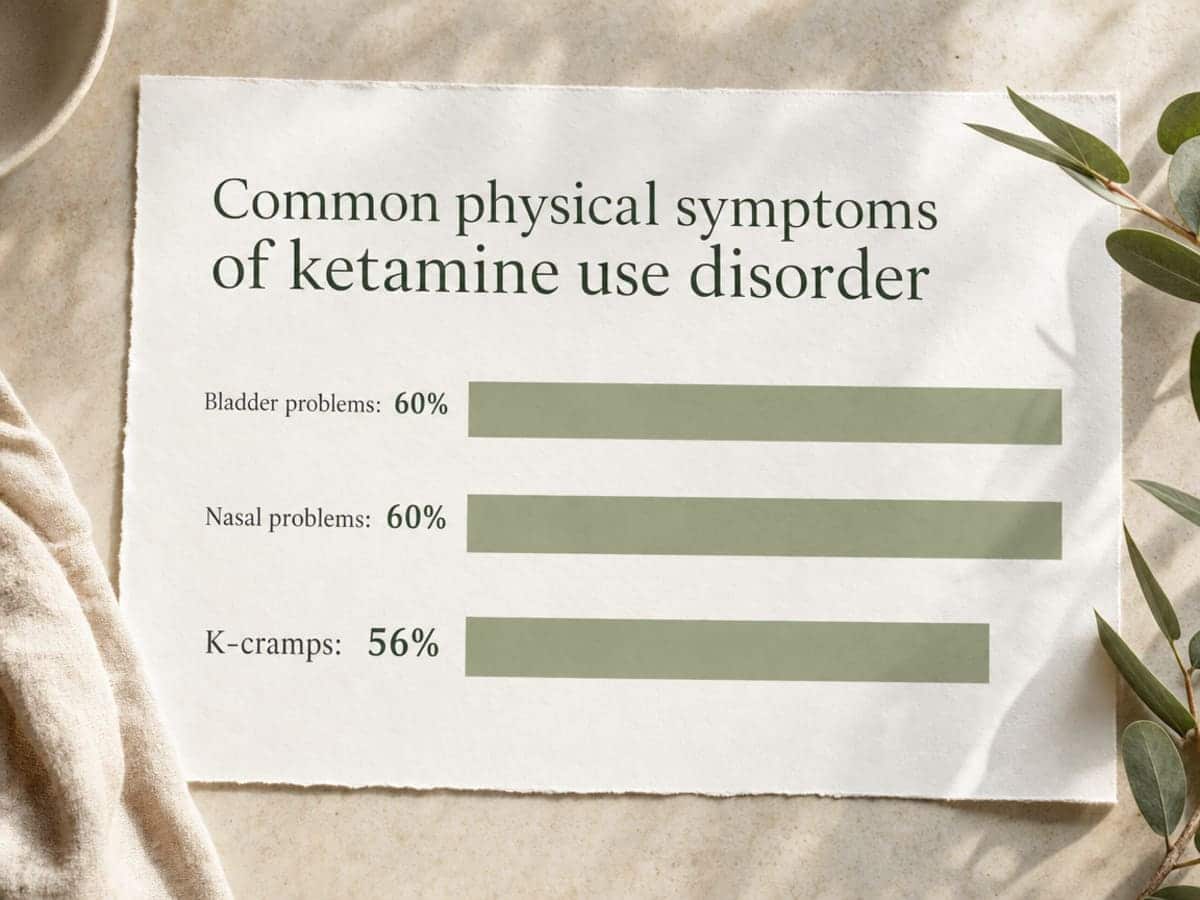
Ketamine-induced cystitis is one of the most painful and least-discussed parts of heavy ketamine use, and here’s the hard part: stopping the drug is what starts healing the bladder, but the pain doesn’t disappear the moment you stop. In the early days and weeks of abstinence, urinary pain, frequency, and blood in the urine can still be present, and for some men they briefly flare as inflammation shifts 3, 17.
What this means for you, right now: the bladder pain is a withdrawal-adjacent problem that needs its own medical eye. If you try to detox alone at home, you may end up in an emergency room at 2 a.m. for urinary symptoms that a detox team could have been managing from day one. Reduced bladder capacity, hematuria, and even hydronephrosis (swelling of the kidneys from backed-up urine) can develop in heavy users 3.
You don’t have to explain this to a stranger in a waiting room. In a medical detox setting, the bladder story is part of the intake. The pain is treated as a real symptom, not a side conversation. And every day of abstinence is a day your bladder gets a chance to calm down 3, 17.
A Realistic Timeline: First 72 Hours, First Two Weeks, and the Month-Plus Tail
You want to know when this ends. That’s a fair question, and it deserves an honest answer instead of a fake hour-by-hour chart. The truth is that ketamine withdrawal doesn’t run on a strict clock the way alcohol or opioid withdrawal does. What the case-report and patient-experience literature shows is more of a shape — three overlapping phases, with some symptoms fading fast and others hanging on longer than you’d expect 2, 4.
The first 72 hours. This is usually when the physical stuff hits hardest, if it’s going to hit at all. Heavy daily users may see autonomic arousal in this window — shaking, sweating, palpitations, chills, restlessness, watery eyes, and vivid nightmares when sleep does come 14. Cravings often peak here too, and they can be relentless. Some men have almost no physical symptoms in these first three days and instead get slammed by sleep collapse and anxiety 10. Both patterns are normal. Inpatient protocols during this window commonly use a short tapering course of a benzodiazepine like diazepam or lorazepam to take the edge off 2.
The first two weeks. This is the danger zone for relapse, and it’s not because the physical symptoms are still peaking. It’s because the psychological load is still heavy — the cravings, the low mood, the anxiety, the irritability — while your sleep and appetite are only starting to reset 4, 12. Case reports describe men in this window who look calmer on the outside but describe the inside as flat, gray, and loud with the urge to use. If you’re going to slip, statistically this is when it happens. That’s why staying in a supervised setting past the first three days matters as much as the first three days themselves.
Weeks three through six and beyond. This is the tail most people don’t warn you about. Mood symptoms — that curtain of low mood, anhedonia, and anxiety — can linger for weeks after the physical picture has calmed down. The hopeful piece: case reports document ketamine-associated depressive symptoms remitting within three to four weeks of stopping, sometimes without any antidepressant medication 8, 9. Bladder symptoms follow their own timeline, driven by tissue healing rather than brain chemistry, and can improve steadily with abstinence over weeks to months 3.
Two honest caveats. First, your timeline depends on how heavily and how long you used 1, 13. A man who used a gram a day for three years won’t feel identical to a man who binged on weekends for six months. Second, cognitive fog — trouble focusing, memory that feels smudged — can outlast the mood symptoms and is one of the last things to clear 14, 17. That’s not a sign the plan isn’t working. It’s a sign your brain is still coming back.
Is Ketamine Withdrawal as Dangerous as Alcohol or Opioid Withdrawal?
Here’s the honest answer you probably came looking for: no, ketamine withdrawal is not typically life-threatening the way severe alcohol withdrawal can be. Alcohol withdrawal can kill through seizures and delirium tremens. Opioid withdrawal, while rarely fatal in healthy adults, is famously brutal on the body. Ketamine sits somewhere else on the map 13, 14.
The clinical picture in the research is clear on this point. Some heavy daily users do develop a physical withdrawal syndrome — shaking, sweating, palpitations, chills — but even in those cases, the acute medical danger is generally lower than what clinicians see in alcohol or opioid detox 14. Other men have almost no somatic withdrawal at all, just sleep disruption and anxiety 10. The FDA itself, in the language attached to esketamine, names craving, fatigue, poor appetite, and anxiety as the reported withdrawal symptoms after prolonged large-dose ketamine exposure — not seizures, not autonomic collapse 1.
So why does this section exist? Because “less physically dangerous” is not the same as “safe to handle alone.”
The danger with ketamine withdrawal is different in kind. It’s the mood crash that hits in week one and makes you feel like using is the only way out. It’s the bladder pain that doesn’t wait its turn while you tough out the cravings 3. It’s the fact that you might look calm on the outside and be drowning on the inside. Underestimating the psychiatric weight of this is what gets people hurt 11.
Why Your Brain Is Doing This: A Short, Plain Explanation
You are not weak. Your brain is doing what brains do after months or years of a drug that turned down its volume knob.
Ketamine works mainly by blocking a receptor called NMDA, which is part of how your brain uses glutamate — the chemical that runs a lot of your alertness, learning, and emotional signaling. When you use ketamine heavily and often, your brain adjusts. It changes how many receptors it keeps active and how it fires, trying to stay balanced against the drug 7.
Then you stop. The drug is gone, but the adjustments are still there. That mismatch is what you’re feeling.
The cravings? That’s your reward system, wired by repeated use, asking for the pattern it learned 7. The low mood and anxiety? Your glutamate system is recalibrating, and mood circuits get caught in the middle 7, 8. The sleep problems, the irritability, the sense that the volume on everything is turned up too loud — same story. Your nervous system is finding its new baseline without the substance that was quieting it 13.
None of this means you’re broken. It means your brain is healing, and healing is not comfortable.
Why 24/7 Medical Supervision Actually Matters Here
If you’ve been told ketamine withdrawal isn’t as dangerous as alcohol or opioids, and you’re using that as a reason to try this alone at home, please read this part slowly.
The reason supervision matters isn’t because you’re likely to seize or stop breathing. It’s because the two weeks after you stop are stacked against you in ways that don’t show up on a vitals monitor. The cravings are loud. The mood drops. Your sleep is broken. Your bladder still hurts. And the fastest way out of all of it — the thing your brain will keep suggesting — is to use again.
- 59% — moderate-to-severe depression
- 38.7% — moderate-to-severe anxiety
What supervision actually does for you: someone notices when your mood drops into a place you shouldn’t be alone with. Someone treats the sleep, so you get a real night instead of another 3 a.m. Someone manages the bladder pain 3so you’re not choosing between cravings and a urology crisis. Someone hands you medication that takes the edge off the physical picture instead of asking you to white-knuckle it 2.
And someone is there at hour 72, and again at day 10, when the urge to use is loudest and your reasons for stopping are quietest.
That’s what 24/7 buys you. Not a guarantee. A fighting chance.
What Treatment Looks Like: Medications, Monitoring, and the First Real Sleep
You may be picturing a hospital room and restraints. That’s not what this is. Medical detox for ketamine looks more like a private bedroom, a nurse checking on you, and a plan that treats each symptom as it shows up.
On the medication side, the inpatient literature is small but consistent. Clinicians commonly use a short tapering course of a benzodiazepine — diazepam or lorazepam — to soften the anxiety, the shakes, and the sleep disruption in the first few days 2. Propranolol can be added to calm the racing heart and physical wired-up feeling that some heavy users get 2. Carbamazepine and vitamins show up in the older case reports, sometimes alongside naltrexone once the acute phase settles and the focus shifts to cravings and staying stopped 2, 10.
None of this is one-size-fits-all. A man who mostly has sleep problems and anxiety gets a different plan than a man with autonomic arousal and nightmares 10, 14. That’s the point of being watched — the plan changes with you.
Monitoring covers what you can’t track yourself when you’re this tired. Heart rate, blood pressure, sleep quality, mood check-ins, and urinary symptoms all get eyes on them. The bladder piece matters here again: urinary pain and frequency are treated as part of the medical picture, not something you’re supposed to tough out in a bathroom at night 3.
And then, usually somewhere in the first several nights, you sleep. Not perfectly. But actual sleep, in a bed, without waking up every hour. That first real sleep is often the moment men describe as the first sign this might actually work.
What Getting Better Looks Like in the First Month
Nobody hands you a badge at day 30. But if you’re watching for it, there are real signs the worst is behind you.
Somewhere in the first week or two, the cravings stop being a constant hum and start coming in waves you can ride out. They don’t vanish. They get quieter, and the space between them gets longer 4. That’s the first win, and it counts.
Sleep usually returns before mood does. You may notice you slept five straight hours, then six, then most of a night. Appetite comes back next — often quietly, in the form of actually finishing a meal instead of pushing food around 12.
The mood tail is slower, and this is where patience matters. Case reports describe men whose ketamine-associated depression lifted spontaneously within three to four weeks of stopping, sometimes without any antidepressant at all 8, 9. That doesn’t mean it will happen on a schedule. It means the flat, gray feeling isn’t your new normal.
Your bladder gets its own quiet victories. Fewer nighttime trips. Less burning. Abstinence is what starts that healing 3.
One month in, you won’t feel finished. You’ll feel like someone who can keep going.
Frequently Asked Questions
How long does ketamine withdrawal last?
The acute phase usually runs about 72 hours, with the heaviest cravings, sleep collapse, and any physical symptoms clustered there 14. The next two weeks are when low mood and anxiety stay loudest, and relapse risk is highest 4. Mood symptoms can tail for weeks, though case reports show ketamine-associated depression remitting within three to four weeks of stopping 8, 9.
Can you die from ketamine withdrawal?
Ketamine withdrawal is not typically life-threatening the way severe alcohol withdrawal can be 13, 14. The FDA label names craving, fatigue, poor appetite, and anxiety as reported symptoms after prolonged large-dose use — not seizures 1. The real risks are indirect: severe depression, relapse, and untreated bladder complications like hydronephrosis in heavy users 3, 11. That’s why supervision still matters.
Will the bladder pain go away when I stop using ketamine?
Abstinence is the foundation of bladder healing, but the pain doesn’t shut off the day you stop 3. Urinary frequency, burning, and blood in the urine can persist and sometimes briefly flare in early abstinence 3, 17. With sustained abstinence and treatments like hydrodistension, pentosan polysulfate, or Botox injections, symptoms improve over weeks to months. Reconstructive surgery is reserved as a last resort 3.
Do I need medical detox, or can I quit ketamine at home?
You can technically try at home, but the first two weeks are stacked against you. More than half of ketamine-dependent patients in withdrawal treatment carry moderate-to-severe depression alongside intense cravings — the combination that drives relapse 11. Add bladder pain 3, sleep collapse, and possible autonomic symptoms in heavy daily users 14, and a supervised setting stops being optional. It becomes the fighting chance.
Why do I feel so depressed after stopping ketamine?
Your brain adjusted to a drug that was quieting your glutamate system, and now it’s recalibrating without it 7. That mismatch shows up as low mood, anhedonia, and anxiety — reported by 62% of people during abstinence 4. This isn’t a character flaw. Case reports show ketamine-associated depressive symptoms can remit within three to four weeks of stopping, sometimes without medication 8, 9.
What medications are used to treat ketamine withdrawal?
Inpatient protocols in the case-report literature commonly use a short tapering course of diazepam or lorazepam to ease anxiety, shakes, and sleep disruption 2. Propranolol can calm racing heart and autonomic arousal in heavy users. Carbamazepine and vitamins appear in older reports, and naltrexone may be added once the acute phase settles and cravings become the focus 2, 10. Plans get tailored, not standardized.
References
- SPRAVATO (esketamine) nasal spray, CIII. https://www.accessdata.fda.gov/drugsatfda_docs/label/2025/211243s016lbl.pdf
- The Pharmacological Management of Ketamine Use Disorder. https://pmc.ncbi.nlm.nih.gov/articles/PMC11882168/
- Management of Ketamine Cystitis: National Guidelines from the [Urological Association]. https://pubmed.ncbi.nlm.nih.gov/39368630/
- The landscape of ketamine use disorder: Patient experiences …. https://pmc.ncbi.nlm.nih.gov/articles/PMC12426348/
- Role of ketamine in the treatment of substance use disorders. https://pubmed.ncbi.nlm.nih.gov/40320049/
- Ketamine in treating opioid use disorder and opioid withdrawal: a scoping review. https://pubmed.ncbi.nlm.nih.gov/40370588/
- Neurobiological Mechanisms of Ketamine Use, its Addiction, and Withdrawal: A Mini Review. https://pubmed.ncbi.nlm.nih.gov/40033594/
- Major Depressive Disorder Induced by Chronic Ketamine Abuse: A Case Report. https://pmc.ncbi.nlm.nih.gov/articles/PMC5035802/
- Spontaneous Remission of Ketamine Withdrawal-Related Mood Symptoms. https://pubmed.ncbi.nlm.nih.gov/26757313/
- [A case of ketamine dependence]. https://pubmed.ncbi.nlm.nih.gov/20214100/
- Association of Craving and Depressive Symptoms in Ketamine-Dependent Patients Undergoing Withdrawal Treatment. https://pubmed.ncbi.nlm.nih.gov/31691402/
- Gender differences in subjective discontinuation symptoms in chronic ketamine users. https://pmc.ncbi.nlm.nih.gov/articles/PMC4183767/
- Ketamine – StatPearls – NCBI Bookshelf. https://www.ncbi.nlm.nih.gov/books/NBK470357/
- Ketamine Misuse (UW PACC Psychiatry and Addictions Case Conference). https://ictp.uw.edu/wp-content/uploads/2024/03/UW-PACC-Murphy-Ryan-Ketamine-Misuse-2.1.24.pdf
- Ketamine: A Potential Adjunct for Severe Benzodiazepine Withdrawal. https://pmc.ncbi.nlm.nih.gov/articles/PMC8723697/
- Experience of the Use of Ketamine to Manage Opioid Withdrawal in an Inpatient Setting. https://pmc.ncbi.nlm.nih.gov/articles/PMC5105239/
- Ketamine Misuse: An Update for Primary Care. https://pmc.ncbi.nlm.nih.gov/articles/PMC9888585/