
Key Takeaways
- Verify any 90-day program is licensed by Arkansas as a residential substance abuse treatment program, which requires 24-hour live-in care with intake, therapy, and case management 3, 4.
- Measure daily clinical intensity by asking how many hours of clinical service you receive weekly and who delivers them, using ASAM’s 5-hour floor as a comparison point 6.
- Judge the aftercare plan before admitting, since continuing care should run 3 to 6 months and up to 12 months to hold recovery in place 10.
You’ve done 30 days. Here’s what a real 90-day program has to prove.
You already know what a 30-day program feels like. The intake paperwork, the first week that’s mostly detox and sleep, the middle stretch where you finally start talking, and the discharge day that arrives before you’re ready. Then you go home, and the structure that held you up disappears.
So when you type “90 day rehab near me” into a search bar, you’re not looking for a brochure. You’re looking for evidence that three more months will actually be different, not just longer.
Federal research is direct about this. The National Institute on Drug Abuse’s synthesis of treatment principles concludes that participation under 90 days is of limited effectiveness, and that better outcomes tend to come with longer stays 1. That’s not a marketing slogan. It’s a finding from a research-based guide meant for clinicians and policymakers, and it applies to residential care specifically because time in a structured setting gives behavioral therapies and medications room to work.
But duration alone doesn’t prove anything. A 90-day program can still be a repackaged 30-day curriculum with 60 extra days of unstructured time bolted on the back. The rest of this guide walks you through what a serious program has to demonstrate: real Arkansas licensure, real daily clinical intensity, and an aftercare plan that starts on day one. You can verify each one before you sign anything.
Why 90 days is the number that keeps coming up
What the federal research actually says about duration
The 90-day figure isn’t a marketing invention. It comes out of decades of federal research on what actually changes when someone stays in treatment long enough for the treatment to do its work.
The National Institute on Drug Abuse’s research-based guide, which synthesizes clinical studies for practitioners and policymakers, states plainly that participation for less than 90 days is of limited effectiveness, and that the best outcomes tend to occur with longer durations of treatment 1. That language is deliberate. It doesn’t say 30 days is useless. It says the shorter you stay, the less room behavioral therapies, medications, and monitoring have to change anything durable.
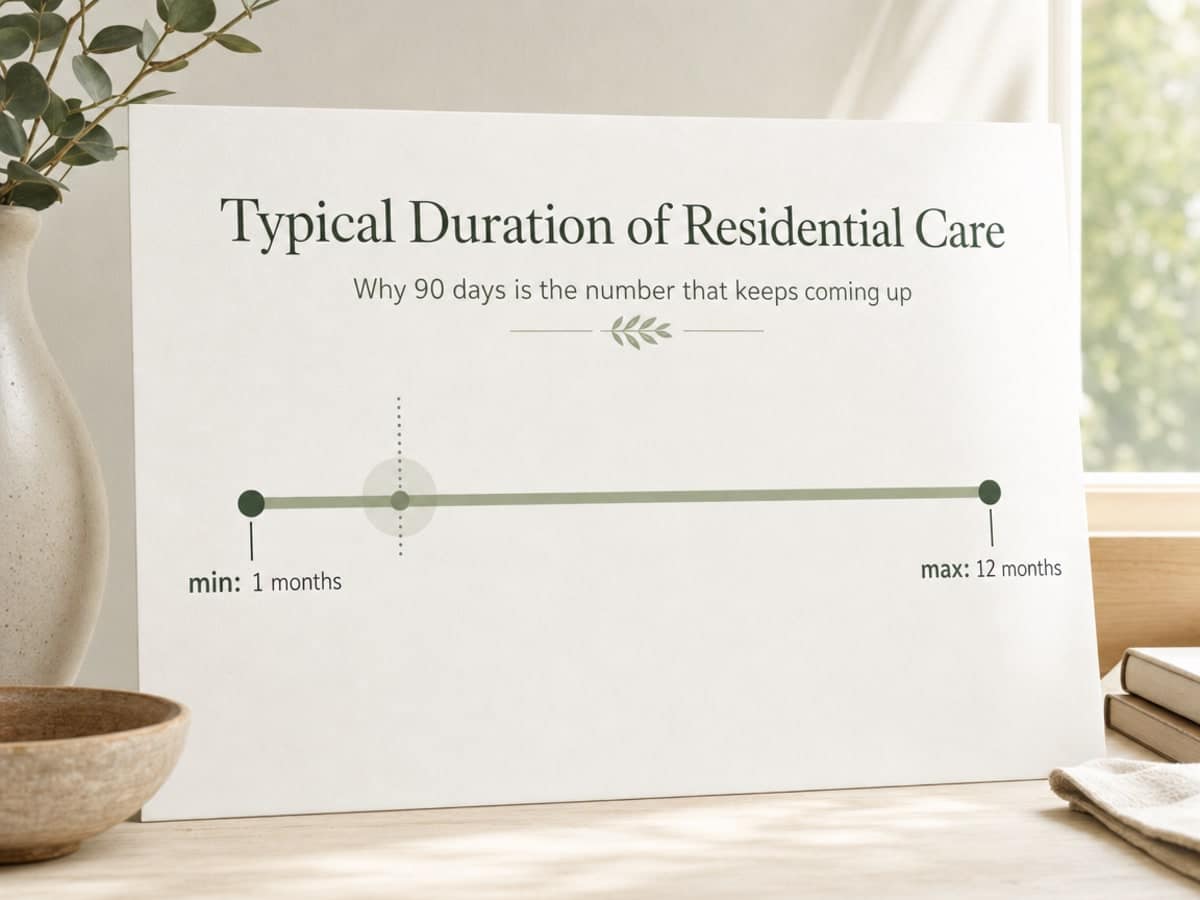
Zoom out and 90 days sits inside a wider clinical band, not at the extreme end of it. FindTreatment.gov, the federal consumer-facing guide, describes residential care as typically lasting anywhere from one month to twelve months, depending on what a person actually needs 2. So a 30-day stay is at the low end of that range. Six months to a year is at the high end. Ninety days is the point where federal research says the clinical returns start to show up more reliably.
If you’ve cycled through 28- and 30-day stays before, that framing matters. You weren’t failing the program. In many cases, the program was ending right around the point where the underlying research says the work becomes more likely to hold. Choosing 90 days is choosing to stay past that inflection point, not to sign up for triple the same experience you already know.
What longer stays are supposed to give you that 30 days can’t
Time itself isn’t the active ingredient. What time buys you is the chance for the actual clinical work to accumulate.
In the first two to three weeks of a stay, a lot of what happens is stabilization. Your sleep starts to come back. Your appetite returns. Cravings become manageable enough that you can sit through a group without white-knuckling it. If you’ve done a 30-day program, you probably remember that most of the emotional work started right around the time you were packing to leave.
Ninety days gives the treatment plan room to actually treat something. Individual counseling has time to move past history-taking into patterns you’ve never worked on before. Group therapy has time to stop being introductions and start being confrontation. If you have a co-occurring mental health issue, which is common for people who’ve relapsed multiple times, a psychiatrist has time to try a medication, see how it lands over several weeks, and adjust.
The evidence on residential care specifically backs this up. A 2019 systematic review that pulled together 23 studies of residential substance use treatment found moderate-quality evidence for effectiveness across several outcome domains, while flagging that outcomes hold up best when discharge connects to continued support 7.
That last part is the piece worth holding onto. Ninety days doesn’t work because ninety is a magic number. It works because it’s usually long enough to stabilize you, do real clinical work, and hand you off to something that keeps going after you leave.
Step 1: Verify the program is actually licensed in Arkansas
What Arkansas requires a residential program to include
Before you weigh anything else about a program, confirm the state actually recognizes it as a residential rehab. This is the least glamorous step and the one that filters out the most trouble.
Arkansas defines a residential substance use treatment program as a 24-hour, seven-day-a-week, non-medical live-in facility. To be licensed, it must include intake, individual and group therapy, case management, and room and board 3. That short list is doing a lot of work. It means a licensed program has a formal intake process (not just a booking form), scheduled one-on-one clinical sessions with a counselor, structured group therapy, and a case manager whose job is to plan what happens next for you, including after you leave.
The state’s administrative rules go further. Any entity holding itself out as a treatment program has to be licensed unless it falls into a specific exemption, such as certain hospital-based programs or self-help groups 4. The current framework lives in Part 433 of Arkansas’s rules for substance abuse licensure 5. You don’t need to read the statute. You do need to know it exists, because it gives you a straight question to ask on any admissions call: “Are you licensed by the State of Arkansas as a residential substance abuse treatment program under the current standards, and can you send me your license number?”
A legitimate program will answer that in one sentence. If the answer wanders, or the person on the phone talks about accreditation from a private body instead of state licensure, that’s not the same thing. Accreditation is meaningful, but it doesn’t replace the license. In Arkansas, the license is the floor. Everything on the marketing site sits on top of it.
Federal consumer guidance says the same thing in plainer language: a quality program should be licensed and accredited, use evidence-based practices, and support you beyond the substance use itself 2. So when you’re comparing two brochures that look identical, the licensure question is the tiebreaker that isn’t up for interpretation.
How to tell a licensed rehab from recovery housing or a sober living home
This is where a lot of people get quietly steered wrong. Not always on purpose. The categories blur, especially in ads.
A licensed residential rehab in Arkansas is regulated as a treatment program. It has to provide the clinical services described in the state licensure standards, including intake, therapy, and case management inside a 24-hour live-in setting 3, 4. That’s rehab.
Recovery housing, sober living homes, and Oxford-style houses are something else. They provide a substance-free place to live, house rules, and often peer accountability. What they typically don’t provide is licensed clinical treatment. There’s no scheduled group therapy led by a counselor, no case manager assigned to your care, no psychiatrist on staff. Many people benefit from recovery housing after treatment, or alongside outpatient care. But if you’re paying for a 90-day residential program expecting clinical intensity and you end up in a house with a curfew and a chore chart, you’ve bought the wrong thing.
One clean way to sort this on the phone: ask who provides your individual counseling and how often, and ask to see the daily schedule. A licensed residential program will have named clinical staff and a structured day. A sober living home will describe community, structure, and support, but not clinical hours. Both can be useful. Only one is what you’re searching for right now.
Step 2: Measure the daily clinical intensity
The 5-hour question every program should be able to answer
Ninety days is a container. What matters is what fills it.
Here’s a specific question you can ask on any admissions call, and one that separates a serious program from one that’s padding the calendar: how many hours of clinical service will you receive each week, and who delivers them?
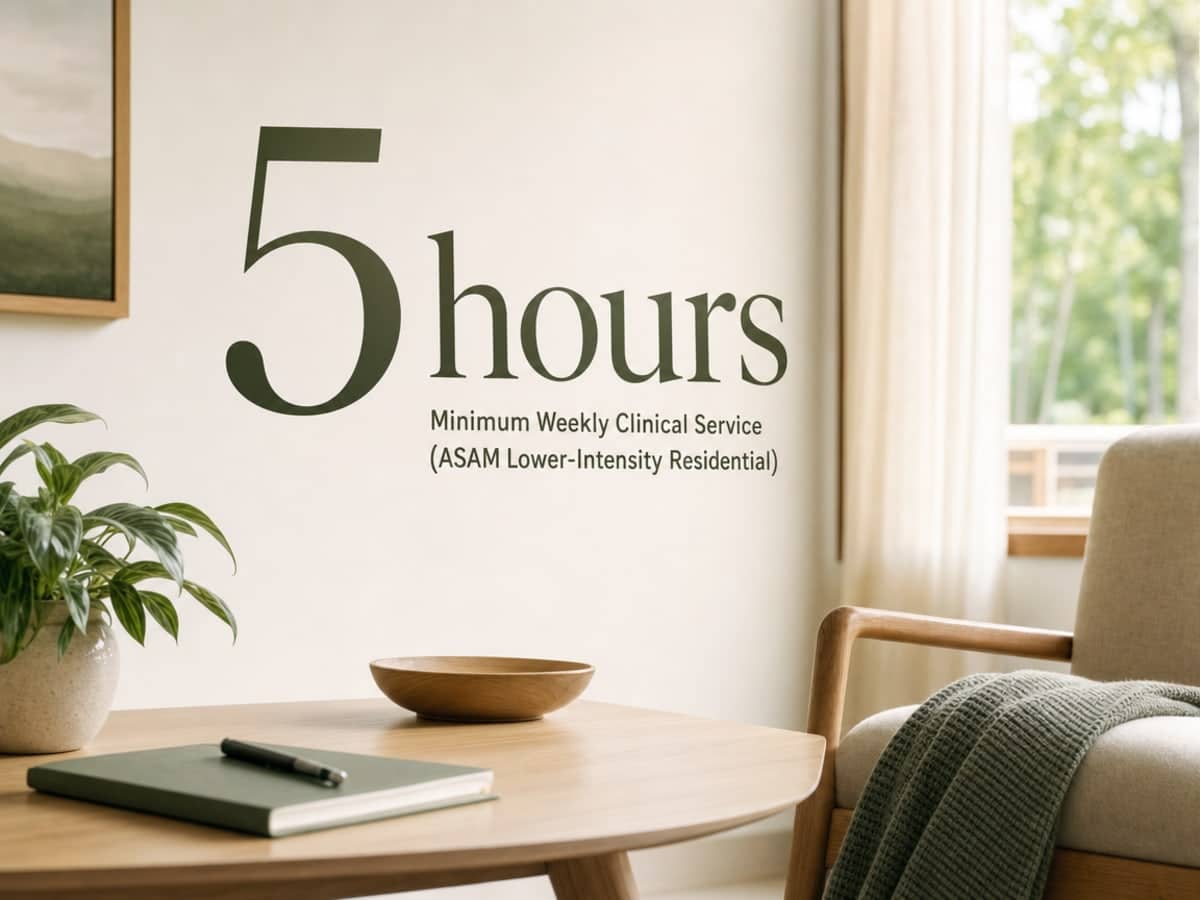
The American Society of Addiction Medicine’s criteria give you a floor to compare against. At the lower-intensity end of residential care, known as Level 3.1, the ASAM Criteria specify a minimum of 5 hours of clinical service per week inside a 24-hour structured setting 6. That’s the bottom of the range, not the target. Higher-intensity residential levels step up from there, with clinical hours climbing as the acuity of the patients climbs. Programs designed for people with heavy relapse histories, co-occurring psychiatric conditions, or complex withdrawal tend to sit well above the 5-hour minimum, often delivering multiple clinical hours per day rather than per week.
Ask the number. Ask who provides it. Then ask what happens during the rest of the day. You’re allowed to make them show their work.
What real evidence-based care looks like on a Tuesday afternoon
Numbers help, but they’re abstract. Picture an actual weekday.
A serious 90-day residential program has a schedule you could read out loud. Morning starts with a check-in group, often before breakfast, where you name where you are that day. Mid-morning is a longer process group, usually 90 minutes, led by a licensed counselor. There’s individual counseling scheduled at least once a week and often twice, with the same counselor across your stay so patterns actually get worked on. There’s a psychiatric appointment on the calendar if you have a co-occurring diagnosis, with follow-ups timed to see how medication is landing. Afternoons include skills-based groups: relapse prevention, cognitive behavioral work, sometimes a specific track for trauma or grief. Evenings often include a 12-step meeting on-site or off-site, plus time for family calls, journaling, or a case management check-in.
That’s what “evidence-based” looks like when you translate it out of marketing language. Federal consumer guidance is direct that a quality program should use evidence-based practices, involve family where appropriate, and address life beyond the substance use itself 2. NIAAA guidance goes a step further and tells you to ask directly whether the program offers all currently available evidence-based methods, and whether the treatment plan is tailored to you rather than pulled off a shelf 14.
If you can’t get a written daily schedule before admission, that’s information. If the schedule you get is mostly meals, chores, and “community time,” that’s also information.
The systematic review readers should know about
You don’t need to read journal articles to make this decision, but one is worth mentioning by name.
A 2019 systematic review pulled together 23 studies of residential substance use treatment outcomes and found moderate-quality evidence for effectiveness across several domains, including substance use reduction and improvements in related life areas. The same review flagged real limits: heterogeneity across studies, attrition, and the way outcomes hold up best when discharge connects to continued support 7.
Two things to take from that. First, residential care does have a base of evidence behind it. It isn’t a hope-based intervention. Second, the evidence gets stronger when the 90 days connect to something that comes after. Which is exactly where the next step lives.
Step 3: Judge the aftercare plan before you say yes
Why aftercare is half the decision, not a closing paragraph
If you’ve relapsed before, you already know where the fall usually happens. Not inside the program. In the first few weeks after discharge, when the schedule ends and the phone stops ringing.
That’s why the aftercare plan isn’t a bonus feature. It’s half the decision. A 90-day stay that hands you a folder with a couple of meeting times and a therapist referral is a 90-day stay that ends on day 90. A 90-day stay with a real continuing care plan is one that keeps working on you into month four, five, and beyond.
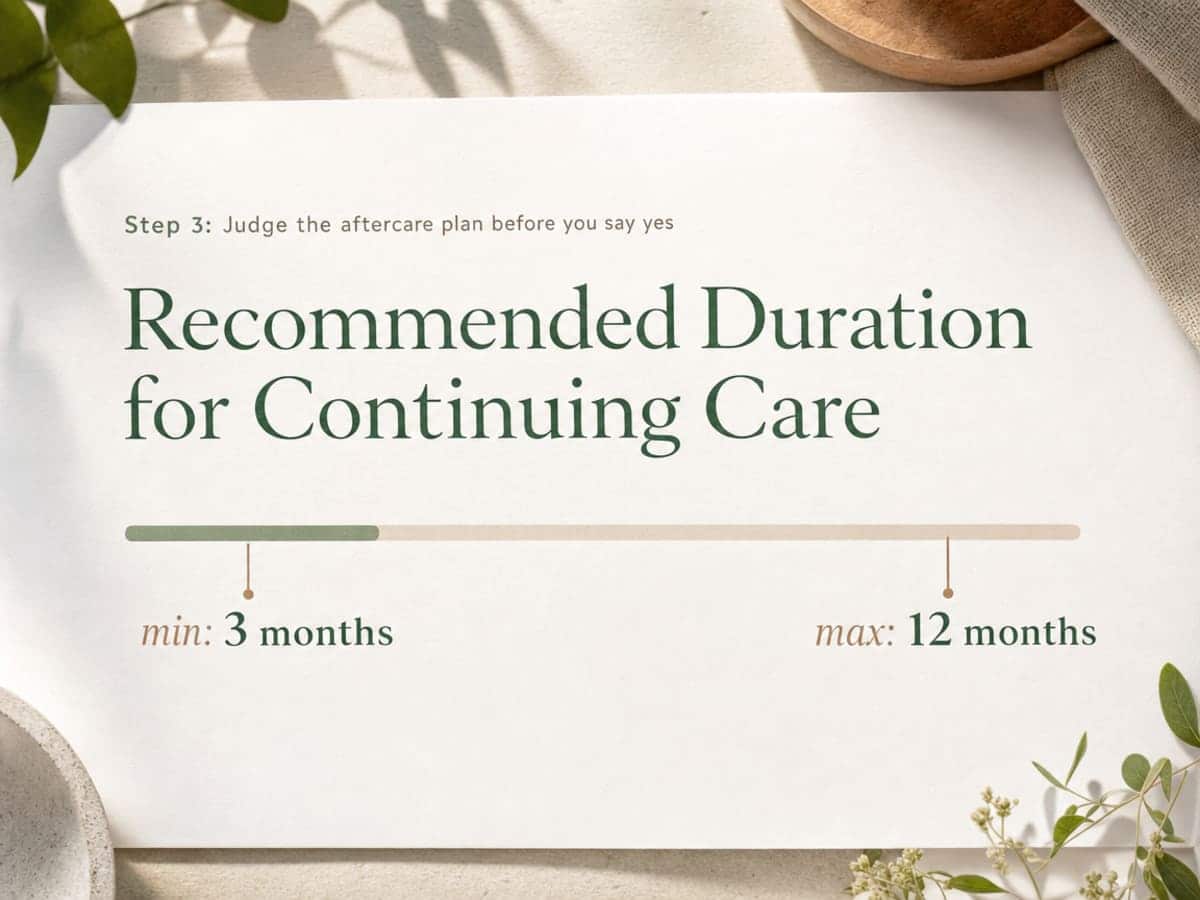
The research is specific about the timeline. A detailed review of continuing care after intensive treatment concludes that post-discharge support should extend for a minimum of 3 to 6 months, and that up to 12 months may be essential for robust recovery 10. So the honest math is that a 90-day residential program is really the front end of a 6- to 15-month arc, if it’s built right.
Meta-analytic work on continuing care backs the direction, if not the magnitude. Structured aftercare shows a small but statistically significant positive effect at the end of treatment and at follow-up 9. A separate narrative review of continuing care found that longer duration and active engagement produce more consistent results, especially for people at higher relapse risk 8, 15. That last group is you, if you’re reading this.
So when you’re on an admissions call, the aftercare question isn’t optional. Ask what happens on day 91, day 120, and day 180. If the program can’t describe that in detail, the 90 days themselves are on shakier ground than the brochure suggests.
Peer recovery support, and what it should look like on paper
Peer support gets thrown around in program descriptions the way “community” gets thrown around in real estate listings. It means something specific, and it’s worth pinning down.
SAMHSA defines peer recovery support services as work delivered by people who have been through recovery themselves, and it covers four concrete activities:
- peer mentoring or coaching,
- connecting people to recovery resources,
- facilitating recovery groups, and
- helping build sober community 11.
The workers who do this are described plainly as people who have been successful in recovery and help others in similar situations 12. That’s a job description, not a vibe.
When you ask a program about peer support in aftercare, listen for those four activities showing up by name. Is there a peer recovery coach assigned to you after discharge, and how often do they check in? Does the alumni program facilitate actual recovery groups, or is it a monthly cookout? Will someone help you connect to resources back home, like a sponsor, a doctor, or sober housing if you need it?
Peer support doesn’t replace clinical care. It sits alongside it. But for a chronic relapser, the peer piece often carries more weight than the clinical piece after month four, because it’s the part that keeps showing up when the therapy appointments taper.
Questions to ask about the discharge plan on day one
Here’s the shift that tells you a program is serious: discharge planning starts on day one, not day 85.
Federal consumer guidance is direct that a quality program includes support that reaches beyond the substance use itself, meaning housing, work, family, and mental health follow-up 2. NIAAA guidance adds that you should be asking whether the treatment plan is tailored to you individually, not pulled off a shelf 14. Both apply to the discharge plan as much as the treatment plan.
On your first admissions call, ask these directly:
- Who is my case manager, and when do we start building the discharge plan?
- What outpatient level of care do you step patients down to, and is it in-house or referred out?
- How long does your alumni or continuing care program run, and what does contact look like at three, six, and twelve months?
- If I have a co-occurring diagnosis, who manages my medication after discharge?
- What happens if I relapse in month four? Do I come back, get re-evaluated, or lose my spot in the alumni network?
A program that has answers to all five is a program worth the drive. A program that gets vague on the last two is telling you where the 90 days actually end.
Cost, coverage, and access when you’re ready to call
Money is usually the reason people stall on this step. That’s fair. Ninety days is longer than 30, and the price tag reflects it. But you don’t have to solve the cost question alone before you pick up the phone.
Ask every program the same three questions: what does the full 90 days cost, what does my insurance actually cover, and what payment options exist if there’s a gap. NIAAA consumer guidance is direct that you should ask programs about cost, coverage, and whether the treatment plan is tailored to you specifically, not sold as a package 14. A serious admissions team will walk you through a benefits check on the first call, in plain numbers, and tell you what your out-of-pocket looks like before you commit.
If you’re not ready to call a specific facility yet, start with the SAMHSA National Helpline. It’s free, confidential, and open 24 hours a day, 365 days a year, and it can refer you to local treatment options and state-funded programs based on where you live 13. That’s a lower-stakes first move than a facility admissions line, and it can shorten the list of programs you actually need to vet.
Frequently Asked Questions
Is a 90-day rehab actually more effective than a 30-day program?
The federal research points that direction. NIDA’s research-based guide concludes that participation under 90 days is of limited effectiveness, and that better outcomes tend to occur with longer stays 1. It’s not that 30 days is useless. It’s that the deeper clinical work usually needs more room to land, especially if you’ve relapsed before.
How do I confirm a rehab near me is licensed in Arkansas?
Ask the program directly for its Arkansas license number and confirm it’s licensed as a residential substance abuse treatment program 3, 5. A licensed residential facility has to provide 24-hour live-in care with intake, individual and group therapy, and case management 4. If the answer wanders, or you only hear about private accreditation, that’s not the same as state licensure.
How many clinical hours per week should a real residential program provide?
The ASAM Criteria set a floor of 5 clinical service hours per week at lower-intensity residential care, with higher-intensity levels going well above that 6. For a chronic relapser or someone with co-occurring conditions, you generally want a program running several clinical hours a day, not per week. Ask for the weekly number and who delivers it.
What should aftercare look like after I finish 90 days?
Structured continuing care should run at least 3 to 6 months after discharge, and up to 12 months is often what it takes for recovery to hold 10. Look for a step-down outpatient level, ongoing medication management if you need it, and a named peer or alumni contact who checks in on a schedule 8, 11. Vague folders don’t count.
What’s the difference between a licensed residential rehab and a sober living home?
A licensed residential rehab in Arkansas provides clinical treatment inside a 24-hour live-in setting, including therapy and case management by named staff 3. A sober living home provides substance-free housing, rules, and peer accountability, but not licensed clinical care. Both can help, at different points. If you’re paying for 90 days of treatment, you want the licensed program.
What should I do if I’m not ready to call a specific facility yet?
Start with the SAMHSA National Helpline. It’s free, confidential, and open 24 hours a day, 365 days a year, and it can point you toward local treatment options and state-funded programs based on where you live 13. It’s a lower-stakes first move than an admissions line, and it can shorten your list before you make any harder calls.
References
- Principles of Drug Addiction Treatment: A Research-Based Guide (Third Edition). https://nida.nih.gov/sites/default/files/podat-3rdEd-508.pdf
- What To Expect. https://findtreatment.gov/what-to-expect/treatment
- Licensure Standards for Alcohol and Other Drug Abuse Treatment Programs. https://humanservices.arkansas.gov/wp-content/uploads/Licensure_Standards_for_Alcohol_and_Other_Drug_Abuse_Treatment_Programs.pdf
- 007.25.00 Ark. Code R. 001 – Licensure Standards for Alcohol …. https://www.law.cornell.edu/regulations/arkansas/007-25-00-Ark-Code-R-001
- Part 433. Licensure Standards for Substance Abuse …. https://codeofarrules.arkansas.gov/Rules/Rule?levelType=part&titleID=20&chapterID=128&subChapterID=170&partID=666&subPartID=null§ionID=null
- The ASAM Criteria®. https://www.azahcccs.gov/PlansProviders/Downloads/CurrentProviders/ASAMCriteriaBrochure.pdf
- The effectiveness of residential treatment services for individuals with substance use disorders: A systematic review. https://pubmed.ncbi.nlm.nih.gov/31254749/
- Impact of Continuing Care on Recovery From Substance Use Disorder. https://pmc.ncbi.nlm.nih.gov/articles/PMC7813220/
- How effective is continuing care for substance use disorders? A meta-analytic review. https://pubmed.ncbi.nlm.nih.gov/24075796/
- The Continuing Care Model of Substance Use Treatment. https://pmc.ncbi.nlm.nih.gov/articles/PMC4007701/
- What Are Peer Recovery Support Services?. https://library.samhsa.gov/product/what-are-peer-recovery-support-services/sma09-4454
- Peer Support Workers for those in Recovery. https://www.samhsa.gov/substance-use/recovery/peer-support-workers
- National Helpline for Mental Health, Drug, Alcohol Issues. https://www.samhsa.gov/find-help/helplines/national-helpline
- Treatment for Alcohol Problems: Finding and Getting Help. https://www.niaaa.nih.gov/publications/brochures-and-fact-sheets/treatment-alcohol-problems-finding-and-getting-help
- Impact of Continuing Care on Recovery From Substance Use Disorder – PubMed. https://pubmed.ncbi.nlm.nih.gov/33500871/