
Key Takeaways
- Treat ‘retreat’ as a hospitality label and verify licensure, structured clinical hours, and medical leadership, since a scenic campus alone does not predict recovery outcomes.
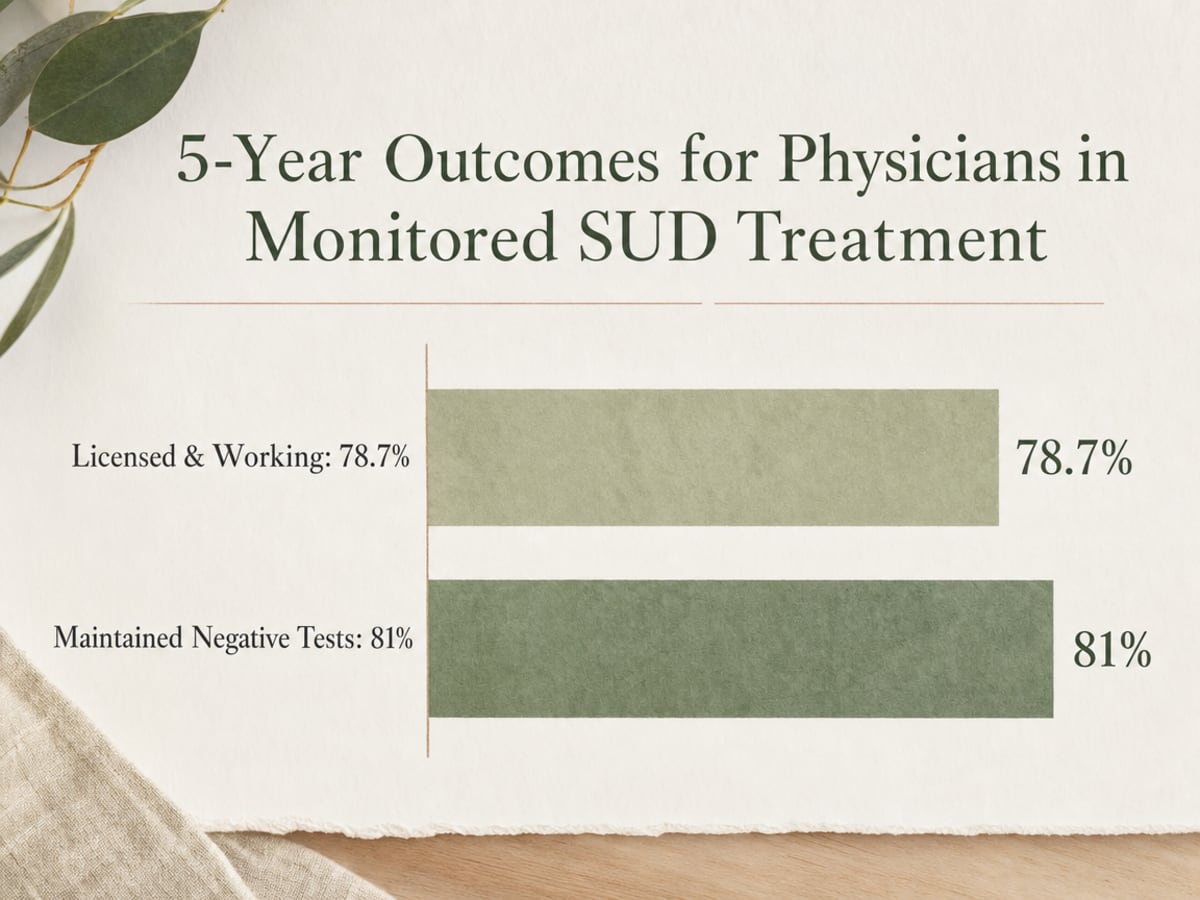
- Use the physician monitoring benchmark as your outcome ceiling: 78.7% licensed and working and 81% negative testing at five years reflect sustained oversight, not a residential stay alone 5.
- Insist on medically supervised detox, an on-site addiction-credentialed medical director, and psychiatric care fully integrated with the clinical team rather than bolted on as referrals.
- Count clinician-led hours against the state licensure floor of roughly twenty to twenty-eight per week, excluding yoga, meals, and amenities from that tally 13.
- For safety-sensitive roles, ask whether the program prescribes and documents MAT properly, since over 70% of monitored physicians and pharmacists using MAT completed successfully 11.
- Map the full continuing-care arc across at least three months and ideally five years, because durable outcomes come from structured aftercare, testing, and mutual-help engagement 9, 10.
- Treat wearables as adjuncts that can flag stress and craving, not replacements for urine toxicology or written monitoring agreements, given insufficient standalone evidence 7, 14.
What ‘Retreat’ Actually Means When You Read the Fine Print
The word “retreat” is often used for marketing, suggesting seclusion and quality scenery. However, it doesn’t clarify whether a program is a licensed clinical facility or a wellness property that admits individuals with substance use disorders.
A residential addiction program is a regulated clinical service. For instance, in Arkansas, state licensure standards mandate residential treatment to provide a minimum of twenty hours per week of structured treatment, with specific staffing, confidentiality protections, and physical plant requirements 13. Some updated standards specify twenty-eight hours. These numbers differentiate a legitimate treatment program from a facility that merely offers a pleasant environment with a therapist on call.
The quality of a program hinges on this distinction. A systematic review of residential treatment across twenty-three studies found moderate-quality evidence for significant improvements in substance use and life domains. However, the authors emphasized that outcomes depend heavily on retention, engagement, and integrated mental health care, rather than the setting itself 8. A serene campus alone does not guarantee recovery.
Therefore, when evaluating a program, consider “retreat” as a hospitality term only. Focus on the underlying clinical structure: who holds the license, the number of structured care hours per week, the continuing care plan, and the medical director’s accessibility before admission. This guide will detail these critical components.
The Outcome Ceiling: What Monitored Recovery Actually Looks Like
The Physician Benchmark and Why It Matters to You
Understanding actual successful outcomes is crucial before committing financially. The physician cohort provides the best benchmark for high-functioning professionals, as these studies track individuals with careers, licenses, and reputational risks similar to yours.
A key study followed 802 physicians treated for substance use disorders and managed by state physician health programs over five years. At the five-year mark, 78.7% were licensed and working, and 81% maintained negative urine tests throughout the monitoring period 5. These figures indicate not only sustained sobriety but also continued professional engagement, which is a critical outcome for professionals considering a leave of absence.
This trend is consistent across broader monitoring research. A systematic review of healthcare professional programs reported no-relapse rates between 65–79% over one to six years, with work retention often ranging from 78% to 88% 4. A Canadian prospective study of physicians found 71% with no known relapse and 85% successfully completing monitoring overall 6. Despite variations in countries and program designs, the outcome ceiling remains similar.
These studies highlight the importance of intensity: formal treatment, a written monitoring agreement, biological testing, mandated mutual-help participation, and sustained workplace oversight for five years. This comprehensive approach is what drives these positive outcomes.
When a program advertises a “success rate,” inquire about the population it was measured in, the duration, and the monitoring involved. Vague answers or a ninety-day timeframe suggest marketing rather than reliable outcome data. The 78.7% figure is not a guarantee but represents the maximum outcome achievable through a specific, structured approach for individuals in similar circumstances, setting a standard for what to expect from any program.
Why the Residential Episode Alone Doesn’t Produce Those Numbers
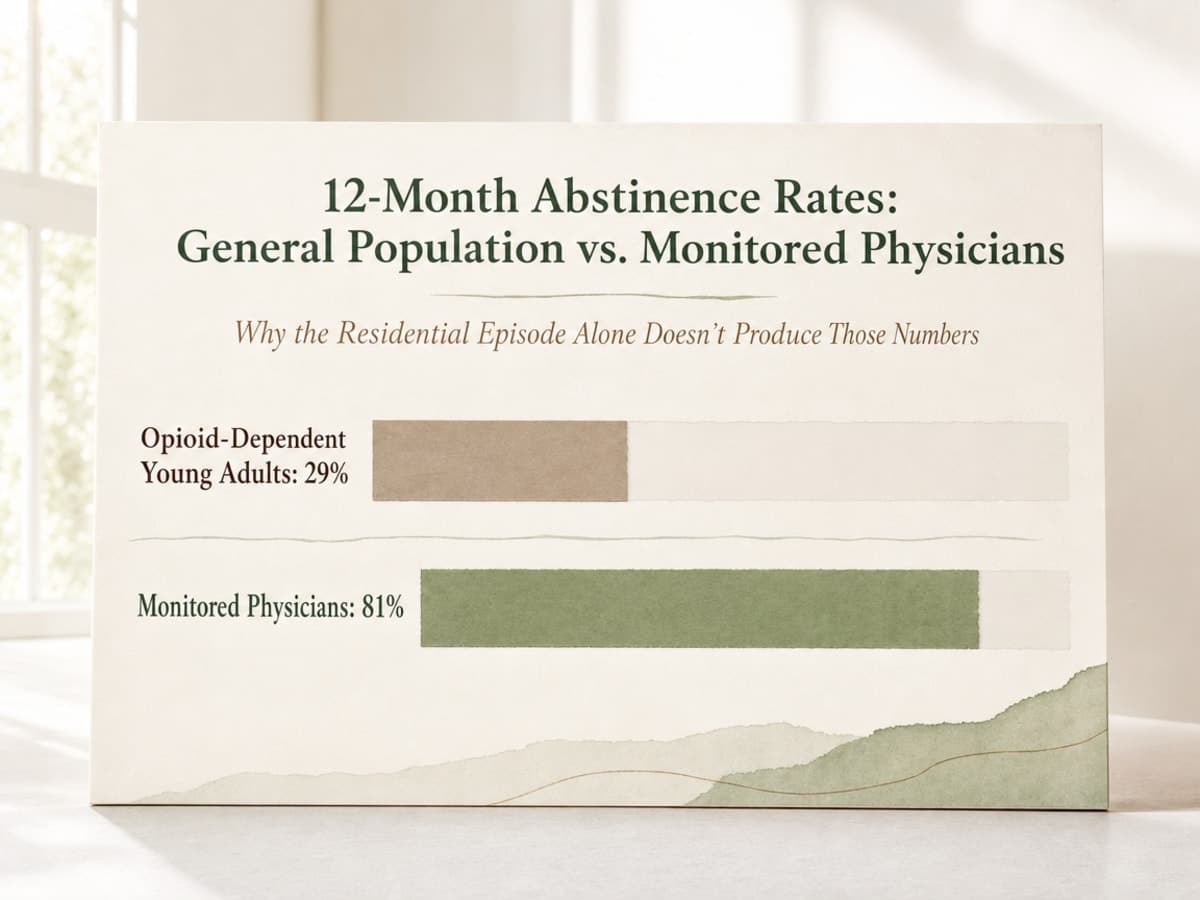
Most program brochures omit a crucial detail: the impressive physician outcomes are not solely due to the residential stay but rather to the five years of monitoring that follow it.
Consider the impact of removing this monitoring. A longitudinal study of young adults with opioid dependence who completed residential treatment found only 29% were completely abstinent at 12 months, and over 40% had re-entered another residential or continuing-care program within three months of discharge 3. This stark contrast with the 81% negative-test rate among monitored physicians 5underscores where the true work of recovery occurs.
This is not to say residential treatment is unimportant. A 2019 systematic review across 23 studies confirmed that residential services moderately improve outcomes in substance use and life domains 8. However, this review and other outcome syntheses consistently show that retention, engagement, and integrated post-discharge care are critical for sustaining these gains 1. The residential phase provides initial sobriety and stability, but the subsequent five years determine long-term recovery.
When evaluating a retreat, ask about the post-discharge arc. If the answer is limited to “alumni check-ins,” you can infer the likely outcome ceiling you are investing in.
The Clinical Anatomy of a Program Worth Your Time
Medically Supervised Detox and Integrated Psychiatric Care
The medical foundation of a program is paramount. If a retreat cannot medically supervise detox on-site, it implies you must arrive stable, excluding individuals whose substance use has led to dangerous withdrawal symptoms. Alcohol and benzodiazepine withdrawal carry significant risks, requiring physician-level care, not just wellness coordination.
Inquire about the medical leadership. There should be a designated medical director with addiction medicine or addiction psychiatry credentials, a prescribing clinician available on a regular schedule, and nursing coverage appropriate for the patient population’s acuity. “On-call” is insufficient; on-site presence is key. A program vague about its medical services is a red flag.
Psychiatric care must be integrated within the clinical team, not merely an add-on. Research consistently shows that integrated mental health care and continuity of care post-discharge are crucial for programs to achieve meaningful improvement 8. If you have co-occurring conditions like anxiety, depression, ADHD, or trauma—common among professionals seeking treatment—you need a psychiatrist who provides care during the residential stay and ensures a seamless transition to post-discharge support. Separate clinicians meeting infrequently do not constitute true integration.
Structured Clinical Hours: The Licensure Floor as Your Diligence Benchmark
A critical metric for your due diligence is the number of structured clinical hours. For example, Arkansas licensure standards require residential addiction treatment programs to provide a minimum of twenty hours per week of structured treatment, along with specific staffing, confidentiality, and facility requirements 13. Some updated standards raise this to twenty-eight hours. Every state has an equivalent minimum, providing a concrete benchmark for evaluating programs.
Structured treatment refers to clinician-led services such as group therapy, individual counseling, psychiatric appointments, and psychoeducation. It does not include activities like yoga, chef-prepared meals, equine therapy, or 12-step meetings, even if these are beneficial. These amenities do not count towards the mandated clinical hours.
Request a sample weekly schedule and a written breakdown of clinical hours versus wellness activities from the intake coordinator. Manually count the clinician-led hours. If they fall below twenty, the program is either failing to meet state requirements or inflating its schedule with amenities to promote a “holistic” image, both of which should raise concerns.
Staffing ratios are also part of these standards. A twenty-bed program running multiple groups daily needs sufficient licensed clinicians to manage them without overstretching a single therapist. Inquire about the number of licensed clinical staff, their credentials, and the typical client census. A small census is only advantageous if the clinical team size is proportionately reduced. A program with twenty clients and three clinicians differs significantly from one with twenty clients and eight.
Treat the licensure certificate as a key document. Ask to see it, inquire about the last audit, and whether any conditions were placed on its renewal. A reputable clinical operation will readily provide this information; any hesitation is a warning sign.
The Environment That Actually Does Therapeutic Work
While clinical hours form the program’s foundation, the environment determines their effectiveness. The therapeutic environment is less about aesthetics and more about fostering genuine change.
A review of residential treatment identified three core mechanisms driving positive outcomes: the need to belong, meaning in life, and self-determination 2. This means an effective residential setting provides a relatable peer group, structured activities that give purpose to the day, and enough autonomy for clients to feel like active participants. Such an environment can be found in modest facilities with disciplined programming and may be absent in some expensive ones.
For you, this translates to specific considerations. A small, men-only census is beneficial because the peer group itself is a therapeutic tool; genuine belonging is difficult with a constantly changing, diverse group. Group composition is vital. Engaging with other professionals who understand the pressures of a deposition, call schedule, or board seat is not a luxury but essential for honest self-reflection. A program that mixes populations and calls it “community” may require you to expend emotional energy on translation in addition to recovery work.
Observe the property, whether virtually or in person. Pay attention to the daily schedule, the composition of your peer group, and whether staff members demonstrate personal knowledge of each client. These details reveal whether the environment is truly conducive to therapeutic work.
The Medication Question for Safety-Sensitive Professionals
For professionals in safety-sensitive roles—those holding licenses, flying aircraft, performing surgery, or relying on critical judgment—the question of medication is complex. Concerns often arise that medication-assisted treatment (MAT) is incompatible with such roles or will complicate re-entry with licensing boards. However, the evidence is more reassuring than common misconceptions.
A recent study compared outcomes for physicians and pharmacists monitored by physician health programs who used MAT versus those who did not. Over 70% successfully completed monitoring or maintained good standing, and periods of MAT use were not associated with worse outcomes or additional impairment 11. While this applies to a specific population under intensive oversight, it is highly relevant to professionals like you and directly challenges the notion that MAT and demanding careers cannot coexist.
For your due diligence, specifically ask if the program has a prescribing clinician credentialed to initiate and manage buprenorphine, naltrexone, or acamprosate. Inquire how MAT decisions are documented for future monitoring agreements and whether the medical director has experience communicating with licensing boards. A program that views MAT as a clinical option rather than an ideological issue is one you can effectively work with.
Length of Stay and the Continuing-Care Arc
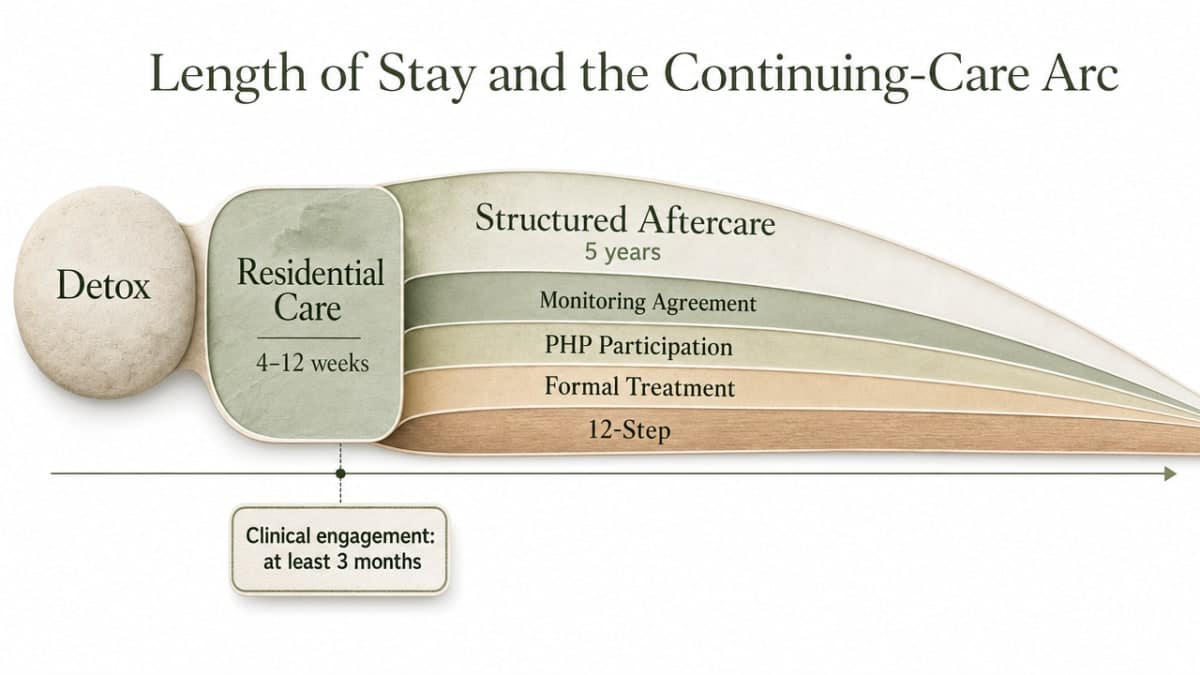
The duration of treatment is often a point of compromise for retreats, as longer stays can be harder to market. However, the evidence is clear: a review of continuing-care models in substance use treatment found that patients receiving three months or more of long-term residential and outpatient treatment showed significantly better outcomes than those with shorter durations 9. This doesn’t mean ninety days on campus, but rather that clinical engagement must extend for at least three months in a structured form to achieve the retention effects crucial for recovery.
Before committing, map out the entire treatment arc. An effective sequence typically involves medically supervised detox, followed by four to twelve weeks of residential care tailored to your needs. This should then transition into a structured aftercare phase—including intensive outpatient care, weekly individual therapy, formal 12-step engagement, and drug testing—maintained at a significant intensity for the first year and gradually tapering over five years. Physicians surveyed five years post-completion rated the monitoring agreement, PHP participation, formal SUD treatment, and 12-step meetings as the most crucial components, each averaging at least 6.2 out of 7 10. These elements should be integrated into your discharge plan, not merely offered as a list of referrals.
Inquire who manages your care after discharge. If the program’s aftercare consists only of a list of phone numbers, you will be solely responsible for navigating your recovery at a time when you are least equipped to do so. Programs that achieve the highest success rates maintain active involvement for years, not just weeks, post-discharge.
Wearables and Monitoring Technology: What the Evidence Supports
Tech-enhanced retreats are gaining popularity, often promoting devices that track heart rate, sleep, and stress to inform real-time clinical adjustments. While some aspects are supported by evidence, others are speculative, and it’s important to distinguish between them.
Research supports that individuals in recovery accept continuous monitoring via wearable sensors, and these devices can accurately detect stress and craving episodes, enabling proactive clinical intervention 16. A broader review of wireless and mobile health technologies identifies wearables as a promising addition to multifactorial treatment plans, useful for tracking physiological indicators of relapse risk 12. When used under clinical supervision within a structured program, this data can enhance individual counseling and medication decisions.
However, current research does not support wearables as standalone clinical tools. Two separate systematic reviews concluded that there is insufficient evidence to support remote monitoring of substance use disorders through wearable devices as a primary intervention 7, 14. If a retreat promotes biosensors as a replacement for urine toxicology, monitoring agreements, or direct clinical oversight, their marketing is outpacing scientific evidence. Wearables are adjunctive tools; they should complement traditional monitoring methods that have proven effective in achieving positive outcomes for professionals, not substitute them.
Discretion as an Operational Property, Not a Slogan
Every retreat promises confidentiality, often highlighted on their website and in communications. However, true protection comes from the program’s operational structure, not just its stated policy.
Consider the census size. A twenty-bed, men-only facility offers a smaller, more cohesive peer group compared to an eighty-bed mixed campus with frequent admissions and discharges. While Arkansas licensure requires separate sleeping areas by sex and age and defined confidentiality protocols 13, the bed count itself is a discretion factor not covered by regulation. Inquire about the number of clients present during your intended admission week, the weekly admission and discharge rates, and whether the clinical team can genuinely know each client by name.
Ask about the physical property: Is intake handled discreetly? Are phones allowed, and under what conditions? Who within the organization has access to client rosters, and how is this information stored? These are operational questions that a serious program should answer concretely.
A more subtle aspect is career continuity. A program designed for professionals will manage practicalities such as coordinating with monitoring agreements, communicating with your attorney, and creating discharge plans that align with your professional calendar rather than a generic ninety-day script. Comparative research across physician health programs indicates that most clients achieve successful recovery under various program structures, provided monitoring rigor is maintained 15. Discretion ensures this rigor can coexist with your professional life.
The Intake Call: Questions That Separate Clinical Programs from Branded Ones
The intake call is a crucial hour for your decision-making. You are not just being screened; you are screening the program. The person on the call often reveals the program’s true nature within twenty minutes.
Begin by requesting to speak with the medical director, not just the admissions coordinator. A reputable program will facilitate this call before you make a deposit. Directly ask three key questions: their addiction medicine credentials, how co-occurring psychiatric diagnoses are managed during the residential stay, and what their written discharge plan entails for a licensed professional. Vague responses about “personalized care” are telling.
Next, address operational questions: What is the current census, and what is the clinician-to-client ratio for the current month? How many hours of clinician-led structured treatment are on the weekly schedule, and can they email you a sample? Programs that meet genuine licensure standards will provide this document without hesitation 13. Ask what continuing care they directly manage for the first year post-discharge—not just refer to, but own. Physicians five years post-completion identified the monitoring agreement, formal treatment, PHP participation, and 12-step engagement as the most important components 10. If the intake coordinator cannot explain how these elements will be integrated into your plan, the program is likely selling a stay, not a sustainable outcome.
Frequently Asked Questions
How is a residential addiction retreat different from a rehab or treatment center?
The term “retreat” is often marketing; the clinical reality varies. A licensed residential program must meet regulatory standards for structured treatment hours, staffing, and confidentiality 13. Some retreats meet these standards but use the term for privacy. Others use it to soften the image of a wellness property lacking a medical license. Always ask for the licensure certificate and a weekly clinical schedule to determine the program’s true nature.
How long should a residential stay be to produce durable recovery?
Long-term outcomes are driven by the entire clinical arc, not just the residential phase. Research on continuing care indicates that patients receiving three months or more of treatment, combining residential and outpatient care, achieve significantly better results than those with shorter durations 9. This doesn’t necessitate ninety days on campus, but rather that clinical touchpoints—residential care, structured aftercare, drug testing, and mutual-help engagement—must extend for at least three months to establish lasting retention effects.
Can I keep my career and licensure intact while attending a retreat?
For most professionals, this is possible if the program is designed to support it. Comparative research across physician health programs shows that the majority of clients achieve successful recovery under various program structures, provided monitoring rigor is maintained 15. Operationally, you need a discharge plan that coordinates with any licensing board or monitoring agreement, a medical director willing to communicate with your attorney, and aftercare scheduled to align with your return-to-work timeline.
Is medication-assisted treatment appropriate for a safety-sensitive professional?
The evidence is more favorable than common belief. A study of physicians and pharmacists monitored by physician health programs found that over 70% successfully completed monitoring or maintained good standing, and MAT use was not associated with worse outcomes or additional impairment 11. This applies to a specific, intensively monitored population. Ask the medical director how MAT decisions are documented for future monitoring agreements or board reviews.
What questions should I ask the medical director before admitting?
Inquire about their addiction medicine credentials, how co-occurring psychiatric diagnoses are managed during the residential episode, and what the written discharge plan looks like for a licensed professional. Physicians five years post-completion rated the monitoring agreement, formal treatment, PHP participation, and 12-step engagement as the most critical components 10. If the medical director cannot articulate how these elements will be integrated into your specific plan, the program may not be suitable.
Are wearable monitoring devices a reliable substitute for traditional drug testing?
No, not currently. Two systematic reviews concluded that there is insufficient evidence to support wearable devices as a standalone tool for monitoring substance use disorders 7, 14. While wearables can accurately detect stress and craving episodes and are acceptable to patients in recovery 16, making them useful adjuncts, they should complement urine toxicology and a written monitoring agreement, not replace them. Any program suggesting otherwise is misrepresenting the science.
References
- Substance Use Disorder Treatment Outcomes: A Systematic Review. https://pmc.ncbi.nlm.nih.gov/articles/PMC12180564/
- A Realist Review of Residential Treatment for Adults with Substance Use Disorder. https://pubmed.ncbi.nlm.nih.gov/36747370/
- Is Residential Treatment Effective for Opioid Use Disorders? A Longitudinal Comparison of Treatment Outcomes. https://www.ncbi.nlm.nih.gov/pmc/articles/PMC4253677/
- Success Rates of Monitoring for Healthcare Professionals with Substance Use Disorders. https://pmc.ncbi.nlm.nih.gov/articles/PMC7828295/
- Five Year Outcomes in a Cohort Study of Physicians Treated for Substance Use Disorders in the United States. https://pmc.ncbi.nlm.nih.gov/articles/PMC2590904/
- Characteristics and Outcomes of Doctors in a Substance Dependence Monitoring Programme in Canada: Prospective Descriptive Study. https://pmc.ncbi.nlm.nih.gov/articles/PMC2577577/
- Systematic Review: Wearable Remote Monitoring to Detect Nonalcohol/Nonnicotine‑Related Substance Use Disorder Symptoms. https://par.nsf.gov/servlets/purl/10448905
- The Effectiveness of Residential Treatment Services for Individuals with Substance Use Disorders: A Systematic Review. https://pubmed.ncbi.nlm.nih.gov/31254749/
- The Continuing Care Model of Substance Use Treatment. https://pmc.ncbi.nlm.nih.gov/articles/PMC4007701/
- Essential Components of Physician Health Program Monitoring for Substance Use Disorder: A Survey of Participants 5 Years Post Successful Program Completion. https://pubmed.ncbi.nlm.nih.gov/35037334/
- Use of Medication for Addiction Treatment Among Physicians and Pharmacists in Physician Health Program Monitoring. https://pubmed.ncbi.nlm.nih.gov/42283207/
- Wearable and Wireless mHealth Technologies for Substance Use Disorders: A Systematic Review. https://pubmed.ncbi.nlm.nih.gov/33738178/
- Licensure Standards for Alcohol and Other Drug Abuse Treatment Programs. https://humanservices.arkansas.gov/wp-content/uploads/Licensure_Standards_for_Alcohol_and_Other_Drug_Abuse_Treatment_Programs.pdf
- Wearable Remote Monitoring to Detect Non‑Alcohol/Non‑Nicotine Substance Use: A Systematic Review. https://pubmed.ncbi.nlm.nih.gov/36062888/
- Comparing Substance Use Monitoring and Treatment Variations Among Physician Health Programs. https://pubmed.ncbi.nlm.nih.gov/22691011/
- Wearable Sensor‑Based Detection of Stress and Craving in Individuals with Substance Use Disorders: A Pilot Study. https://pmc.ncbi.nlm.nih.gov/articles/PMC7197459/