
Key Takeaways
- Career performance is a lagging indicator; clinicians stage alcoholism by DSM-5-TR symptom count and neurobiological cycling, not by whether your calendar still holds together 4.
- The three clinical maps—early/middle/late progression, DSM-5-TR severity tiers, and the NIAAA binge/withdrawal/anticipation cycle—describe the same territory from different altitudes and can all be active simultaneously 1, 3, 4.
- High-functioning is a stage viewed from inside your reserves, not an exemption; executive function and cognitive capacity erode measurably before titles and revenue reflect the damage 6, 8.
- Count only symptoms from the past 12 months against the 11 criteria; two qualifies as mild AUD, and withdrawal or four-plus symptoms signals when medically supervised detox becomes standard of care 2, 4.
Why your calendar is the wrong place to measure your drinking
You already know how this conversation usually starts. Someone asks if you’re okay, you point at your calendar, your last quarter, your title. Case closed.
Here’s the problem with that defense: your calendar is a lagging indicator. It reports what your brain and body were capable of six, twelve, eighteen months ago. It does not show what’s happening between drinks right now—the rising tolerance, the physical adaptations that begin quietly in the early stage of alcohol dependence 1, the way the reward system is being rewired by repeated cycling through intoxication, withdrawal, and anticipation 3.
Clinicians don’t stage alcoholism by how well you run a meeting. They stage it by symptom count against the eleven DSM-5-TR criteria for alcohol use disorder 4, by where you sit in the addiction cycle, and by what your nervous system does when you try to stop.
So put the calendar down for the next twenty minutes. This piece gives you three clinical maps, one honest self-assessment, and a clear answer to the question you’ve probably already Googled more than once: am I actually in trouble if my career still looks fine?
The three clinical maps that actually define the stages
The classic early, middle, and late progression
The oldest map is also the most familiar. It comes out of workplace and disease-model literature, and it describes alcoholism as a slow arc through three overlapping phases.
In the early or adaptive stage, tolerance rises and the body starts making quiet physical adjustments to regular alcohol exposure. The changes are largely invisible from the outside 1. You drink more to feel the same. Your recovery time in the morning gets shorter, or you tell yourself it does. Nothing looks broken.
In the middle stage, control starts to slip in specific, deniable ways. You planned two drinks and had five. You promised yourself a dry Tuesday and it did not happen. Work still holds, but the internal negotiation about drinking now runs in the background of most evenings.
In the late stage, health consequences and functional impairment become harder to hide 1. Sleep is a wreck. Mornings require a ritual. Physical symptoms enter the picture. This is where the workplace typically notices, though the arc has been running for years by then.
The strength of this map is intuition. The weakness is that it invites you to argue about which stage you are in based on how bad things look, rather than what your brain is doing.
DSM-5-TR severity: mild, moderate, severe
The second map is the one your doctor would actually use. The DSM-5-TR defines alcohol use disorder as a problematic pattern of alcohol use captured across 11 diagnostic criteria, spanning impaired control, social impairment, risky use, tolerance, and withdrawal 4.
Severity is not a judgment call. It is a count.
- Mild AUD: 2 to 3 symptoms present in the past 12 months
- Moderate AUD: 4 to 5 symptoms
- Severe AUD: 6 or more symptoms 4
Two things about this map matter for you specifically. First, meeting only two criteria already qualifies as a clinical diagnosis. That is a lower bar than most professionals assume when they picture what “an alcohol problem” looks like. Second, none of the 11 criteria require you to have lost a job, a marriage, or a license. Symptoms like drinking more or longer than you intended, spending significant time recovering, strong cravings, and continued use despite knowing it is causing trouble can all be true while your career is still upright 4.
This is the framework clinicians use to decide what level of care is appropriate. It replaces the argument about whether you are “really” an alcoholic with a specific number you can count in about ninety seconds.
The NIAAA three-stage neurobiological cycle
The third map is the most useful one for understanding why this keeps happening even when you have told yourself, repeatedly, that it will not.
The NIAAA describes addiction as a repeating cycle with three neurobiological stages: binge/intoxication, negative affect/withdrawal, and preoccupation/anticipation 3. Each stage is tied to specific changes in the brain’s reward, stress, and executive systems.
Here is what that looks like in your week. The binge/intoxication stage is the pour itself and the hours after—the reward circuits firing, the tension unloading. The negative affect/withdrawal stage is what shows up between drinks: the low-grade anxiety at 4 p.m., the irritability, the flat mornings, the sense that something is off until you drink again. The preoccupation/anticipation stage is the mental real estate—the thinking about the drink, the planning around it, the small logistical choices that quietly organize your day around when it will happen 3.
Each pass through the cycle tightens it. Reward gets less rewarding. Withdrawal gets more uncomfortable. Anticipation gets louder. The cycle is why willpower alone tends to run out of gas—you are working against a nervous system that has physically adapted to expect the next drink.
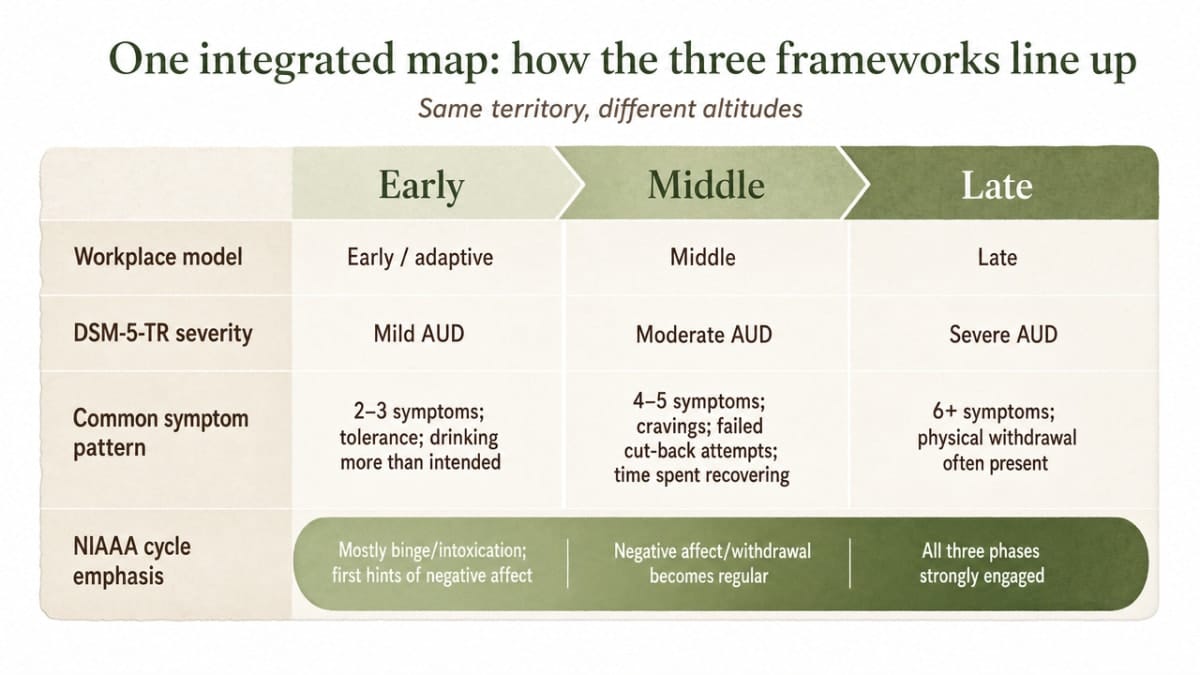
One integrated map: how the three frameworks line up
Three maps sound like three arguments. They are not. They describe the same territory from different altitudes.
The early/adaptive stage in the workplace model 1 tends to line up with mild AUD in the DSM-5-TR count—two or three symptoms, often tolerance and drinking more than intended 4. Neurobiologically, you are cycling primarily through binge/intoxication, with the first hints of negative affect between drinks 3.
The middle stage 1 typically maps to moderate AUD—four or five symptoms, with cravings, failed attempts to cut back, and time spent recovering entering the picture 4. The negative affect/withdrawal phase of the cycle is now a regular feature of your week, not a rare event 3.
The late stage 1 aligns with severe AUD—six or more symptoms, often including physical withdrawal 4. All three neurobiological stages are active and reinforcing each other, with preoccupation/anticipation running much of the day 3.
Read across the three maps and one honest fact emerges: you can be in the early workplace stage, meet criteria for mild AUD, and already be cycling neurobiologically. Outward function is a description of the top layer. The lower two layers are doing their own work, on their own timeline, whether the calendar reflects it yet or not.
High-functioning is a stage, not an exemption
Here is the sentence you probably want to argue with: high-functioning is not a diagnostic category. It is a description of timing.
The phrase gets used as a shield. If you are still closing deals, running the room, hitting the numbers, then whatever you are doing with alcohol must not be that bad. The math on that argument does not hold up when someone actually measures it.
Impairment does not announce itself. It shows up as the second draft that used to be the first. The meeting you got through instead of ran. The email you sent at 11 p.m. that you would have rewritten a year ago. The version of you that closed the deal, but slower, with more effort, at higher cost to your nervous system.
What high-functioning really means is that your reserves are still absorbing the damage. Talent, seniority, a good team, and years of pattern recognition are doing the work your fully rested brain used to do on its own. That is not an exemption from the stages of alcoholism. That is a stage—typically the early or adaptive one described in workplace clinical literature 1—viewed from inside the reserves.
Reserves are finite. The clinical question is not whether you are still performing. It is how much of your capacity is currently being spent covering for something the calendar has not caught yet.
What executive function loses before your calendar does
Your work runs on a specific set of cognitive capacities: planning several moves ahead, absorbing new information quickly, learning from what did not work last time, holding multiple threads without losing any of them. Clinicians call this bundle executive function, and it is the first thing alcohol quietly taxes.
Habitual drinkers show measurable reductions in the capacity to process new information, acquire new skills, and formulate plans 8. That is not a description of late-stage impairment. It is a description of what the brain does while adapting to regular alcohol exposure—well before anyone at work has a reason to raise a concern.
You feel this before you name it. The strategy memo that used to take a morning takes a morning and an afternoon. The name you always remembered arrives ten seconds late. You reread the same paragraph in a contract twice. You lean harder on your team, your notes, your calendar reminders. The scaffolding around your thinking gets thicker because the thinking itself has less headroom.
This is the layer that erodes first. Titles, revenue, and reputation are downstream of it, which is why they lag. By the time the calendar reflects what is happening, the cognitive slippage has been running for a while.
A private self-assessment using the 11 DSM-5 criteria
Translating each criterion into a professional’s week
Reading the DSM-5-TR criteria in clinical language is easy to dismiss. Reading them as descriptions of your actual week is harder. Here is what the 11 criteria 2, 5 look like when you translate them into the life you are actually living.
- Drinking more or longer than intended. The two-drink dinner that ends at four. The nightcap that becomes three.
- Wanting to cut down and failing. Dry January that ended January 4. The self-imposed weeknight rule you keep renegotiating.
- Significant time spent drinking or recovering. Slow mornings. The productive hours you now write off before noon.
- Craving. The specific thought about the specific drink at the specific hour, running underneath a meeting.
- Failure to fulfill role obligations. Not necessarily a missed deadline—also the memo you phoned in, the call you rescheduled, the workout you skipped for the fourth week 5.
- Continued use despite social or interpersonal problems. The argument at home you keep having. The friend who stopped inviting you.
- Giving up important activities. The hobby you used to protect. The early meeting you no longer take 5.
- Use in physically hazardous situations. Driving after two. Mixing with sleep aids. The flight where you had four before boarding.
- Continued use despite known physical or psychological harm. The lab results your doctor flagged. The sleep you know is broken. The anxiety you know is worse the day after.
- Tolerance. The volume it now takes to feel what two used to do.
- Withdrawal. Shakiness, sweating, sleep disruption, anxiety on days you do not drink—or drinking specifically to make those symptoms go away 2.
Read that list slowly. Not as accusations. As a checklist your doctor would walk through in a private consultation, without judgment, in about ten minutes.
Counting symptoms and locating yourself honestly
Now count. Only the ones that have been true in the past 12 months. Not your twenties. Not your worst year. This year.
Two or three puts you in mild AUD. Four or five is moderate. Six or more is severe 4.
Two things to hold steady while you count. First, this is not a verdict on your character or your career. It is a symptom count, the same way a blood pressure reading is a number, not a moral position. Second, honest is better than generous in both directions. Minimizing keeps you stuck. Catastrophizing sends you into a spiral that does not help you make the next decision.
If your count surprised you—up or down—sit with it for a minute before doing anything with it. The number is data. What you do with the data is the next section.
Your environment as accelerant: the workplace risk loop
The work itself is doing something to you. That is not an excuse. It is a variable worth naming, because it changes what you are actually up against.
Recent occupational research identifies a specific cluster of workplace conditions that predict harmful alcohol use and progression toward AUD:
- High job strain
- Chronic workplace stress
- Low social support
- Job insecurity
- Unfavorable organizational culture 7
If you read that list and recognized four of five, you are not unusual. You are describing the operating conditions of most senior roles in law, finance, medicine, and executive leadership.
Here is the loop. Job strain drives evening drinking as a reset. The drinking degrades sleep and executive function. Diminished capacity makes tomorrow’s strain harder to absorb. You compensate by working longer and socializing less, which shrinks the support that would otherwise buffer the stress. The culture around you—client dinners, deal closes, the drink in your hand at every industry event—normalizes the volume. Insecurity about status keeps you inside the culture rather than opting out 7.
Each turn of that loop pushes you further along the stage map above. Your environment is not the reason you drink. It is the accelerant on a fire that is already burning.
What late-stage actually costs a career
The reserves run out. That is the part nobody writes into their five-year plan.
Late-stage AUD does not usually end with a single dramatic incident. It ends with a slow migration of your problems from private to visible. Health issues that were manageable become the reason for a medical leave. Cognitive slippage that used to be covered by a strong team becomes the reason a client asks for someone else on the account. The decisions that used to take an hour take a week, and the ones that used to take a week do not get made.
Alcohol use disorder is a documented driver of long-term work disability, showing up in occupational claims as a meaningful contributor to lost employability 10. By the time it lands there, the person filing the claim was often high-functioning for years.
The cost of waiting is not moral. It is arithmetic. Every quarter you spend deeper in the cycle is a quarter of compounding damage to the exact capacities—judgment, stamina, learning, executive control—that your income depends on.
When medically supervised detox and residential care become the correct call
Detox is a medical decision, not a moral one. The question is not whether you have earned the right to step away. It is whether stopping on your own is safe.
If you have been drinking heavily and consistently, your nervous system has adapted to expect alcohol. Cutting it off without supervision can trigger tremors, sweating, elevated heart rate, disrupted sleep, and in more advanced cases, seizures. Withdrawal is one of the 11 DSM-5 criteria for a reason 2. If it is present in your symptom count, medically supervised detox is not an overreaction—it is the standard of care.
Residential care becomes the correct call when the count and the cycle are both pointing the same direction. Moderate to severe AUD—four or more symptoms in the past 12 months 4—typically indicates a level of neurobiological adaptation that outpatient effort alone struggles to interrupt. Repeated failed attempts to cut back are themselves a criterion 2, and each failed attempt is data about what the next attempt will need to succeed.
A residential setting does two things a strong week at home cannot. It removes the cues and access that keep the cycle running 3. And it puts medical monitoring, psychiatric care, and behavioral therapy in the same building during the days when your body is renegotiating its baseline.
Choosing this level of care is a clinical decision about protecting the machine that earns your living. Nothing more dramatic than that.
The discretion question: confidentiality, disclosure, and career continuity
You have almost certainly already thought about this part. Whether you say it out loud or not, the question underneath the medical question is: what does getting help cost me professionally?
That concern is legitimate, and it is one of the reasons alcohol problems in professional settings tend to stay hidden until later stages than they need to. Stigma and confidentiality worries measurably delay when employees seek help, which shifts the apparent timing of the stages—not because the disease moved slower, but because the disclosure did 9.
Here is what is actually true. Residential treatment is medical care. It is protected by the same privacy framework as any other inpatient episode. You are not required to disclose a diagnosis to an employer to take medical leave. Licensed professionals in most fields have confidential pathways specifically designed to preserve standing while treatment happens.
Choosing care early, on your terms, is the version of this that protects continuity. Waiting until the calendar catches up is the version that does not.
Frequently Asked Questions
Can I be in a real stage of alcoholism if my work performance is still strong?
Yes. Clinical staging is based on symptom count against the 11 DSM-5-TR criteria and where you sit in the neurobiological cycle, not on whether your calendar is holding 4. Traditional workplace clinical literature specifically describes an early stage in which physical adaptations to alcohol are already underway while outward performance still looks adequate 1. Strong performance is a lagging indicator, not a diagnostic exclusion.
How many DSM-5 symptoms do I need to meet to be diagnosed with alcohol use disorder?
Two. Meeting 2 or 3 of the 11 criteria within the past 12 months qualifies as mild AUD. Four or five is moderate. Six or more is severe 4. The bar is lower than most professionals assume. None of the 11 criteria require a lost job, a DUI, or a visible incident—cravings, tolerance, drinking longer than intended, and failed attempts to cut back all count 2.
What is the difference between the classic early/middle/late stages and the NIAAA three-stage cycle?
The early/middle/late model describes a long arc across years, focused on tolerance, control, and visible impairment 1. The NIAAA cycle describes what happens inside each week: binge/intoxication, negative affect/withdrawal, and preoccupation/anticipation, each tied to specific brain changes 3. One tracks the disease over time. The other tracks the loop your nervous system is running right now. Both are true; they describe different altitudes of the same territory.
When does medically supervised detox become necessary rather than optional?
When withdrawal symptoms are present—tremors, sweating, elevated heart rate, sleep disruption, anxiety on days you do not drink, or drinking specifically to make those symptoms stop 2. Unsupervised withdrawal from heavy, consistent use can escalate to seizures. If you already meet moderate or severe AUD thresholds 4, medical supervision is the standard of care, not a precaution. It protects your body while your baseline resets.
Will entering residential treatment show up on my professional record or licensure?
Residential treatment is medical care and is protected by the same privacy framework as any other inpatient episode. You are not required to disclose a diagnosis to an employer to take medical leave. Stigma and confidentiality worries measurably delay when professionals seek help, which shifts when problems surface—not the underlying disease 9. Most licensed fields have confidential pathways specifically designed to preserve standing during treatment.
How do I honestly self-assess without minimizing or catastrophizing?
Count symptoms, not stories. Walk through the 11 DSM-5-TR criteria 2 and mark only what has been true in the past 12 months. Not your worst year, not your twenties—this year. The number is data, not a verdict 4. If you land at 2 or above, that is a clinical threshold worth discussing with a physician. If your count surprised you, sit with it before deciding what to do next.
References
- Alcoholism In The Workplace: A Handbook for Supervisors. https://www.opm.gov/policy-data-oversight/worklife/reference-materials/alcoholism-in-the-workplace-a-handbook-for-supervisors/
- Table 1. DSM-5 criteria for diagnosis of alcohol use disorder. https://pmc.ncbi.nlm.nih.gov/articles/PMC12916135/table/T1/
- The Cycle of Alcohol Addiction. https://www.niaaa.nih.gov/publications/cycle-alcohol-addiction
- Alcohol Use Disorder: From Risk to Diagnosis to Recovery. https://www.niaaa.nih.gov/health-professionals-communities/core-resource-on-alcohol/alcohol-use-disorder-risk-diagnosis-recovery
- An Example with DSM-5 Alcohol Use Disorder. https://pmc.ncbi.nlm.nih.gov/articles/PMC4714779/
- Association between alcohol consumption and impaired work performance. https://pmc.ncbi.nlm.nih.gov/articles/PMC6661906/
- Risk factors for harmful alcohol consumption among …. https://pmc.ncbi.nlm.nih.gov/articles/PMC12813131/
- Executive Dysfunction in Patients With Alcohol Use Disorder. https://pmc.ncbi.nlm.nih.gov/articles/PMC9573267/
- Working on addiction in the workplace. https://www.health.harvard.edu/blog/working-on-addiction-in-the-workplace-2017063011941
- Evaluation of alcohol use disorders in workplace disability claims. https://pubmed.ncbi.nlm.nih.gov/25102475/