
What Works for Codeine Addiction Treatment?
Key Takeaways
- Codeine dependence is clinically opioid use disorder, and the 2024 national guideline treats buprenorphine, methadone, and naltrexone as first-line care rather than detox alone 1.
- Each of the three FDA-approved medications works differently — partial agonist, full agonist, and antagonist — so the right fit depends on his history, health, and daily logistics, not moral ranking 2.
- A partner’s role is measurable: family engagement raised treatment retention roughly 2.95 times in one study, though the medical and psychological work still belongs to clinicians and him 19.
- Focus next on the intake call — confirm on-site OUD medication, supervised induction, early release of information, family counseling cadence, aftercare planning, and naloxone in the home 15.
When the cough syrup stopped being about a cough
You probably knew before you knew. Maybe it was the second pharmacy on the other side of town, or the bottles that used to sit on the counter and now live somewhere else. Maybe it was the Sunday afternoon he spent in bed with the shades down, then swore he was fine by Monday morning. Maybe it was the receipt you weren’t supposed to see.
Codeine can hide in ordinary places. A prescription after a dental procedure. A syrup for a cough that lingered. A small orange bottle refilled a few too many times. And because it looks so ordinary, the shift from medicine to something else is easy to miss, and easy for him to explain away.
What you’re looking at now is a medical condition with a well-mapped treatment path. It has medications with decades of evidence behind them, structured counseling, and a real role for you 24. This guide walks you through what actually works, what the treatment team should offer, and where your voice fits in the plan without crossing lines you shouldn’t cross.
Why codeine dependence is treated as opioid use disorder
Codeine is an opioid. That sentence sounds obvious once you read it, but it’s the piece that gets lost in a lot of kitchen-table conversations. Because it comes in cough syrup and small pills, because a doctor wrote the first prescription, because it doesn’t have the street reputation of heroin or fentanyl, it’s easy to file codeine under “strong medicine” instead of where it actually belongs. When someone’s body has come to rely on it, the clinical picture is opioid use disorder, and the treatment framework is the same one used for any opioid dependence 1.
Here’s the piece that most codeine articles skip: once dependence is established, a taper by itself often isn’t enough. The 2024 national OUD guideline is clear that buprenorphine and methadone are first-line, and that withdrawal management alone is not a recommended stopping point 1. In other words, the question isn’t just how to come off the codeine. It’s what carries him through the months after.
The three medications that carry the treatment
When treatment works, medication is usually doing the quiet, steady work in the background. Counseling, groups, and family sessions matter — but for opioid use disorder, the medication is the spine that holds the rest upright 24. Here is what the three FDA-approved options actually do, what starting one looks like, and why medication changes the odds compared to detox alone.
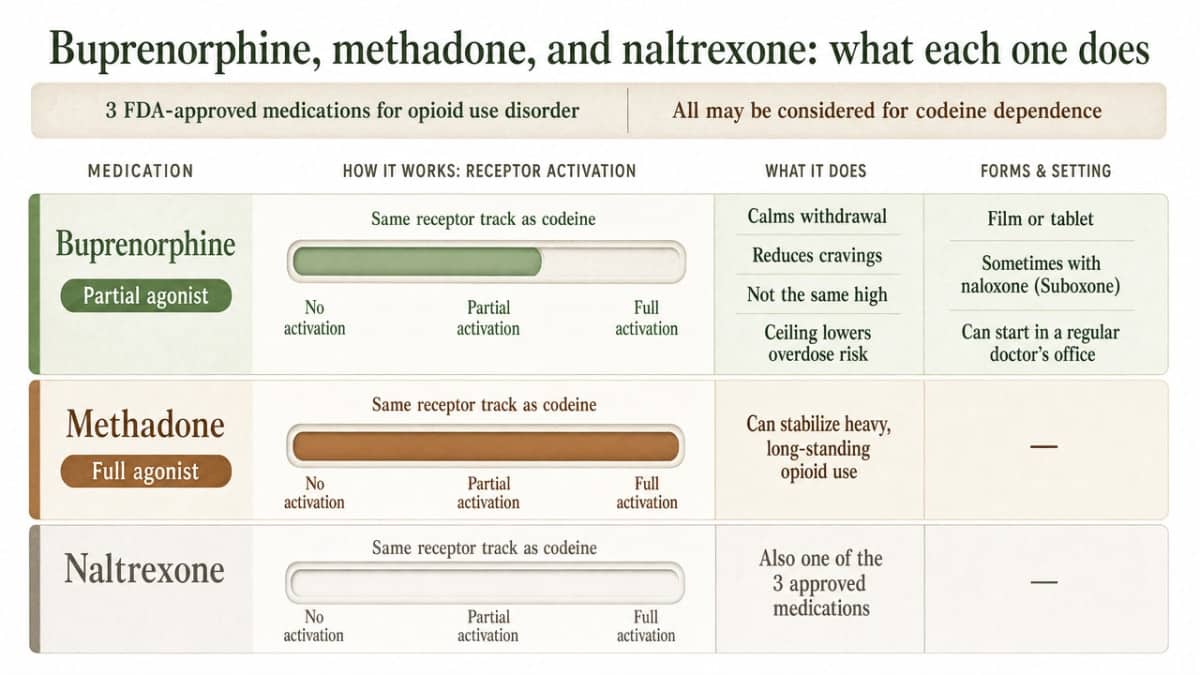
Buprenorphine, methadone, and naltrexone: what each one does
There are three medications approved for opioid use disorder in the United States, and all three are on the table for someone dependent on codeine 2. They work in very different ways, and knowing which is which will help you follow the conversation when a clinician starts explaining the plan.
- Buprenorphine — partial agonist
- It fits into the same receptors codeine hits, but only turns them on partway. That partial action calms withdrawal and cravings without producing the same high, and it has a built-in ceiling that lowers overdose risk. It’s often prescribed as a film or tablet (sometimes combined with naloxone, sold as Suboxone) and can be started in a regular doctor’s office 1.
- Methadone — full agonist
- It turns the receptors on completely, which is why it can stabilize even heavy, long-standing opioid use. The trade-off is that methadone for OUD is dispensed through federally regulated opioid treatment programs, at least at first — that usually means daily visits to a clinic for the dose 3. For a partner, this is worth knowing up front: methadone often means a real change in the daily schedule.
- Naltrexone — antagonist
- It blocks the receptors entirely, so codeine or other opioids can’t produce their effect. The long-acting injectable form (XR-NTX, brand name Vivitrol) is given monthly. It doesn’t require an OTP and can be prescribed in office-based settings — but it requires a fully opioid-free period before the first dose, which is a harder gate to clear than the other two 2.
None of these is a moral choice. They’re clinical tools with different profiles, and the right one depends on his history, other medical conditions, work and family logistics, and what he’s willing to stick with.
What medically supervised induction actually looks like
The first dose is not a leap into the unknown. For buprenorphine, the clinician waits until your partner is already in mild-to-moderate withdrawal — usually 12 to 24 hours after his last codeine dose — before giving the first tablet or film. Starting too early can cause what’s called precipitated withdrawal, where the medication briefly displaces the opioid on the receptors and makes symptoms sharply worse. That’s why the timing matters, and why induction happens under supervision 17.
A typical first day involves a small starting dose, a check about an hour later, and additional dosing if symptoms are still uncomfortable. By the end of the first 24 to 48 hours, most people have found a dose that quiets the withdrawal and the cravings. From there, the dose is adjusted over the following days and weeks until it holds steady 17.
Methadone induction follows a different rhythm, with lower starting doses and slow, careful upward titration over days to avoid oversedation. Naltrexone induction, again, waits for a full opioid-free window first — often confirmed with a naloxone challenge — before the injection.
What you’ll see at home during those first days: less physical distress, sometimes some fatigue, and a person who can finally sit through a conversation without watching the clock.
Detox alone versus medication-supported recovery
Here is the part that surprises a lot of partners. “Getting off” codeine — even in a supervised setting — is not the same as treating opioid use disorder. The 2024 national guideline is explicit: withdrawal management alone is not recommended as a stopping point 1. Detox clears the drug. It doesn’t repair the brain chemistry that keeps pulling him back.
The numbers behind that recommendation are hard to ignore. In a pilot randomized trial of young adults with OUD, participants who received treatment-as-usual after starting extended-release naltrexone had a 95% relapse rate. Those assigned to a structured recovery support program — with proactive outreach, family involvement, and coordinated care — had a 61% relapse rate 18. That’s a pilot study, in young adults, specifically measuring adherence to XR-NTX, so it doesn’t translate one-to-one to every codeine patient. But the direction is unmistakable: medication plus structure beats medication with a handshake goodbye.
If a program is pitching a two-week detox and no clear plan for what happens on day 15, that’s a program treating the symptom and skipping the disorder. What you want to hear on the intake call is a medication plan, a counseling schedule, a family communication plan, and an aftercare handoff — all named before he walks in the door.
Withdrawal management, and why it isn’t a finish line
If you’ve watched him try to quit before, you already know what those first days look like. Sweating through a t-shirt at 3 a.m. Restless legs. A stomach that won’t settle. Yawning that won’t stop. Muscle aches that make him say he has the flu, because it’s easier than saying the other word. Codeine withdrawal is real, and it’s medically manageable — the WHO withdrawal guidelines describe how supervised care uses medications to ease symptoms and reduce cravings so he isn’t white-knuckling it alone 12.
A supervised withdrawal usually runs somewhere between five and ten days for codeine, with the worst of it clustered in the first 72 hours. Clinicians can use short-acting comfort medications for symptoms, or — more often now — start buprenorphine during that window and simply keep him on it. That second path is not detox in the traditional sense. It’s the beginning of treatment.
The piece worth holding onto: clearing the drug from his system is the easiest part of what’s ahead. Cravings, sleep disruption, and mood changes can linger for weeks after the acute withdrawal ends. A program that hands him a discharge sheet on day seven and calls it done has treated the symptom, not the disorder 1. What you want next to withdrawal management on the treatment plan is a medication decision, a counselor’s name, and a first appointment already on the calendar.
Where a partner’s role actually fits
You are not a bystander in this, and you’re also not the clinician. Somewhere between those two roles is the space where a partner actually helps — and the evidence for what that looks like is more specific than most people realize. The next few sections walk through what family involvement does (and doesn’t) do, how it works in practice, the patterns that quietly sabotage recovery, and why your own care is part of the plan, not a bonus item.
Family engagement, retention, and what the evidence measures
The most consistent finding in the family-involvement literature isn’t dramatic. It’s steady. When partners and family members are engaged in treatment, people stay in treatment longer. And staying in treatment is the single biggest predictor of whether medication has time to do its work.
One peer-reviewed study of adults receiving opioid-assisted treatment — the same buprenorphine and methadone programs used for codeine dependence — found that family engagement was independently associated with retention. After adjusting for other factors, patients with family engagement had roughly 2.95 times higher odds of staying in treatment (95% CI 1.31–6.65) 19. That’s a meaningful effect for a factor that costs nothing and requires no additional medication.
Here’s the honest part, and the reason to hold this number carefully: the same study found that family engagement was associated with retention, but not with a direct reduction in opioid use itself 19. What that means, in plain terms, is that your presence helps him stay in the chair. It doesn’t do the medical work of the medication or the psychological work of counseling. Those are still his to do, with clinicians.
A separate narrative review found that treatments integrating significant others produce modest reductions in substance use — roughly a 5.7% reduction in use frequency, with benefits persisting 12 to 18 months after treatment 9. Modest, but durable. The 2026 systematic review of RCTs on family-based interventions came to a similar conclusion: 11 of 15 eligible trials showed significant positive effects 6. This is not a field of miracle results. It’s a field of small, real advantages that add up over time.
The mechanics: releases of information, communication cadence, family counseling
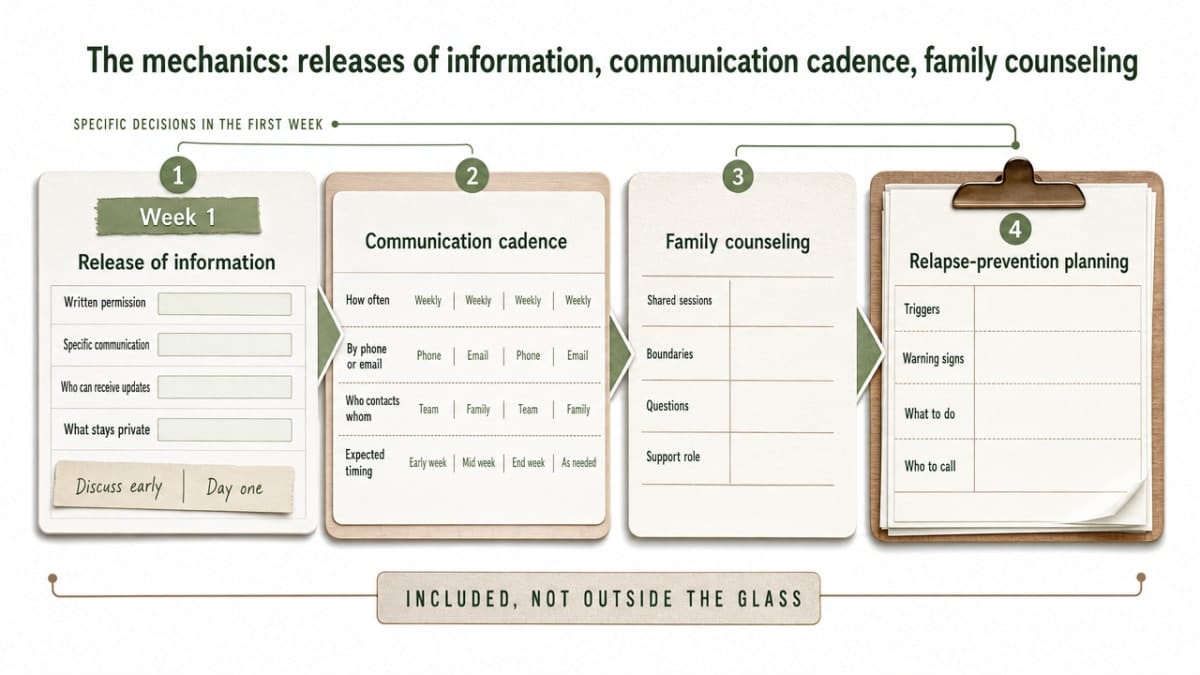
“Family involvement” sounds warm and abstract until you sit down with a treatment team. Then it becomes a series of specific decisions, most of them made in the first week. Knowing what to expect makes the difference between feeling included and feeling like you’re pressing your face against the glass.
- The release of information. Federal privacy rules mean the treatment team cannot share information about your partner’s care without his written permission. A release of information (ROI) is the form he signs to authorize specific communication — with you, with a primary care doctor, with an employer if that’s relevant. The evidence-based guidance is to discuss this early, name what will be shared, and clarify what stays between him and the clinician 4. A good program will bring this up on day one, not after you’ve called three times wondering why no one is returning your messages.
- The communication cadence. Ask what “family involvement” actually looks like on the calendar. A weekly phone call from a counselor? A family session every other week? A family education group on Thursdays? Vague answers usually mean vague follow-through.
- Family counseling itself. The evidence-based update on couple and family therapy for SUD found that systemic family therapy is well-established as a standalone treatment, and behavioral couple therapy is probably efficacious 8. These are not soft add-ons. They’re structured therapies with protocols, and they belong on the treatment plan alongside individual counseling.
- Relapse-prevention planning. Before discharge, the plan should name the early warning signs specific to him, who calls whom when those signs appear, and what the response looks like 4. Not a general handout. His plan, with your name in it.
Denial, enabling, and the patterns worth naming
There’s a piece of research from the early 1980s that clinicians still cite because nothing since has contradicted it. It looked at how family denial affects treatment outcomes for opiate addiction. Maximum family involvement — spouses and parents openly engaged, addiction named for what it was — predicted longer drug-free periods. Denial within the family predicted shorter ones 20.
Denial doesn’t look the way people think it looks. It’s rarely a partner insisting nothing is wrong. More often it’s small daily accommodations: calling in sick for him, paying the pharmacy bill without asking, cleaning up before his parents visit, telling yourself the last three months were just stress at work. These are not moral failures. They’re what happens when someone you love is in pain and you love them. They also, quietly, make it easier for the codeine to stay.
Family counseling is the place to sort through this without judgment. A counselor can help you name which behaviors are support and which are accommodations that keep the status quo in place. This is uncomfortable work. It’s also one of the specific things family sessions are designed to do — and one of the reasons a program that offers real family counseling, not just occasional updates, is worth choosing.
Your own wellbeing is part of the treatment plan
You have probably been running on less sleep than you should for months. You may have stopped telling your closest friends what’s actually happening at home. You may have a knot in your stomach when you hear a car door close at an odd hour.
The research is clear that partners and family members of people with substance use disorders carry real mental health costs of their own. A systematic review and meta-analysis found that psychosocial interventions delivered directly to family members — not the patient, the family members — reduced depression and distress. Individually delivered interventions had the strongest effects on depression and distress, and group interventions also improved several outcomes 7.
Translation: therapy or a support group for you is not selfish, and it is not a distraction from his treatment. It’s a separate, evidence-backed intervention with its own outcomes. Ask the treatment team what they offer for partners — many programs run family education groups, and community-based options like Al-Anon and Nar-Anon exist in most areas. Your recovery is not contingent on his.
Naloxone in the house
You can get it as a nasal spray at most pharmacies without a prescription. Two doses in the medicine cabinet, one in a bag or car, and — this is the part people skip — a five-minute conversation about where it is and how to use it. If he stops responding, feels cold, breathes slowly or not at all, or has blue lips or fingertips, you spray one dose in a nostril and call 911. If nothing changes in two to three minutes, use the second.
Having naloxone at home is not a signal that you expect him to fail. It’s the same reason you keep a smoke detector.
Choosing a level of care: outpatient MAT vs. residential
Not every codeine problem needs the same setting. The question is what he needs to hold steady while medication and counseling do their work — and that answer changes with his history, his physical health, and what his day looks like when he’s honest about it.
Office-based outpatient MAT can be the right level of care when someone is medically stable, has a workable home environment, and can keep appointments. Buprenorphine, in particular, was designed for this — started in a doctor’s office, filled at a pharmacy, adjusted at follow-up visits. It fits a working professional’s schedule and lets him keep going to his job while treatment ramps up 2.
Residential care with medically supervised detox earns its place when the picture is more complicated: high daily codeine amounts, a history of failed outpatient attempts, unstable housing or a home full of triggers, co-occurring mental health conditions, or medical issues that need eyes on him during withdrawal. A 24-hour setting also removes the daily decision of whether to use, which for some people is the difference between a first week that holds and a first week that doesn’t 1. If he’s tried the outpatient route twice and each attempt collapsed by week three, that’s clinical information, not character evidence.
The honest version of this conversation happens at the assessment. A good clinician will match the level of care to what’s actually in front of him, not to what sounds most impressive on paper.
What to ask on the intake call
By the time you pick up the phone, you have already done the hard part. What comes next is a short list of questions that will tell you, in about fifteen minutes, whether the program in front of you is built for opioid use disorder or just built to sell a bed.
- Which of the three OUD medications do you offer on-site — buprenorphine, methadone, or naltrexone — and how is the choice made? If the answer is “we don’t use medication” or “only for detox,” that’s not aligned with the 2024 national guideline 1.
- What does medically supervised induction look like in the first 24 to 48 hours? You want to hear about symptom monitoring and dose adjustment, not a fixed protocol 17.
- When will he sign a release of information, and what will you share with me? Early, specific, and in writing is the right answer 4.
- What’s the family communication cadence — calls, sessions, education groups? Ask for days and times.
- Do you offer couple or family therapy, and who leads it? 8
- What does the relapse-prevention plan and aftercare handoff look like on discharge day? 4
- Is naloxone provided and taught to the household before he comes home? 15
Write the answers down. A program that welcomes these questions is one that expects to earn its place.
A realistic timeline, and what ‘working’ looks like
You may be waiting for a finish line. A day when you can exhale, hand back the pill counts, and say the whole thing is behind you. That day exists, and it’s further out than most people expect — and closer than it feels right now.
The first two weeks are stabilization. Withdrawal eases, a medication dose settles, sleep starts to look more like sleep. The next three months are where the real work happens: counseling appointments held, a routine that doesn’t revolve around the next dose, a family session or two where hard things get said out loud. Somewhere around month six, you’ll notice you haven’t been checking his pockets. That’s a real milestone, even if no one throws a party for it.
Ongoing medication is not a failure of willpower. For opioid use disorder, staying on buprenorphine, methadone, or naltrexone for a year or longer is standard, evidence-based care 2. “Working” doesn’t mean off the medication. It means fewer bad days, honest conversations, a job kept, appointments made without a fight, and the two of you talking about next weekend instead of the last relapse.
Frequently Asked Questions
Is codeine really addictive, or is my partner just physically dependent?
Both can be true, and they often overlap. Physical dependence means his body has adapted to the drug and produces withdrawal without it. Addiction, or opioid use disorder, adds compulsive use despite harm — the pharmacy runs, the secrecy, the failed attempts to stop. Clinically, codeine dependence is treated within the OUD framework 1.
Can he just taper off codeine at home instead of going to treatment?
Tapering matters — the FDA label says never stop codeine abruptly in a dependent patient, and about 15% per week is the recommended pace 13, 21. But a taper alone is not treatment. The 2024 national OUD guideline states that withdrawal management by itself is not recommended 1. A supervised plan with medication and counseling holds up far better.
Which medication is best: buprenorphine, methadone, or naltrexone?
There isn’t one “best” — all three are FDA-approved for OUD, and the right choice depends on his history, other health conditions, and daily logistics 2. Buprenorphine fits office-based care. Methadone stabilizes heavier use but requires an opioid treatment program 3. Naltrexone blocks opioids entirely but needs a full opioid-free window first. A clinician matches the medication to him.
How long does codeine addiction treatment actually take?
Acute withdrawal usually settles in 5–10 days, but that’s the beginning, not the end 12. The first three months focus on stabilization and counseling. Ongoing medication for a year or longer is standard, evidence-based care — not a sign of failure 2. Family-involved treatment shows benefits persisting 12 to 18 months out 9.
Will the treatment team talk to me, or is everything confidential?
Federal privacy rules mean the team cannot share information without his written permission, given through a release of information form. Evidence-based guidance is to discuss this in the first week, name exactly what will be shared, and set a communication cadence 4. If a program can’t answer clearly on day one, that’s a signal about how family work will go later.
Should we keep naloxone in the house even if he’s in treatment?
Yes. The FDA strongly recommends naloxone for anyone being treated for opioid use disorder, and HHS names household risk as its own reason to have it available 15, 16. It’s a nasal spray, no prescription needed at most pharmacies. Keeping it on hand isn’t a lack of faith in his recovery — it’s the same logic as a smoke detector.
References
- Management of opioid use disorder: 2024 update to the national guideline for the clinical management of opioid use disorder. https://pmc.ncbi.nlm.nih.gov/articles/PMC11573384/
- Medications for Opioid Use Disorder (TIP 63). https://library.samhsa.gov/sites/default/files/pep21-02-01-002.pdf
- Federal Guidelines for Opioid Treatment Programs. https://library.samhsa.gov/sites/default/files/federal-guidelines-opioid-treatment-pep24-02-011.pdf
- Chapter 3—Family Counseling Approaches. https://www.ncbi.nlm.nih.gov/books/NBK571088/
- Chapter 1—Substance Use Disorder Treatment. https://www.ncbi.nlm.nih.gov/books/NBK571084/
- Efficacy of Family-based Interventions in Addressing Substance Use Disorders: A Systematic Review on Randomized Controlled Trials. https://pmc.ncbi.nlm.nih.gov/articles/PMC13068785/
- The effectiveness of psychosocial interventions for family members impacted by another’s substance use: A systematic review and meta-analysis. https://pubmed.ncbi.nlm.nih.gov/36744608/
- Couple and family therapy for substance use disorders: Evidence-based update 2010-2019. https://pubmed.ncbi.nlm.nih.gov/34435387/
- Family Involvement in Treatment and Recovery for Substance Use Disorders. https://pmc.ncbi.nlm.nih.gov/articles/PMC8380649/
- Family interventions in the treatment of alcohol and drug abuse: current status and future perspectives. https://pubmed.ncbi.nlm.nih.gov/16234133/
- The role of the family in preventing and intervening with substance use and misuse: a comprehensive review of family interventions, with a focus on young people. https://pubmed.ncbi.nlm.nih.gov/16076580/
- Clinical Guidelines for Withdrawal Management and Treatment of Drug Dependence in Closed Settings. https://www.ncbi.nlm.nih.gov/books/NBK310652/
- CODEINE SULFATE TABLETS. https://www.accessdata.fda.gov/drugsatfda_docs/label/2023/022402s015lbl.pdf
- codeine sulfate tablets. https://www.accessdata.fda.gov/drugsatfda_docs/label/2021/022402s014lbl.pdf
- New Recommendations for Naloxone. https://www.fda.gov/drugs/drug-safety-and-availability/new-recommendations-naloxone
- Naloxone: The Opioid Reversal Drug that Saves Lives. https://www.hhs.gov/system/files/naloxone-coprescribing-guidance.pdf
- Opioid Use Disorder: Diagnosis, Evaluation, and Treatment Clinical Guidance. https://www.bop.gov/resources/pdfs/opioid_use_disorder_cg.pdf
- A pilot randomized controlled trial of assertive treatment for young adults with opioid use disorder. https://pubmed.ncbi.nlm.nih.gov/32621368/
- The impact of family engagement in opioid assisted treatment. https://pubmed.ncbi.nlm.nih.gov/33325311/
- Family denial as a prognostic factor in opiate addict treatment outcome. https://pubmed.ncbi.nlm.nih.gov/6619824/
- Codeine – StatPearls – NCBI Bookshelf. https://www.ncbi.nlm.nih.gov/books/NBK526029/
- Evidence-based family interventions for substance use disorders (UW PACC 2024). https://ictp.uw.edu/sites/default/files/didactic_files/UW%20PACC%202024_05_09%20okoloko.pdf
- National Helpline for Mental Health, Drug, Alcohol Issues. https://www.samhsa.gov/find-help/helplines/national-helpline
- Prescription Opioids DrugFacts. https://nida.nih.gov/publications/drugfacts/prescription-opioids