
Key Takeaways
- Hydrocodone treatment follows a defined clinical pathway: assessment, medically supervised withdrawal, medications for opioid use disorder, structured therapy, and twelve months of continuing care linked together.
- Detox alone raises the risk of return to use, overdose, and overdose death because tolerance drops fast, so withdrawal must be welded to MOUD 2.
- Buprenorphine, methadone, and naltrexone all improve outcomes for prescription opioid addiction 6; the right choice depends on dosing history, work logistics, privacy needs, and the abstinence window naltrexone requires.
- Evaluate any program by what happens on day eight: which medication starts, which therapy runs, and who manages month six — not by how comfortable the first week sounds.
When the Prescription Stopped Being the Point
You already know how you got here. A back surgery, a torn rotator cuff, a dental procedure that went longer than expected, or a slow chronic pain problem that never quite resolved. The prescription made sense at the time. It still made sense at the first refill. Somewhere after that, the math changed. You started watching the clock between doses. You started counting pills on Sunday night to see if you’d make it to the next appointment. You may have called in a refill early, or found a second prescriber, or bought pills from someone who didn’t ask questions.
If you’re reading this at 11 p.m. on your phone, you’re not looking for a lecture. You’re looking for a straight answer about what treatment actually involves and whether you can go through it without losing the career, the marriage, or the reputation you’ve spent decades building.
Here’s the short version: there is a clinical pathway for hydrocodone dependence that is well-defined, medically supervised, and designed to get you back to your life intact. It starts with assessment, moves through medically supervised withdrawal, and then does the work most people skip — the part that actually keeps you off the pills 1. The rest of this article walks you through it.
The Clinical Assessment Before Anything Else Happens
Before a single pill is stopped, a clinician needs a full picture of what you’re taking, how often, and why. That’s the assessment. It’s not an interrogation, and it’s not a moral inventory. It’s a medical intake designed to answer three questions: how physically dependent are you, what else is going on medically or psychologically, and what level of care will keep you safe when the hydrocodone comes off.
A good assessment covers your prescription history (dose, formulation, duration), any non-prescribed sources, your last dose, and any other substances in the mix — alcohol, benzodiazepines, sleep aids, stimulants. That last part matters. Withdrawal from hydrocodone alone is miserable but rarely dangerous. Withdrawal from hydrocodone plus alcohol or benzodiazepines is a different clinical problem, and it changes the setting you need.
Expect a physical exam, labs, and a mental health screen. Depression, anxiety, and untreated pain often sit underneath long-term opioid use, and any treatment plan that ignores them is set up to fail. If you’re using hydrocodone because your original pain never actually resolved, that needs to be named now, not six weeks in.
The assessment also produces a formal diagnosis. Opioid use disorder is defined by specific criteria — tolerance, withdrawal, using more than intended, unsuccessful attempts to cut back, continued use despite problems. Getting the diagnosis on paper isn’t a label, it’s what unlocks the rest of the pathway: medically supervised withdrawal followed by medications for opioid use disorder and psychosocial care 1. Without a clear diagnosis and a clean picture of your medical context, the next steps are guesswork.
You’ll leave the assessment knowing what level of care is being recommended and why. That’s the point. No surprises later.
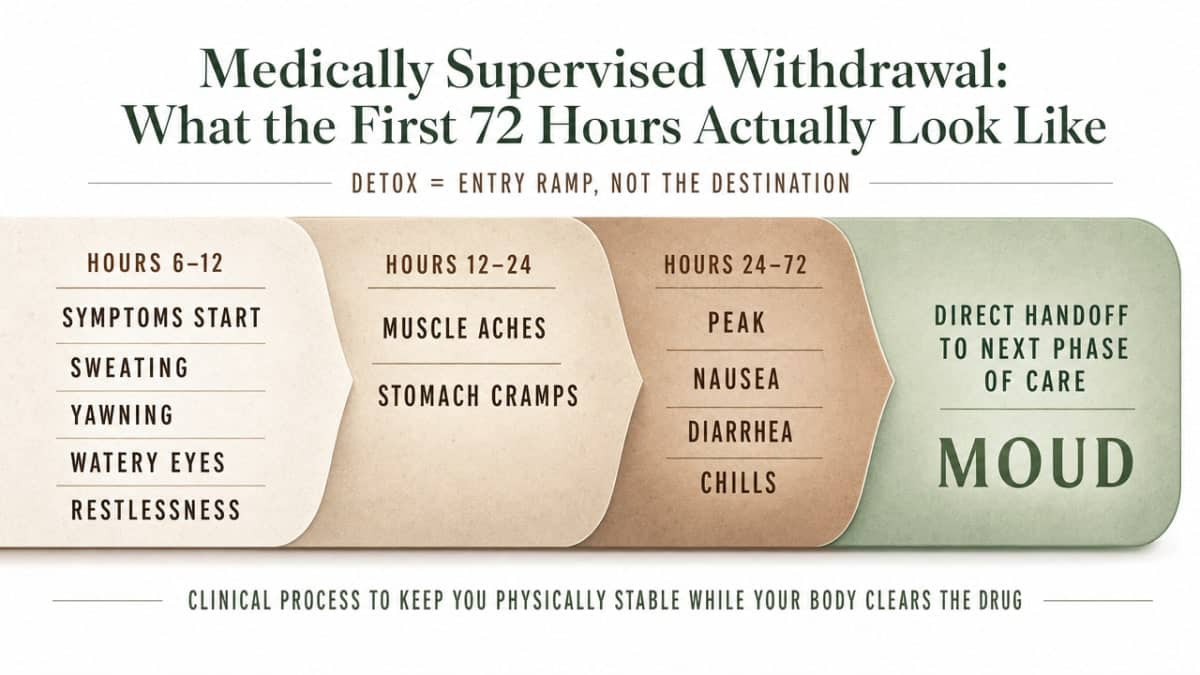
Medically Supervised Withdrawal: What the First 72 Hours Actually Look Like
You’ve probably already tried to stop on your own. Most men in your position have. You know what happens: the second day feels like the flu you can’t sleep off, and by the third day you’re either back on the pills or you’re staring at the ceiling wondering how long this is going to last.
Medically supervised withdrawal isn’t willpower with a nicer bathroom. It’s a clinical process designed to keep you physically stable while your body clears the drug, and to hand you off directly into the next phase of care 7. That handoff is the whole point. Detox is the entry ramp, not the destination.
Here’s the arc:
- Hours 6 to 12 after your last dose, symptoms start — sweating, yawning, watery eyes, restlessness.
- Hours 12 to 24, the muscle aches and stomach cramps set in.
- Hours 24 to 72 is the peak: nausea, diarrhea, chills alternating with sweats, insomnia, and a specific kind of skin-crawling agitation that opioid withdrawal is known for.
- By day four to five, the acute physical symptoms start to ease.
- By day seven, most men are on the other side of the worst of it physically, though sleep, appetite, and mood take longer to normalize.
In a medically supervised setting, you’re not white-knuckling any of that. A clinician monitors vitals, hydration, and withdrawal severity using a standardized scale. Comfort medications treat specific symptoms: something for the nausea, something for the muscle cramps, something for the anxiety and insomnia, something for the diarrhea 7. In many programs, buprenorphine is started during this window, which shortens the acute phase considerably and doubles as the first step of your longer-term medication plan 8.
What you should hear in that description is this: the point of supervised withdrawal is to make you medically safe and to link you to what comes next 7. A program that runs you through detox and sends you home with a pat on the back has done roughly a third of the job. The physical clearance of hydrocodone from your system doesn’t treat the underlying disorder — it just resets the clock. Your brain chemistry, your cue responses, your sleep architecture, and your pain processing all need weeks to months of active treatment to recalibrate.
That’s why the way you should evaluate a detox program isn’t by how comfortable the first week sounds. It’s by what happens on day eight. If the answer is discharge, that’s not treatment. If the answer is a warm handoff to MOUD induction, structured therapy, and a written continuing care plan, you’re in the right place.
The Pivot: Why Detox Alone Raises Your Overdose Risk
Here is the part most rehab marketing does not tell you clearly, so read it once and let it sit.
The mechanism is not complicated. When you use hydrocodone regularly, your tolerance climbs. When you detox, that tolerance drops fast — often within a week or two. If you then use again at anything close to your previous dose, the same amount of drug now hits a body that can no longer handle it. That is the setup for a fatal respiratory depression event. It is why the days and weeks after a clean detox are statistically the most dangerous window in the entire course of opioid use disorder.
The clinical answer is not to skip detox. The answer is to make sure detox is welded to what comes next: medications for opioid use disorder, structured therapy, and a written continuing care plan 2. Buprenorphine, methadone, and naltrexone all improve outcomes for people addicted to prescription opioids — that is the finding, plainly stated 6. Detox without them is a partial intervention that leaves you more exposed than when you started.
So when you are evaluating a program, the question is not “how comfortable is your detox?” It is: on the day I finish withdrawal, what medication am I starting, what therapy am I in, and who is following me for the next twelve months? If the program cannot answer that in one sentence, you are looking at a business, not a treatment plan.
Choosing Among Buprenorphine, Methadone, and Naltrexone
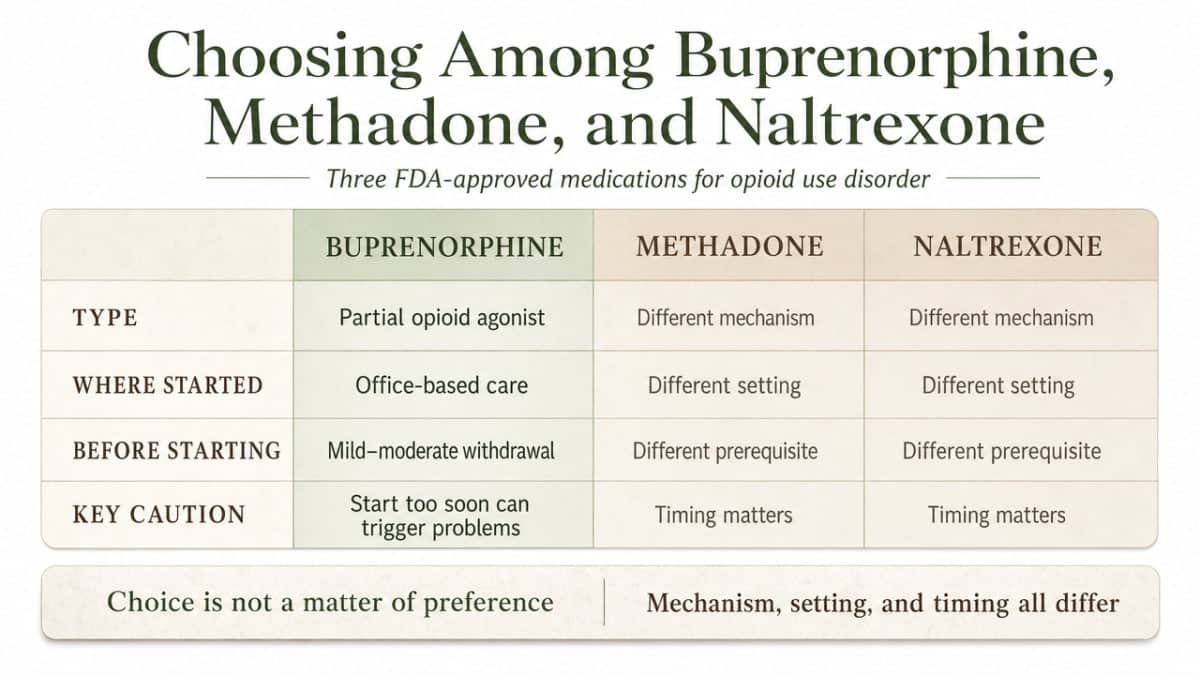
Three medications are FDA-approved to treat opioid use disorder: buprenorphine, methadone, and naltrexone 4. They are not equivalent, and the choice is not a matter of preference. Each has a different mechanism, a different setting requirement, and a different prerequisite before you can start. Understanding those trade-offs is how you avoid the two most common mistakes: starting the wrong medication, and starting the right one at the wrong time.
- Buprenorphine
- A partial opioid agonist. It occupies the same receptors hydrocodone hits, but with a ceiling effect that limits euphoria and respiratory depression. You can start it once you’re in mild-to-moderate withdrawal, usually 12 to 24 hours after your last dose of hydrocodone. It is prescribed in office-based settings by any DEA-registered clinician, which means it fits neatly into a professional life — monthly visits, standard pharmacy pickup, no daily clinic trips. The evidence is unambiguous on one point: buprenorphine works when it’s used long-term, not as a short taper 15. If a program pitches you a 30-day buprenorphine wash-out, that is not what the data supports.
- Methadone
- A full opioid agonist, dispensed only through federally regulated opioid treatment programs. It is highly effective, particularly for people with long histories or high tolerance, and outcomes are comparable to buprenorphine 15. The trade-off is logistics. Early treatment typically requires daily on-site dosing, which is difficult to hide from a spouse, a partner at your firm, or a licensing board. For most professional men with a hydrocodone-only history and preserved daily function, buprenorphine is the more practical starting point.
- Naltrexone
- Different in kind. It is not an opioid at all. It is an opioid antagonist — it blocks the receptors so hydrocodone can’t produce an effect. The extended-release injectable form is given once monthly. The prerequisite is where men get tripped up: you must be 7 to 10 days fully opioid-free before your first dose, or you will be thrown into precipitated withdrawal that is more severe than what you just came through 15. That gap is why naltrexone is often started after residential detox, when you’ve been supervised through the required abstinence window in a controlled setting.
The honest framing: methadone, buprenorphine, and naltrexone all improve outcomes for people addicted to prescription opioids 6. The right one for you is the one you can actually stay on. Fit is decided by your dosing history, your work schedule, your privacy constraints, and your willingness to sit through the abstinence window naltrexone requires. Any clinician who hands you a single option without explaining the other two is skipping the conversation you deserve.
Residential Therapy: Structure Without the Rehab Theater
If your image of residential treatment comes from movies or a nephew’s stint at 22, set it aside. The version built for a 48-year-old attorney or surgeon does not involve trust falls, name tags, or a group leader asking you to describe your feelings as a color.
What it does involve is structure. A residential program is a full-time environment designed to remove the ambient noise — the phone, the deadlines, the pill bottle in the nightstand — so the clinical work can actually happen 5. Days have a spine: medical rounds, individual therapy, group sessions, physical activity, meals on a schedule, sleep on a schedule. The point of the routine is not discipline for its own sake. It is that opioid use disorder disrupts sleep, appetite, and stress regulation at a physiological level, and those systems need a predictable environment to reset.
Inside that structure, the therapy is where the recalibration happens. Cognitive behavioral therapy targets the specific cue-response loops that drove you back to the bottle at 4 p.m. every day. Motivational interviewing works on the ambivalence you’re probably still carrying into week two. If untreated pain, depression, or anxiety showed up in your assessment, those are treated concurrently — not deferred until you finish some other phase.
The critical detail: MOUD stays running throughout. Residential settings historically treated medications and abstinence as competing philosophies, and that framing hurt outcomes. Current federal guidance is explicit that medication for opioid use disorder should be integrated with residential treatment, and patients in these settings should have access to buprenorphine, methadone, or naltrexone 8. If a residential program tells you their approach is to taper you off buprenorphine before discharge, you are hearing outdated practice, not clinical judgment.
Inpatient vs. Outpatient: The Setting Question, Answered Honestly
You will hear people argue this like it’s a moral question. It isn’t. It’s a fit question, and the honest answer is that setting matters less than what you’re linked to inside it.
Federal research is actively examining whether inpatient versus outpatient care produces different outcomes for opioid use disorder, and the framing itself is instructive: the assumption that residential is automatically better than office-based care is not settled science 14. What is settled is that any setting only works if it connects you to medication for opioid use disorder and keeps you connected 14.
Residential makes sense when the pill bottle is still in your house, when the people around you don’t know what’s happening, when withdrawal has already failed twice at home, or when your daily environment is the trigger. It gives you a full-time supportive setting without the distractions and temptations that pulled you back before 5. For a professional man juggling a caseload, a practice, or a crew, the removal of decision-making bandwidth is often the therapeutic ingredient, not a luxury.
Outpatient MOUD makes sense when your home is stable, when a spouse or partner is informed and supportive, when your work can be structured around appointments, and when you can start buprenorphine and hold the dose while continuing to function. It is not a lesser option. It is a different tool.
The wrong question is which setting is superior. The right question is: which setting gets me on the right medication and keeps me in therapy for the next year? Pick for that.
Continuing Care and the Return to Work
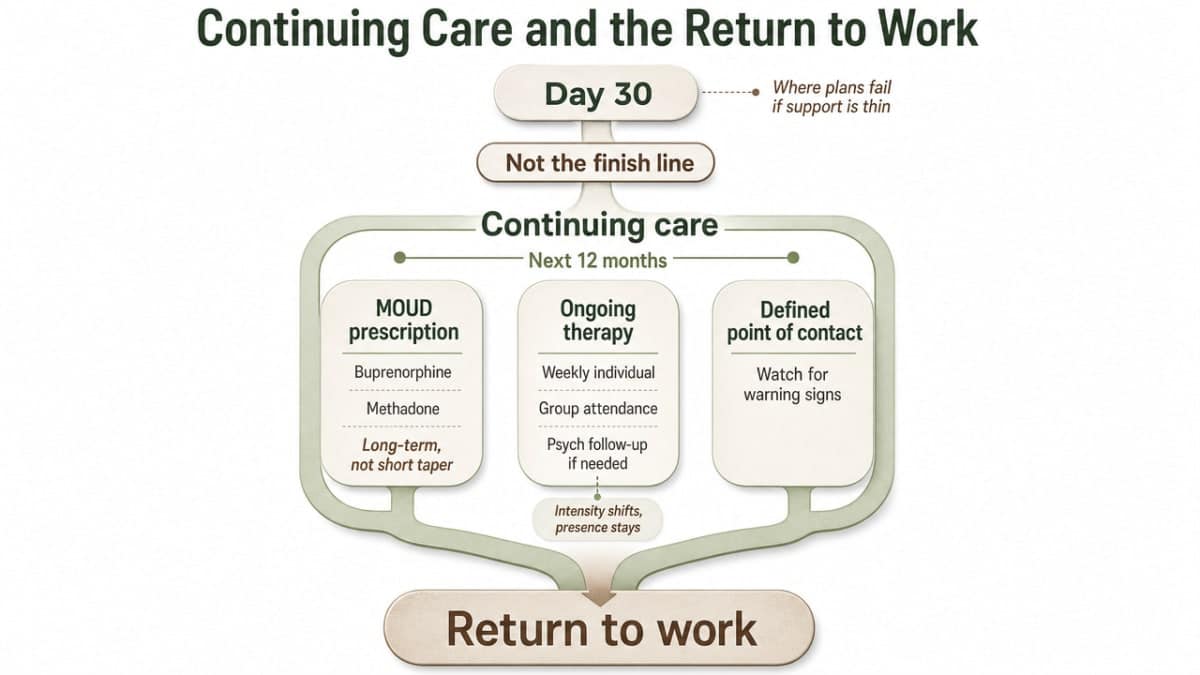
Day 30 is not the finish line. It is the point where most of the failure modes show up if the plan behind it is thin.
Continuing care is the part of the pathway that decides whether the first month holds. Practically, it means three things running in parallel for the next twelve months:
- Your MOUD prescription
- Ongoing therapy
- A defined point of contact who is watching for warning signs before you are
Buprenorphine and methadone are most effective when used long-term, not as a short taper, so if your discharge plan includes a countdown to being “off” medication, ask why 15. The evidence points the other direction.
Therapy shifts in intensity but not in presence. Weekly individual sessions, a group you actually show up to, and a psychiatric follow-up if depression or anxiety was part of the picture. Peer support — whether that is a 12-step room, a physician health program group, or a professionals-focused meeting — is where the isolation gets addressed. You do not have to love it. You do have to use it.
The return to work is a phased conversation, not a single day. Some men go back on a modified schedule during outpatient care after residential discharge. Others use accrued leave to complete the intensive phase and return at full capacity. What matters is that your treatment team knows your work environment and that your prescribing clinician stays constant across the transition. Arkansas state rule frames the goal of opioid treatment as total rehabilitation of the client, and that framing is worth holding onto 13. Not detox. Not thirty days. Rehabilitation, meaning you get your life back — the job, the marriage, the license, the standing — with the underlying disorder actively treated in the background.
If a program cannot tell you who is managing month six, you are not looking at continuing care. You are looking at a discharge.
The Arkansas Regulatory Layer You Should Know About
If you’re being treated in Arkansas, a few state rules quietly shape what your care looks like. You don’t need to memorize them. You should know they exist so you can recognize a program that’s operating inside them.
Hydrocodone is a Schedule II controlled substance in Arkansas, listed by the Department of Health under code 9193 10. That classification is why refills are restricted, why prescriptions require specific documentation, and why any legitimate program treats your prescribing history as a controlled clinical record, not a talking point.
Prescribing authority extends to physicians and to advanced practice registered nurses with DEA registration and the appropriate protocol 12. In practice, that means the clinician managing your buprenorphine or naltrexone in Arkansas may be an APRN working within a physician-led protocol — and that arrangement is standard, not a downgrade. Arkansas rule also requires that when opioids are prescribed at 50 morphine milligram equivalents per day or higher, or to patients with a history of opioid use disorder or overdose, the prescriber must provide a prescription for an opioid antagonist — naloxone 9. If you’re leaving a program, that naloxone script should be in your hand.
Two more items worth knowing. Arkansas Medicaid places extended-release hydrocodone formulations under prior authorization as non-preferred agents, which affects access to Zohydro ER and Hysingla ER 11. And state rule frames the explicit goal of opioid treatment as “total rehabilitation of the client” — not stabilization, not detox completion, but rehabilitation 13. Hold your program to that standard.
What This Costs You Professionally — and What It Doesn’t
Here is the concern you have not said out loud: if you step out for treatment, what happens to the practice, the case load, the crew, the license, the marriage.
The honest answer has two parts. The first: a residential stay long enough to cover medically supervised withdrawal and the intensive phase of therapy typically fits inside the same job-protected leave window most professionals already have available for a surgery or a family medical event. You are not disappearing for a year. You are stepping out for a defined block, in a full-time supportive setting, so the clinical work can happen without the phone in your hand 5.
The second: what actually costs you professionally is not treatment. It is the trajectory you are on without it. A missed refill window at the wrong meeting. A tolerance-crash overdose in the weeks after a self-attempted taper — the statistically most dangerous window in opioid use disorder. A licensing board that finds out from someone other than you.
Treatment, structured correctly and linked to long-term medication for opioid use disorder, is what keeps the career intact 2. Arkansas rule frames the goal explicitly as total rehabilitation of the client — not stabilization, not a clean detox, but the return of your standing and function 13. That is the outcome you are buying. Ask any program you evaluate to describe it in exactly those terms.
Frequently Asked Questions
How long does hydrocodone addiction treatment take?
The acute physical withdrawal from hydrocodone typically resolves within five to seven days in a supervised setting 7. The intensive phase of residential or outpatient therapy usually runs 30 to 90 days. Medication for opioid use disorder is a longer commitment — buprenorphine and methadone are most effective when used long-term, not as a short taper 15. Plan for months of active treatment, not weeks.
Can I keep my job while getting treatment for hydrocodone dependence?
Yes, in most cases. A residential stay covering supervised withdrawal and intensive therapy typically fits inside the same job-protected leave window you’d use for a surgery. Inpatient rehabilitation provides a full-time supportive environment without daily distractions 5. After discharge, buprenorphine can be prescribed in office-based settings by any DEA-registered clinician 4, which fits monthly follow-ups into a normal work schedule without daily clinic visits.
Is medically supervised detox enough on its own?
No. The CDC is explicit: detoxification without medications for opioid use disorder is not recommended because it raises your risk of resuming use, overdose, and overdose death 2. Tolerance drops fast after detox, so returning to a previous dose can be fatal. SAMHSA frames detox as an entry point into ongoing treatment, not a standalone intervention 7. Any program that markets detox as a complete solution is selling you a partial one.
Which medication for opioid use disorder is right for hydrocodone addiction?
All three FDA-approved options — buprenorphine, methadone, and naltrexone — improve outcomes for prescription opioid addiction 6. For most professional men with a hydrocodone-only history and preserved function, buprenorphine offers the best combination of effectiveness and office-based logistics 15. Naltrexone requires 7 to 10 days fully opioid-free before your first dose 15, which is why it’s often started after residential detox rather than at home.
Do I need residential treatment, or will outpatient care work?
Setting matters less than linkage to medication and therapy. Federal research is still examining whether inpatient produces better outcomes than outpatient for opioid use disorder 14. Residential makes sense when your home environment is a trigger, when self-directed attempts have failed, or when you need full-time structure away from work pressure 5. Outpatient buprenorphine works when home is stable and your schedule can accommodate regular appointments.
Will my employer or licensing board find out I went to treatment?
Medical treatment records are protected under federal privacy law, and substance use treatment records carry additional protections under 42 CFR Part 2. Most professionals use accrued medical leave without disclosing the specific diagnosis. Licensing boards generally require self-reporting only under specific circumstances that vary by profession and state. The greater professional risk is usually the trajectory without treatment — a missed refill, a tolerance-crash overdose, a colleague who notices first.
References
- Hydrocodone – StatPearls – NCBI Bookshelf. https://www.ncbi.nlm.nih.gov/books/NBK537288/
- Opioid Use Disorder: Treating | Overdose Prevention. https://www.cdc.gov/overdose-prevention/hcp/clinical-care/opioid-use-disorder-treating.html
- CDC Clinical Practice Guideline for Prescribing Opioids for Pain — United States, 2022. https://www.cdc.gov/mmwr/volumes/71/rr/rr7103a1.htm
- Guideline Recommendations and Guiding Principles. https://www.cdc.gov/overdose-prevention/hcp/clinical-guidance/recommendations-and-principles.html
- Treatment of Opioid Use Disorder | Overdose Prevention. https://www.cdc.gov/overdose-prevention/treatment/opioid-use-disorder.html
- Reducing the Risks of Relief — The CDC’s Opioid-Prescribing Guideline. https://pmc.ncbi.nlm.nih.gov/articles/PMC4852278/
- Detoxification and Substance Abuse Treatment. https://www.ncbi.nlm.nih.gov/books/NBK64115/
- Medications for Opioid Use Disorder — Executive Summary (SAMHSA TIP 63). https://www.ncbi.nlm.nih.gov/sites/books/NBK574916/
- 17 CAR § 123-604. Prescribing privileges – Code of Arkansas Rules. https://codeofarrules.arkansas.gov/Rules/Rule?levelType=section&titleID=17&chapterID=85&subChapterID=110&partID=1158&subPartID=6329§ionID=41315
- Controlled-Substances-List-7.3.25.pdf. https://healthy.arkansas.gov/wp-content/uploads/Controlled-Substances-List-7.3.25.pdf
- AR Medicaid Prior Authorization Edits approved at the AR …. https://humanservices.arkansas.gov/wp-content/uploads/PharmMemo-5-14-25.pdf
- Prescribing-Authority-in-Arkansas.pdf. https://healthy.arkansas.gov/wp-content/uploads/Prescribing-Authority-in-Arkansas.pdf
- 20 CAR § 433-323. Opioid treatment – Code of Arkansas Rules. https://codeofarrules.arkansas.gov/Rules/Rule?levelType=section&titleID=20&chapterID=128&subChapterID=170&partID=666&subPartID=3988§ionID=24551
- Inpatient versus Outpatient Treatment Outcomes for People with Opioid Use Disorder (NIH HEAL Initiative). https://nida.nih.gov/about-nida/organization/cctn/ctn/research-studies/inpatient-versus-outpatient-treatment-outcomes-people-opioid-use-disorder-nih-heal-initiative
- Linking People with Opioid Use Disorder to Medication Treatment: A Technical Package of Strategies. https://stacks.cdc.gov/view/cdc/119464/cdc_119464_DS1.pdf