
Medical Detox in Little Rock, AR: A Guide to Safe Care
Key Takeaways
- Medical detox in Little Rock pairs round-the-clock monitoring with medications that ease withdrawal symptoms and prevent complications like seizures, blood pressure spikes, and dangerous dehydration during the first 72 hours.
- For opioid use disorder, detox alone is not recommended because tolerance drops quickly and overdose risk rises after discharge — a safe plan includes ongoing medication, counseling, and naloxone 1.
- Arkansas Medicaid removed prior authorization barriers for Suboxone film and buprenorphine tablets effective January 1, 2020, so day-one medication is possible without waiting on payer paperwork 6, 7.
- Before choosing a program, ask whether they admit today, start medication on day one, accept your insurance, and send you home with naloxone and a scheduled follow-up appointment.
What Withdrawal Actually Feels Like — And Why Supervision Changes It
If you are reading this at 2 a.m. with your skin crawling and your stomach turning, you already know what withdrawal feels like. You do not need a clinical definition. You need someone to tell you the truth about what is happening in your body — and what changes when a medical team is standing between you and the worst of it.
Here is the honest picture. Around hour 6 to 12 after your last drink or dose, the sweating starts. Your hands shake. Your heart speeds up for no reason. You cannot get comfortable, and sleep is gone. By hour 24, the nausea is constant. Muscles ache in places you did not know had muscles. You feel wired and exhausted at the same time. For some people — especially those coming off alcohol or benzodiazepines — this is also when seizures become a real risk. For opioids, the vomiting, diarrhea, and bone-deep restlessness peak somewhere between hour 36 and hour 72.
None of that is weakness. That is your nervous system re-learning how to work without a substance it had adapted to.
Medical supervision does not erase withdrawal. It does something more important: it makes withdrawal survivable and, in most cases, far less brutal. A clinician takes your vitals on a schedule. Medications are given to blunt the worst symptoms — trembling, blood pressure spikes, agitation, cravings. Fluids go in when you cannot keep water down. Someone is watching for the complications that kill people who try this alone at home.
You are not failing at quitting. You are asking the right question: how do I get through this without dying or giving up? The answer is you do not do it by yourself.
The First 72 Hours Inside a Medical Detox
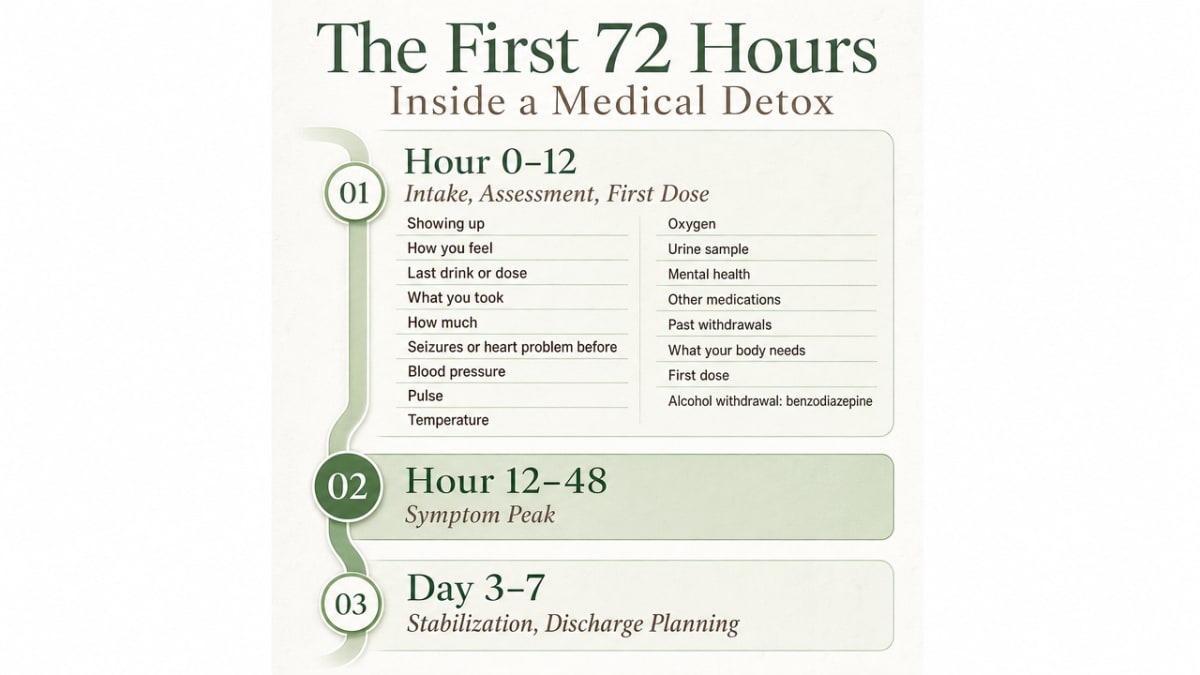
Hour 0 to Hour 12: Intake, Assessment, and the First Dose
You walk in. Maybe someone drives you. Maybe you called from the parking lot before you could change your mind. Either way, showing up is the hardest part, and you already did it.
The first thing that happens is not paperwork. It is a person asking how you feel, how long since your last drink or dose, what you took, how much, and whether you have had seizures or a heart problem before. This is the medical assessment. A nurse takes your blood pressure, pulse, temperature, and oxygen. You give a urine sample. You answer questions about mental health, other medications, and past withdrawals. None of it is a test. It is how the team figures out exactly what your body needs in the next few hours.
Then comes the first dose. For alcohol withdrawal, that usually means a benzodiazepine to quiet the nervous system and prevent seizures. For opioids, it may mean buprenorphine once you show early withdrawal symptoms, along with medications for nausea, cramping, and sleep. You get water. You get a bed. Someone checks on you every few hours through the night.
You may not sleep much. That is expected. What matters is that you are being watched by people who know what to do if something changes.
Hour 12 to Hour 48: When Symptoms Peak
This is the stretch you were most afraid of. It is also the stretch medical supervision was built for.
Somewhere between hour 12 and hour 48, symptoms climb. Your pulse may run high. You sweat through the sheets. Your legs will not stay still. Anxiety comes in waves that feel like they will not end. For opioid withdrawal, the gut symptoms hit hardest here. For alcohol, this is the window where blood pressure can spike and, without medication, seizures become a real risk. The staff is not surprised by any of it. They are watching for it.
Vitals get checked more often. Doses get adjusted. If a medication is not holding your symptoms, they change it. Fluids go in. Something for nausea. Something for the muscle pain. If you cannot sleep, they help with that too. You are not asking for too much. You are letting the treatment do what it is designed to do.
Getting through hour 48 is a real thing. It counts. Say it out loud if you have to.
Day 3 to Day 7: Stabilization and Planning What Comes Next
By day three, something shifts. Not everything gets easier at once, but the worst of the physical storm starts to break. You keep food down. You sleep for a few hours in a row. Your hands are steadier. The medication team is fine-tuning doses now instead of chasing symptoms.
This is when the conversation changes. The clinical staff starts talking with you about what happens after. That is not a rushed discharge. It is the most important part of your stay. Detox stabilizes your body. It does not, by itself, treat the reason you are here. CDC guidance is clear that medications for opioid use disorder, counseling, and continuing care need to be lined up before you leave, not after 1.
Practical things get sorted. Whether you continue on buprenorphine or another medication. Whether you step into residential treatment, an outpatient program, or a structured aftercare plan. Who your outside contacts will be. Whether your family needs to be part of the plan. Whether naloxone goes home with you.
You may feel raw. You may feel unsure whether you can do the next part. Both are normal. What you have already done — sitting through the first 72 hours in a bed instead of alone on a bathroom floor — is not small. It is the ground the next step is built on.
Why Detox Alone Is Not Enough for Opioid Use Disorder
Here is the hardest thing to hear when you are exhausted and just want the sickness to stop: getting through detox is not the finish line. If opioids are what brought you in, detox by itself is the most dangerous plan you could pick.
The CDC is direct about this. Detoxification on its own, without medications for opioid use disorder, is not recommended, because it increases the risk of resumed use, overdose, and overdose death after discharge 1. That is not a scare tactic. It is what the data has been saying for years. Your body loses its tolerance in a matter of days. If you use again at the amount you were using before, the dose that used to get you through a morning can stop your breathing.
This is why the honest version of medical detox looks different from the movie version. It is not a week of white-knuckling in a bed and then a handshake at the door. Detox alone leaves the biggest pieces unaddressed: the cravings that come back at week two, the wiring in your brain that still expects opioids, the triggers waiting at home, the friend who still has your number. A full pathway keeps a medication like buprenorphine or naltrexone going after discharge, connects you to counseling, plans for housing and work, and puts naloxone in the hands of the people around you 1.
You are not signing up for the rest of your life in one conversation. You are agreeing to not walk out into the most dangerous window alone. That is a real distinction, and it is worth saying out loud when the staff brings up what comes after day seven.
If a program you are calling only offers detox and nothing after it, ask directly: what medication will I leave on, and who will I see next week? A safe answer to that question is the difference between stabilization and a coin flip.
Where Arkansas Stands Right Now
If it feels like the whole state is quietly drowning, you are not making that up. But something did shift, and it is worth knowing while you decide what to do next.
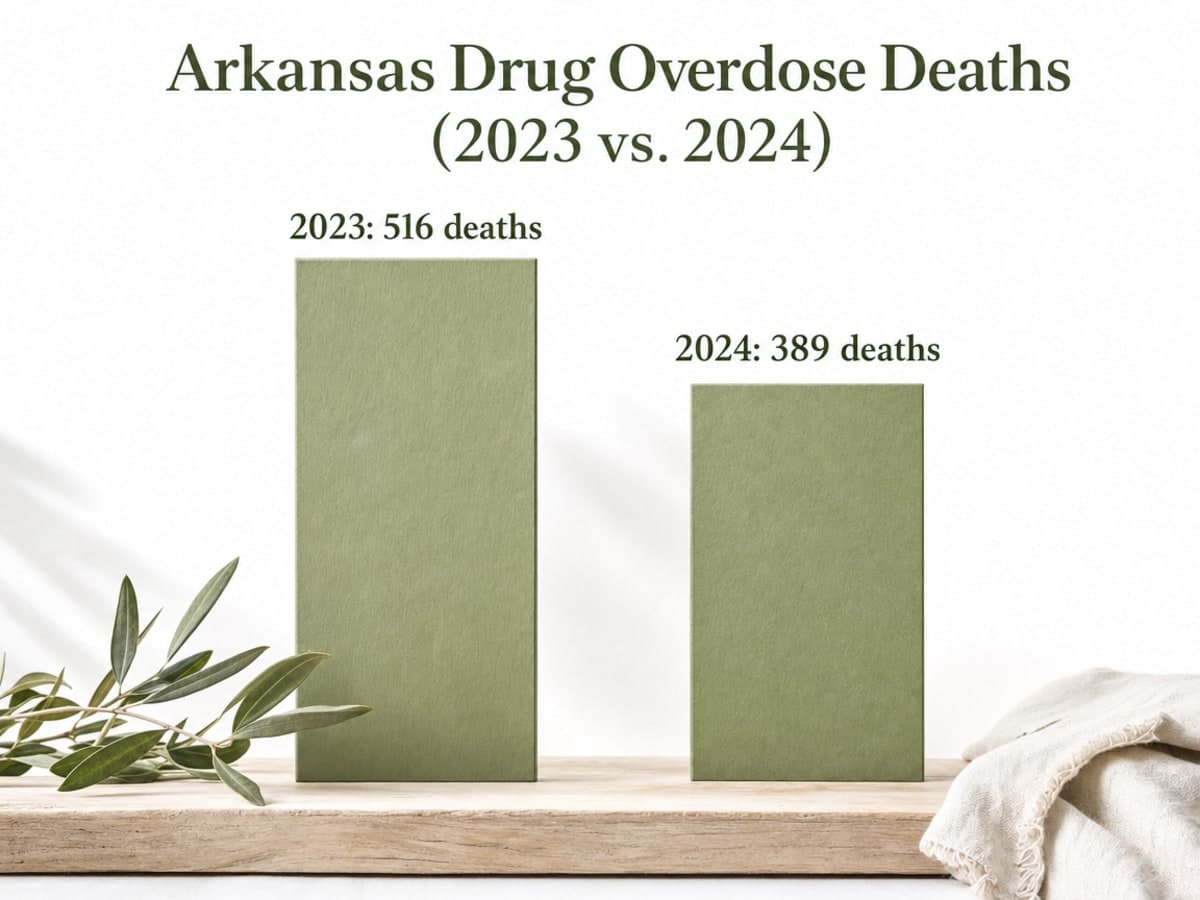
Provisional data from the Arkansas Department of Health shows 389 drug overdose deaths in Arkansas in 2024, down from 516 in 2023 5. That is a state-level count of drug overdose deaths, and the 2024 number is still provisional, meaning it can move slightly as records are finalized. It is not a victory lap. Every one of those numbers was a person, and the total is still too high. But a drop of 127 deaths in one year is not noise. It is real people who were still here at the end of 2024 who might not have been.
Some of that shift is naloxone in more hands. Some of it is fentanyl test strips. Some of it is Medicaid rules that made medication for opioid use disorder easier to start. And some of it is people like you — men who were exhausted at 2 a.m., who picked up the phone, who walked into a medical detox instead of trying to ride it out on a bathroom floor.
Arkansas is not alone in this fight. CDC tracks state-level overdose mortality across the country, and the pattern of harm — and of slow, uneven recovery — shows up in most states, not just this one 8. That matters because the shame you might be feeling is not a personal defect. It is a public health problem with a medical answer.
What the number really tells you is this: the direction can change. Yours can too. Getting into supervised care is not a small gesture against a big problem. It is part of the reason the graph is moving the way it is.
How Arkansas Access Rules Affect How Fast You Can Start Medication
Here is something most people never hear until they are already in the middle of it: in some states, the medication that quiets opioid withdrawal has to wait for a payer approval that can take days. In Arkansas, that specific delay was pulled out of the way.
In 2019, the state passed Act 964. Arkansas Medicaid then put rules in place, effective January 1, 2020, that prohibit prior authorization barriers for certain FDA-approved medications for opioid addiction treatment when used in line with SAMHSA guidelines 6. In plain terms, Suboxone film and buprenorphine tablets were moved off the prior authorization list for Medicaid patients 7. That means when the medical team decides it is time to start you on buprenorphine, they do not have to stop and fax a form and wait for a call back before you get your first dose.
Why does that matter to you at hour 24, sweating and sick? Because time is the whole point. The sooner medication is on board, the sooner the worst symptoms ease, and the less likely you are to walk out looking for relief the wrong way.
A few things to ask when you call a program:
- Do you accept Arkansas Medicaid, and do you start medication on day one?
- What medication will I likely leave on, and who prescribes it after discharge?
- If I have private insurance or no insurance, what are my options?
You do not need to know the statute numbers. You just need to know that in this state, the door to medication is closer than it used to be.
What to Bring and What to Expect on Day One
You do not need to pack like you are moving out. You need enough to be comfortable for a few days while the medical team handles the rest. Keep it simple. If you are already sick, ask someone else to gather this while you rest.
What to bring:
- A photo ID and your insurance card, if you have them. If you do not, come anyway.
- A current list of medications you take, including doses. A photo of the pill bottles on your phone works.
- Five to seven days of comfortable clothes. Sweatpants, t-shirts, a hoodie, socks, slip-on shoes. You will sweat. You will change often.
- Toiletries without alcohol in the ingredients. Toothbrush, deodorant, shampoo.
- A phone charger. One book if reading helps you.
- Emergency contact numbers written on paper, in case your phone is stored during intake.
What to leave at home: your stash, mouthwash with alcohol, anything sharp, and the pressure to have this figured out before you arrive.
Day one is quieter than you expect. A nurse takes your vitals. You answer questions. You get water, medication, a bed. You are allowed to sleep. You are allowed to cry. You are allowed to not know yet what happens next. Showing up was the decision. The team takes it from there.
After Detox: The Safety Window Nobody Talks About
Here is the part nobody wants to say out loud, so you should hear it now while you are still inside a place that can help: the days right after you leave detox are the most dangerous days of this whole thing. Not because you failed. Because your body changed.
In five to seven days, your tolerance drops fast. The amount you were using before detox is not the amount your body can handle now. If you use again at your old dose, breathing can stop. That is why the CDC is direct that detoxification on its own, without medications for opioid use disorder, is not recommended — the risk of overdose and overdose death goes up in the window after discharge 1. That risk is not theoretical. It is the reason discharge planning exists.
Two things make that window survivable. First, leaving on medication and with a real next appointment already on the calendar — a prescriber, a counselor, a residential bed, an outpatient program. Something scheduled, not something you are supposed to figure out on Tuesday. Second, naloxone. CDC recommends offering naloxone to patients at increased risk of opioid overdose, and that includes people leaving treatment 4. It should go home with you, and the people who live with you should know where it is and how to use it 2. Naloxone can restore breathing in an opioid overdose within a few minutes, and it is available over the counter 3.
Ask for it before you walk out. Ask twice if you have to. Put it in the same drawer as your phone charger. Tell one person in your life it is there.
This is not a lack of trust in yourself. It is the same reason a house has smoke alarms. You do not plan on the fire. You just do not want to be alone if there is one.
For the Family Member Reading This Instead
If you are the one reading this at 2 a.m. — the wife, the mother, the sister, the grown son — while he sleeps in the next room or does not answer his phone, this part is for you.
You are exhausted. You have been carrying something heavy for a long time, and you probably feel a mix of love, fear, and anger that no one warned you would live in the same body at the same time. All of that is normal. None of it means you are handling this wrong.
Here is what actually helps right now. Do not wait for him to hit some imaginary bottom. Bottoms in this disease are often overdoses. If he says yes tonight, or even a soft maybe, call a medical detox program with him in the room. Let the intake nurse ask the medical questions — she has done this thousands of times, and he will answer her differently than he answers you.
Once he is admitted, ask the discharge planner three things before he comes home. What medication will he leave on. Who is his first appointment with, and when. Whether naloxone is going home with him and where you should keep it 4, 2. Naloxone can restore breathing within a few minutes during an opioid overdose, and it is available over the counter now 3. Put it somewhere you both can reach.
You are not overreacting. You are the reason he is still here to read the next page.
How to Ask for Help Today
You do not need a script. You do not need to know what to say. You just need to make the call.
If you can, use these words:“I need medical detox. When can I be admitted?”That is enough. The person on the other end will take it from there. They will ask about what you have been using, how much, and when you last used. Answer honestly. Nobody on that line is going to be shocked, and nothing you say will change whether they help you.
If you are steady enough to make one call, ask three things:
- Can you admit me today or tomorrow?
- Do you start medication on day one?
- What does aftercare look like when I leave?
You have been carrying this alone for a long time. You do not have to carry the next part. Pick up the phone.
Frequently Asked Questions
How long does medical detox in Little Rock usually take?
Most medical detox stays run about five to seven days, depending on what you were using, how much, and how your body is responding to medication. Alcohol and benzodiazepine withdrawal often needs the full week. Opioid detox can be shorter in days but longer in the tail of symptoms. The clinical team adjusts based on your vitals and symptoms, not a fixed timer. Detox is the first step, not the whole plan 1.
Is medical detox covered by Arkansas Medicaid?
Arkansas Medicaid covers behavioral health services, and medication-assisted treatment access improved after Act 964 took effect. Effective January 1, 2020, Arkansas Medicaid removed prior authorization barriers for certain FDA-approved medications for opioid addiction treatment when used in line with SAMHSA guidelines, including Suboxone film and buprenorphine tablets 6, 7. When you call a program, ask specifically whether they accept Medicaid and start medication on day one.
Can I start buprenorphine or Suboxone right away in Arkansas?
In most cases, yes. Under Arkansas Medicaid policy, Suboxone film and buprenorphine tablets were moved off the prior authorization list, so the medical team does not have to wait on payer paperwork to start you 7. Timing still depends on how far into withdrawal you are — buprenorphine works best once early opioid withdrawal symptoms are present. The clinician will decide the right moment based on your assessment.
What happens if I try to detox at home instead?
Alcohol and benzodiazepine withdrawal can cause seizures and dangerous blood pressure spikes without medication. Opioid withdrawal is rarely fatal on its own, but the danger comes after: tolerance drops in a few days, and using again at your old dose can stop your breathing. CDC guidance is direct that detox alone, without medications for opioid use disorder, is not recommended because of the higher risk of overdose and overdose death 1.
What should my family do to keep me safe after I leave detox?
Ask the discharge planner for naloxone before he walks out the door. CDC recommends offering naloxone to patients at increased risk of opioid overdose, which includes people just leaving treatment 4, 2. Keep it somewhere both of you can reach, and learn how to use it. Naloxone can restore breathing within two to three minutes during an opioid overdose and is available over the counter 3. Make sure the first follow-up appointment is already scheduled.
Can I go to detox if I have a job, kids, or no place to stay?
Yes. Family Medical Leave protections cover many workers seeking treatment, and intake staff can help you think through what to tell an employer without oversharing. If housing is unstable, say so during the intake call — programs often coordinate with residential treatment or sober living for the step after detox. Not having your life sorted is not a disqualifier. Showing up sick and unsure is exactly who these programs were built for.
References
- Opioid Use Disorder: Treating. https://www.cdc.gov/overdose-prevention/hcp/clinical-care/opioid-use-disorder-treating.html
- Naloxone Toolkit. https://www.cdc.gov/overdose-prevention/hcp/toolkits/naloxone.html
- Lifesaving Naloxone. https://www.cdc.gov/stop-overdose/caring/naloxone.html
- When to Offer Naloxone to Patients. https://www.cdc.gov/overdose-prevention/media/pdfs/2024/07/Fact-Sheet-When-to-Offer-Naloxone-to-Patients.pdf
- Substance Misuse Education and Prevention – Arkansas Department of Health. https://healthy.arkansas.gov/programs-services/prevention-healthy-living/substance-misuse-education-and-prevention/
- AR SPA 20-0013 Approval Package.pdf. https://www.medicaid.gov/medicaid/spa/downloads/AR-20-0013.pdf
- MAT memorandum – Arkansas Department of Human Services. https://humanservices.arkansas.gov/wp-content/uploads/MATmemo.doc
- Drug Overdose Mortality | Stats of the States. https://www.cdc.gov/nchs/state-stats/deaths/drug-overdose.html
- International Overdose Awareness Day (IOAD) Toolkit. https://www.cdc.gov/overdose-prevention/php/toolkits/ioad.html