
Does IOP Rehab Allow You to Keep Your Job?
Key Takeaways
- IOP is structurally designed to protect employment through evening or early-morning sessions, but keeping your job depends on schedule fit, correct use of FMLA and ADA, and honest clinical matching.
- Nine hours of weekly clinical contact is only the visible ask — budget 15 to 20 hours once you add commute, homework, outside meetings, and medication management 6.
- Starting at the wrong level of care usually costs more work time, not less; daily use with withdrawal, triggering home environments, or opiate involvement often warrants detox or residential before stepping down to IOP 5.
- Before enrolling, make three calls: a clinical assessment across levels of care, your licensing board’s assistance program or an employment attorney, and the person at home who needs to know.
The Real Question Behind “Can I Keep My Job?”
You already know something has to change. What you don’t know is whether getting help means losing the career you spent twenty years building. That fear is legitimate, and pretending otherwise would waste your time.
Here’s the honest answer: intensive outpatient programs are specifically built so you can keep working. IOP means treatment on evenings or early mornings, at home each night, no residential stay. Federal guidance describes outpatient care as suitable for people who are motivated and can maintain regular employment 5. So yes, the structural design is on your side.
But work-compatible is not work-invisible. Keeping your job through IOP depends on three things you actually control: whether the program’s schedule fits your real week, whether you use FMLA and ADA correctly so a medical leave is job-protected rather than a disclosure event, and whether you’re honest with your clinician about whether IOP is the right starting point or you need a residential stabilization first.
The better question isn’t “Will treatment cost me my career?” It’s “How do I sequence this so my career and my recovery both survive?” That’s what the rest of this guide walks you through — schedule, law, disclosure, clinical fit, and what finishing actually requires.
What IOP Actually Demands of Your Week
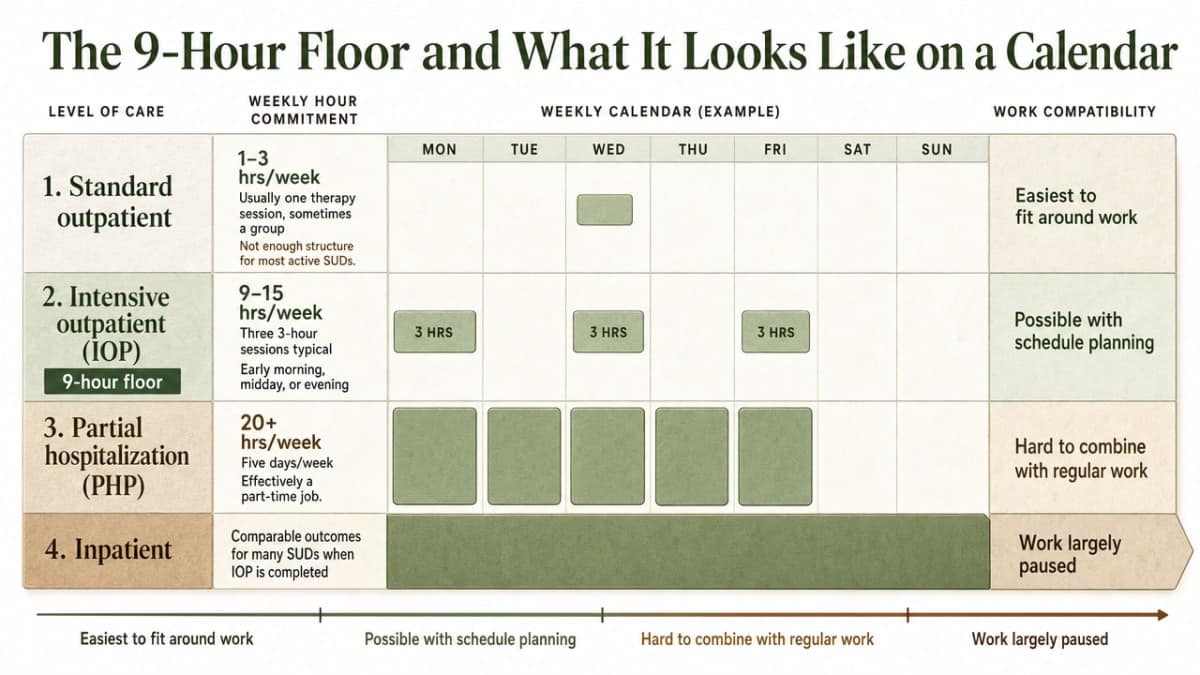
The 9-Hour Floor and What It Looks Like on a Calendar
Before you can decide whether IOP fits your life, you need to see the number on a calendar. SAMHSA’s benchmark is a minimum of nine hours per week of clinical contact, and the evidence base treats IOPs as roughly equivalent to inpatient care for many substance use disorders when patients complete the program 6. Nine hours is the floor. Many programs run twelve to fifteen.
Here is how that stacks up against the other levels of care you might be weighing:
- Standard outpatient: 1–3 hours per week. Usually one therapy session, sometimes a group. Not enough structure for most active SUDs.
- Intensive outpatient (IOP): 9–15 hours per week, typically three sessions of three hours each, often scheduled early morning, midday, or evening 6.
- Partial hospitalization (PHP): 20+ hours per week, five days a week. Effectively a part-time job. Not compatible with continuous employment.
- Residential: 24/7 clinical environment for 28–90 days. Requires a full leave of absence.
Most IOPs designed for working adults schedule sessions in three-hour blocks: Monday, Wednesday, and Thursday from 6:00 to 9:00 p.m., for example, sometimes with a Saturday morning group. Some offer an early-morning track — 6:00 to 9:00 a.m. — for people who bill hours during the day or run job sites. A midday track exists in a few markets but rarely works for professionals with client-facing calendars.
If your workweek routinely runs 50 to 60 hours, three evenings a week is a real ask — but a survivable one. It’s the difference between working late from home and not working at all, which is what residential requires.
The Hidden Hours: Homework, Meetings, and Recovery Time
The nine hours in the clinical schedule is not the whole ask. It’s the visible part.
Add the drive. If your program is thirty minutes each way, that’s another three hours a week. Add between-session assignments — reading, worksheets, journaling, relapse-prevention planning. Most programs expect two to four hours a week of that work, and clinicians can usually tell when you skipped it. Add outside recovery meetings. Many IOPs require or strongly encourage two to three 12-step or SMART Recovery meetings per week, which is another two to three hours. Add individual counseling, which sometimes sits outside the group hours. Add medication management appointments if you’re on MAT.
Look at your actual calendar for next week. If you can’t find those hours without stealing them from sleep or from your kids, that’s information. It doesn’t mean IOP is wrong for you. It means the schedule you’re currently running is.
Is IOP Clinically Right for You, or Do You Need Residential First?
When Outpatient Is the Wrong Starting Line
Here’s the part most articles about IOP will not tell you: sometimes the right answer for keeping your job is not IOP. It’s a short residential stay first, and then IOP.
NIDA is direct about this. Outpatient care is well-suited to people who are motivated and can maintain regular employment — but individuals with unstable living situations, high relapse risk, or serious co-occurring conditions may need residential care instead 5. Reading between the lines: keeping your job is not a clinical reason to start below the level of care you actually need.
A few honest signals that IOP is the wrong starting line for you right now:
- You drink or use daily, and stopping produces shaking, sweating, racing heart, or seizures. This is medical withdrawal. It needs supervised detox, not a Wednesday evening group.
- Your home is a trigger. Your partner drinks with you, the bottle is in the cabinet you walk past at 10 p.m., or your dealer lives eight minutes away. IOP sends you back into that environment every night.
- You’ve tried outpatient before and could not keep the streak. That’s data, not a character flaw.
- You are using opiates, benzodiazepines, or high-volume alcohol. The clinical stakes and the withdrawal profile change what “safe” looks like.
Starting in the wrong level of care usually costs you more work time, not less. A relapse in week two of IOP that pulls you into detox anyway means you burned two weeks of evenings, disclosed a leave to someone, and still ended up where you should have started. Get the assessment first, then match the schedule to the diagnosis — not the diagnosis to the schedule.
Honest Predictors That You Won’t Finish IOP
Completing IOP is not a formality. A significant share of people who start don’t finish, and researchers have identified who is most at risk of dropping out. Use this as a mirror, not a verdict.
A pilot study of a one-month SUD IOP found that dropout was associated with earlier age of substance-use onset, male gender, greater past-week use, opiate use, and higher overall SUD severity — and that measures of addiction severity predicted attrition more strongly than depression or anxiety did 4. Executive functioning problems were common in participants but were not the main driver of dropout. What pulled people out was how deep the use had gotten and how early it had started.
Read those predictors honestly against your own situation:
- Age of onset: If you were drinking heavily or using in high school, your relationship to substances is older than your career. That’s a longer groove to work against.
- Male gender: The population this article is written for. Not something to fix, something to know.
- Past-week use: How much did you actually drink or use in the last seven days? Not your average. Last week.
- SUD severity: How much has this cost you already — sleep, mornings, memory, a marriage, a case, a client?
- Opiate use: If opiates are in the picture, the withdrawal and craving profile changes the math on outpatient.
If you check three or more of these, that does not mean you are doomed. It means IOP alone, starting cold, may not hold you. The authors specifically suggested that brief motivational work — or, read more broadly, a higher initial level of care — before IOP may improve retention 4. Finishing matters, and the research is clear that graduates fare better than non-completers on relapse and other outcomes 8. Set yourself up to be a graduate, not a statistic.
Sequencing: Detox or Residential, Then Step Down to IOP
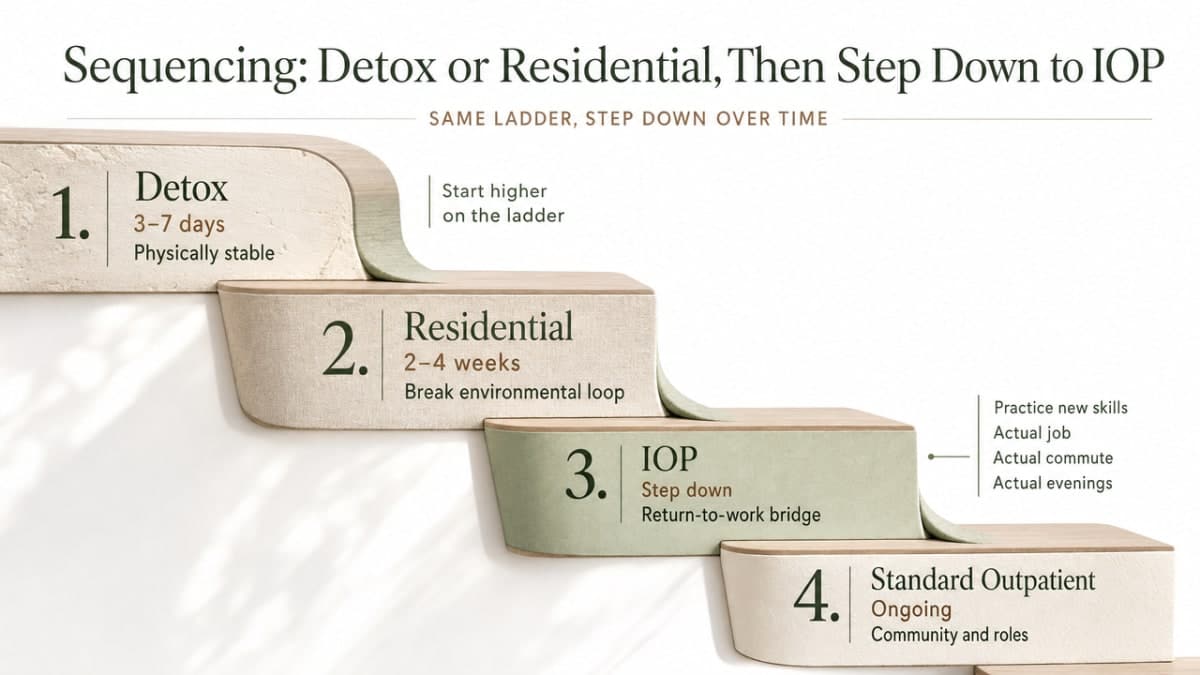
Treat this as a sequence, not a choice between camps. Detox, residential, IOP, and standard outpatient are rungs on the same ladder. Most professionals who need help start somewhere higher on the ladder and step down.
A common path looks like this: three to seven days of medically supervised detox to get you physically stable, then two to four weeks of residential care to break the environmental loop and get therapy started with your full attention on it, then a step down to IOP as the return-to-work bridge. IOP is designed to be a step-down level, giving you enough structure to keep practicing new skills while you re-enter the community and your roles 3.
The advantage of sequencing is that IOP does what it’s best at — letting you rehearse recovery inside your actual job, your actual commute, your actual evenings — after the acute risk is handled. You use FMLA once, for a defined block, and then return on a schedule that fits alongside work. That’s a cleaner story for your calendar, your family, and your clinician than starting at IOP, failing, and stacking a leave on top of a rough month at work.
Ask the assessing clinician one question directly: given my use pattern and my home, what level of care do I need to start at, and what’s the step-down plan? If they answer both parts, you’re in the right conversation.
FMLA, ADA, and What Your Employer Is Entitled to Know
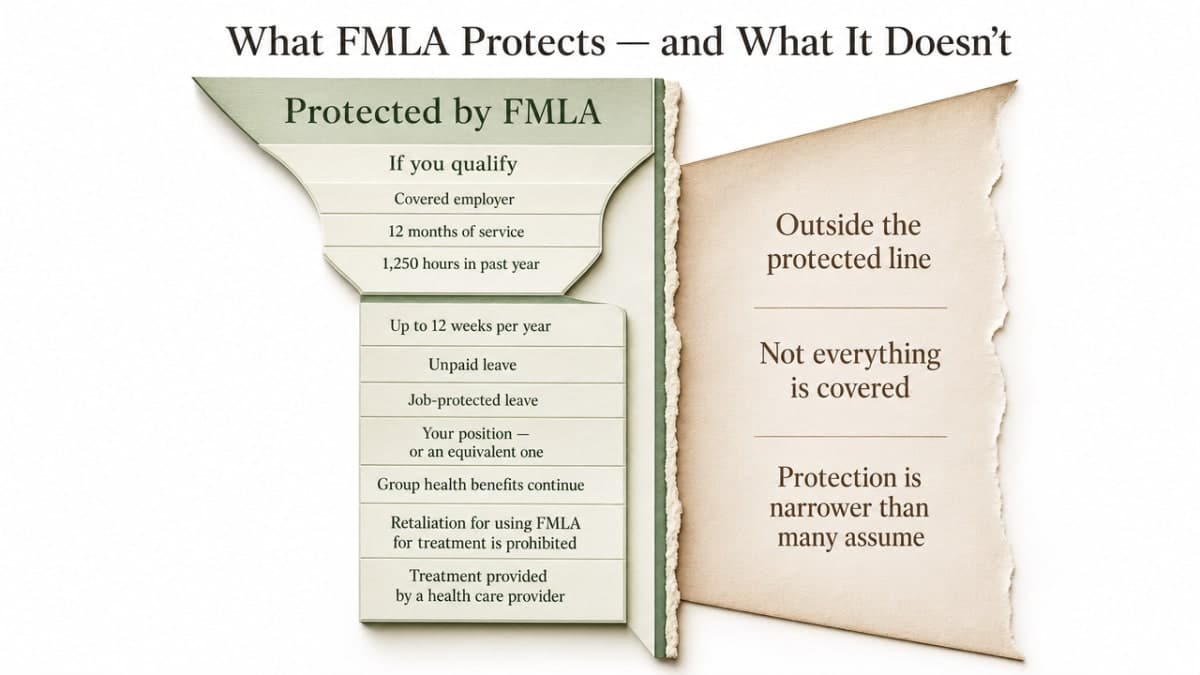
What FMLA Protects — and What It Doesn’t
The Family and Medical Leave Act is the single most useful tool you have for keeping your job through treatment — but only if you understand what it actually covers. Read this carefully, because the line between protected and not-protected is narrower than most people assume.
The Department of Labor is explicit: FMLA leave may be taken for substance abuse treatment provided by a health care provider, and an employer cannot take action against you for exercising that right 1. If you qualify for FMLA (a covered employer, twelve months of service, 1,250 hours worked in the past year), you get up to twelve weeks of job-protected, unpaid leave per year. Your position — or an equivalent one — is held. Your group health benefits continue. Retaliation for using FMLA to attend treatment is prohibited 1.
Here is where it gets sharper. FMLA covers treatment. It does not cover absences caused by active use. If you miss Tuesday because you were hungover, that Tuesday is not FMLA-protected — even if you start IOP on Wednesday 1. And FMLA does not override a neutral workplace substance-use policy. If your employer has a written policy that says a positive test or an on-the-job incident results in termination, that policy still applies. FMLA protects the treatment; it does not erase the conduct that preceded it 1.
What you tell HR to activate FMLA is narrow: that you have a serious health condition requiring treatment, the expected schedule (intermittent for IOP evenings, or a continuous block for detox and residential), and a certification from your health care provider on form WH-380-E. You do not have to specify the diagnosis. You do not have to name the substance. “Serious health condition under continuing treatment” is the standard phrasing on the form, and it is enough.
ADA, Reasonable Accommodations, and Neutral Discipline Policies
The Americans with Disabilities Act is the second layer. A substance use disorder in active recovery — meaning you are in treatment and no longer currently using illegal drugs — is generally a protected disability under the ADA. Current illegal drug use is not protected. Alcohol use disorder is treated somewhat differently: the condition itself can be a covered disability, but your employer can still hold you to the same performance and conduct standards as everyone else.
What the ADA gives you in practice is the right to request a reasonable accommodation. For a professional in IOP, that usually looks small and specific: a modified schedule so you can leave by 5:30 on session nights, permission to take a longer lunch for a midday group, or a temporary shift from client-facing duties while you stabilize. The request goes through HR, not your direct manager, and it triggers an interactive process — a conversation about what works for both sides.
The gap to watch: neutral discipline policies. If your firm’s partnership agreement or your employer’s handbook says a DUI, a missed deposition, or a failed test triggers review, that review can still happen. The ADA protects the disorder; it does not immunize the conduct. Get into treatment before an incident, not after — the sequence matters.
Licensing Boards, Security Clearances, and Partnership Agreements
FMLA and ADA are federal floors. What sits on top of them — and what actually keeps most professionals awake at night — is the reporting infrastructure specific to your work.
State licensing boards vary widely. Physicians, attorneys, pilots, CPAs, and licensed therapists all have reporting duties that differ by state and by circumstance. Most states have a physician health program or lawyers’ assistance program that offers a confidential, non-disciplinary track if you self-refer before a complaint or incident triggers a formal investigation. That distinction is the whole game. Voluntary entry into a monitoring program, with documented IOP or residential treatment, is generally handled outside the disciplinary process. A board finding out from a patient complaint, a client grievance, or a DUI arrest is not. Call your board’s assistance program from a personal line, before you enroll, and ask what self-referral looks like in your state.
Security clearances follow SF-86 rules. Treatment for a substance use disorder is not automatically disqualifying — in fact, adjudicators often view voluntary treatment favorably as a mitigating factor. Undisclosed use discovered later is the disqualifier. Loop in your facility security officer through the process your agency specifies.
Partnership agreements and physician contracts often contain morals clauses, cause provisions, or mandatory-reporting language written well before anyone in the room considered how they would apply to a partner in IOP. Read yours. Then have a confidential conversation with an employment attorney in your jurisdiction before you file anything with HR — one hour of counsel is worth what it costs.
Disclosure: What to Say to HR, Your Boss, and Your Team
Disclosure is the part most professionals overthink and underplan. You do not owe anyone your diagnosis. You do owe your employer a clean process if you’re going to be out or on a modified schedule. Those two things can coexist.
For HR, keep it to the FMLA vocabulary. “I have a serious health condition that requires ongoing treatment. My provider will send form WH-380-E. I’ll need intermittent leave on Monday, Wednesday, and Thursday evenings for approximately twelve weeks.” That’s the whole conversation. No substance named, no story, no apology. HR handles the certification and coding. Your manager gets told you’re on approved intermittent FMLA — that’s it 1.
For your direct boss or managing partner, the question is what your job requires them to know. If you have client work that lands on session nights, you need to move it. “I have a medical matter that will require me to be offline three evenings a week for the next few months. I’ve cleared it with HR. Here’s how I’m covering my files.” You are giving him logistics, not a confession.
For your team, say less. Reassignments and calendar blocks explain themselves. The people who need to know already do — your spouse, one trusted peer, maybe your assistant. Everyone else is watching your work product, and your work product is what you’re protecting by getting into treatment now.
Why Practicing Recovery at Work Is Part of the Treatment
There’s a reason clinicians push IOP as a step-down after residential rather than a lesser version of it. The mechanism that makes IOP work is the same thing that makes it hard: you keep going to your actual job while you’re learning to stay sober. That is not a compromise. That is the treatment.
Residential removes you from the environment. IOP teaches you to function inside it. You leave a group at 9 p.m. where you just talked about the client dinner you’re dreading on Thursday, and Thursday still comes. You order the seltzer. You notice what your hands do when someone else orders bourbon. You bring that back to Monday’s session. That loop — real trigger, real response, real feedback — is what the occupational therapy literature describes when it says IOPs let patients practice new skills in real-life contexts and maintain their occupational roles 3. The role is the classroom.
For men whose identity is bound to the work — the case, the company, the trade — reclaiming that role cleanly is not a distraction from recovery. It’s part of the outcome you’re paying for 10.
What Finishing IOP Actually Requires From You
Getting into IOP is the decision. Finishing it is the work. And finishing matters — the VA study of a substance abuse IOP found that graduates had lower relapse rates and lower incarceration rates than people who started the program but did not complete it 8. Sample caveat: veterans, not civilian professionals. But the direction is clear enough to plan around.
Here is what completion actually asks of you over 8 to 12 weeks:
- Attendance without negotiation. You do not skip Wednesday because a deposition ran long. You move the deposition, or you use the makeup session your program offers. Faithful attendance is the mechanism the outcomes ride on 8.
- Doing the between-session work. Worksheets, relapse-prevention plans, sober contacts logged. Your clinician can tell.
- Telling the truth in group. If you drank on Saturday, group on Monday is where that goes. Hiding it costs you the whole point of being there.
- Protecting your sleep, meals, and exercise. The pilot with vocational counseling found longer IOP participation correlated with both better employment outcomes and lower drug-use severity — the two move together, not against each other 2.
Set the finish line before you start. Put session dates on the calendar the same way you’d block a trial or a launch. That is how you graduate.
Making the Decision This Week
You do not need a perfect plan by Friday. You need three phone calls.
- The first is a clinical assessment with a program that treats professionals. Ask for someone who can evaluate you across levels of care — detox, residential, IOP — not just the one they happen to sell. Tell them the truth about the last seven days, not the last seven months. Let them tell you where to start.
- The second is to your board’s assistance program or an employment attorney in your state, from a personal phone, before HR hears anything. Ten minutes on what self-referral looks like for your license or your contract is worth more than a week of reading online.
- The third is to whoever at home needs to know — a spouse, one peer, the person who will drive you to session on the night you’d rather not go.
You already carried this in silence long enough to build the career worth protecting. Protecting it now means starting. Serenity Park Recovery Center can be the first call, or it can be one of three. Either way, make one today.
Frequently Asked Questions
Can my employer fire me for going to IOP rehab?
Not for the treatment itself, if you use FMLA correctly. The Department of Labor makes clear that an employer cannot take action against you for exercising your right to FMLA leave for substance abuse treatment 1. What your employer can still do is enforce a neutral, pre-existing workplace policy — a positive test, a DUI, an on-the-job incident. FMLA protects the treatment, not the conduct that preceded it.
Do I have to tell my boss or HR that I’m in treatment for a substance use disorder?
No. FMLA paperwork uses the phrase “serious health condition under continuing treatment” 1. You give HR the certification form (WH-380-E) from your provider and the schedule you’ll need. You do not name the diagnosis or the substance. Your direct manager receives approved-leave logistics, not a medical file. Keep the conversation to dates, coverage, and how your work will get done.
Will an IOP show up on a background check or get reported to my licensing board?
Treatment records are protected under HIPAA and federal 42 CFR Part 2, and they do not appear on standard employment background checks. Licensing boards are separate. Most states offer a confidential physician health or lawyers’ assistance track for voluntary self-referral before any complaint is filed — that path is generally handled outside formal discipline. Call your board’s assistance program from a personal line before enrolling.
How do I know if I need residential treatment instead of IOP?
Ask an assessing clinician, but a few signals point toward residential first: daily use with physical withdrawal symptoms, a home environment that keeps triggering you, opiate or high-volume alcohol use, or prior failed outpatient attempts. NIDA notes that people with unstable situations or high relapse risk may need residential care rather than outpatient 5. Starting too low usually costs you more work time, not less.
What happens if I relapse during IOP while I’m still working?
Tell your clinician first, in Monday’s group. Relapse is clinical information, not a reason to hide. Your program may intensify sessions, add medication management, or recommend a short residential step-up. On the work side, be careful: an absence caused by active use is not FMLA-protected, even mid-treatment 1. Get back into the schedule before conduct catches up with you. Faithful attendance is what completion rides on 8.
How long does IOP last, and can I keep working the whole time?
Most IOPs run 8 to 12 weeks of three-session weeks, then taper to standard outpatient. Yes, you can typically keep working — sessions are scheduled early morning, evening, or weekend to protect employment. A pilot study found that longer IOP participation correlated with a higher likelihood of full- or part-time employment and lower drug-use severity 2. Small sample, but the direction is what you want.
References
- elaws – Family and Medical Leave Act Advisor: Serious Health Condition – Leave for Treatment of Substance Abuse. https://webapps.dol.gov/elaws/whd/fmla/10c9.aspx
- The Impact of a Vocational Counseling Based Substance Abuse Intensive Outpatient Program upon Work and Well‑Being: A Pilot Study. https://thescholarship.ecu.edu/items/d8b0eaf1-9237-4fea-a7c9-d02b28140b53
- Intensive Outpatient Program for Substance Abuse: Occupational Therapy Guideline to Recovery. https://commons.und.edu/cgi/viewcontent.cgi?article=1349&context=ot-grad
- Factors Associated with Attrition in Substance Using Patients Enrolled in an Intensive Outpatient Program. https://pubmed.ncbi.nlm.nih.gov/28921780/
- Principles of Drug Addiction Treatment: Behavioral Therapies. https://www.nida.nih.gov/publications/principles-drug-addiction-treatment-research-based-guide-third-edition/evidence-based-approaches-to-drug-addiction-treatment/behavioral-therapies
- Substance Abuse Intensive Outpatient Programs: Assessing the Evidence (SAMHSA Advisory). https://store.samhsa.gov/sites/default/files/d7/priv/sma13-4792.pdf
- Substance Abuse Intensive Outpatient Programs: Assessing the Evidence (McCarty et al., 2014). https://pubmed.ncbi.nlm.nih.gov/24766763/
- Substance Abuse Intensive Outpatient Treatment: Does Program Graduation Matter?. https://pubmed.ncbi.nlm.nih.gov/15152720/
- Occupation‑Based Intervention for Addictive Disorders: A Systematic Review. https://pubmed.ncbi.nlm.nih.gov/25580924/
- Loss of Activities and Its Effect on the Well‑Being of Substance Abusers. https://pubmed.ncbi.nlm.nih.gov/25229203/