
Key Takeaways
- A 45-day stay is clinically defensible when it opens a longer continuum; length alone does not decide outcomes, and one review found 15-45 day stays outperformed 90-day averages on alcohol composite scores 2.
- Evaluate where 45 days sits in the evidence by separating detox from rehabilitation, since TIP 45 places residential detox at 7 to 30 days and the therapeutic work begins after stabilization 5.
- Interrogate every program along four axes: clinical fit, confidentiality architecture, continuing care depth, and workplace reintegration, because a brochure that skips any one is selling a truncated intervention.
- Press on clinical fit by asking the medical director about severity, co-occurring diagnoses, medical complexity, and the daily therapeutic schedule, so length translates into treatment rather than supportive rest.
- Verify confidentiality architecture by confirming 42 CFR Part 2 status and narrowing any single consent by recipient, information, and expiration, since Part 2 protects the fact of treatment itself 11.
- Demand continuing care depth spanning three to six months, with a named IOP provider, psychiatric handoff, and at least 12 weeks of outpatient mental health treatment for co-occurring conditions 1.
- Secure workplace reintegration in writing, including a return-to-work letter, accommodation requests, and IOP-compatible scheduling, using ADA and Rehabilitation Act protections for people in treatment or recovery 15.
- Disqualify programs that blur detox into the whole stay, cannot name your outpatient provider before admission, keep the medical director unavailable, or use vague consent and monitoring language.
The Question Behind the Question: Is 45 Days Actually Enough?
You’ve probably already run the math. Forty-five days is enough to disappear from a calendar without triggering an all-hands search party, but long enough that you’re not pretending a long weekend fixed anything. What you actually want to know is whether the clinical evidence backs the length, or whether you’re buying a compromise dressed up as a program.
Here’s the honest answer: 45 days is a defensible clinical window, but only when you evaluate it as the opening chapter of a longer continuum, not the whole book. The widely cited 90-day benchmark from NIDA is real, and it matters 13. It also isn’t the only signal in the literature. One peer-reviewed continuing care review found that patients with an average residential stay of 15 to 45 days actually showed greater improvement on alcohol composite scores than those averaging 90 days 2. Length alone is not the variable that decides your outcome.
What decides it is fit. Whether the program matches your severity, protects your identity, hands you off cleanly to outpatient care, and gets you back to work without lighting your career on fire. Those are the four questions this guide helps you interrogate.
Where 45 Days Actually Sits in the Evidence
The 90-Day Benchmark, Read Honestly
The 90-day number you keep seeing on rehab websites did not come from marketing. It comes from NIDA’s research-based guide, which states plainly that participation in residential or outpatient treatment for less than 90 days is generally of limited effectiveness, and that longer durations are recommended for maintaining positive outcomes 13. That is a real finding, and dismissing it would be dishonest.
So would treating it as the only finding. The same body of research also acknowledges that individuals progress at different rates and that treatment length should be adjusted to clinical needs. And one peer-reviewed continuing care review reported something that rarely makes it into the brochure: patients whose average residential stay was 90 days showed significantly less improvement in ASI alcohol composite scores than patients averaging 15 to 30 or 31 to 45 days 2. That result does not overturn the 90-day guidance. It complicates any simple “longer is always better” reading of it.
What National Length-of-Stay Data Tells You
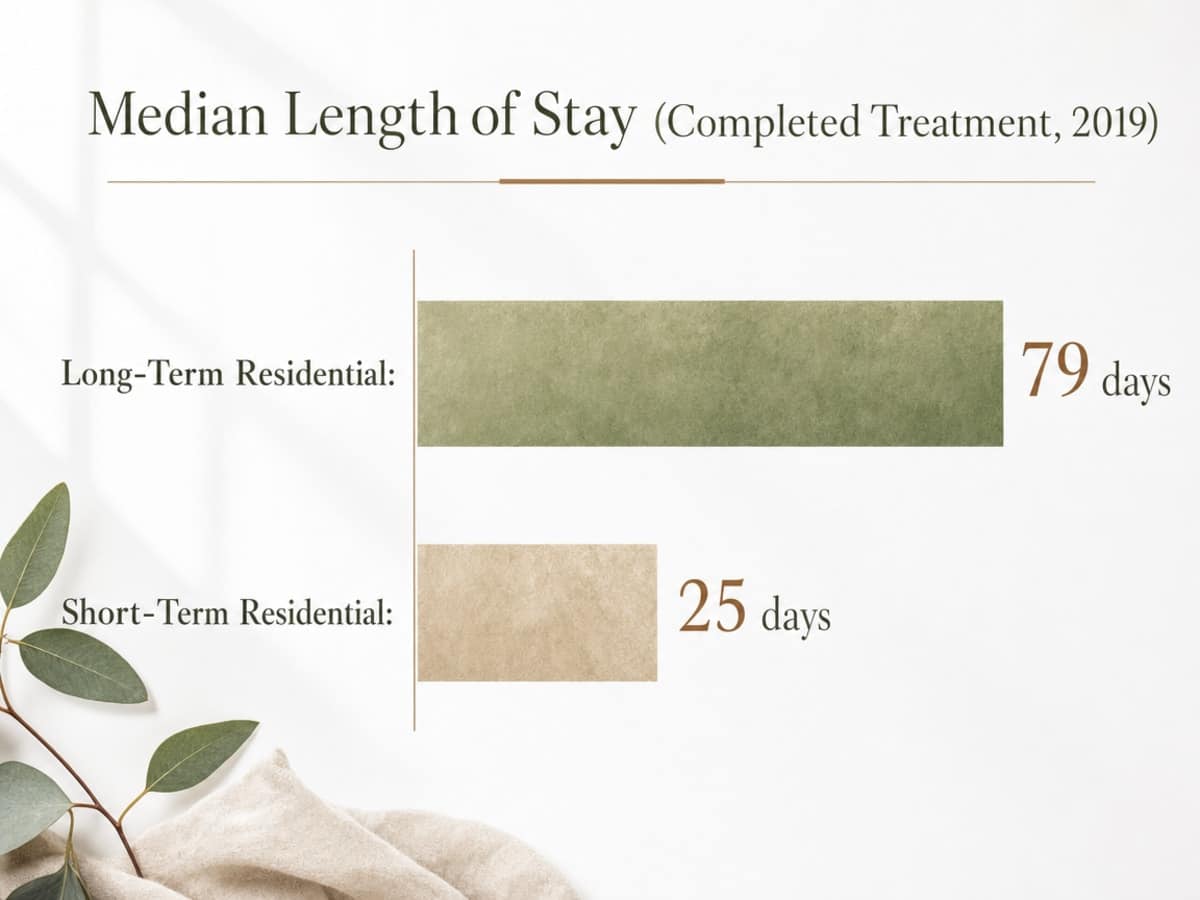
If you want to know whether 45 days is a mainstream choice or a fringe one, the SAMHSA Treatment Episode Data Set gives you the reference points. Among patients who completed treatment in 2019, the median length of stay was 79 days for long-term residential and 25 days for short-term residential 3. A 45-day program sits between those two medians, closer to the middle of the national distribution than to either end.
That placement matters for how you should read a program’s brochure. Forty-five days is not a discount version of 90 days, and it is not an extended version of a 28-day model. It is a distinct clinical window that lets a program absorb medically supervised withdrawal, get you stable, and then spend meaningful time on the therapeutic work that actually predicts what happens after you leave.
What the TEDS data cannot tell you is whether a specific 45-day program is designed to use that window well. Two facilities can both quote 45 days and deliver very different things: one front-loading detox and calling the rest supportive rest, another spending week two onward on individual therapy, co-occurring diagnosis, family sessions, and a written continuing care plan. Ask which one you are being sold.
Detox Is Not Rehab: Separating the Two Inside 45 Days
One of the fastest ways to misread a 45-day program is to assume the whole stay is rehabilitation. It is not. SAMHSA’s TIP 45 puts the general rule for residential detox and short-term treatment at 7 to 30 days 5, and detox itself typically occupies the front end of that window, sometimes just the first week to ten days depending on your substance, dosage, and medical history.
That means a well-designed 45-day stay gives you something a 28-day program cannot: two to five additional weeks of actual therapeutic work after your body has stabilized. That is when individual counseling starts to land, when co-occurring anxiety or depression becomes assessable without the noise of acute withdrawal, and when discharge planning stops being theoretical.
When you interview admissions, ask them to draw the line for you. Which days are medically supervised withdrawal? Which days are stabilization? On what day does the therapeutic curriculum actually begin, and how many hours per day of it are you getting? If they cannot answer that clearly, the number 45 on their website is a marketing figure, not a clinical plan.
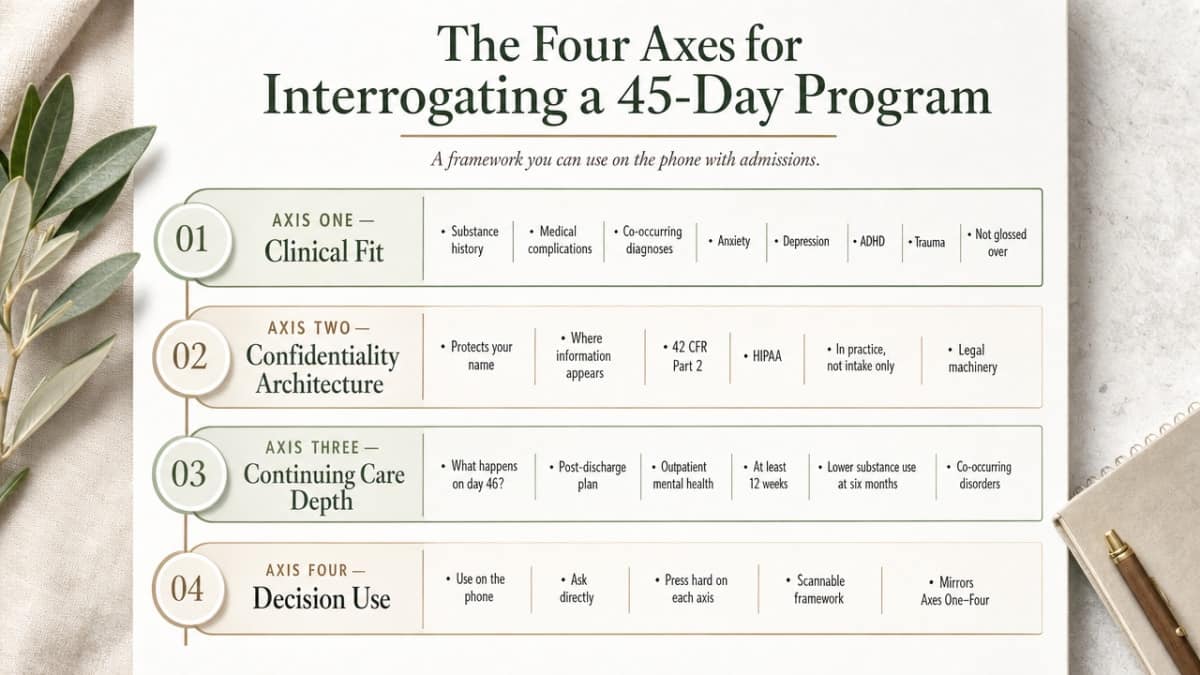
The Four Axes for Interrogating a 45-Day Program
You need a framework you can actually use on the phone with an admissions clinician, not a mood. Four axes are enough if you press hard on each one.
- Clinical fit
- Asks whether the program can handle your specific case: your substance history, your medical complications, and any co-occurring anxiety, depression, ADHD, or trauma diagnosis that a 28-day container tends to gloss over.
- Confidentiality architecture
- Asks what legal machinery protects your name from showing up where you don’t want it, and how the program actually operates 42 CFR Part 2 and HIPAA in practice, not just on the intake form.
- Continuing care depth
- Asks what happens on day 46. The peer-reviewed evidence on co-occurring disorders found that at least 12 weeks of outpatient mental health treatment post-discharge was associated with lower substance use at six months 1, so a 45-day residential episode without a real outpatient plan is a truncated intervention.
- Workplace reintegration
- Asks whether the program will hand you a documented return-to-work plan or a hug and a discharge summary.
Run every brochure and every admissions call through those four axes. The next four sections give you the diagnostic questions.
Axis One: Clinical Fit
Severity, Co-Occurring Conditions, and Medical Complexity
Clinical fit is where 45-day programs either earn their length or waste it. The first question is severity. A daily drinker with a decade of high-tolerance use and elevated liver enzymes needs a different opening week than someone whose use escalated over the last eighteen months around a divorce. Both may benefit from 45 days. Only one may safely start therapeutic work in week one.
Co-occurring conditions raise the stakes further. If you carry a diagnosis of depression, generalized anxiety, ADHD, PTSD, or bipolar II, or if you suspect one has been sitting underneath your drinking for years, the residential episode has to do double duty. The research on this is direct: for patients with co-occurring mental health disorders, receiving at least 12 weeks of outpatient mental health treatment after discharge was associated with lower substance use at six months 1. That finding presumes the residential team accurately diagnosed the co-occurring condition in the first place and handed you off to a clinician who can continue it. A program that treats your anxiety as “withdrawal-related” and never revisits it is not doing dual diagnosis work; it is doing addiction treatment with a mental health garnish.
Medical complexity is the third variable. Prior seizures, benzodiazepine dependence, opioid use with cardiac history, uncontrolled hypertension, or any pattern that has already sent you to an emergency room changes what week one has to look like. Ask whether the facility has 24-hour nursing, on-site or on-call physician coverage for medically supervised withdrawal, and the ability to run medication-assisted treatment when clinically indicated. If the answer is vague, the 45 days on offer are shorter than they appear.
Questions to Ask the Medical Director
You are not being difficult by asking to speak with the medical director before admission. You are doing what any clinically literate professional should do. Keep the call focused.
- Ask who conducts the initial psychiatric evaluation, when it happens, and whether it is repeated after withdrawal clears. A first-week assessment done while you are still symptomatic will miss things a week-three assessment will catch.
- Ask how co-occurring diagnoses are documented, who owns medication decisions during the stay, and how those decisions are communicated to the outpatient psychiatrist who will inherit them.
- Ask for the actual daily schedule during the therapeutic phase, not the marketing summary. How many hours of individual therapy per week? How many of group? What modalities: CBT, motivational enhancement, trauma-focused work? Who runs family sessions and when?
- Ask what would trigger a recommendation to extend beyond 45 days, and what the criteria are for stepping down to IOP earlier.
A medical director who can answer both without hesitation is running a program that treats length as a clinical decision. One who cannot is running a fixed container and hoping you fit.
Axis Two: Confidentiality Architecture
42 CFR Part 2 and HIPAA: What Each Actually Does
Two different federal frameworks govern what a rehab can say about you, and confusing them is how people get burned. HIPAA covers protected health information across the healthcare system in general. 42 CFR Part 2 sits on top of that with stricter rules built specifically for substance use disorder records held by federally assisted SUD programs. The Part 2 regulations prohibit disclosure of records or information that would identify a person as having been diagnosed, treated, or referred for treatment for a SUD, except under specified conditions 11. In plain terms: your presence at an SUD‑specific facility is itself protected information, not just your chart.
The practical implication is that a Part 2 program cannot confirm you are a patient to your law firm’s HR department, your medical board, or your spouse’s attorney unless you have signed a valid consent or a court order compels it. Records are also barred from use in most civil, criminal, administrative, or legislative proceedings without additional authorization 10. HIPAA alone does not give you that second layer. When you evaluate a 45‑day program, ask directly whether it is a Part 2 program and how staff are trained on the distinction. If the answer is a shrug, that is your answer.
Single Consent, Redisclosure, and Employer Communications
The 2026 final rule changed one thing you should understand before you sign anything. A single patient consent can now authorize all future uses and disclosures of your SUD records for treatment, payment, and health care operations, rather than requiring a separate form for each recipient 9. That is a coordination win for clinicians who need to talk to your outpatient psychiatrist and your insurer. It is also a document you should read slowly, because “all future uses” is a wide door.
Redisclosure is the other point where professionals get hurt. Once information leaves a Part 2 program, the prohibition on redisclosing anything that would identify you as having been diagnosed, treated, or referred for SUD travels with it 11. That protection matters most when your employer, EAP, or licensing body is in the loop. Before you sign any consent naming an employer contact, insist on scope limits in writing: which specific person, what specific information (treatment dates and return‑to‑work clearance, not clinical detail), and a defined expiration date. A program that resists narrowing that language is telling you how it will operate later.
Axis Three: Continuing Care Depth
The 3-6 Month Window That Makes 45 Days Work
Day 46 is the day your program’s real quality shows up. The residential episode ends, and what waits on the other side either extends the work or lets it evaporate. The peer-reviewed continuing care literature is direct about the shape of that window: robust recovery after a residential episode typically requires 3 to 6 months of structured continuing care, not a few follow-up calls 2. That is the planning horizon you should be negotiating with an admissions team, not the 45 days on their landing page.
Inside that window, the intensity matters as much as the calendar. For patients with co-occurring conditions, receiving at least 12 weeks of outpatient mental health treatment post-discharge was associated with lower substance use at six months 1. And SAMHSA’s own data situates the outpatient phase: the median length of stay for adults who complete intensive outpatient treatment is 81 days 4. Stack those together and the picture is clear. Forty-five days residential plus roughly three months of IOP plus continued mental health treatment is not an aspirational plan. It is the mainstream clinical shape of what tends to work.
Ask your program to draw that arc for you on paper before you admit.
IOP Step-Down and Discharge Planning You Can Verify
Discharge planning is where good 45-day programs separate themselves from adequate ones, and you can test the difference by asking for artifacts, not assurances. A serious program will name the intensive outpatient provider in your home city by the end of your second week, coordinate an intake appointment before you leave, and transmit a clinical handoff document with your consent so the receiving team is not starting from a blank page.
Ask to see the template of the discharge plan. It should include:
- The specific IOP provider and start date
- The outpatient psychiatrist inheriting any medication decisions
- The frequency of individual therapy sessions and for how many weeks
- The recovery peer supports built in
- A documented relapse response plan naming who you call and in what order
Ask what happens if the IOP has a waitlist. A program that has never thought about that gap is a program that will let you fall into it.
One more question worth asking: what percentage of your alumni are still engaged in outpatient care at 90 days post-discharge, and how do you know? A program that tracks this is running continuing care as clinical work, not as a mailing list.
Tech-Enabled Monitoring as Clinical Decision Support
Wearables and mHealth tools have moved from novelty to legitimate clinical decision support, and for a 45-day program handing you off to outpatient care, they can quietly extend the sightline. Transdermal alcohol sensors, heart rate variability, sleep patterns, and smartphone-based ecological momentary assessment give clinicians objective signals about stress, sleep debt, and physiological markers of relapse risk that self-report alone tends to blur 6. A systematic review of mHealth interventions for substance use found that most of the studies examined reported at least one statistically significant effect on reduced craving or substance use, with generally high acceptability 8. That is meaningful, not miraculous.
The limitations are meaningful too. The wearables literature flags real concerns about user burden, small sample sizes in the outcome studies, and data privacy questions that get sharper when the wearer’s day job involves a bar admission, a medical license, or a board seat 7. Before you consent, ask who sees the data, where it is stored, whether it flows into your Part 2 record or sits in a separate vendor system, and what happens to it after discharge. If a program treats monitoring as a marketing bullet rather than a supervised clinical input with documented boundaries, that is your signal to slow down.
Axis Four: Workplace Reintegration
ADA and Rehabilitation Act Protections While You’re Away
The fear of professional consequences is not paranoia. It is the single most common reason capable men delay treatment past the point where 45 days would have been enough. So it matters that federal law is more protective than the average HR handbook suggests. Under the ADA and the Rehabilitation Act, employers generally may not deny a job to or fire a qualified person because that person is in treatment or in recovery from a substance use disorder, unless the disorder would prevent safe and competent performance of the essential job functions 15. Being in treatment is not, by itself, a firing offense.
The protections have real edges you should understand, not gloss over. Current illegal drug use is treated differently from alcohol use and from a history of drug use, and safety-sensitive roles carry additional standards. Licensure and fitness-for-duty rules in medicine, law, aviation, and finance layer their own requirements on top of federal statutes. What the ADA reliably gives you is protection against being discriminated against for the fact of seeking treatment, and confidentiality protections around medical information your employer receives during any accommodation process 15. Before you take leave, have a plain conversation with an employment attorney about how these protections apply to your specific role and jurisdiction.
The Return-to-Work Plan You Should Have in Hand
A discharge summary is not a return-to-work plan. The Department of Labor’s Recovery-Ready Workplace Toolkit is direct about this: employers should plan for the return to work following SUD treatment, providing needed reasonable accommodations and workplace supports 12. That planning is your leverage. If your program treats reintegration as your problem to solve alone, they are undersizing what a 45-day episode is supposed to produce.
What you should walk out with, in writing:
- A return-to-work letter with clearance dates and any medical restrictions, drafted so it discloses only what your employer legitimately needs and nothing more
- A proposed schedule for the first four to six weeks that accounts for IOP attendance
- A written list of reasonable accommodations you plan to request, such as flexible hours for outpatient sessions, an adjusted travel schedule during early recovery, or a modified on-call rotation
- A communication script for what you say to colleagues who ask where you were
Ask your program’s discharge planner who at the facility has actually coordinated with employers before, and how they handle the boundary between clinical information and workplace-appropriate information. If an EAP or occupational health office is involved, the same 42 CFR Part 2 consent discipline from earlier applies: narrow the scope, name the recipient, set an expiration. You are not being difficult. You are protecting the career you took 45 days off to preserve.
Reading the Brochure: A Short List of Disqualifiers
By the time you’ve done this much diligence, most 45-day programs will start to sound alike. A shorter test helps. Here are the signals that should end a conversation, not extend it.
- The brochure conflates detox with rehabilitation, or refuses to draw the line between the two on your calendar. TIP 45 puts residential detox in the 7 to 30 day range for a reason 5; a program that lets detox blur into the whole stay is padding the number.
- The admissions team cannot name your outpatient provider before you arrive, or treats the 3 to 6 month continuing care window as your homework 2. Discharge planning that starts in week five is discharge planning that failed.
- The medical director is unavailable for a pre-admission call.
- Confidentiality language is vague on 42 CFR Part 2 status.
- Consent forms are broad, undated, and unnamed.
- Wearable data flows into vendor systems no one will describe.
Any one of these is a reason to keep interviewing. Deciding to evaluate this carefully is not a small thing. Neither is walking away from the wrong program.
Frequently Asked Questions
Is a 45-day rehab long enough if the standard benchmark is 90 days?
It can be, when 45 days is the opening of a longer arc rather than the whole intervention. NIDA’s guidance points to 90 days as a general threshold 13, but one continuing care review found that patients with average stays of 15 to 45 days improved more on alcohol composite scores than those averaging 90 days 2. Fit and follow-through matter more than the calendar.
Can my employer find out I’m in a 45-day residential program?
Not without your written consent or a court order, if the facility operates under 42 CFR Part 2. Your presence at an SUD-specific program is itself protected information, not just your chart 11. If you do sign a consent naming your employer, narrow it in writing: specific recipient, specific information, defined expiration date.
How does detox fit inside a 45-day stay?
Detox typically occupies the front end. SAMHSA’s TIP 45 puts residential detox and short-term treatment in the 7 to 30 day range as a general rule 5. In practice, medically supervised withdrawal often runs the first week to ten days, leaving four to five weeks for the therapeutic work that predicts what happens after discharge.
What continuing care should I expect after 45 days of residential treatment?
Plan for three to six months of structured continuing care, not a few check-in calls. SAMHSA data puts the median IOP length of stay at 81 days for adult completers 4, and that intensity should be paired with ongoing individual therapy, psychiatric follow-up, and peer support. A named IOP provider and start date should be in your discharge plan before you leave.
What ADA protections apply while I’m in treatment and returning to work?
Under the ADA and Rehabilitation Act, employers generally may not deny a job to or fire a qualified person because they are in treatment or in recovery, unless the disorder would prevent safe and competent performance of essential functions 15. Medical information shared during any accommodation process is confidential. Get role-specific advice from an employment attorney.
Should I agree to wearable or mHealth monitoring during and after treatment?
It can be genuinely useful clinical decision support, with limits. A systematic review found most mHealth studies reported at least one statistically significant reduction in craving or substance use 8. Before consenting, ask who sees the data, where it is stored, whether it enters your Part 2 record, and what happens to it after discharge.
References
- Stability of Outcomes Following Residential Drug Treatment Among Patients With Co‑Occurring Disorders. https://pmc.ncbi.nlm.nih.gov/articles/PMC3146302/
- The Continuing Care Model of Substance Use Treatment. https://pmc.ncbi.nlm.nih.gov/articles/PMC4007701/
- Treatment Episode Data Set (TEDS): 2019 Discharges. https://www.samhsa.gov/data/sites/default/files/reports/rpt35314/2019_TEDS_Proof.pdf
- Clinical Issues in Intensive Outpatient Treatment for Substance Use Disorders. https://library.samhsa.gov/sites/default/files/pep20-02-01-021.pdf
- TIP 45 Detoxification and Substance Abuse Treatment. https://www.govinfo.gov/content/pkg/GOVPUB-HE20_400-PURL-gpo124442/pdf/GOVPUB-HE20_400-PURL-gpo124442.pdf
- A Review of Wearable Biosensors in Alcohol Use Disorder Treatment. https://pmc.ncbi.nlm.nih.gov/articles/PMC8019775/
- Wearable and Wireless mHealth Technologies for Substance Use Disorder. https://pubmed.ncbi.nlm.nih.gov/33738178/
- Current reporting of usability and impact of mHealth interventions for substance use: A systematic review. https://pubmed.ncbi.nlm.nih.gov/32777691/
- Fact Sheet: 42 CFR Part 2 Final Rule. https://www.hhs.gov/hipaa/for-professionals/regulatory-initiatives/fact-sheet-42-cfr-part-2-final-rule/index.html
- 42 CFR Part 2 — Confidentiality of Substance Use Disorder Patient Records. https://www.ecfr.gov/current/title-42/chapter-I/subchapter-A/part-2
- 42 CFR Part 2 Confidentiality (Training Module). https://www.ihs.gov/sites/privacytraining/themes/responsive2017/display_objects/documents/modules/42%20CFR%20Part%202%20Confidentiality.pdf
- Recovery‑Ready Workplace Toolkit (July 2026). https://www.dol.gov/sites/dolgov/files/ETA/RRW-hub/pdfs/RRW_Toolkit_July_2026.pdf
- Principles of Drug Addiction Treatment: A Research-Based Guide (Third Edition). https://nida.nih.gov/sites/default/files/podat-3rdEd-508.pdf
- Principles of Drug Addiction Treatment: A Research-Based Guide (Earlier Edition Excerpt). https://nida.nih.gov/sites/default/files/podat_1.pdf
- Know Your Rights: Rights for Individuals with Alcoholism and Drug Addiction (Federal GovInfo Reprint). https://www.govinfo.gov/content/pkg/GOVPUB-HE20_400-PURL-LPS79711/pdf/GOVPUB-HE20_400-PURL-LPS79711.pdf