
Arkansas Drug Addiction Treatment: What to Know
Key Takeaways
- Arkansas’s overdose death rate dropped 13.8% between 2022 and 2023, reflecting expanded medication-assisted treatment, wider naloxone access, and infrastructure built under State Opioid Response grants 1.
- Medicaid currently covers MAT as a mandatory benefit, and a Section 1115 waiver effective January 1, 2026 will extend coverage to short-term residential SUD treatment in IMDs 3, 6.
- Choosing an in-state men’s program keeps family involved in weekly sessions, connects discharge planning to local prescribers and peer specialists, and supports discretion for those needing it.
- Before admitting a loved one, ask any Arkansas program about staff licensing, post-2026 IMD billing, family therapy structure, and the specific handover plan for aftercare in your county.
Why staying in Arkansas for treatment finally makes sense
If you’re reading this, someone you love is hurting, or you are. Maybe you’ve already looked at programs in Texas, Tennessee, Florida. Maybe you’ve been told the real help is somewhere else, somewhere far. That advice used to hold water. It doesn’t anymore.
Arkansas has changed. Between 2022 and 2023, the state’s age-adjusted drug overdose death rate fell 13.8%, from 21.7 to 17.7 per 100,000 1. This significant reduction reflects expanded medication-assisted treatment, wider naloxone access, and a treatment infrastructure that has grown quickly under State Opioid Response grants 10.
The policy landscape is also shifting. Arkansas Medicaid has covered medication-assisted treatment as a mandatory benefit since October 2020, with coverage extending through September 30, 2025 3, 4. Furthermore, a Section 1115 waiver, effective January 1, 2026, will allow Medicaid to cover short-term residential SUD treatment within institutions for mental diseases 6. This means residential care in Arkansas is becoming more accessible than ever before.
The old logic, suggesting that quality men’s residential treatment required out-of-state travel, was based on a shortage that Arkansas has been diligently addressing. Staying in-state means your family can participate in sessions, your sponsor can visit, and your children can hear your voice without time-zone complications. The clinical benefits of proximity are substantial, and Arkansas now offers programs to support this.
The rest of this guide explores what this decision entails.
What the Arkansas numbers actually say about recovery right now
Numbers can feel cold when you’re making a difficult decision, but honest data is crucial. In 2024, Arkansas recorded 389 drug overdose deaths, a decrease from 516 the previous year 9. This reduction represents 127 individuals who survived a year that might have been fatal previously. This decline aligns with the CDC’s finding that Arkansas’s age-adjusted overdose death rate fell more sharply than the national average between 2022 and 2023 1, indicating that current strategies are effective.
A key factor in this success is the enhanced treatment infrastructure. The State Opioid Response III grant period, which concluded in 2024, facilitated opioid use disorder treatment services for 2,870 individuals and recorded 7,615 overdose reversals statewide 12. For instance, UAMS’s medication-assisted treatment program expanded its reach from approximately a dozen counties to 58, growing its grantee network from 6 to 22 sites and providing medications for opioid use disorder to 2,131 people in a single year 10. If accessing residential-adjacent care in Arkansas was challenging five years ago, the landscape has significantly improved.
However, challenges remain. In 2022, the Arkansas Department of Health tracked 3,837 nonfatal drug overdoses, a provisional figure likely to be higher 14. For every fatality, several individuals survived an overdose but returned to the same circumstances. Survival is not synonymous with recovery; a pulse in an emergency room is merely the beginning of a journey, not its conclusion.
This disparity between falling death rates and the persistent number of individuals experiencing crises highlights the critical role of residential treatment. It offers individuals who have survived multiple overdoses a chance to break the cycle rather than merely escaping it temporarily. If you or a loved one are in this situation, you are not alone. Arkansas has dedicated the past four years to developing resources to reach this population.
The takeaway is not that all problems are solved, but that access to quality treatment in Arkansas is more open than ever before, offering care comparable to programs in other states.

The levels of care, translated for a family making a real decision
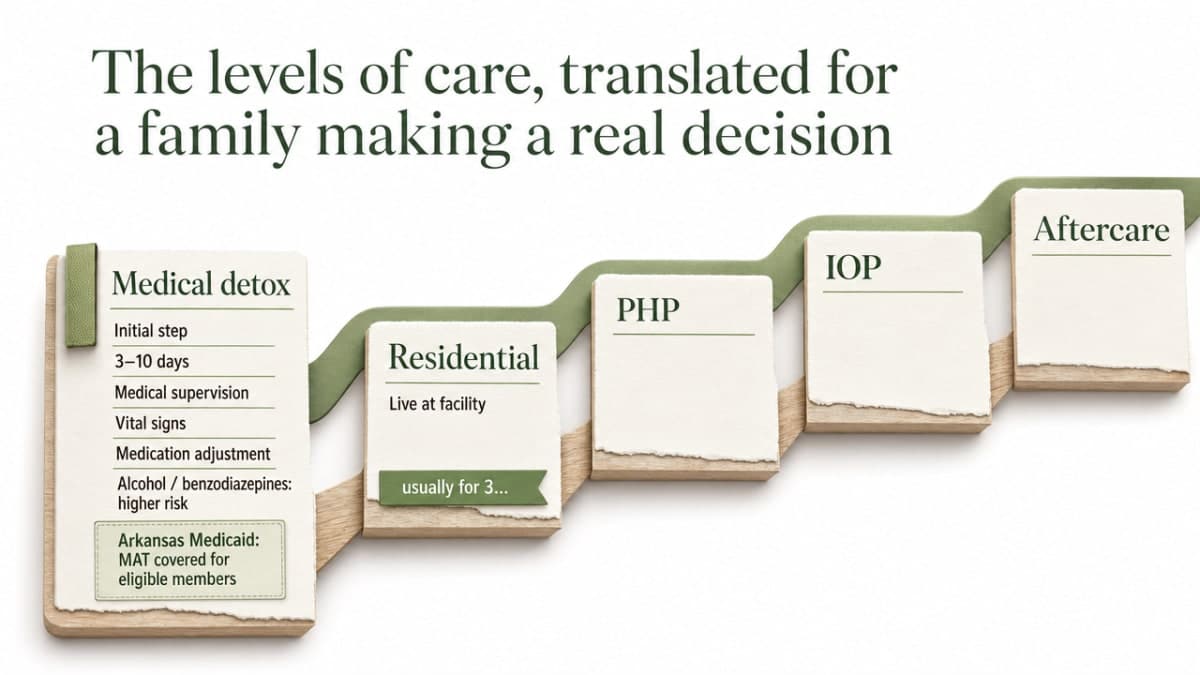
Medical detox, residential, PHP, IOP, aftercare
These terms, often seen on program websites, represent a progression of care, a ladder that most individuals ascend in order.
- Medical detox
- The initial step, typically lasting 3 to 10 days, during which the body eliminates substances. This phase can be dangerous, particularly with alcohol or benzodiazepine withdrawal, and requires medical supervision. Nurses monitor vital signs, and doctors adjust medications to prevent withdrawal from becoming a medical emergency. Under Arkansas Medicaid, medication-assisted treatment for opioid or alcohol use disorder is a covered benefit for eligible members, significantly impacting affordability at this stage 3, 5.
- Residential treatment
- What most people envision as “rehab.” Patients reside at the facility, usually for 30 to 90 days, following a structured daily schedule that includes individual counseling, group therapy, psychiatric evaluations for co-occurring disorders, medication management, and time for rest and nutrition. This phase shifts the focus from physical withdrawal to mental and emotional healing. Effective January 1, 2026, Arkansas Medicaid will cover short-term residential SUD treatment within institutions for mental diseases under an approved Section 1115 waiver, broadening access to this level of care within the state 6.
- Partial hospitalization (PHP)
- Serves as a step-down, where individuals attend a facility five or six days a week for most of the day, returning home or to sober living at night. This maintains clinical intensity while gradually reintroducing individuals to their external environment.
- Intensive outpatient (IOP)
- Follows, involving three to five sessions weekly, typically a few hours each, often in the evenings to accommodate work schedules. This stage focuses on relapse prevention in real-world settings, where triggers are no longer theoretical.
- Aftercare
- A crucial, yet often overlooked, component. It includes alumni groups, continuing care meetings, ongoing therapy, and support from a peer recovery specialist. Arkansas’s SOR IV program has introduced digital recovery tools through CHESS Health to bridge the gap between formal treatment and daily life, particularly for individuals outside the Little Rock–Fayetteville corridor 11.
While not every rung of this ladder may be necessary, understanding where to begin and who makes those decisions is vital.
How Arkansas licensing shapes who is actually treating you
The credentials of staff are more important than a facility’s aesthetics. Arkansas Medicaid rules mandate that substance use counseling and MAT services be provided by qualified professionals, including Licensed Alcoholism and Drug Abuse Counselors (LADACs) and licensed behavioral health agencies 5. When touring a program, inquire about the qualifications of those leading groups, prescribing medications, and approving treatment plans. You have the right to ask these questions.
For men, specifically, look for a psychiatric provider on staff or under contract. Depression, trauma, and anger often co-occur with substance use, and a program that addresses only one aspect will leave the other unaddressed. Medication-assisted treatment for opioid or alcohol use disorder is available to qualifying Medicaid beneficiaries in Arkansas 5, but a program must have the staff to deliver it effectively. Confirm this before admission.
What Medicaid covers now, and what changes January 1, 2026
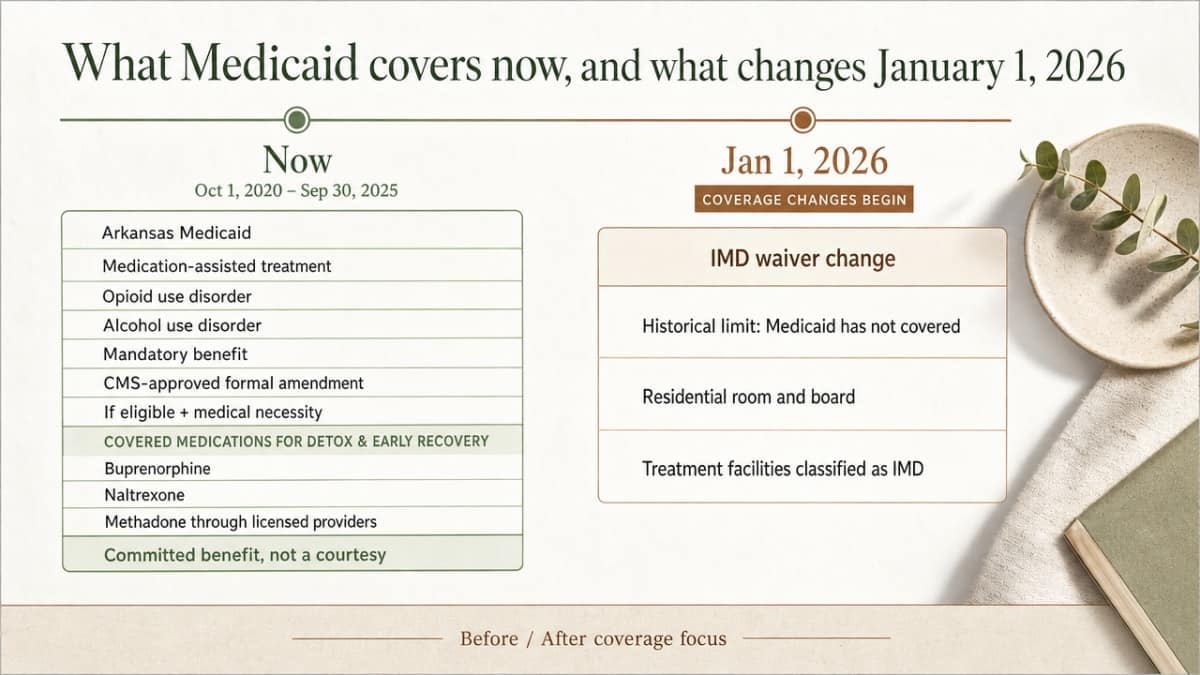
Financial considerations are a significant part of this decision. Here’s an overview of Arkansas’s current coverage and upcoming changes.
Currently, Arkansas Medicaid covers medication-assisted treatment for opioid use disorder and alcohol use disorder as a mandatory benefit. This coverage, established through a formal amendment, is active from October 1, 2020, through September 30, 2025 3, 4. If you or your son qualifies for Medicaid and meets medical necessity criteria, medications vital for detox and early recovery, such as buprenorphine, naltrexone, and methadone (through licensed providers), are covered. This is a committed benefit, not a courtesy, approved by CMS.
Historically, Medicaid has not covered the residential room and board component of treatment in facilities classified as institutions for mental diseases, due to a federal rule dating back to the 1960s. This rule often led Arkansas families to seek out-of-state programs, even when suitable in-state options existed, because the cost of the residential stay was not covered.
On July 22, 2025, CMS approved Arkansas’s Section 1115 demonstration waiver for SUD and SMI treatment in IMDs 6. The approval specifies that coverage for SUD residential services under the waiver becomes effective January 1, 2026 6. Arkansas’s transition strategy confirms this date and outlines how the state will fund short-term residential SUD treatment and reentry support for adults with SUD and co-occurring serious mental illness 7. For context, Arkansas Medicaid spent $825.3 million on behavioral health services and prescription drugs for patients with a primary behavioral health diagnosis in 2020 7. This is a substantial expansion of coverage for a critical level of care.
In practical terms for your family:
- If admission occurs before January 1, 2026, Medicaid will cover MAT and outpatient services, but the residential stay may require private payment, private insurance, or grant-supported beds.
- If admission is on or after January 1, 2026, Medicaid-eligible individuals will have a viable pathway to residential SUD coverage in IMD-classified facilities that was previously unavailable.
- The MAT coverage window closes September 30, 2025, and while continuation is expected, it’s advisable to confirm the current status with the program during intake 3.
Two practical recommendations:
- If timing is flexible and finances are a primary concern, ask any Arkansas program about their billing plans under the new IMD coverage after January 1, 2026, and if they possess the necessary licensing.
- If timing is not flexible, do not delay. Relapse does not adhere to coverage calendars, and all credible Arkansas programs currently offer private-pay, private-insurance, and scholarship options. Inquire about all three during your initial call.
Why men’s residential care is its own clinical category
A men-only residential setting is a clinical decision, not merely a marketing choice, and its benefits warrant explanation before you select a program.
Men in early recovery often grapple with a specific combination of issues: unaddressed anger, undiagnosed depression, deep-seated shame, and a tendency to project an image of competence even when struggling. In mixed-gender groups, many men revert to this performative self, which hinders genuine recovery. This often leads to discharge and subsequent relapse.
A men’s group facilitates more open and honest communication. When the room is exclusively male, discussions more readily delve into topics such as fatherhood, strained marriages, career implications of addiction, and the unique loneliness experienced by men who are expected to be strong. Group work is the driving force of residential treatment, and its effectiveness is enhanced when the environment is tailored to the specific needs of men.
Clinical staffing must align with these needs. Arkansas Medicaid rules require substance use counseling and MAT services to be delivered by qualified providers, including Licensed Alcoholism and Drug Abuse Counselors and licensed behavioral health agencies 5. For men, the presence of a psychiatric provider who can evaluate co-occurring depression, anxiety, PTSD, or ADHD is crucial, as these diagnoses are common in this population and often overlooked.
Discretion is another important clinical factor. For men in high-profile professions or leadership roles, a small-capacity men’s program in their home state is not a luxury but a necessity that enables them to seek treatment without undue exposure.
The recovery infrastructure around a program matters as much as the program
Choosing a treatment program in isolation often yields isolated results. The 30, 60, or 90 days spent in a facility are only effective if the surrounding state infrastructure can support an individual upon discharge. This aspect of the Arkansas story has undergone significant transformation, yet it is rarely highlighted in promotional materials.
Consider the reach of these services. Under the State Opioid Response III grant, 2,870 Arkansans received opioid use disorder treatment services, and 7,615 overdose reversals were recorded across the state 12. This high number of reversals signifies 7,615 instances where individuals, such as paramedics, family members, or coworkers, administered naloxone, providing a second chance at life. Through the subsequent SOR IV initiative, 63 of Arkansas’s 75 counties have achieved full naloxone saturation or higher 11. If an individual leaves a program in Little Rock and returns home to Pope County, Craighead County, or Sevier County, their local pharmacy can dispense naloxone under a statewide standing order without a prescription 15. This widespread access to naloxone can be the difference between a slip and a fatality.
The digital component is also significant. SOR IV has implemented CHESS Health digital recovery applications, enabling individuals in recovery to connect with peers, log cravings, or find meetings from their phones, even late at night 11. Combined with a hub-and-spoke MOUD model that trains community providers around anchor programs 13, the network of support available at any given time is vastly improved compared to 2019.
When touring a program, inquire about post-discharge support. Ask about the peer recovery specialist they will connect you with, the prescriber who will manage medication in your home county, and alumni groups in your area. A reputable Arkansas program in 2025 will have clear answers to these questions, as the necessary infrastructure is now in place.
Wearables and continuous monitoring: promising, not proven
Programs are increasingly discussing wearables such as smartwatches, patches, rings, and wristbands that track heart rate, sleep, stress, and sometimes skin temperature. It’s important to understand the actual capabilities and limitations of these tools, as marketing often outpaces scientific evidence.
Continuous monitoring can provide clinicians with real-time physiological data during detox and early recovery. This includes spikes in heart rate, shallow sleep patterns, and stress correlations with specific times or events. Such data is valuable. A nurse who observes a rising resting heart rate before a craving manifests can intervene earlier than one who waits for the patient to verbalize their struggle.
However, wearables are not a substitute for human interaction in treatment. They cannot provide emotional support in group therapy, offer comfort during moments of shame, or communicate with family members. The published evidence for wearable-assisted addiction treatment outcomes is still developing, and any program claiming a wristband alone ensures sobriety is misrepresenting its capabilities. If a facility uses continuous monitoring, inquire about how clinicians utilize the data, rather than focusing solely on the device’s functions. This is the critical question.
Keeping family close during and after treatment
The clinical rationale for seeking treatment in Arkansas is rooted in improved outcomes, not just sentiment. Family members who actively participate in sessions, maintain contact, and provide ongoing support significantly contribute to sustained recovery. Distance complicates these vital interactions, and it is no longer a necessary barrier.
When evaluating programs, ask about their approach to family involvement. A quality Arkansas facility will offer scheduled family therapy, often weekly, which may be in-person or via video for relatives in distant areas like Texarkana, Jonesboro, or Mountain Home. Inquire about what is covered and what is not. Ask if spouses can attend dedicated support groups, recognizing that partners also undertake significant emotional work and require their own space.
Consider the transition after treatment. Discharge is not an endpoint but a handover. Before an individual leaves the facility, the program should identify the outpatient prescriber who will continue medication management, the peer recovery specialist assigned to their county, and an alumni meeting that fits their schedule. Arkansas’s current opioid response efforts have expanded digital recovery apps and peer support networks across the state, ensuring that this handover extends beyond county lines 11.
If you are currently evaluating programs, prioritize those that integrate family into the clinical plan rather than treating them as an afterthought. Serenity Park Recovery Center, a small men’s residential program in Little Rock, exemplifies this approach, offering proximity that enables loved ones to be an active part of the recovery process.
Frequently Asked Questions
Does Arkansas Medicaid cover residential drug addiction treatment?
Currently, Arkansas Medicaid covers medication-assisted treatment for opioid and alcohol use disorder as a mandatory benefit through September 30, 2025 3, 4. However, the residential room-and-board portion within an institution for mental diseases has not been covered. This changes on January 1, 2026, when short-term residential SUD services in IMDs become a covered benefit under an approved Section 1115 waiver 6. Inquire with any program about their billing procedures after this date.
What levels of care should I expect from an Arkansas treatment program?
A reputable Arkansas program should either offer directly or provide referrals for a comprehensive continuum of care: medical detox (3-10 days), residential treatment (30-90 days), partial hospitalization (PHP) as a step-down, intensive outpatient (IOP) for reintegration, and structured aftercare including alumni groups and continuing care. While not every level may be necessary for every individual, the program should clearly outline who manages each stage and how transitions occur within your county.
Is it better to stay in Arkansas for treatment or go out of state?
For most individuals, staying in Arkansas is now the clinically advantageous choice. Proximity to home facilitates family sessions, in-person visitation, and continuity of care with in-state prescribers, all of which enhance recovery outcomes. The state’s overdose death rate decreased from 21.7 to 17.7 per 100,000 between 2022 and 2023 1, reflecting substantial growth in its treatment infrastructure. Out-of-state travel is typically only warranted when a specific clinical need cannot be met locally.
What makes men’s residential treatment different from mixed-gender programs?
Group therapy is fundamental to residential care, and men-only environments foster deeper engagement. Discussions more readily address topics such as fatherhood, marital strain, career risks, and the shame men often conceal in mixed settings. Clinical staffing is also often tailored to address co-occurring depression, anger, trauma, and undiagnosed anxiety, which are prevalent in this population. For men requiring discretion, a small, in-state men’s program removes a significant barrier to seeking help.
How can my family stay involved during residential treatment?
Inquire with the program about scheduled family therapy, partner support groups, and video sessions for relatives residing outside the immediate area. An effective facility integrates family into the clinical plan, rather than treating them as an afterthought during visiting hours. Prior to discharge, obtain written details regarding the outpatient prescriber, the assigned peer recovery specialist, and relevant alumni meetings. Arkansas’s SOR IV initiatives have expanded digital recovery applications and peer support networks statewide, ensuring continuity of care in your county 11.
What credentials should the counselors and clinical staff hold in Arkansas?
Arkansas Medicaid rules stipulate that substance use counseling and MAT services must be delivered by qualified professionals, including Licensed Alcoholism and Drug Abuse Counselors and licensed behavioral health agencies 5. For a men’s program, also seek a psychiatric provider on staff or under contract to evaluate co-occurring depression, anxiety, PTSD, or ADHD. Ask about the qualifications of those leading groups, prescribing medications, and signing off on treatment plans. A lack of clear answers should be a cause for concern.
References
- Changes in Drug Overdose Mortality and Selected Drug Type by State: 2022–2023. https://www.cdc.gov/nchs/data/hestat/drug-overdose/drug-overdose-2022-2023.htm
- Arkansas 2024 State Opioid Response Grant. https://wysac.uwyo.edu/wysac/projects/arkansas-2024-state-opioid-response-grant/
- Medication Assisted Treatment Coverage Guidance (Arkansas DHS). https://humanservices.arkansas.gov/wp-content/uploads/MAT-Revised-Website-posting-12.14.pdf
- Arkansas State Plan Amendment (SPA) AR-23-0017 – Medication-Assisted Treatment. https://www.medicaid.gov/sites/default/files/2023-12/AR-23-0017.pdf
- SECTION II – COUNSELING AND CRISIS SERVICES (Arkansas Medicaid Rules). https://codeofarrules.arkansas.gov/Rules/PartDocument?partID=1354
- Approval Letter – Arkansas Section 1115 Demonstration for SUD and SMI Treatment in IMDs. https://www.medicaid.gov/medicaid/section-1115-demonstrations/downloads/ar-opps-sud-smi-appvl-07222025.pdf
- Arkansas Transition Strategy – Supporting Community and Incarcerated Individuals in IMDs. https://www.medicaid.gov/sites/default/files/2024-02/ar-opport-transi-stratg-supp-comm-incar-instit-mentl-diseas-pa-02282024.pdf
- Prescription Drug Monitoring Program Annual Report 2023. https://healthy.arkansas.gov/wp-content/uploads/Prescription-Drug-Monitoring-Program-Annual-Report-2023.pdf
- Substance Misuse Education and Prevention. https://healthy.arkansas.gov/programs-services/prevention-healthy-living/substance-misuse-education-and-prevention/
- Arkansas State Opioid Response (SOR) III Program Evaluation (2024). https://humanservices.arkansas.gov/wp-content/uploads/WYSAC-SOR-3-Final-Eval-Report-12162024.pdf
- H79TI087824 1H79TI087824-01 Mid-Year SORIV FY25 Report [10/1/24 – 3/31/25]. https://humanservices.arkansas.gov/wp-content/uploads/SOR4-6-Month-1-FY25-Report-1.pdf
- Award Number: 5H79TI085733-02. https://humanservices.arkansas.gov/wp-content/uploads/SOR3-Closeout-Report-9.2024-1.pdf
- Year 1 Award number: 1H79TI087824-01 Revised This annual programmatic progress report. https://humanservices.arkansas.gov/wp-content/uploads/SORIV-FY25-Year-1-Annual-Report.pdf
- All Drug Nonfatal Overdose Rates per 100,000 People per County for Arkansas Residents – Arkansas 2022*. https://healthy.arkansas.gov/wp-content/uploads/3-7-23_age_adjusted_nonfatal_overdose_per_100000.pdf
- Arkansas Opioid Antagonist Protocol (Naloxone Standing Order). https://healthy.arkansas.gov/wp-content/uploads/Naloxone_Standing_Order_Dr_Bala.pdf