
Key Takeaways
- Treat recovery like a chronic condition managed over years, not a 90-day fix, since continuing care and monitoring produce the strongest long-term outcomes 13, 10.
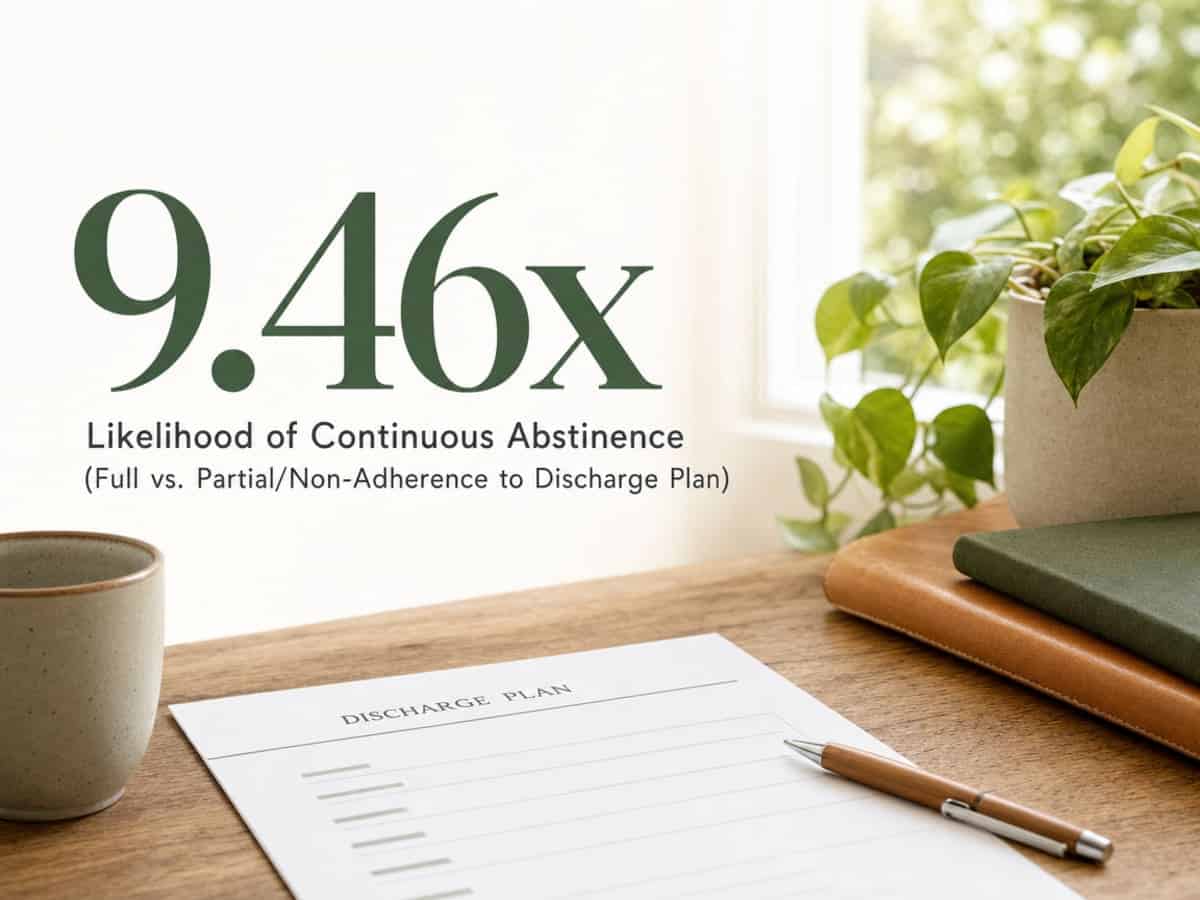
- Full adherence to the multi-component discharge plan (outpatient, mutual-help, mental health, medication) drives a 9.46x higher chance of abstinence at 12 months versus partial follow-through 3.
- Structure beats motivation: a written contract, prompts when you miss, and reinforcers when you show up lifted 12-month abstinence from 37% to 57% in a veterans trial 7.
- Start this week by consolidating appointments on one calendar, filling prescriptions the day you get home, attending one meeting inside 72 hours, and writing a one-page slip response plan.
The Day You Walk Out Is Day One, Not Day Done
You packed the duffel bag. Someone hugged you. Maybe you shook a counselor’s hand and walked past the front desk one more time. And then the door closed behind you, and the noise of the world came back on all at once.
If you’ve been through residential treatment before, you already know the truth nobody prints on the discharge folder: the day you walk out is the day the real work starts. What happened inside those walls was the setup. The next twelve months are where the outcome actually gets written.
That’s not a scare tactic. It’s the honest framing that decades of research keeps pointing to. Substance use disorder behaves like a chronic condition, and the people who do best after residential care are the ones who treat it that way, with an ongoing plan and steady community supports rather than a one-and-done mindset 13, 10.
So this guide skips the pep talk. You’ll get a week-by-week plan for the first 90 days, the aftercare stack that actually moves outcomes, how to handle a slip, and where wearable monitoring fits in. You’ve done the hard part once. Now you build the scaffolding that makes it stick.
Why Recovery Behaves Like a Chronic Illness (And Why That’s Good News)
Here’s the reframe that changes everything: addiction is a chronic disease, not a moral event. That means it works more like diabetes or high blood pressure than a broken bone. You don’t cure it in 30, 60, or 90 days. You manage it, and the management gets easier and more automatic the longer you stay in the system that supports it 13, 10.
Why is that good news? Because it takes the whole “if I relapse, I failed” story off the table. Nobody tells a guy with high blood pressure that his medication “didn’t work” when his numbers creep up after a stressful quarter. They adjust the plan. The National Institute on Drug Abuse says the same about substance use disorder: a return to use doesn’t mean treatment failed, it means the plan needs to be reinstated or changed 10.
The Discharge Plan Is the Contract That Keeps You Alive
What ‘Full Adherence’ Actually Looks Like
Somewhere in that folder they handed you on the way out is a discharge plan. Outpatient appointment. Meeting schedule. Psychiatrist follow-up. Maybe a medication list. It looks like a checklist. It is actually a contract, and the terms of that contract are what separate the men who stay sober from the men who are back in a detox bed by spring.
Here is the number that ought to sit on your refrigerator: patients who fully adhered to their multi-component continuing care discharge plan after residential treatment were 9.46 times more likely to be continuously abstinent at 12 months, and 7.53 times more likely to report a positive quality of life, than patients who only partially followed their plan or ignored it 3. That is not a marketing claim. That is a peer-reviewed comparison of what happens when you do the whole thing versus when you cherry-pick.
The word that carries the weight in that sentence is fully. Not “mostly.” Not “the parts I felt like doing.” Fully adherent means you went to the outpatient sessions, you went to the meetings, you kept the psychiatry appointment, you took the medication as prescribed, and you did it for the whole window your team set, not just the first three weeks when it felt fresh.
If you have been in and out of treatment before, look back honestly. In your last attempt, which pieces did you keep? Which did you quietly drop? That is your blueprint. The men who relapse rarely blow up the whole plan on day one. They shave a meeting here, skip the psychiatrist there, decide the medication is a crutch, and by month four the scaffolding is gone. The 9.46x gap is what that shaving costs you.
Full adherence is not moral effort. It is calendar management. Put every appointment on one calendar, share it with one person who will notice when something disappears, and treat missed sessions the way you would treat missed dialysis. That is the tone that matches the stakes.

The Multi-Component Stack: Outpatient, Mutual-Help, Mental Health, Medication
So what are the components you are supposed to be adhering to? Four layers, and they work together the way brakes, tires, steering, and headlights work together on a car. Pull one and the whole system gets sketchy.
Outpatient care. A partial hospitalization program (PHP) or intensive outpatient program (IOP) is the direct step-down from residential. It keeps clinical eyes on you weekly while you rebuild the rest of your life. The evidence is consistent that longer, more intensive continuing care outperforms brief or minimal follow-up 1.
Mutual-help. AA, NA, SMART Recovery, Refuge Recovery, whichever room you can actually sit in. This is your peer layer and it runs on a different schedule than clinical care. More on the dose-response in a later section.
Mental health follow-up. If you have a co-occurring diagnosis, and a large share of men in residential do, this is not optional. Systematic reviews of residential treatment specifically call out integrating mental health care and continuity after discharge as a best-practice marker 12. Depression, anxiety, and untreated trauma are relapse fuel.
Medication. If you were started on naltrexone, acamprosate, buprenorphine, an SSRI, or a mood stabilizer, keep taking it as prescribed and keep the prescriber in the loop. Medication is a component, not a crutch to graduate from.
Four layers. One contract. Sign it with your calendar, not just your intentions.
Your First 90 Days: A Week-by-Week Operational Plan
Weeks 1–4: Stabilization and Linkage
The first month is about linkage, not lifestyle. Skip the vision board. What matters is that every appointment on your discharge sheet has a real day, a real time, and a real address by the end of week one.
Here is what the calendar should look like:
Week 1. Confirm your PHP or IOP start date and show up to the first session. Fill any prescriptions the day you get home, not “soon.” Get to your first mutual-help meeting inside 72 hours of walking out the door. Tell one person in your household exactly what your week looks like so they can spot a missed appointment before you can rationalize it away.
Week 2. Meet with the outpatient prescriber or your primary care doctor. If you have a psychiatric medication, this is the visit where dosing gets confirmed. Start collecting phone numbers at meetings. You do not need a sponsor yet. You need three or four numbers you would actually call at 9 p.m. on a Tuesday.
Weeks 3–4. Lock in a meeting cadence you can sustain. Attend your outpatient sessions without negotiating with yourself about which ones are optional. Aftercare attendance in the weeks right after residential is one of the factors that separates lower relapse and mortality from higher, according to a 5-year cohort of veterans who completed residential SUD care 5. Do the boring stuff. Boring is the point.
Months 2–3: Routine, Sponsor, Reentry to Work
By month two, the newness wears off. That is when men quietly start shaving the plan. Do not.
This is the window to pick a sponsor. You have been to enough meetings to know who talks like someone you would take advice from. Ask. It is a two-minute conversation, not a wedding. Start working steps or whatever framework your program uses. If you are in SMART Recovery, this is when you commit to a facilitator and a home group.
Reentry to work belongs here too, not sooner. If your job is high-stress, ease in. Talk to HR about a phased return if that option exists. Keep your outpatient schedule as a fixed appointment on your work calendar. Non-negotiable, like a dialysis slot.
Duration is doing quiet work in the background during this stretch. The continuing care literature is direct: patients receiving three months or more of treatment show significantly better 12-month outcomes than those with under three months, and continuing care sustained for at least 12 months appears necessary if abstinence rates above roughly 65% are the target 11. Translation: month three is not the finish line. It is the halfway point of the ramp.
By the end of month three, you should have a sponsor, a stable meeting home, a working prescriber relationship, and an outpatient program that is either continuing or has stepped you down deliberately, not by attrition.
Accountability Beats Motivation: What Structured Continuing Care Adds
Motivation is a weather system. It shows up, it leaves, it changes with the season. If your recovery plan depends on how you feel on a Tuesday morning at 7 a.m. when the alarm goes off and the IOP session is at 9, you are going to lose that argument more often than you win it. This is why the men who stay sober past year one almost always have some form of external accountability built into the week.
The clearest evidence for this comes from a randomized trial of 150 predominantly male veterans leaving residential SUD treatment. One group got standard aftercare. The other got what the researchers called CPR: a written contract about what aftercare they would attend, prompts (calls and reminders) when they missed a session, and small reinforcers when they showed up. Not motivational speeches. Structure. At 12 months, 57% of the CPR group were abstinent versus 37% in standard care, and 55% completed at least three months of aftercare versus 36% in standard care 7. Same men, same diagnosis, same clinical services. The only difference was that somebody noticed when they did not show up, and somebody acknowledged when they did.
You do not need a research protocol to install this at home. You need three things.
A written contract. Not a vow. A one-page document listing which meetings, appointments, and check-ins you commit to for the next 90 days, signed by you and one other person who has permission to ask about it. Sponsor, spouse, therapist, close friend in recovery. One person. Not five. Five is nobody.
A prompt system. Calendar alerts an hour before each obligation. A standing text from that one person on the morning of your IOP day. Whatever gets the friction below the threshold where your brain can talk you out of it.
A reinforcer. A concrete acknowledgment of the boring win. Coffee with a friend after the Thursday meeting. A meal out at the end of a full week of attendance. This sounds small. It is not. The CPR trial worked because someone was paying attention on both ends.
If you are a chronic relapser, you already know that willpower is not the missing ingredient. The missing ingredient is a system that keeps working when your motivation does not. Build it this week, while the discharge is still fresh and the phone numbers still answer.
Mutual-Help: The Dose-Response You Can Feel
Meetings are the cheapest, most available piece of your plan, and they act more like medication than most men realize. There is a dose. You can feel it when you hit it, and you can feel it when you fall below it.
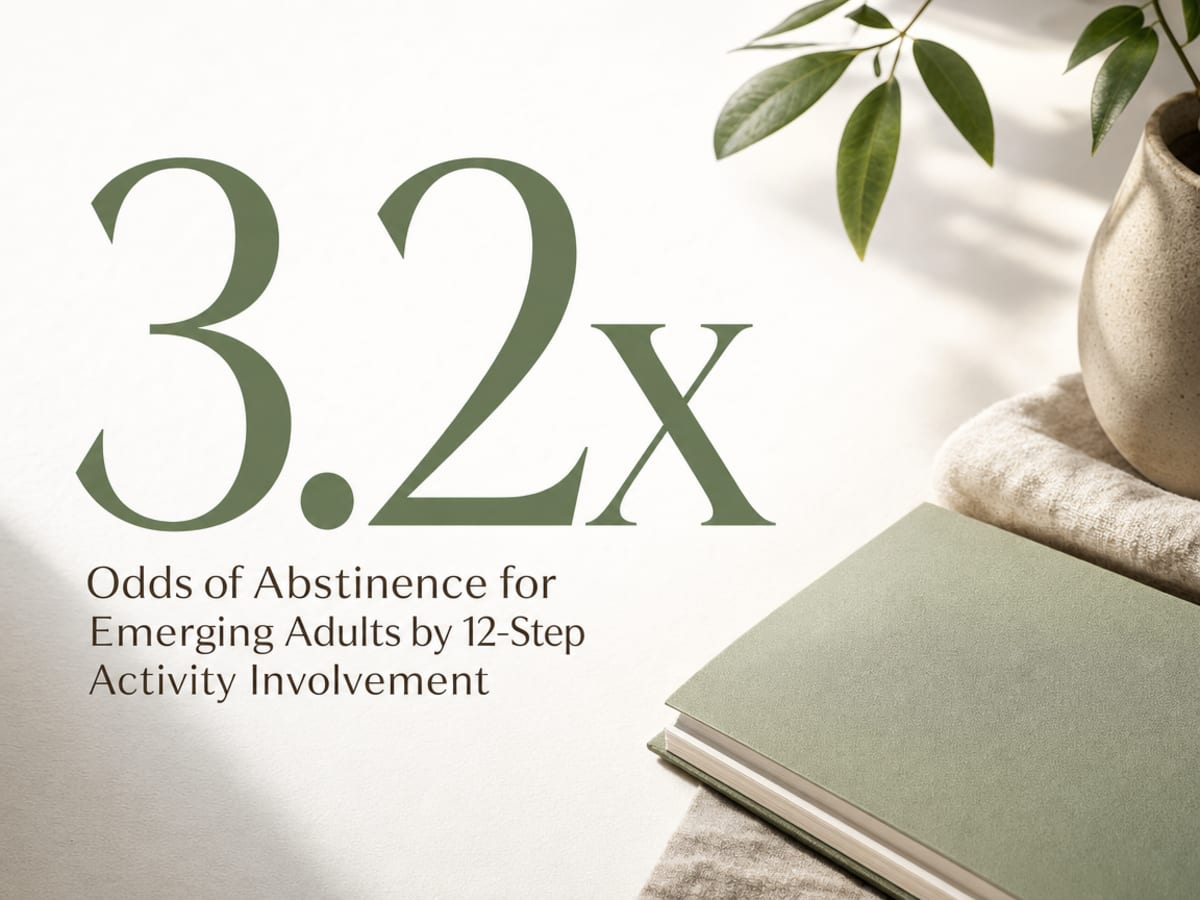
A study of emerging adults leaving residential treatment measured this directly. Compared to zero 12-step activities in a given week, the odds of abstinence were 1.3 times greater with one activity and 3.2 times greater with five weekly activities 4. That sample was 18 to 24, so the exact numbers may not translate cleanly to a 45-year-old in Little Rock, but the pattern shows up across the continuing care literature: more engagement, better outcome, especially when it is paired with professional care 11.
Five activities a week is not five meetings. It counts calling your sponsor, reading the literature, service work at your home group, and a step-work session. Stack small things. Skip the debate about which fellowship is best and go to the one you can walk into on a Tuesday night without talking yourself out of the car.
Recovery Capital: Housing, Work, Relationships, Body
Recovery capital is the boring word for the stuff that keeps you sober when the meeting is over and the therapist is off the clock. It is the sum of your resources: where you sleep, who you eat dinner with, whether you have a paycheck, whether your body works. Researchers have measured this directly. In a study of people leaving structured recovery residences, lower scores on a combined recovery factor, involuntary departures from housing, and younger age all predicted a higher likelihood of relapse 2. Translation: the men who lost stable footing were the men who slipped. The men who kept it did not.
Four buckets to audit this week.
Housing. Is where you sleep tonight actually sober? Not just clean of substances but clean of the people, the arguments, and the 2 a.m. chaos that used to send you looking? If the answer is no, a sober living house for 90 days is not a step backward. It is the single most protective move you can make.
Work. A paycheck is recovery capital. So is not being crushed by the wrong job. If your old work environment was a drinking culture or a pill culture, you are going back into the fire. Ask yourself honestly whether a lateral move buys you a year of stability.
Relationships. One honest person in your corner beats ten who are afraid to ask hard questions. Rebuild slowly with family. Repair takes months, not a weekend. Cut contact, at least temporarily, with the people whose main function in your life was using with you.
Body. Sleep, food, movement, and the dentist you have been avoiding. Physical health is not a bonus round. It is the platform everything else stands on. Walk 30 minutes a day. Eat something green. Get the labs done.
Audit each bucket. Pick the weakest one. Fix that first.
Pain, Opioids, and the Conversation You Have to Have With Every New Doctor
Sooner or later, something is going to hurt. A wisdom tooth. A torn rotator cuff. A kidney stone at 2 a.m. When it happens, the person holding the prescription pad may not know your history unless you say it out loud, and “I’m in recovery from substance use disorder” is a sentence you need to be able to deliver without flinching.
The CDC guideline is direct about this. Clinicians are advised to avoid prescribing opioids to patients with active or historical substance use disorder when possible, and to use risk-mitigation strategies if opioids are truly necessary 15. That is your leverage. Bring it up first, before the prescription is written, not after you are staring at a bottle on the kitchen counter.
Have a script ready. Tell any new dentist, surgeon, urgent care doc, or ER physician three things: you have a history of substance use disorder, you want non-opioid options first (acetaminophen, NSAIDs, nerve blocks, physical therapy), and if opioids are unavoidable, you want the shortest possible course with a specific stop date. Loop in your sponsor, your therapist, and one person at home before you fill anything. Pain is real. So is your history. Both facts belong in the room.
Wearables and mHealth: An Honest Look at What They Can and Can’t Do Yet
You have probably noticed that half the men leaving treatment now walk out wearing something on their wrist that tracks sleep, heart rate, and stress. That is not a gimmick. It is a category of tools that is starting to show up in the relapse-prevention literature, and it is worth knowing what the evidence actually says before you either overtrust it or dismiss it.
A 2020 systematic review of wearable and wireless mHealth technologies for substance use disorders concluded that these tools“can be used to decrease heavy substance use, mitigate factors related to relapse, and monitor for overdose”9. Biosensors can pick up on physiological signals tied to craving and stress. Smartphone check-ins can catch mood shifts and sleep disruption before they show up in a slip. Paired with a clinician who is actually looking at the data, that changes what relapse prevention can be.
Now the honest part. The same review flagged small sample sizes, limited long-term outcome data, and open questions about engagement, privacy, and data security 9. Translation: a wearable is not a sponsor and it is not a substitute for the four-layer stack. It is one more input, useful when a person you trust is reading the readings with you.
If You Slip: The Response Plan You Write Before You Need It
Write this plan now, sober, on paper. Not in your head. Not next month. This week, while the discharge is fresh and your judgment is intact. If a slip happens, you will not be in a state to think clearly, and you do not want to be inventing a response at 11 p.m. with a drink in front of you.
A slip is not the end of recovery. NIDA is direct about it: a return to use does not mean treatment failed, it means the plan needs to be reinstated or adjusted 10. That framing matters because the men who spiral hardest after a slip are usually the ones who decide the whole thing is over and stop calling anyone. Shame is the accelerant. The plan is the fire extinguisher.
Your one-page slip response should name three things. First, who you call in the first hour: sponsor, therapist, one trusted person at home, in that order. Second, where you go: back to a meeting that night, into your outpatient team the next morning, into detox if the use has gone past a single episode. Third, what changes in the plan going forward: more meetings, a medication review, a housing move, whatever piece was missing before the slip. Sign it. Give a copy to the person you would call first. A slip handled inside 24 hours rarely becomes a relapse. A slip you hide for a week almost always does.
Where to Start This Week
You do not have to build the whole year today. You have to build this week. Pull out the discharge folder. Put every appointment on one calendar. Text one person the schedule and give them permission to notice when something slips.
Then do four small things before Sunday. Confirm your outpatient start date. Fill every prescription. Sit in one meeting, even if you say nothing. Write your slip response plan on a single sheet of paper and hand a copy to the person you would call first.
That is it. Not motivation. Structure. The men who make it to year one are not the ones who feel the strongest on discharge day. They are the ones who kept the calendar honest when the feeling ran out. If you want a program built around that kind of scaffolding, Serenity Park is here when you need it.
Frequently Asked Questions
How long should continuing care last after residential rehab?
Longer beats shorter, and the effect size is meaningful. A review of continuing care research found that outcomes improve when interventions run longer and stay more intensive, with adaptive, extended models producing better substance use outcomes than brief follow-up 1. Plan for at least 12 months of active continuing care, not three, and step down deliberately rather than by drift.
Does a slip mean rehab didn’t work?
No. NIDA frames a return to use the same way a cardiologist frames a blood pressure spike: the plan needs to be reinstated or adjusted, not scrapped 10. What matters is what you do in the next 24 hours. Call your sponsor, call your outpatient team, get back in a meeting that night. Shame is what turns a slip into a full relapse.
How many meetings a week do I actually need?
Aim higher than one. In a study of emerging adults leaving residential treatment, five weekly 12-step activities were tied to 3.2 times greater odds of abstinence versus none 4. That sample skews young, but the dose-response pattern holds across the continuing care literature 11. Count sponsor calls, literature reading, and service work alongside meetings themselves. Stack the small stuff.
What if I have chronic pain and a doctor wants to prescribe opioids?
Tell the doctor your history before the pad comes out. The CDC guideline directs clinicians to avoid opioids for patients with active or historical substance use disorder when possible, and to use risk-mitigation strategies if opioids are truly necessary 15. Ask for non-opioid options first. If opioids are unavoidable, request the shortest course with a stop date and loop in your sponsor.
When is it safe to go back to work full-time?
Month two or three, in most cases, and only after your outpatient schedule is locked in as a fixed appointment on your work calendar. Aftercare attendance in the weeks right after residential is one factor that separates lower relapse and mortality from higher 5. If your old workplace was a drinking or pill culture, a lateral move buys you a year of stability.
Are recovery apps and wearables worth using?
Yes, as one input, not a replacement. A systematic review found wearable and wireless mHealth tools can help decrease heavy substance use, mitigate relapse factors, and monitor for overdose, though most studies remain small and early-stage 9. A wristband is useful when a clinician or sponsor is actually reading the data with you. It is not a substitute for meetings, medication, or your outpatient team.
References
- Impact of Continuing Care on Recovery From Substance Use Disorder. https://pmc.ncbi.nlm.nih.gov/articles/PMC7813220/
- Personal and Environmental Social Capital Predictors of Relapse Following Resolution of Substance Use Problems. https://pmc.ncbi.nlm.nih.gov/articles/PMC8549579/
- Patient adherence to multi-component continuing care discharge plans. https://pubmed.ncbi.nlm.nih.gov/28755773/
- The effects of continuing care on emerging adult outcomes following residential addiction treatment. https://pubmed.ncbi.nlm.nih.gov/26116368/
- Long-Term Outcomes After Residential Substance Use Treatment: Relapse, Morbidity, and Mortality. https://pubmed.ncbi.nlm.nih.gov/28051978/
- Randomized controlled trial of telephone monitoring with psychiatry inpatients with co-occurring substance use and mental health disorders. https://pubmed.ncbi.nlm.nih.gov/30466040/
- Contracting, prompting, and reinforcing substance use disorder continuing care: a randomized clinical trial. https://pubmed.ncbi.nlm.nih.gov/17874889/
- Continuing Care Research: What We’ve Learned and Where We’re Going. https://pmc.ncbi.nlm.nih.gov/articles/PMC2670779/
- Wearable and Wireless mHealth Technologies for Substance Use Disorders: A Systematic Review. https://pubmed.ncbi.nlm.nih.gov/33738178/
- Treatment Approaches for Drug Addiction DrugFacts. https://nida.nih.gov/publications/drugfacts/treatment-approaches-drug-addiction
- The Continuing Care Model of Substance Use Treatment. https://pmc.ncbi.nlm.nih.gov/articles/PMC4007701/
- The effectiveness of residential treatment services for individuals with substance use disorders: A systematic review. https://pubmed.ncbi.nlm.nih.gov/31254749/
- Facing Addiction in America: The Surgeon General’s Report on Alcohol, Drugs, and Health – Chapter 4: Early Intervention, Treatment, and Management of Substance Use Disorders. https://addiction.surgeongeneral.gov/sites/default/files/2016-12/chapter-4-treatment.pdf
- A randomized trial comparing telephone continuing care with group continuing care. https://www.ncbi.nlm.nih.gov/pmc/articles/PMC3860460/
- CDC Guideline for Prescribing Opioids for Chronic Pain (Selected Recommendations Relevant to Patients in Recovery). https://www.cdc.gov/drugoverdose/pdf/prescribing_guidelines_provider.pdf