
Key Takeaways
- Prior relapse after residential care usually reflects structural gaps, not personal failure—short intensive stays stabilize patients but rarely finish the work without a longer aftercare arc 6.
- Real integration means the same clinical team—psychiatrist, therapist, medical staff, case manager—meets weekly under one plan and one chart, not a referral relationship with an outside prescriber 2.
- Hold any program to SAMHSA’s six components: access, assessment, matched level of care, integration, comprehensive services, and continuity of care 3, with equal weight on what happens after discharge.
- Focus next on the aftercare architecture—named prescribers with scheduled handoffs, rapid re-assessment within days, self-monitoring skills, and continuing care groups tied back to the residential team 5.
Why the last program didn’t hold
If you’ve already been through detox and residential care more than once, you don’t need another article explaining what a co-occurring disorder is. You need an honest answer to a harder question: why didn’t the last stay hold?
The answer is rarely that you didn’t try hard enough. More often, it’s structural. The program treated your drinking or drug use in one track and your depression, anxiety, PTSD, or bipolar symptoms in another—maybe with a psychiatrist you saw twice, maybe with a therapist who only touched the addiction piece. That split is exactly what integrated treatment is designed to close. When the same clinicians address both conditions in one coordinated plan, outcomes improve across substance use, psychiatric symptoms, hospitalization, housing stability, arrests, and quality of life 2. When they don’t, you leave with half a treatment plan.
There’s a second structural reason, and it’s the one most programs won’t say out loud. Short intensive episodes—28, 45, even 90 days—consistently struggle with what happens after discharge. A large review of dual-diagnosis studies found that intensive integrated inpatient and residential programs had trouble retaining patients, and once discharged, relapse rates were high. The programs that produced substantial, sustained reductions in substance use and hospital admissions were the ones delivering comprehensive integrated care for 18 months or longer, tied tightly to continuing care 6.
That’s diagnostic information, not a verdict. The rest of this article walks through what to look for so the next decision is different.
What integration actually looks like inside a program
Every treatment website claims integrated care. The word has been drained of meaning by marketing. So set the label aside and ask an operational question instead: when you’re a patient in the building, who actually decides your care, and how often do they talk to each other?
The working definition is narrow and useful. Integrated treatment means the same clinicians, or the same team of clinicians, working in one setting, deliver both the mental health interventions and the substance use interventions in a coordinated plan 2. Not a referral relationship. Not a psychiatrist who consults from off-site twice a month. The psychiatrist who adjusts your medication sits in on the same treatment team meeting as the counselor running your process group and the case manager coordinating your discharge. They share one chart, one care plan, and one weekly conversation about how you’re actually doing.
That matters because half-integrated programs create a familiar failure pattern. The addiction side stabilizes while the psychiatric side drifts, or the psychiatric medications get dialed in while nobody on the clinical team is tracking how your cravings shifted when the dose changed. You’ve probably lived through some version of that.
When integration is real, the outcomes are measurable across six specific domains. Compared to non-integrated care, integrated treatment is linked to:
- reduced substance use
- improvement in psychiatric symptoms and functioning
- decreased hospitalization
- increased housing stability
- fewer arrests
- improved quality of life 2
Those aren’t marketing bullets. They’re the actual endpoints research tracks, and they’re the endpoints that describe whether your life gets more stable or keeps cycling.
A practical test: ask how the treatment team meets. If the answer is a weekly meeting where the psychiatrist, primary therapist, medical staff, and case manager review each patient together, you’re looking at a program built to deliver what the label promises. If the answer involves phrases like “we coordinate with an outside psychiatrist” or “our therapists refer for medication management,” you’re looking at parallel services with an integrated brochure. The umbrella review evidence is direct on this point: coordinated integrated treatment tends to outperform parallel, uncoordinated services for adults with substance use and common mental health conditions 8.
The setting matters too. Integration is harder to fake in a small residential program where the same clinical team sees you every day. It’s easier to fake in a larger facility where you rotate through specialty tracks and nobody owns the whole picture of your care. When you’re evaluating a program, the question isn’t whether they say the word. It’s whether the daily structure makes coordination unavoidable.
The six-component checklist to hold any program to
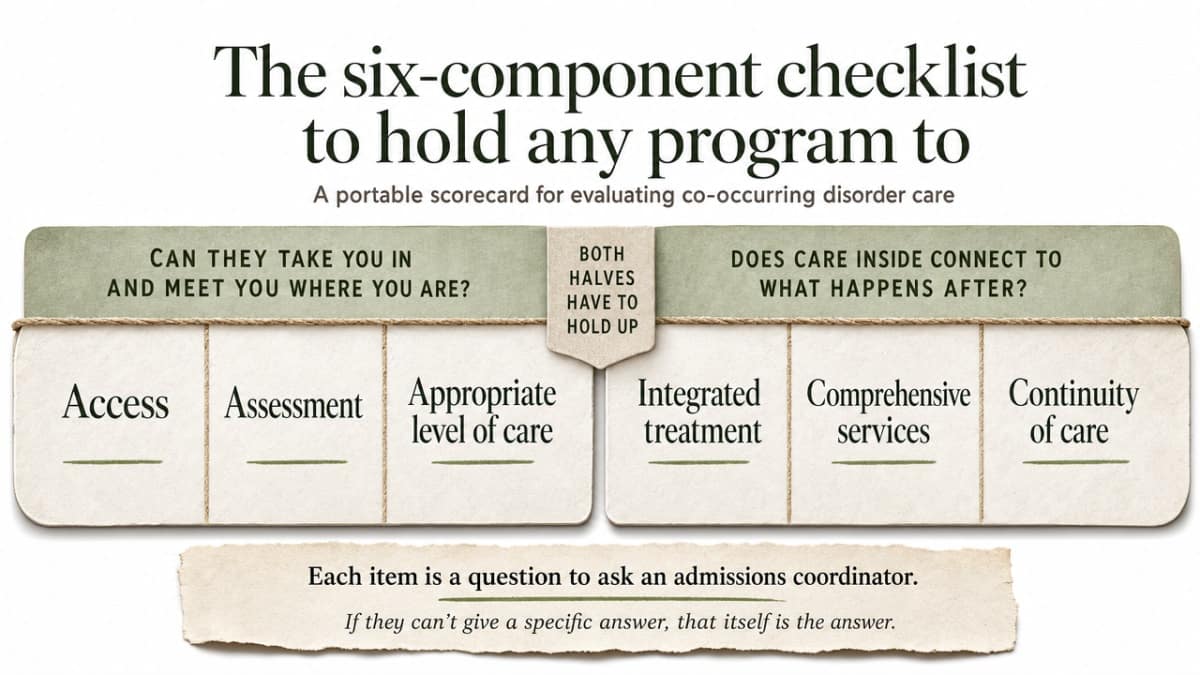
You need a scorecard, not another brochure. SAMHSA’s TIP 42 lays out six components that define competent care for co-occurring disorders, and you can use them as a portable evaluation tool: access, assessment, appropriate level of care, integrated treatment, comprehensive services, and continuity of care 3. Every item on that list is a question you can ask an admissions coordinator by phone. If they can’t give you a specific answer, that itself is the answer.
The first three components tell you whether the program can actually take you in and meet you where you are. The last three tell you whether what happens inside the building connects to what happens after. Both halves have to hold up.
Access, assessment, and matched level of care
Access sounds like a scheduling issue. It isn’t. Access means the program can bring you in during the window when you’re actually willing to come in—not two weeks from Tuesday. For someone with a relapse history, the gap between deciding and starting is where things fall apart. Ask how quickly a bed becomes available and what happens medically in the first 24 hours.
Assessment is where most programs quietly cut corners. A full assessment for co-occurring disorders means routine screening for mental health conditions in everyone entering SUD treatment, and routine screening for substance use in everyone entering mental health treatment 3. Not a checkbox on intake paperwork. A structured clinical evaluation that names the psychiatric conditions in play, maps their history, and connects them to your substance use patterns. If the assessment is done in 30 minutes by an intake counselor, the treatment plan built on top of it will be equally thin.
Matched level of care is the third question. Given what the assessment found, is residential the right setting right now—or do you need a higher acuity medical detox first, or a lower-intensity outpatient step? A program that admits everyone to the same track regardless of assessment is running a bed, not a clinical program.
Integration, comprehensive services, and continuity
Integration is the component you’ve already read about—same team, one setting, one coordinated plan. Comprehensive services is the one most programs underdeliver on. It means the program addresses the full range of what actually destabilizes recovery: psychiatric medication management, medical care, trauma treatment when relevant, family involvement, housing planning, employment or vocational support, and legal issues if they’re active. If your last stay treated the drinking and left the divorce, the eviction notice, and the untreated ADHD sitting in a pile for after discharge, that’s a comprehensive-services failure, not a willpower failure.
Continuity of care is where the whole framework either holds or collapses. TIP 42 treats continuity as a core component, not an afterthought 3. The question is whether the program has a defined pathway from residential to step-down to outpatient to peer support, with named clinicians and scheduled handoffs—not a discharge folder and a wish of luck.
Run the whole six-item list against any program you’re considering: access, assessment, level of care, integration, comprehensive services, continuity 3. If a program scores strongly on the first three and thinly on the last three, you’re looking at a good 30 days followed by the same cycle. Both halves.
Why short intensive stays keep failing you
Here’s the part that’s hard to sit with if you’ve been through this cycle a few times: the 30-day model isn’t broken because you’re broken. It’s broken because the evidence on short intensive stays has been mixed for a long time, and the field kept selling them anyway.
The clearest look at this comes from a synthesis of 36 studies on integrated treatment for people with co-occurring disorders. When researchers examined intensive integrated care delivered in inpatient, residential, and day treatment settings, they found two consistent problems:
- Retention was hard—patients with dual disorders struggled to stay engaged through short intensive episodes.
- Once discharged, relapse rates were high.
Adding brief dual-diagnosis groups or short intensive integrated stays to standard care produced what the reviewers bluntly called disappointing results 6.
The same review found something different for programs built on a longer horizon. Integrated treatment delivered comprehensively for 18 months or longer produced substantial reductions in substance use and meaningful reductions in hospital use 6. That’s not a small edit to the picture. That’s a completely different clinical outcome from a completely different structural design.
Read those two findings side by side and the pattern becomes obvious. Short intensive residential episodes stabilize you. They don’t finish the work. If prior stays followed the same shape—strong 28 or 45 or 90 days, followed by a thinning support structure—the design was set up to produce exactly what it produced. That’s not fatalism. It’s the argument for a different question when you evaluate the next program.
The question isn’t “how long is your residential stay.” It’s “what does the 18-month arc look like from admission to month eighteen?” A well-run residential program is the opening chapter of that arc, not the whole book. If the admissions team can walk you through the specific step-down levels, the named clinicians who pick up your care after discharge, and how continuing care groups tie back to the residential team, you’re looking at a program built for the duration the evidence supports. If the answer is a discharge folder and referrals to outside providers, you’re looking at another intensive episode with the same design flaw as the last one.
This reframes what “finding an effective co-occurring disorder treatment program” actually means. You’re not shopping for a bed. You’re evaluating whether a program owns your care across the arc that the research says actually changes trajectories. The residential piece matters. The scaffolding after it matters more.
Stage-wise treatment and why sequence matters
Integration alone doesn’t solve the problem. The other variable is where you are in your own recovery when a particular intervention shows up. A program that runs every patient through the same curriculum on day one—regardless of whether that patient is in acute withdrawal, ambivalent about quitting, or six weeks into stable engagement—is treating a room, not a person.
Stage-wise treatment matches the intervention to the stage. Early on, the work is engagement and stabilization: getting you medically safe, keeping you in the building, and building enough trust with the clinical team that you’ll tell them what’s actually happening. Persuasion comes next—the work of examining what substance use has cost and what change might look like—before active treatment begins in earnest. Relapse prevention and long-term maintenance come last, and they extend well past the residential episode. This is the sequence integrated care is designed to move you through, with the same team carrying the plan forward as your stage shifts 2.
Why does this matter for someone with a relapse history? Because programs that skip stages are the ones that leave you cold. If you arrived at a prior stay still ambivalent and the curriculum assumed you were ready for active behavioral work, you were being taught skills for a stage you weren’t in yet. If you were psychiatrically unstable and the program pushed group participation before medication was adjusted, the group didn’t take. That’s a sequencing failure, not a motivation failure.
A well-designed program tracks where you are and adjusts. Your treatment plan in week one shouldn’t look identical to your treatment plan in week six. The psychiatrist’s role shifts. Group content shifts. The case manager’s focus moves from stabilization to discharge architecture. Ask a program how the plan changes across the length of stay. If they describe a fixed curriculum every patient completes in the same order, they’re running a schedule. If they describe a stage-based framework the team adjusts weekly, they’re running clinical care 3.
The aftercare architecture that actually protects gains
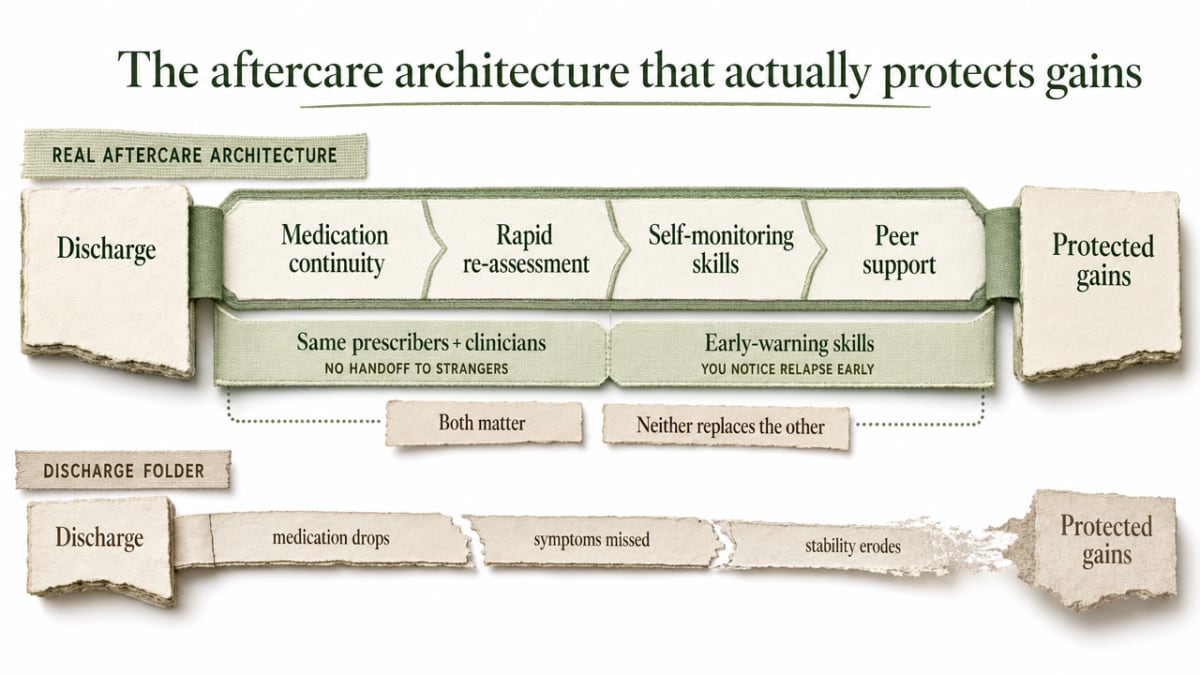
Everything up to this point—integration, stage-wise sequencing, the six components—is preparation for the part of care that decides whether the gains stick. Continuing services after discharge aren’t a nice add-on. Without them, medication management drops, symptoms recur without anyone noticing early, and the stability you built in residential erodes quickly 5.
A real aftercare architecture has two features you can inspect before you ever admit: prescribers and clinicians who don’t hand you off to strangers, and skills training that turns you into a reliable early-warning system for your own relapse. Both matter. Neither replaces the other. The subsections below break down what each one looks like when it’s built well and what to ask when you’re trying to tell the difference.
Medication continuity and rapid re-assessment access
The most preventable relapse pattern after discharge involves psychiatric medication. You leave residential stable on a working regimen. The bridge script runs out. The outside psychiatrist has a six-week wait. Symptoms return, sleep goes, and by week three you’re using again to manage what the medication was managing. That sequence is common enough that federal guidance names it directly: without continuity of services, medication management, and support after discharge, client stability and recovery are severely compromised 5.
A program with real aftercare architecture closes that gap before you leave the building. The prescriber who managed your medications in residential either continues seeing you or does a warm handoff to a named outpatient psychiatrist with an appointment already on the calendar—not a referral list. Prescriptions are written to cover the transition, not to expire mid-week.
The second piece is rapid re-assessment access. When symptoms recur, you need a clinician on the phone within days, not a portal message that gets returned next month. Continuing care guidance is specific on this: clients should be able to access assessment services rapidly when SUD or mental disorder symptoms return 5. Ask the program what the mechanism is. If the answer is a named clinician and a defined response window, you have something. If the answer is “call the main line,” you don’t.
Self-monitoring skills and peer support integration
The other half of aftercare is the work the program does to make you the first person who notices something is off. Relapse-prevention interventions should teach you to recognize the symptoms of SUD or mental disorder relapse on your own, use symptom management techniques when they show up, and reach out for assessment early 5. That’s not a lecture on triggers. It’s structured skill-building over the length of stay—identifying your specific early signs, practicing what you do when you notice them, and rehearsing the exact call you’ll make to the exact person.
Peer support belongs inside that architecture, not next to it. AA and NA meetings, alumni groups, and continuing care groups linked back to the residential team give you weekly contact with people who can see changes you might miss in yourself. Given the chronic and cyclical pattern of co-occurring disorders, continuing care after residential services helps preserve the stability and functioning you built 4.
Staying engaged in a continuing care group for six months after discharge is the kind of thing that changes trajectories. Not because the group is magic, but because it keeps you inside a system that catches drift early. That’s the whole point of the architecture.
Trauma, PTSD, and the honest limits of integration
If trauma is part of your history—combat, assault, childhood abuse, an accident that still lives in your body—you’ve probably been told that treating PTSD and substance use together is the answer. That’s mostly right. It’s also more complicated than the marketing suggests, and you deserve the honest version.
The guideline direction is clear. Current VA/DoD clinical practice guidance advises that comorbidity should be taken into consideration and that concurrent treatment of comorbid conditions appears effective, particularly for PTSD and SUD together. Substance use should not automatically preclude treatment for a co-occurring condition 10. Translation: a program that tells you to get sober first and address the trauma later, or vice versa, is running an outdated protocol. The two conditions feed each other, and treating them in parallel silos leaves the feedback loop intact.
Here’s the part that gets left out of program descriptions. A systematic review comparing integrated trauma-addiction programs with non-integrated comparators found that both approaches reduced trauma and substance use symptoms, but there was little evidence that integrated programs conferred additional benefits over non-integrated ones at longer follow-up 9. Symptom improvement happened either way. Clear superiority for integration didn’t show up the way it does for other co-occurring patterns.
That’s not a reason to avoid integrated trauma care. It’s a reason to ask sharper questions. What specific trauma-focused modality does the program deliver, who is trained to deliver it, and at what stage of your stay does it start? Trauma work pushed too early, before medication and stabilization are in place, tends to destabilize rather than heal. A program that names its trauma approach and sequences it thoughtfully is doing the work. A program that lists “trauma-informed care” as a bullet without specifying what happens clinically is using a label.
Questions to ask before you commit to a bed
By the time you’re on the phone with an admissions coordinator, you’ve earned the right to be specific. Vague answers are the tell. Below is a short list you can work through in a single call. Take notes on the answers, not the reassurances.
How does the treatment team meet, and who’s in the room? You’re listening for a weekly clinical meeting that includes the psychiatrist, primary therapist, medical staff, and case manager reviewing each patient together. If the psychiatrist is off-site or consulting from a distance, integration is a label, not a structure 2.
What does the initial assessment actually cover, and how long does it take? You want routine screening for mental health conditions built into intake, not layered on later, with a structured evaluation that names the psychiatric conditions in play and maps their history against your substance use 3.
How does the treatment plan change from week one to week six? A stage-based framework the team adjusts as you stabilize is clinical care. A fixed curriculum every patient completes in the same order is a schedule.
Who prescribes my medications after discharge, and when is that appointment scheduled? The answer should be a named clinician with a date on the calendar before you leave the building, not a referral list. Without medication continuity and support after discharge, stability erodes quickly 5.
If symptoms return in month two, who do I call, and how fast can I be re-assessed? Look for a named clinician and a defined response window measured in days 5.
What does month six look like for someone who completed your program? If the program can describe the continuing care group, the step-down levels, and how alumni stay connected to the residential team, they’re building for the arc the evidence supports 6. If the answer is a folder and a phone number, you already know how that ends.
You’ve been through this before. That’s not a liability in this conversation—it’s the reason you can hear the difference between a program that owns the whole arc of your care and one that owns thirty days.
Frequently Asked Questions
What makes a co-occurring disorder treatment program truly integrated rather than just labeled that way?
Integration means the same clinicians or team, in one setting, deliver both mental health and substance use interventions under a single coordinated plan 2. The operational test: does the psychiatrist, primary therapist, medical staff, and case manager meet weekly to review your care together, sharing one chart? If the program “coordinates with an outside psychiatrist” or refers out for medication management, that’s parallel services with an integrated label.
If I’ve relapsed after residential treatment before, does that mean integrated care won’t work for me either?
No. Prior relapse often reflects a structural gap, not a personal failure. Research shows short intensive residential episodes struggle with retention and post-discharge relapse, while integrated care delivered comprehensively for 18 months or longer produces substantial reductions in substance use and hospital use 6. If your last stays ended with a discharge folder and a phone number, the design stopped short of the arc that actually holds gains. That’s diagnostic, not a verdict.
How long should a co-occurring disorder treatment program last to produce durable results?
The residential episode itself is only the opening chapter. Evidence favors integrated treatment sustained across roughly 18 months or longer when linked tightly to continuing care, showing meaningful reductions in substance use and hospitalization 6. Ask a program to walk you through what admission through month eighteen looks like—residential, step-down, outpatient, continuing care groups, named clinicians at each stage. If they can only describe the first 30 to 90 days, the arc is incomplete.
What should aftercare look like after discharge from a residential dual diagnosis program?
Two features matter most. Medication continuity: the prescriber who managed you in residential either continues or does a warm handoff to a named outpatient psychiatrist with an appointment on the calendar before you leave. Rapid re-assessment: when symptoms return, a named clinician responds within days 5. Layered on top: relapse-prevention skills that make you the first to notice drift, and peer support groups tied back to the residential team 5.
Is integrated treatment always better for PTSD combined with substance use?
Concurrent treatment is the guideline direction—VA/DoD guidance advises that substance use shouldn’t preclude treating a co-occurring condition, particularly PTSD and SUD 10. But a systematic review comparing integrated trauma-addiction programs with non-integrated ones found both approaches reduced symptoms, with little evidence that integration conferred additional long-term benefits 9. Ask sharper questions: which trauma-focused modality, who’s trained to deliver it, and when in your stay does it start relative to stabilization?
What specific questions should I ask a program before admission?
Six direct ones. How does the treatment team meet and who’s in the room? What does the initial assessment cover, and does it routinely screen for both conditions 3? How does the treatment plan change from week one to week six? Who prescribes my medications after discharge, and when is that appointment scheduled? If symptoms return in month two, who do I call and how fast can I be re-assessed 5? What does month six look like?
References
- Integrated Treatment for Co-Occurring Disorders: Building Your Program. https://library.samhsa.gov/sites/default/files/ebp-kit-building-your-program-10112019.pdf
- Integrated Treatment for Co-Occurring Disorders: The Evidence. https://library.samhsa.gov/sites/default/files/ebp-kit-the-evidence-10242019.pdf
- TIP 42: Substance Use Disorder Treatment for People With Co-Occurring Disorders (2020). https://library.samhsa.gov/sites/default/files/SAMHSA_Digital_Download/PEP20-02-01_004.pdf
- Chapter 7—Treatment Models and Settings for People With Co-Occurring Disorders. https://www.ncbi.nlm.nih.gov/books/NBK571024/
- Recommendations for Continuing Care Following Discharge From Residential Treatment. https://www.ncbi.nlm.nih.gov/books/NBK571024/box/ch7.b21/
- Review of integrated mental health and substance abuse treatment for patients with dual disorders. https://pubmed.ncbi.nlm.nih.gov/9853791/
- Integrating Treatment for Co-Occurring Mental Health Conditions. https://pmc.ncbi.nlm.nih.gov/articles/PMC6799972/
- Effectiveness of Psychosocial Interventions for Adults With Substance Use Disorder That Have a Co-Occurring Common Mental Health Disorder: An Umbrella Review. https://pubmed.ncbi.nlm.nih.gov/41192364/
- Integrated treatment programs for individuals with concurrent substance use disorders and trauma experiences: a systematic review and meta-analysis. https://www.ncbi.nlm.nih.gov/books/NBK84755/
- Evidence Brief: Treatment of Comorbid Conditions. https://www.hsrd.research.va.gov/publications/esp/comorbid-conditions-brief.pdf