
Smart Recovery vs AA: Which Is Better for Privacy?
Key Takeaways
- Outcomes research shows involvement in any mutual-help group predicts abstinence more than the specific program chosen, so the real decision is about exposure, not efficacy 4.
- Judge AA and SMART on four privacy axes: identity exposure, disclosure depth, sponsorship intimacy, and medication stigma — each maps to a real moment you’ll face.
- SMART’s facilitator-led CBT format bounds what you share to skills and behaviors, but its rooms skew toward employed, college-educated professionals who may mirror your peer group 1, 3.
- AA’s meeting density — roughly 60-to-1 over SMART in major metros — lets you pick distant rooms and rotate locations, but sponsorship asks for detailed personal history held by a peer, not a clinician 3, 9.
- Neither program is covered by HIPAA or 42 CFR Part 2, so keep clinically sensitive history with your therapist and attorney, and don’t let privacy fear push you into attending nothing 7, 9.
The real question isn’t which program works — it’s which one leaks
You already know what AA is. You already know what SMART Recovery is. What you’re actually trying to figure out, sitting in your office at 9pm with the door closed, is which one is less likely to end up as a conversation your managing partner has with HR, or a note in your licensing file, or a whisper at your kid’s school pickup.
That’s a legitimate question. You’re right to ask it before your first meeting, not after.
Here’s the honest starting point: when researchers actually measure outcomes, involvement in a mutual-help group predicts abstinence and fewer alcohol problems — and the specific group you pick matters less than whether you show up and engage 4. So you can stop treating this as a hunt for the “better” program. Both work when you work them.
The real variable is exposure. AA and SMART create very different shapes of risk. One leans on a dense fellowship network, sponsorship, and shared personal narrative. The other leans on trained facilitators, CBT worksheets, and bounded skills talk. Neither is covered by HIPAA. Neither is covered by 42 CFR Part 2 7, 9. Both rely on peer norms to hold your name.
That means your job here isn’t to pick a winner. It’s to map each model against your actual threat surface — and choose the combination that keeps you in the room without putting your career on the table.
Four privacy axes to judge either program against
Instead of asking which program is “safer,” break the question into four things you can actually see and score. Each one maps to a real moment you’ll face in a meeting.
- Identity exposure.
- Who else is in the room, and how likely is one of them to know your face? SMART’s participant profile skews toward higher-income, college-educated, employed, married adults with less severe alcohol involvement 1. That’s your professional peer group. It means the SMART room is statistically more likely to contain someone from your world — the parent from your kid’s school, the partner from a competing firm. AA rooms are more demographically mixed, which cuts the odds of recognition in some settings and raises them in others depending on where you sit.
- Disclosure depth.
- How much of your personal narrative are you expected to share out loud? AA leans on peer-led sharing rounds where lived experience is the currency. SMART is facilitator-led and organized around CBT tools and worksheets, which tends to bound talk to behaviors, urges, and skills 3. Same room energy, different scripts.
- Sponsorship intimacy.
- AA culture asks you to build a one-on-one relationship with a sponsor who knows your history in detail. SMART does not have a formal sponsorship structure 1. That’s a different kind of trust to hand out.
- Medication stigma.
- If you’re on naltrexone, buprenorphine, or a psychiatric med, how safe is it to say so? SMART is explicitly medication-neutral. Some AA and NA settings still carry stigma around medication-assisted treatment, and that stigma has been linked to people quietly stopping their meds against medical advice 8. That’s a safety issue, not just a comfort one.
Score each program against your own answers on all four before you walk in. You’re not looking for a winner. You’re looking for the combination that lets you stay in the room honestly, without handing over more than the recovery requires.
Who’s actually sitting in the room with you
Before you decide, look around the room — figuratively. The people already there shape your exposure more than the format on the whiteboard.
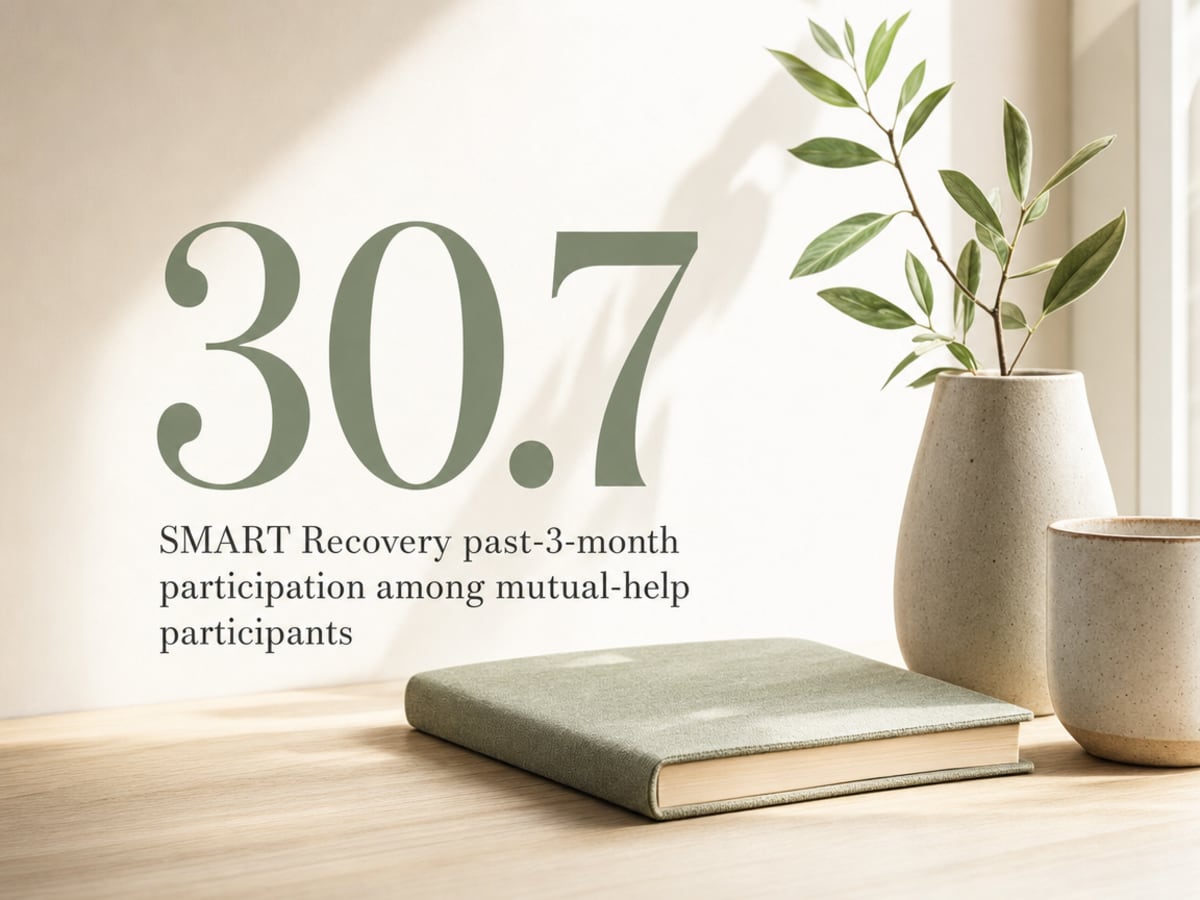
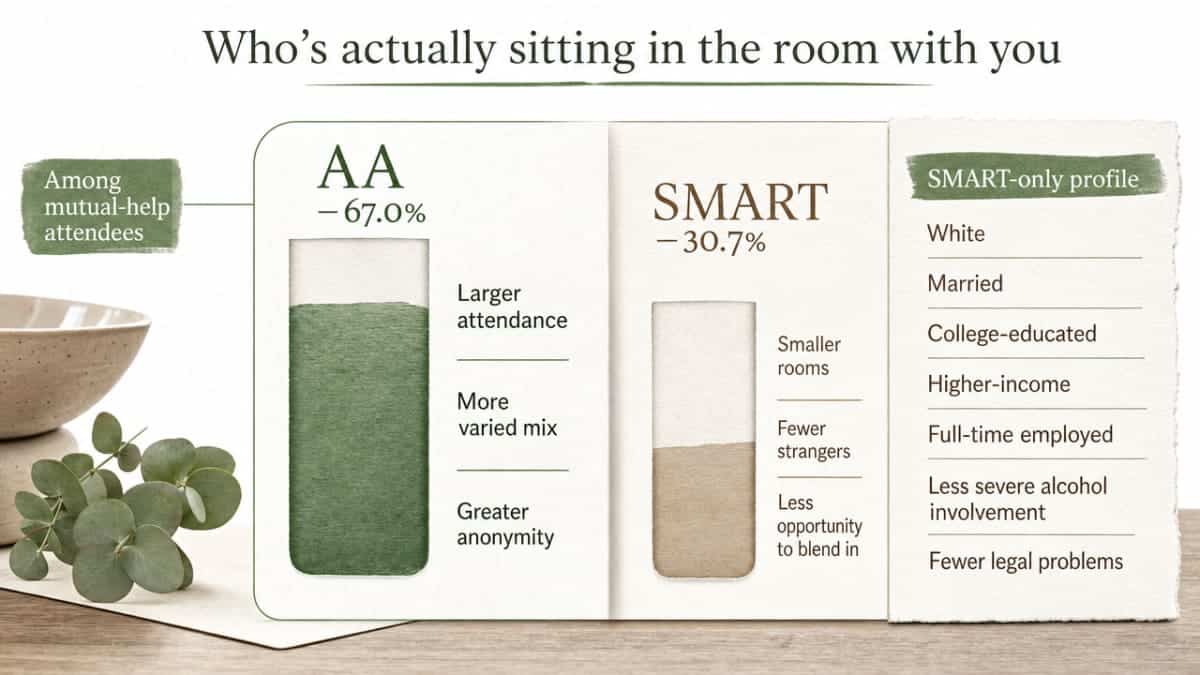
Research on 361 adults with alcohol use disorder found that among those attending any mutual-help group, roughly 67.0% had attended AA in the past three months, compared with 30.7% for SMART 1. This gap indicates that AA has a larger and more varied attendance, which can offer greater anonymity through sheer volume. Conversely, SMART rooms are smaller, meaning fewer strangers but also less opportunity to blend in.
The same study found SMART-only attendees skewed disproportionately White, married, college-educated, higher-income, and full-time employed, with less severe alcohol involvement and fewer legal problems than AA participants 1. This demographic sketch of SMART attendees often mirrors the professional peer group of individuals concerned about privacy.
Statistically, a SMART meeting is more likely to contain someone from your professional circle than a typical AA meeting. This isn’t a reason to avoid SMART, but rather to carefully select your specific meeting based on location, time of day, and whether it’s in a professional corridor or a quieter area.
AA’s extensive network allows you to attend meetings far from your professional and social circles, such as a 6:30 am meeting in a different neighborhood. This geographical flexibility is a significant privacy advantage.
For SMART, a similar strategy involves attending online meetings hosted outside your metro area or choosing a facilitator-led group in a suburb your peers don’t frequent. The principle remains the same: strategic use of geography and timing enhances privacy.
The choice isn’t between “private” and “exposed,” but rather which specific meeting, on which night, in which zip code, best aligns with your privacy needs, informed by who statistically attends where.
AA’s network depth is a feature and a risk
AA’s long history since 1935 has resulted in a vast number of meetings, which is the most significant structural difference impacting discretion. For example, within a 45-minute drive of downtown Boston, there are 1,800 AA meetings a week compared with just 30 SMART meetings 3. This 60-to-1 ratio is typical in most major metropolitan areas and dictates practical possibilities.
The advantage of this density is selectivity. You can choose a 6:15 am meeting in a working-class neighborhood 25 minutes from your office, minimizing the chance of encountering colleagues. AA also offers specialized meetings, such as those for lawyers or physicians, developed over decades. You can rotate meetings to avoid any single room learning your full pattern, and attend meetings in any city while traveling. SMART’s smaller footprint does not offer this level of maneuverability.
However, this density also presents a risk. AA meetings are often held in locations that intersect with professional life—a church basement near your office, a hospital community room, or a courthouse wing. While AA culture emphasizes anonymity, this tradition is a peer norm, not a legally binding contract 9.
To mitigate this risk, use AA’s density strategically. Avoid meetings closest to your office. Drive further than convenient. Choose times when your peer group is occupied elsewhere. AA’s widespread presence, while a potential privacy weakness, can also be leveraged to enhance your anonymity.
SMART’s facilitator model bounds what you say
SMART meetings are structured differently from the outset. They typically have an agenda, are run by a trained facilitator, and focus on specific tools like cost-benefit analyses, ABC worksheets, or disputation exercises.
This structure inherently limits the scope of personal disclosure. Discussions in a SMART room remain focused on behaviors, triggers, and skills. You can discuss a challenging week without revealing specific client details or describe an urge without naming your workplace. The CBT framework allows you to address recovery mechanics without delving into personal biography 3.
The Harvard Health review highlights this contrast, noting that SMART’s facilitator-led format tends to reduce the detailed personal narratives, or “drunkalogues,” common in peer-led AA sharing rounds 3. The emphasis is on doing the work, not recounting your life story.
This bounded disclosure was a key factor valued by participants in qualitative research, who appreciated the science-based content, even if they stayed for the camaraderie 2. While the facilitator is not bound by confidentiality laws like a clinician 9, the structural format itself guides conversations towards skills rather than personal stories, offering a practical privacy benefit.
For professionals, this structural boundary is crucial. You can practice recovery skills without disclosing your firm’s name, your specialty, or your board affiliations.
Sponsorship: the intimate relationship AA asks for and SMART doesn’t
Sponsorship in AA is a deeply personal aspect that can raise significant privacy concerns. The tradition involves finding a more experienced member to guide you through the program, often requiring a detailed account of your drinking history, resentments, fears, and a written moral inventory. This process is fundamental to AA’s methodology.
For career-exposed individuals, this can be particularly unsettling. A sponsor is a peer, not a legal or medical professional, yet they hold a comprehensive record of your past behaviors. While AA’s anonymity ethos is strong, it remains a norm upheld by an individual, not a legally privileged relationship 9.
SMART Recovery does not have an equivalent sponsorship structure. There is no expectation to pair with an experienced member and share your personal history 1. Support within SMART meetings is facilitated and centered on tools rather than personal testimony.
If sponsorship intimacy is a major concern, there are ways to navigate it within AA. Take ample time to choose a sponsor, perhaps months. Seek out closed professional meetings where sponsors understand the risks associated with licensure and disclosure. Some individuals choose to work with a clinical therapist for in-depth historical work, using a sponsor primarily for step guidance. This approach is a legitimate configuration, not merely a workaround, and helps keep sensitive information within privileged professional relationships.
Medication stigma and the safety of concealment
For individuals on medications like naltrexone, buprenorphine, antidepressants, or ADHD medication, the issue of medication stigma is paramount. This is not merely about comfort but about clinical safety, as concealing prescribed medication can have serious health consequences.
Research indicates that some AA and NA groups still stigmatize medication-assisted treatment (MAT). This stigma has been linked to individuals discontinuing opioid agonist therapy against medical advice 8. This represents a significant risk, potentially leading individuals to relapse by abandoning medically necessary treatment to conform to group ideology.
SMART Recovery explicitly maintains a medication-neutral stance. You can disclose your use of prescription medication without it being viewed as a lesser form of sobriety. AA’s culture, however, varies considerably by meeting; some rooms are fully MAT-supportive, while others are not, and this can only be determined by attending.
What confidentiality you actually have (and don’t)
It’s crucial to understand that neither AA nor SMART Recovery are healthcare providers or federally assisted treatment programs. Consequently, they are not covered by HIPAA or 42 CFR Part 2, the stricter federal rule governing substance-use records in clinical settings 7. The confidentiality protections that apply to your residential treatment, prescriber, and therapist do not extend to mutual-help meetings.
Confidentiality in these settings relies on a peer norm. While AA has a strong anonymity ethos, it is a social contract among peers, not a legally enforceable privilege. If someone in a meeting chooses to disclose what you’ve shared, there is no federal statute to provide recourse 9.
This has two practical implications. First, sensitive clinical information—such as details that could impact a licensing complaint, custody dispute, or partnership review—should be reserved for your therapist, physician, and attorney, who are bound by confidentiality laws. Use mutual-help groups for peer support, and professional relationships for legally protected records.
Second, if a treatment program refers you to a mutual-help group, the program itself remains bound by Part 2, but the group does not 7. It is advisable to ask your discharge planner precisely what information will be shared, with whom, and what forms you need to sign. A reputable program will provide this information in writing.
Online meetings are their own exposure category
Since 2020, both AA and SMART have expanded their online presence, with SAMHSA listing both as offering virtual options 11. While this provides accessibility, it also introduces distinct privacy risks compared to in-person meetings.
In-person privacy primarily concerns who is physically present. Online privacy extends to your Wi-Fi network, device security, and the potential for link reuse.
Regarding physical space, HHS guidance for telehealth is highly relevant: attend from a private location, use headphones, and avoid home offices where family or assistants might overhear 12, 13. Be aware that your IT team may monitor platforms accessed from work devices if you log in from the office.
On the technical front, NIST warns against reusing login credentials across virtual meetings due to eavesdropping risks. They recommend disabling your camera and microphone before joining 14. Use a unique account for recovery meetings, and avoid signing in with work or shared personal IDs.
Your display name is a direct disclosure. Use only your first name, or a pseudonym. Avoid including a last initial that could be linked to your city.
It’s important to reiterate that mutual-help groups are not HIPAA-covered, and this status does not change when meetings move online 9. Recovery participation, if exposed and linked to your name, becomes personally identifiable information, which NIST classifies as sensitive data 15. Protect it accordingly.
The ‘Neither’ trap — when privacy fear costs you the outcome
A common pitfall is to become so focused on privacy concerns that you avoid both AA and SMART Recovery. After weighing the pros and cons—sponsorship intimacy versus smaller room size, meeting density versus demographic overlap—some individuals conclude that the risks outweigh the benefits for both programs and choose to do nothing.
This avoidance is often the worst possible outcome. Qualitative research indicates that adults who chose neither AA nor SMART frequently cited anxiety about privacy as their reason for abstaining. These individuals often continued to struggle with changing their drinking habits independently, lacking the peer support that is strongly correlated with better outcomes 2. Involvement in any mutual-help group predicts abstinence and fewer alcohol problems; opting out predicts the opposite 4.
Examine your hesitation carefully. If the thought “neither feels safe enough” arises, it may be prioritizing career protection at the expense of recovery. A career built on a fragile recovery is not truly protected.
Instead of avoidance, channel this anxiety into making structural choices: selecting a different meeting, a different zip code, a different format, or opting for online instead of in-person. The goal is to remain engaged in a supportive environment, strategically choosing the environment that best suits your needs.
Building a hybrid stack that fits your threat model
Many professionals who successfully protect their recovery do not commit to a single program but instead build a hybrid approach.
This typically involves using residential programs for clinical work—detox, dual diagnosis, and therapy covered by confidentiality laws. Your prescriber and therapist manage medication and in-depth personal history. Peer support is then layered on top, chosen deliberately for its benefits and potential exposure risks.
A common configuration for a career-exposed individual might include SMART for weekly skills work, perhaps in a closed professional meeting or an out-of-metro online group, allowing for CBT tool practice without extensive biographical disclosure. AA can be utilized for its meeting density and long-term fellowship, attending meetings geographically distant from work and social circles, with sponsorship deferred until you’ve observed the group for an extended period. Both formats are generally free and available in-person and online 11, 16, making fit, rather than cost, the primary consideration.
It is appropriate to approach this process thoughtfully. Asking these questions before engaging is a sign of a well-considered strategy.
Frequently Asked Questions
Is SMART Recovery more private than AA?
Not automatically. SMART’s facilitator-led, CBT-based format tends to bound talk to skills and behaviors rather than personal history, which limits what you’re expected to disclose 3. However, SMART rooms are smaller and its participant base skews toward employed, college-educated professionals 1—meaning the person next to you may look a lot like you. Privacy depends on the specific meeting, not just the program brand.
Do I have to get a sponsor and share my full story at AA?
No one can force you. However, sponsorship is central to how AA works, and the relationship traditionally involves detailed personal history and a written moral inventory. You can take months choosing a sponsor, look for closed professional meetings, and keep the deepest clinical work with your therapist. This approach is a legitimate configuration—not a workaround—and it keeps the record in privileged hands.
Are AA and SMART Recovery meetings protected by HIPAA or 42 CFR Part 2?
No. Neither program is a healthcare provider or a federally assisted treatment program, so neither HIPAA nor 42 CFR Part 2 applies to what happens in the room 7. What you have is a peer norm—strong in AA’s anonymity tradition, but not a legal privilege 9. Keep clinically sensitive history with your therapist, prescriber, and attorney, where confidentiality law actually attaches.
Will I be judged at AA or SMART for being on medication like naltrexone or buprenorphine?
SMART is explicitly medication-neutral, so disclosure there is generally safe. AA varies meeting by meeting—some rooms are fully supportive of medication-assisted treatment, others still carry stigma, and that stigma has been linked to people quietly stopping prescribed medication against medical advice 8. Never adjust your protocol to fit a peer group’s ideology. Pick the meeting that matches your prescriber’s plan.
How do I protect my identity in online recovery meetings?
Take the call from a private location, use headphones instead of speakerphone 12, and turn off your camera and microphone before joining 14. Create a unique account with credentials you don’t reuse anywhere else 14. Use a first-name-only display name that doesn’t pair with your city. Recovery participation counts as sensitive personal data the moment it’s tied to your identity 15.
Can I attend both AA and SMART, or do I have to pick one?
You can absolutely attend both, and many professionals do. Dual attendance is common enough that researchers study it as a distinct pathway 1. Both formats are typically free and available in-person and online 11, 16, so cost isn’t the gating variable—fit is. Use SMART for structured skills work, AA for meeting density and long-run fellowship, and layer them around your threat model.
References
- Who affiliates with SMART Recovery? A comparison of individuals attending SMART Recovery, Alcoholics Anonymous, both, or neither. https://pmc.ncbi.nlm.nih.gov/articles/PMC10605873/
- A systematic qualitative study investigating why individuals attend, and what they like, dislike, and find most helpful about, SMART Recovery, Alcoholics Anonymous, both, or neither. https://pmc.ncbi.nlm.nih.gov/articles/PMC11090757/
- Want to stop harmful drinking? AA versus SMART Recovery. https://www.health.harvard.edu/blog/want-to-stop-harmful-drinking-aa-versus-smart-recovery-202409053068
- A Longitudinal Study of the Comparative Efficacy of Women for Sobriety, LifeRing, SMART Recovery, and 12-step Groups for those with AUD. https://pmc.ncbi.nlm.nih.gov/articles/PMC5884451/
- An investigation of SMART Recovery: protocol for a longitudinal cohort study of individuals making a new recovery attempt from alcohol use disorder. https://pmc.ncbi.nlm.nih.gov/articles/PMC9900056/
- A Systematic Review of SMART Recovery, LifeRing, and Women for Sobriety Mutual Help Groups for Alcohol Use Disorders: Outcomes, Moderators, and Mechanisms of Change. https://minds.wisc.edu/items/eec4f7a4-4c15-4224-8d8a-4654682a4788
- A Crosswalk Between the Final HIPAA Privacy Rule and Existing Federal Substance Abuse Confidentiality Requirements. https://hsrc.himmelfarb.gwu.edu/cgi/viewcontent.cgi?article=1007&context=sphhs_policy_briefs
- Effectiveness of Mutual Help Groups for Illicit Drug Use Disorders: A Review of the Current Literature. https://pmc.ncbi.nlm.nih.gov/articles/PMC12360454/
- Mutual-help groups for alcohol and other substance use disorders: Benefits and limitations (Addiction Science & Clinical Practice). https://www.ncbi.nlm.nih.gov/pmc/articles/PMC3860544/
- National Helpline for Mental Health, Drug, Alcohol Issues. https://www.samhsa.gov/find-help/helplines/national-helpline
- Find a support group for mental health, drugs, alcohol. https://www.samhsa.gov/find-support/health-care-or-support/support-group-or-local-program
- Telehealth Privacy and Security Tips for Patients. https://www.hhs.gov/hipaa/for-professionals/privacy/guidance/telehealth-privacy-security/index.html
- Guidance on How the HIPAA Rules Permit Covered Health Care …. https://www.hhs.gov/hipaa/for-professionals/privacy/guidance/hipaa-audio-telehealth/index.html
- Preventing Eavesdropping and Protecting Privacy on Virtual Meetings. https://www.nist.gov/blogs/cybersecurity-insights/preventing-eavesdropping-and-protecting-privacy-virtual-meetings
- NIST Special Publication 800-122, Guide to Protecting the Confidentiality of Personally Identifiable Information (PII). https://csrc.nist.gov/pubs/sp/800/122/final
- Recovery-Oriented Mutual Self-Help Groups. https://www.va.gov/WHOLEHEALTHLIBRARY/docs/Recovery-Oriented-Mutual-Self-Help-Groups.pdf