
Key Takeaways
- Verify the program’s Arkansas DHS license, accreditation, and an actual weekly schedule that meets the 28-hour structured treatment minimum before considering admission 1, 3.
- Insist that placement recommendations reference specific ASAM dimension scores rather than marketing tiers, since residential is not automatically superior to intensive outpatient for every patient 6, 11.
- Confirm the program prescribes evidence-based AUD medications like naltrexone, acamprosate, and disulfiram, and delivers named psychosocial therapies with integrated dual-diagnosis capability 4.
- Press on what ‘men’s program’ actually means clinically, including how the program handles careers, employer communication, and co-occurring psychiatric conditions rather than aesthetics 8, 4.
- Demand a written discharge plan naming continuing care, prescribers, and first appointments, and judge any wearable monitoring as an emerging adjunct rather than proven outcome improvement 4, 9, 10.
What due diligence looks like when the vendor is a treatment program
You have probably run harder diligence on a software vendor than most families run on a rehab. That is not a criticism. It is the situation. When your career, your marriage, and your liver are all on the line, the temptation is to pick the facility with the best photography and the fastest intake call, then hope. Hope is not a plan.
Treat this the way you would treat any serious professional decision. A men’s alcohol treatment program is a licensed medical vendor operating under state regulation, delivering a specific set of clinical services, at a specific intensity, with measurable inputs you can verify before you admit. In Arkansas, adult residential substance use disorder facilities must be licensed by the Department of Human Services and meet defined standards for staffing, documentation, and structured treatment hours 1, 3. That gives you an audit baseline. Every program you consider either meets it or does not.
The five steps below are a vetting sequence, not a pep talk. You will:
- verify licensure and weekly treatment hours;
- match level of care to ASAM dimensions instead of to a marketing tier;
- confirm the clinical practices are evidence-based;
- test how the program handles men, careers, and co-occurring conditions;
- and pressure-test what happens after discharge, including any wearable monitoring the program markets.
If you have been through treatment before and it did not hold, this is where the difference gets made.
Step 1: Verify licensure and the actual weekly treatment hours
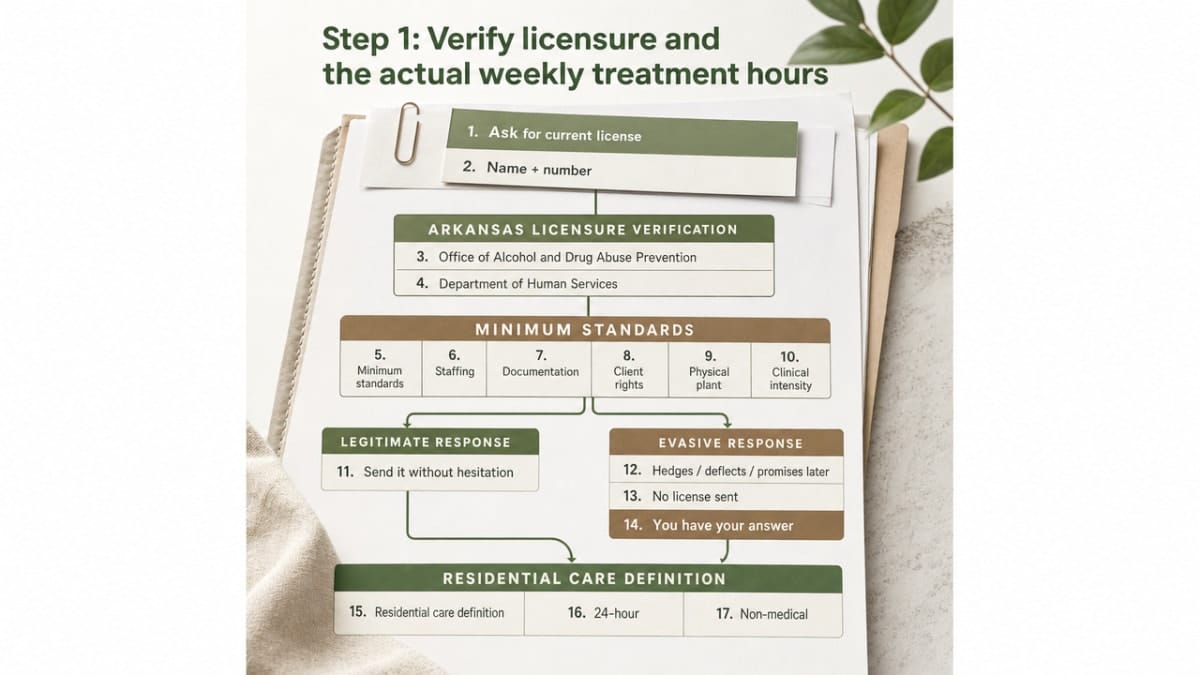
Start with the paperwork the facility either has or does not have. In Arkansas, any entity holding itself out as an alcohol and other drug abuse treatment program must be licensed by the Office of Alcohol and Drug Abuse Prevention within the Department of Human Services 1. That is not a formality. It is the state’s confirmation that the program meets minimum standards for staffing, documentation, client rights, physical plant, and clinical intensity. Ask for the current license by name and number. A legitimate program will send it without hesitation. If the intake coordinator hedges, deflects, or promises to email it later and then does not, you have your answer.
Once licensure checks out, look at what residential care actually means under state definition. Arkansas defines a residential program as a 24-hour, non-medical, live-in facility offering treatment and rehabilitation services, with a required minimum service set of intake, individual and group therapy, case management, and room and board 2. That last phrase matters. If a program markets itself as residential but does not deliver individual therapy or does not have case management, it is not meeting the floor.
Then audit the schedule. Adult residential SUD programs in Arkansas must provide at least 28 hours of structured treatment weekly, with a minimum of 5 hours daily Monday through Friday and a minimum of 3 hours daily on Saturday and/or Sunday 3. Ask for a sample weekly calendar. Not a brochure. An actual schedule showing what happens between 8 a.m. and 5 p.m. on a Tuesday, and what happens on Sunday. Structured treatment means clinical programming led by qualified staff: therapy groups, individual sessions, psychoeducation, medication management, case review. It does not mean unstructured downtime, meal times, or self-directed journaling. If a program’s schedule shows 12 hours of “community time” and four hours of actual group, that is not 28 hours of structured treatment.
While you are looking at the calendar, count the staff. Ask who runs each block. A licensed counselor. A registered nurse. A psychiatrist doing medication management on which days and for how long. The residential definition is non-medical, but any program admitting men in early recovery from alcohol should have medical oversight arrangements documented, especially if they also provide medically supervised detox on-site or through a partner.
Two more items belong in this audit. First, ask for accreditation status beyond state licensure. The Joint Commission and CARF are the two national bodies that matter. Accreditation is voluntary, but it signals that a program has invited external clinical review and passed. Second, ask for a copy of the client rights statement and the grievance procedure. Under Arkansas licensure standards, both are required documents 1. How a program talks about your right to refuse treatment, request records, or leave against medical advice tells you a lot about whether they treat clients as patients or as inventory.
Step 2: Match the level of care to ASAM dimensions, not to marketing tier
Programs love to talk in tiers. Standard, premium, executive. That language tells you about the linens, not the medicine. The clinical question is not which package you can afford. It is which level of care matches what is actually happening in your body, your history, and your home. That match is what the American Society of Addiction Medicine (ASAM) criteria exist to answer, and any competent admissions team will be fluent in them.
Bring the framework to the intake call. Ask the assessor which ASAM dimensions they are scoring you against, what level of care they are recommending, and why. If the answer is a room type instead of a clinical rationale, you are talking to sales, not to a clinician.
The six ASAM dimensions and where alcohol detox fits
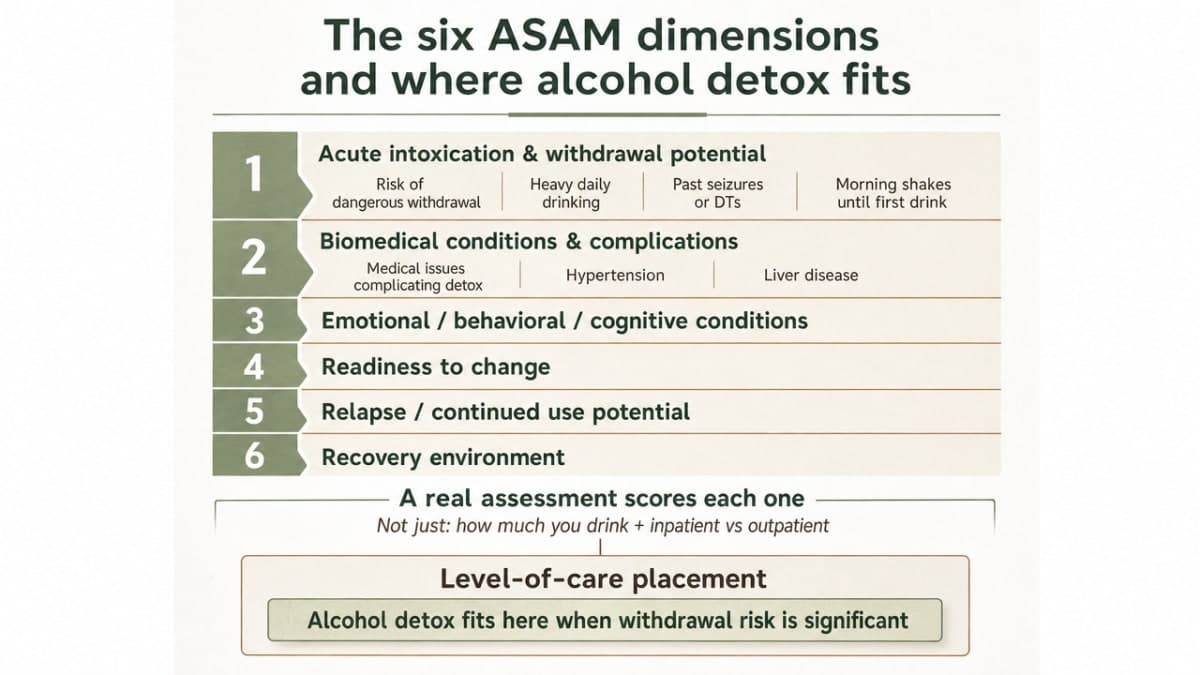
ASAM placement is built on six assessment dimensions, and the SAMHSA TIP 45 guide lays them out cleanly 6:
- acute intoxication and withdrawal potential,
- biomedical conditions and complications,
- emotional/behavioral/cognitive conditions,
- readiness to change,
- relapse or continued use potential,
- and recovery environment.
A real assessment scores each one. A weak assessment asks how much you drink and whether you want inpatient or outpatient.
Walk through them in your own head before the call. Dimension one is whether you are at risk of dangerous withdrawal. If you have been drinking heavily and daily for months, if you have had seizures or DTs before, if you shake in the morning until the first drink, this dimension is not theoretical. Dimension two covers medical issues that complicate detox, from hypertension to liver disease. Dimension three is where depression, anxiety, PTSD, and cognitive load get scored. Dimension four is honest self-assessment about motivation. Dimension five asks how likely relapse is without structure. Dimension six is your home: is there alcohol in the house, is your spouse also drinking, is your job the trigger.
If your dimension one score is high, you likely need medically supervised detox before residential programming begins. TIP 45 defines ASAM Level III.7-D as medically monitored inpatient detoxification, typically a freestanding detox center or hospital unit providing 24-hour medically supervised detox for patients whose withdrawal risk exceeds what an outpatient or subacute setting can safely manage 6. A residential program that markets itself as handling detox should tell you exactly which ASAM detox level it operates at, what medical coverage it provides overnight, and how it transfers to a higher level if you decompensate.
Residential vs. intensive outpatient: an honest read of the evidence
Here is where a lot of marketing runs ahead of the data. The peer-reviewed comparison literature does not consistently show residential treatment to be superior to intensive outpatient care for every patient with alcohol use disorder. Certain high-severity groups appear to benefit from residential settings, but across broad populations the outcome differences are less clean than brochures suggest 11. That is not an argument against residential care. It is an argument against choosing it by default.
The NCBI clinical review on residential SUD treatment lands in a similar place: residential is indicated when your living environment is not safe or conducive to recovery, when you need 24-hour structure and support, and when severity, co-occurring conditions, or prior treatment failures point that way, but evidence on whether it beats intensive outpatient is mixed 5. The NIH’s AUD treatment chapter puts it plainly: match severity, comorbidities, prior treatment history, and social environment to intensity, and offer pharmacotherapy to any patient with moderate-to-severe AUD who has no contraindications 4.
So when you ask a program why residential is the right level for you specifically, expect a clinical answer that references your ASAM scores, your withdrawal risk, your home environment, and what has been tried before. If the answer is that residential is simply better, you have your data point on how they think.
Step 3: Confirm the clinical practices are evidence-based, not vibes-based
You can tell a lot about a program by how it answers a direct clinical question. Ask what medications for AUD they prescribe and under what protocols. Ask which psychosocial therapies their counselors are trained in and how dual diagnosis is handled in-house versus referred out. If the response drifts into language about “our philosophy” or “our unique approach,” you are hearing branding, not medicine. The evidence base for alcohol use disorder treatment is specific and public. A program either uses it or does not.
Medications for AUD: naltrexone, acamprosate, disulfiram
The NIH’s clinical chapter on AUD treatment states plainly that pharmacotherapy for AUD should be offered to all patients with moderate-to-severe AUD who do not have contraindications 4. That is not a preference. That is the standard. Yet a lot of residential programs still treat medication as optional, or worse, treat it as inconsistent with a “real” recovery. If the program you are calling frames MAT as a crutch or a shortcut, you have learned something important.
Three medications carry the primary evidence base:
- Naltrexone, available as a daily oral tablet or as an extended-release monthly injection (Vivitrol), reduces craving and blunts the reward from drinking.
- Acamprosate helps stabilize the post-acute withdrawal period and is often used once you have stopped drinking.
- Disulfiram creates an aversive reaction if you drink while taking it and is useful for patients with strong motivation and structured supervision.
Ask which of the three the program prescribes, who does the prescribing, and how medication decisions get revisited during your stay. A program that offers only one option, or one that does not have a prescriber on staff, is limiting your treatment before you walk in 4.
Psychosocial therapies and dual-diagnosis capability
Medication alone is not treatment. The psychosocial side is where most of your hours will go, and it is where quality varies most. Ask the program to name the therapies its counselors deliver and the training behind them. Cognitive behavioral therapy, motivational enhancement therapy, contingency management, and 12-step facilitation are the modalities with the strongest evidence in AUD care 4. A competent clinical director can describe how each is used and which staff are credentialed to deliver it. A weak one will list every acronym on the brochure and then talk about group culture.
Dual diagnosis is the second pressure point. If you have been drinking heavily for years, there is a meaningful chance you also carry depression, anxiety, trauma exposure, or ADHD that has been self-medicated. The NIH review is direct: treatment planning for AUD should account for co-occurring conditions and prior treatment history, because ignoring those is a common reason outpatient attempts fail 4. Ask who does the psychiatric evaluation, when it happens in the first week, and how psychiatric medications are managed alongside AUD medications.
Then ask what happens if a diagnosis surfaces mid-stay that the program is not equipped to treat, such as active bipolar disorder or suicidal ideation. A program that cannot answer that question with a specific transfer protocol is not a dual-diagnosis program. It is a residential program that occasionally sees co-occurring cases.

Step 4: Test how the program handles men, careers, and co-occurring conditions
A men’s program should be more than a men’s floor. The label is easy to slap on. The clinical adaptation behind it is harder, and it is worth pressing on before you admit.
Start with what the epidemiology actually says. Men carry a higher lifetime prevalence of alcohol use disorders than women, and they tend to delay treatment until problems have already become severe. Gender differences in co-occurring psychiatric disorders and in social roles have real implications for how treatment should be planned and delivered 8. In practical terms: by the time a man in his 40s makes the call, he is often further into medical damage, further into isolation, and further into a self-image problem than the pattern would suggest on paper. A gender-responsive program builds programming around that, not around a locker-room aesthetic.
Ask the clinical director what “men’s program” means in their model. You want specific answers. Which therapy groups are structured around themes that men in this population actually bring in the door: performance identity, provider role, anger management, shame, fatherhood, sexual health, grief over lost years. What is the staff composition and how is transference handled when the client is a 52-year-old executive and the primary therapist is 31. How does the program work with spouses and adult children during family sessions without turning them into a hostage negotiation.
Then press on careers directly. You have a job, a license, possibly a board seat, and a reputation. Ask how the program handles communication with employers, EAPs, licensing boards, and monitoring programs when those are involved. Ask about phone and laptop policy, not because you want to check email at 10 p.m., but because a total blackout can be the wrong answer for a founder mid-diligence or a physician with patient handoff obligations. A serious program will have a written policy that balances clinical containment with the reality of your obligations, and they will not treat the question as a red flag. Small-capacity settings tend to handle this better than 100-bed facilities, simply because the clinical team can flex around a real person.
Co-occurring conditions belong in this same conversation. If your assessment surfaces depression, anxiety, ADHD, or trauma, ask specifically how the psychiatric provider integrates with the primary therapist, how often medication is reviewed during your stay, and what the plan is if a new diagnosis emerges in week two 4. Programs that treat psychiatric care as a monthly consult, rather than an integrated thread, are not equipped for the men who actually show up.
If the answers to these questions are generic, the program is generic. Cross it off.
Step 5: Pressure-test continuity of care and any tech-enabled monitoring
The last thing most programs want you focused on during admission is what happens the day you leave. That is exactly what you should focus on. Residential is a container, not a cure. What determines whether the work holds is the plan that carries you from your last group session back into your kitchen, your inbox, and the client dinner on your calendar in three weeks. Ask to see a sample discharge plan before you admit, not on day 27 of a 28-day stay.
The same skepticism applies to any technology the program is marketing. Wearables and biosensors are a real research area with genuine promise, but the evidence base is still early. A program that describes continuous monitoring as a proven relapse-prevention tool is overstating what the literature actually says. A program that describes it as an emerging clinical adjunct being studied for how it fits into aftercare is telling you the truth.
The discharge plan is the treatment plan
A serious discharge plan is a document, not a conversation on your last morning. It should name:
- your continuing care level (typically an intensive outpatient program or a weekly outpatient group), the specific clinician or program you are handed off to, and the date of your first appointment after discharge;
- your medications, dosages, and the prescriber who will manage them for the next 90 days;
- your mutual-help commitment if you are using one, whether that is a specific 12-step home group or an alternative, and who your first point of contact is when you get there.
The NIH’s AUD chapter is direct that treatment planning must account for social environment and prior treatment history, which is another way of saying that a plan built without your actual life in it will fail 4. Ask how the program handles the first 30 days after discharge specifically. Is there a scheduled check-in from your primary therapist. Does the medical provider re-evaluate your medications at week two or week four. Is there an alumni structure that is more than a monthly email. If you had a psychiatric diagnosis surface during your stay, who owns that follow-up and how did they get the records.
A program that cannot show you this in writing is asking you to trust a handoff that has not been built yet.
Wearables and biosensors: promising, still early
Some residential programs now use wearable devices to track physiologic data during your stay and, in some cases, into aftercare. Heart rate variability, sleep architecture, stress markers, and activity data can give clinicians a continuous read that a weekly session cannot. The 2020 systematic review of wearable and wireless mHealth technologies in SUD care concluded that these tools can help monitor substance use, mitigate factors related to relapse, and support intervention, while noting that most studies to date are small and proof-of-concept, and that adherence and privacy remain open questions 9. A 2023 study went further, suggesting that biosensor data combined with mobile ecological momentary assessment may serve as a method of predicting near-term drug use recurrence, potentially prompting intervention before use occurs 10.
That is genuinely interesting. It is not the same as proven outcome improvement. Ask a program using wearables what data they collect, who reviews it, how it changes your treatment plan, and what happens to the data after discharge. If those answers are specific, the technology is being used clinically. If they are vague, it is a marketing surface.
The questions to ask before you sign anything
Consolidate the audit into a call sheet. Whoever you have on the phone should be able to answer these without a callback. If they cannot, you are not talking to the clinical team.
On licensure and structure: Can you send your current Arkansas DHS license and your Joint Commission or CARF accreditation status today? Can you send a real weekly schedule showing structured treatment blocks against the state minimum 3?
On placement: Which ASAM dimensions did your assessor score, and what level of care are you recommending for me specifically? If detox is indicated, which ASAM detox level do you operate at, and what is the transfer protocol if I decompensate 6?
On clinical practice: Which AUD medications do you prescribe, who prescribes them, and how often are they reviewed? Which psychosocial therapies are your counselors credentialed to deliver 4?
On men, careers, and co-occurring conditions: How is your program adapted for men clinically, not just architecturally? What is your written policy on employer, EAP, and licensing board communication, and on phone and laptop access?
On what happens after: Can you show me a sample discharge plan, and what does the first 30 days of continuing care look like on paper?
Get the answers in writing. Then decide.
Frequently Asked Questions
How do I verify that a men’s alcohol treatment program is properly licensed in Arkansas?
Ask for the current license issued by the Arkansas Department of Human Services through the Office of Alcohol and Drug Abuse Prevention, by name and number 1. Any legitimate program will produce it the same day. Then request the client rights statement, grievance procedure, and staffing roster, all of which are required under Arkansas licensure standards 1. Accreditation from The Joint Commission or CARF is a useful additional signal but does not replace state licensure.
Is residential treatment actually better than intensive outpatient for alcohol use disorder?
Not automatically. The comparative evidence does not consistently show residential care as superior to intensive outpatient for every patient, though certain high-severity groups do appear to benefit from residential settings 11. Residential is generally indicated when your home environment is unsafe for recovery, when withdrawal risk is significant, or when prior outpatient attempts have failed 5. Match the level of care to your clinical picture, not to the assumption that more intensive is always better.
What medications should a legitimate alcohol treatment program offer?
Pharmacotherapy should be offered to all patients with moderate-to-severe AUD who have no contraindications 4. The three medications with the strongest evidence base are naltrexone (oral or extended-release injectable), acamprosate, and disulfiram. Ask which the program prescribes, who does the prescribing, and how medication decisions are reviewed during your stay. A program that offers only one option, or frames MAT as a crutch, is limiting your treatment before you admit 4.
How do I protect my career and privacy while in a residential program?
Ask for the written policy on employer, EAP, and licensing board communication before you admit. Ask about phone and laptop access and whether the clinical team can flex around genuine professional obligations like patient handoffs or active deals. Small-capacity settings generally handle this better than large facilities. HIPAA and 42 CFR Part 2 already protect your treatment records, but a serious program will document exactly what is shared, with whom, and under what written authorization from you.
What should the discharge and continuing care plan actually include?
A written document, not a conversation on your last morning. It should name your continuing care level (typically intensive outpatient or weekly outpatient), the specific clinician handling handoff, and the date of your first post-discharge appointment. It should list medications, dosages, and the prescriber for the next 90 days. Treatment planning must account for social environment and prior treatment history, so the plan should reflect your actual life, work, and family situation 4.
Do wearables and biosensors improve outcomes in alcohol treatment?
The evidence is promising but still early. A 2020 systematic review concluded that wearable and wireless mHealth technologies can help decrease heavy substance use, mitigate relapse-related factors, and support monitoring, while noting most studies are small and proof-of-concept 9. A 2023 study suggested biosensor data plus ecological momentary assessment may predict near-term recurrence, potentially prompting earlier intervention 10. Useful as a clinical adjunct. Not yet proof of improved outcomes. Treat any program’s claims accordingly.
References
- Licensure Standards for Alcohol and Other Drug Abuse Treatment Programs. https://humanservices.arkansas.gov/wp-content/uploads/Licensure_Standards_for_Alcohol_and_Other_Drug_Abuse_Treatment_Programs.pdf
- 007.25.00 Ark. Code R. 001 – Licensure Standards for Alcohol and Other Drug Abuse Treatment Programs. https://www.law.cornell.edu/regulations/arkansas/007-25-00-Ark-Code-R-001
- State Residential Treatment for Behavioral Health Conditions: Arkansas. https://aspe.hhs.gov/sites/default/files/2021-08/StateBHCond-Arkansas.pdf
- Treatment of Alcohol Use Disorder. https://www.ncbi.nlm.nih.gov/books/NBK561234/
- Residential Treatment for Substance Use Disorder. https://www.ncbi.nlm.nih.gov/books/NBK541232/
- Quick Guide for Clinicians Based on TIP 45 — Detoxification and Substance Abuse Treatment. https://nida.nih.gov/sites/default/files/samhsa_detoxification_and_substance_abuse_treatment.pdf
- Helping Patients Who Drink Too Much: A Clinician’s Guide (Updated 2005 edition, NIAAA). https://www.ncbi.nlm.nih.gov/books/NBK424859/
- Gender Differences in Substance Use Disorders: Clinical Implications for Women and Men. https://www.ncbi.nlm.nih.gov/pmc/articles/PMC3860461/
- Wearable and Wireless mHealth Technologies for Substance Use Disorders: A Systematic Review. https://pubmed.ncbi.nlm.nih.gov/33738178/
- Identifying biomarkers of drug use recurrence using wearable biosensors and ecological momentary assessment. https://pubmed.ncbi.nlm.nih.gov/37331302/
- Residential Versus Outpatient Treatment for Substance Use Disorders: Is There a Difference?. https://www.ncbi.nlm.nih.gov/pmc/articles/PMC5757723/