
Key Takeaways
- Understand that detox is medical stabilization through withdrawal, not a cure for alcohol use disorder, so any program worth choosing must connect to continuing care.1,12
- Verify state licensure by asking for the licensing agency and license number, then confirm it online, because licensure sets the minimum safety and staffing standards.2,13
- Press admissions on what 24/7 monitoring actually means, including how often vitals are charted, who performs checks, and how fast a physician can order withdrawal medication.2,11
- Confirm a written escalation pathway with a named hospital, ambulance transport, and a defined CIWA-Ar threshold, since severe withdrawal and delirium tremens require ICU-level care.9, 0
- Run a structured 20-minute intake call using eight specific questions so you can compare programs on licensure, medical staffing, protocols, and discharge planning rather than marketing claims.
- Skip the intake call and go straight to 911 or the ED if there is a seizure, confusion, hallucinations, severe agitation, or dangerous vital signs.6,9
- Ask about supportive care like thiamine, folate, IV fluids, and benzodiazepine or anticonvulsant protocols, because these details reveal whether the program follows real clinical guidelines.7,11,14
- Confirm privacy protections under 42 CFR Part 2 and require a concrete post-detox plan, since the period right after discharge carries the highest relapse risk.1,3,12
Before You Call: What You’re Actually Choosing Tonight
If you’re reading this while your hands are shaking, or while your husband is pacing the kitchen, or while your son won’t answer his phone — take one breath. You’re already doing the hard part. You’re looking.
Here’s what you need to know before you dial the first number: not every place that calls itself a “detox” is set up to keep someone safe through alcohol or benzo withdrawal. Some are sober-living homes with a nurse on call. Some are hospitals. Some are licensed residential programs with a doctor overseeing medication around the clock. The word “detox” covers all of it, and the differences matter tonight.
Withdrawal from alcohol is not like withdrawal from most other things. It can turn dangerous fast — seizures, delirium tremens, and autonomic instability are real risks that need real medical people watching for them. That’s why the choice you make in the next hour is a safety choice, not a shopping choice.9
You’re looking for three things, and this article walks you through each one: proper state licensure, actual 24/7 medical supervision with documented monitoring, and a clear pathway to hospital-level care if things escalate. Everything else — the amenities, the website photos, the promises about comfort — comes after those three.
Read the next few sections like a checklist. Write the questions down. Then pick up the phone. You don’t have to have all the answers. You just have to ask the right ones.
What a Real Medical Detox Does (and What It Doesn’t)
Detox Is Stabilization, Not Treatment
Detox and treatment are not the same thing. The National Institute on Alcohol Abuse and Alcoholism (NIAAA) states that detox alone does not constitute treatment for alcohol use disorder. Detox helps you safely navigate the dangerous initial days as your body and brain adjust without alcohol.1
Think of detox as a medical bridge. Federal clinical guidance defines detoxification as the management of acute intoxication and withdrawal — a staged process that should transition to continuing care, not end upon discharge. Stabilization is the immediate goal, with sobriety being a long-term objective built afterward.12
Understanding this distinction is crucial for evaluating a program. You’re not asking, “Will this place cure him?” Instead, you’re asking, “Can this place safely manage his withdrawal, and does it provide a clear path to real treatment once detox concludes?” This focused question is essential for your upcoming phone call.
Why Medical Supervision Matters for Withdrawal
Alcohol withdrawal is a serious physiological event, ranging from mild discomfort to potentially fatal complications. There’s no way to predict the severity of withdrawal without medical assessment.
Statistics highlight the risk: approximately 50% of individuals with alcohol use disorder experience some withdrawal symptoms when they stop drinking. Another review of acute-care admissions found that about 40% of individuals who misuse alcohol develop an acute withdrawal syndrome upon abrupt cessation or significant reduction. These figures underscore that for heavy drinkers, the body’s reaction to stopping alcohol is a significant concern.1,8
This is why medical supervision is critical. A program with a doctor prescribing medication, nurses monitoring vitals, and protocols for benzodiazepines or anticonvulsants for escalating symptoms is not a luxury; it’s the standard of care for managing potential withdrawal complications. Clinical guidelines from SAMHSA’s TIP 45 recommend immediate medication for individuals with a history of seizures or delirium, those already experiencing withdrawal, and those with moderate symptoms.11
Therefore, your goal is to find a clinical setting where medical care is central. Directly ask: Who prescribes medications, who monitors the patient, and how frequently? The following section will guide you on what the correct answers should entail.
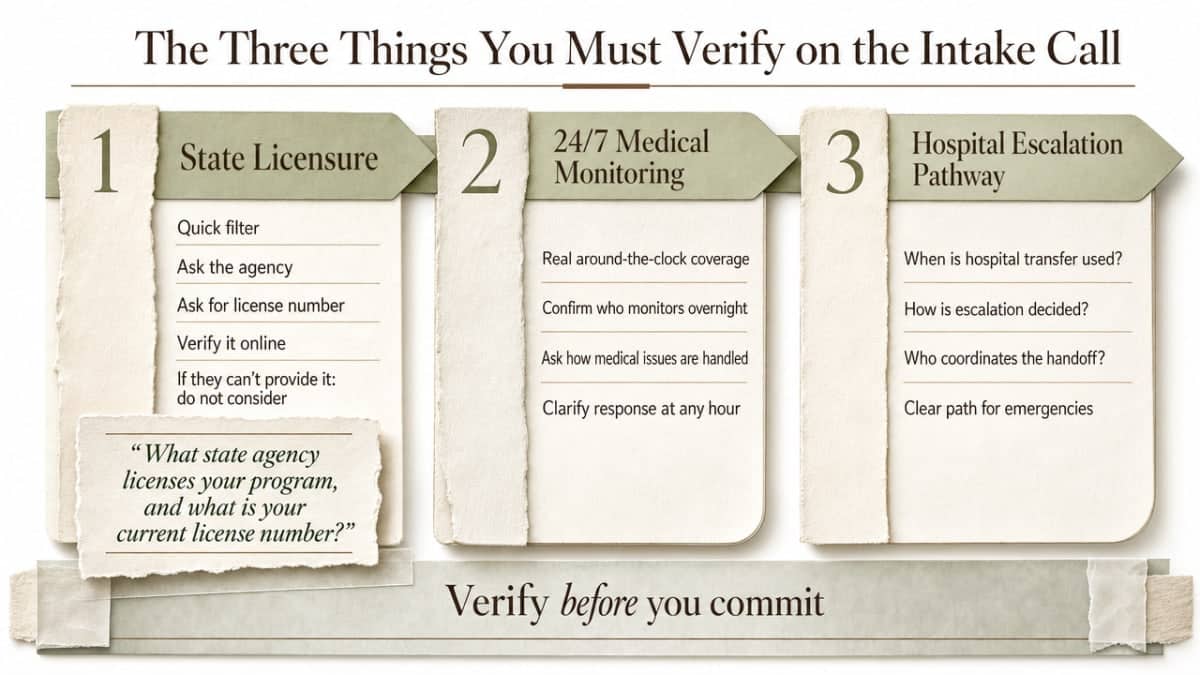
The Three Things You Must Verify on the Intake Call
Verify State Licensure in Plain Language
Begin by verifying state licensure, as this is a quick filter. In Arkansas, for example, licensure is mandatory for any organization operating an alcohol and other drug treatment program. Similar requirements exist in every state. If a facility cannot identify its licensing state agency or provide a license number, it should not be considered.13
Ask directly: “What state agency licenses your program, and what is your current license number?” A legitimate admissions representative will provide this information readily, as they routinely answer this question from insurance providers, referring physicians, and concerned families. It’s a standard inquiry that a hospital case manager would make.
Once you have the license number, verify it. Most state licensing bodies offer public online lookups where you can confirm the license’s active status and check for any complaints or corrective actions. This process typically takes only a few minutes and can be done while still on the phone.
Licensure signifies that the state has inspected the facility, reviewed staffing, checked record-keeping, and established minimum operational standards. It represents the foundational requirements; if a program doesn’t meet these, other aspects of their offerings are irrelevant.2
What Real 24/7 Medical Monitoring Looks Like
The phrase “24/7 medical supervision” is common on detox websites, but its meaning varies. Your task during the call is to clarify what this means in practice.
Consider this benchmark: Arkansas licensure standards mandate that medically supervised detox clients have their vital signs documented upon admission, at least every 2 hours until stable, and then no less than every 6 hours thereafter. This is the minimum standard for a licensed program.2
Ask specifically: “How often will vital signs be taken and documented during the first 24 hours? Who performs these checks—an RN, an LPN, or a tech? And who reviews the documentation?” Listen for precise answers with defined roles. If you receive a vague response like “our staff checks on clients regularly,” press for more detail. The ideal answer involves checks every two hours, documented in a chart reviewed by a physician.
Next, inquire about medication prescription for withdrawal and the speed of response. A medical director or on-call physician should be able to issue orders for benzodiazepines or anticonvulsants promptly if withdrawal symptoms worsen, not hours later. Ask if they use a symptom-triggered protocol like CIWA-Ar and if a nurse is on-site around the clock, not just on-call.11
Finally, ask: “If his vitals spike at 3 a.m., who makes the decision, and how quickly?” A confident program will clearly describe their chain of command. A hesitant response is a warning sign. Trust your instincts based on their answers.
The Escalation Pathway to Hospital-Level Care
No detox center can safely manage every severe case. Some withdrawals become critical. Delirium tremens, for instance, is a medical emergency requiring intensive care unit (ICU) sedation and close monitoring for autonomic instability, fever, fluid loss, and electrolyte imbalance. Severe withdrawal often necessitates ICU admission, intravenous sedatives, and adjunctive pharmacotherapy. Detox centers do not have ICUs; hospitals do.9,10
Therefore, the third crucial verification is the transfer plan. Ask: “If his withdrawal escalates beyond your facility’s safe management capabilities, what happens? Which hospital do you transfer to? How is he transported? How long does this process take?”
You are looking for three specific details. First, a named hospital, ideally one nearby with an emergency department (ED) and ICU capacity. Second, a transfer protocol that includes ambulance transport with a nurse handoff, rather than relying on family. Third, a defined threshold—what symptoms or CIWA-Ar score triggers a transfer. Emergency medicine guidelines emphasize that instability in airway, breathing, circulation, or mental status requires prompt intervention.5
If the admissions representative becomes defensive or claims they’ve “never had to transfer anyone,” this is a red flag, not reassurance. All reputable programs have transferred patients, indicating they recognize their limits and act responsibly. This is the kind of judgment you want for someone under their care at any hour.
Note down the hospital name they provide. This information could be vital later.
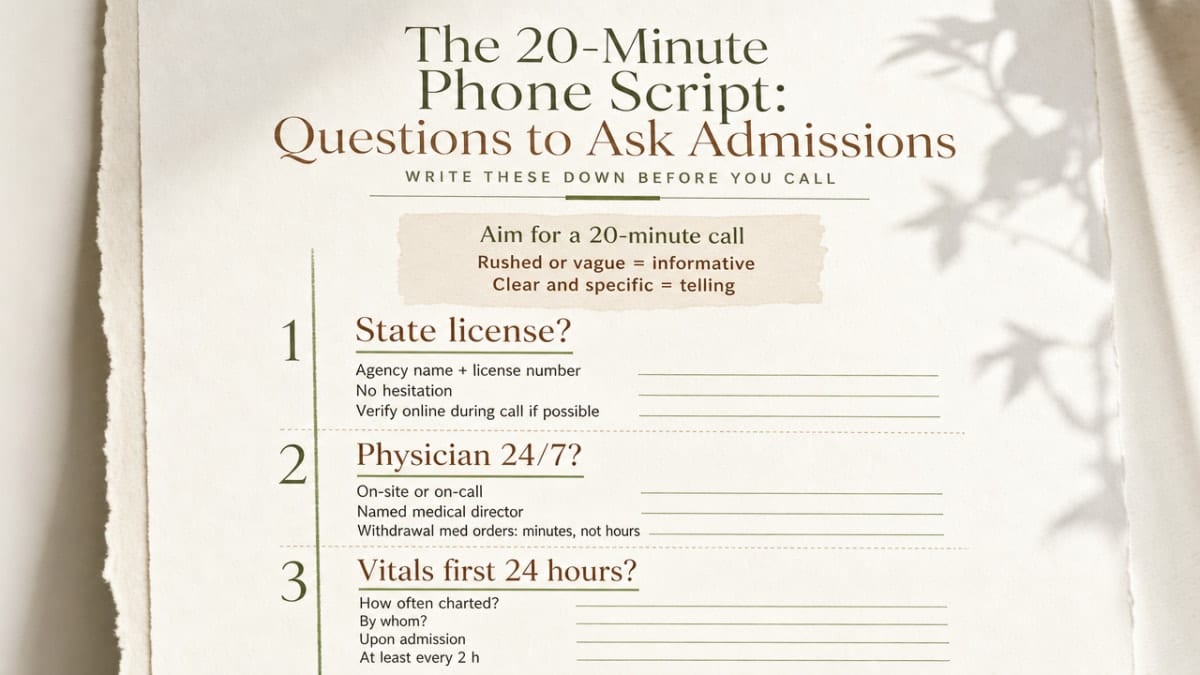
The 20-Minute Phone Script: Questions to Ask Admissions
Write these questions down before you call. When you’re scared or exhausted, your brain might overlook details. Your written list won’t.
Aim for a 20-minute call. If admissions rushes you or avoids specifics, that’s informative. If they take their time and provide clear answers, that’s also telling.
- “Are you licensed by the state, and what’s your license number?” You need the agency name and number, delivered without hesitation. Verify it online if possible while on the call.13
- “Is there a physician on-site or on-call 24/7, and how quickly can they issue orders for withdrawal medications?” Listen for a named medical director and a realistic timeframe—minutes, not hours.11
- “How often will his vital signs be taken and charted in the first 24 hours, and by whom?” The desired answer: upon admission, at least every two hours until stable, then no less than every six hours, performed by nursing staff.2
- “Do you use a symptom-triggered protocol like CIWA-Ar, and what score triggers a physician call or a transfer?” A reliable program will name the tool and the specific threshold.14
- “Which hospital do you transfer to for severe withdrawal or delirium tremens, and how is he transported?” You want a named hospital and ambulance transport with a nurse handoff, not family transport.5
- “Do you administer thiamine, folate, and IV fluids as part of standard supportive care?” The answer should be yes. Hospital withdrawal guidelines consider thiamine essential.7
- “What does the discharge plan entail? What happens on day six?” A comprehensive program will have a plan that includes ongoing treatment, not just a ride home.1
- “How soon can he be admitted, and what should we bring?” If they can admit him “tonight” or “within a few hours” and calmly explain logistics, you’ve likely found a suitable program.
Also, observe the representative’s demeanor. Are they kind? Do they ask about his drinking history, last drink, or past seizures, or only about insurance? A program that prioritizes clinical questions demonstrates a clinical focus, which is what you need.
Red Flags That Mean You Skip Detox and Call 911
Some situations require immediate emergency care, bypassing an intake call. If any of the following symptoms are present, call 911 or go to the nearest emergency department. A detox center can stabilize many conditions, but it cannot manage a life-threatening emergency.
- Active seizure or a seizure in the last few hours. Even a single withdrawal seizure warrants an emergency department visit. Do not wait for another one.
- Confusion about location, identity, or time. Altered mental status during withdrawal is a precursor to delirium tremens (DTs). DTs are a medical emergency requiring heavy sedation in an intensive care unit, with close attention to autonomic instability, fever, fluid loss, and electrolyte imbalance. A residential detox facility lacks an ICU.9
- Hallucinations—seeing insects, hearing voices, or believing untrue things. These are not dramatic behaviors but neurological warning signs.
- Severe, uncontrollable agitation, or conversely, difficulty rousing him. Both extremes are critical indicators.
- Autonomic instability: heart rate above 120 bpm, spiking blood pressure, high fever, profuse sweating, or uncontrolled tremors. These are physical signs of severe distress.
If any of these symptoms are present, the emergency room is the safest option. Many EDs can stabilize the acute phase and then arrange transfer to a licensed detox program once the immediate danger has passed. Going to the hospital first does not mean skipping treatment; it means choosing the appropriate level of care for the situation. A responsible admissions nurse would advise this course of action.
Supportive Care and Medications a Competent Program Uses
Beyond benzodiazepines, which are commonly discussed, an effective detox program provides essential, often overlooked supportive care. Inquire about these during your call, as their answers indicate whether the program follows a genuine medical protocol or simply monitors patients.
Thiamine is crucial. Heavy drinkers often have a deficiency, and untreated thiamine deficiency during withdrawal can lead to permanent neurological damage. Hospital guidelines for withdrawal recommend thiamine 100 mg orally or intravenously daily, folic acid 1 mg daily, and a daily multivitamin as baseline supportive care. If admissions personnel are unfamiliar with thiamine, it’s a significant concern.7
Intravenous fluids and electrolyte replacement are also vital. Withdrawal can cause fluid loss and deplete essential minerals like magnesium, potassium, and phosphate. A program capable of initiating IVs, performing lab tests, and correcting imbalances is medically equipped.
For withdrawal management, ask about available medications and who orders them. Benzodiazepines, such as lorazepam or diazepam, are standard, administered either on a fixed schedule or triggered by CIWA-Ar scores. Anticonvulsants may be prescribed for individuals with a history of seizures. A medical director should be able to escalate treatment rapidly if scores increase.11,14
Document their responses and compare them to the information provided here. Any discrepancies will help you assess the program’s quality.
Privacy, Records, and Who Gets Told
A common concern preventing individuals from seeking detox is the fear of disclosure to employers, family, or insurance companies. This is a valid concern that deserves a clear answer.
Records related to substance use disorder are protected under federal rule 42 CFR Part 2. This rule generally restricts the use or disclosure of records from a licensed detox program, preventing their use in civil, criminal, administrative, or legislative proceedings, except as specifically permitted. In simple terms, the program cannot inform your employer, in-laws, or a court of your presence without your written consent, with limited exceptions such as medical emergencies.3
Ask admissions two questions. First: “How do you manage 42 CFR Part 2 consent forms?” A licensed program will explain this process without hesitation. Second: “Who is permitted to know he is here?” The answer should be: only those individuals you explicitly authorize on a release form.
This means you control who receives information. Your spouse can be informed and receive updates, but your employer does not have to be. The law protects your privacy in this situation.
What Should Happen After Detox Ends
Detox helps individuals through withdrawal, but it does not teach them how to live without alcohol. This is why a reputable program begins planning for post-detox care from day one.
The NIAAA explicitly states that detox alone is not sufficient treatment for alcohol use disorder. Federal clinical guidelines view detoxification as a staged process—managing acute intoxication and withdrawal—that must transition into continuing care, not end at discharge. If a program cannot articulate what comes next, it is only addressing half of the recovery process.1,12
Before committing, ask admissions three specific questions: What does the transition to residential or outpatient treatment involve? Who handles the referral, and is a bed already reserved? What happens if he decides to leave against medical advice on day three?
A robust discharge plan specifies the next level of care—whether residential treatment, an intensive outpatient program, a therapist, a psychiatrist for medication management, or peer support meetings—and arranges it before the patient leaves. This should be a genuine “warm handoff,” not just a list of phone numbers.
The period immediately following detox carries the highest risk of relapse. The arrangements you make tonight are not just for a safe five days, but for the crucial bridge to sustained recovery.
What to Do in the Next Hour
Pick up the phone. Here’s the sequence of actions.
First, check the individual against the red-flag list. If there’s a seizure, confusion, hallucinations, or a dangerously fast heart rate, call 911 or go to the ED immediately. Other steps can wait until he is safe.
Second, if he is stable but experiencing withdrawal, identify two or three licensed detox centers within driving distance. Call the first one. Go through the eight vetting questions. If they meet the criteria—licensed, provide real 24/7 monitoring, and have a named transfer hospital—ask about immediate admission availability.
Third, if you cannot quickly find a licensed program, contact SAMHSA’s National Helpline at 1-800-662-4357. This service is free, confidential, available 24/7, 365 days a year, and can help you locate licensed withdrawal management facilities nearby.4
Pack lightly: ID, insurance card, medication list, phone charger, and comfortable clothes. Leave non-essentials behind.
You’ve likely been managing this burden alone for some time. Tonight, you’re entrusting part of it to professionals whose job is to provide care. This is a sign of strength, not weakness. If you are in central Arkansas, Serenity Park Recovery Center is a potential starting point for your call.
Frequently Asked Questions
How fast can I actually get admitted to a medical detox tonight?
Most licensed programs can admit within a few hours if a bed is available and the individual is medically stable. Call two or three facilities, ask the vetting questions, and inquire directly about admission timing. If you struggle to reach a program quickly, contact SAMHSA’s National Helpline at 1-800-662-4357—it’s a free, confidential, 24/7 resource to help you find licensed withdrawal management near you.4
What’s the difference between medical detox and going to the emergency room?
An emergency room stabilizes acute crises like seizures, delirium tremens, or dangerously unstable vital signs, then discharges or refers the patient. A medical detox admits the patient for several days of monitored withdrawal management with medication. If severe signs like seizure, altered mental status, or agitation are present, the ER is the first stop. If withdrawal is occurring but the patient is stable, a licensed detox facility is appropriate.6
Will my employer, family, or insurance be told I went to detox?
No, not without your written consent. Substance use records are protected under 42 CFR Part 2, which restricts how programs can disclose your presence. You control who is included on the release form. Your spouse can receive updates, but your employer does not need to know. While insurance processes claims, this information is also protected by federal privacy rules.3
How long does medical detox usually last?
For alcohol withdrawal, most stays range from three to seven days, depending on withdrawal severity and how quickly vital signs stabilize. Some individuals may require longer if complications arise. Detox is a staged clinical process, not a fixed timeline; the program should adjust based on the patient’s response and ensure a connection to continuing care afterward. Ask admissions what factors typically determine the length of stay.12
What happens if I try to quit drinking on my own instead?
For a light drinker, quitting cold turkey might be uncomfortable but manageable. For a heavy daily drinker, it poses a significant medical risk. Approximately 40% of individuals who misuse alcohol develop an acute withdrawal syndrome upon abrupt cessation. Symptoms can escalate from tremors and anxiety to seizures or delirium tremens within a day or two. Medical supervision ensures someone is monitoring for these critical changes.8
Is detox by itself enough to stay sober?
No, and any honest program will confirm this. The NIAAA explicitly states that detox alone does not constitute treatment for alcohol use disorder. Detox addresses the physical withdrawal. Sustaining sobriety requires subsequent steps, such as residential treatment, outpatient therapy, medication, peer support, or a combination. The best detox programs will have the next phase of care arranged before discharge.1
References
- Recommend Evidence-Based Treatment: Know the Options. https://www.niaaa.nih.gov/health-professionals-communities/core-resource-on-alcohol/recommend-evidence-based-treatment-know-options
- Licensure Standards for Alcohol and Other Drug Abuse Treatment Programs. https://humanservices.arkansas.gov/wp-content/uploads/Licensure_Standards_for_Alcohol_and_Other_Drug_Abuse_Treatment_Programs.pdf
- 42 CFR Part 2 — Confidentiality of Substance Use Disorder Patient Records. https://www.ecfr.gov/current/title-42/chapter-I/subchapter-A/part-2
- SAMHSA’s National Helpline. https://www.samhsa.gov/find-help/helplines/national-helpline
- Management of Alcohol Withdrawal in the Emergency Department: Current Perspectives. https://pmc.ncbi.nlm.nih.gov/articles/PMC7093658/
- Alcohol Withdrawal Syndrome – StatPearls – NCBI Bookshelf. https://www.ncbi.nlm.nih.gov/books/NBK441882/
- Alcohol Withdrawal in Hospitalized Patients – NCBI Bookshelf. https://www.ncbi.nlm.nih.gov/books/NBK604324/
- Acute alcohol toxicity and withdrawal in the emergency room and medical admissions unit. https://pmc.ncbi.nlm.nih.gov/articles/PMC4953238/
- Acute withdrawal: diagnosis and treatment. https://pubmed.ncbi.nlm.nih.gov/25307572/
- Alcohol withdrawal syndrome: improving outcomes in the emergency department with aggressive management strategies. https://pubmed.ncbi.nlm.nih.gov/33729735/
- Quick Guide For Clinicians Based on TIP 45—Detoxification and Substance Abuse Treatment. https://nida.nih.gov/sites/default/files/samhsa_detoxification_and_substance_abuse_treatment.pdf
- KAP Keys For Clinicians Based on TIP 45—Detoxification and Substance Abuse Treatment. https://www.govinfo.gov/content/pkg/GOVPUB-HE20_400-PURL-gpo30189/pdf/GOVPUB-HE20_400-PURL-gpo30189.pdf
- 007.25.00 Ark. Code R. 001 – Licensure Standards for Alcohol and Other Drug Abuse Treatment Programs. https://www.law.cornell.edu/regulations/arkansas/007-25-00-Ark-Code-R-001
- The ASAM Clinical Practice Guideline on Alcohol …. https://www.samhsa.gov/resource/ebp/asam-clinical-practice-guideline-alcohol-withdrawal-management-pocket-guide
- Detoxification and Substance Abuse Treatment. https://www.ncbi.nlm.nih.gov/books/NBK64115/